



Community hub
Recent from talks
Knowledge base stats:
Talk channels stats:
Members stats:
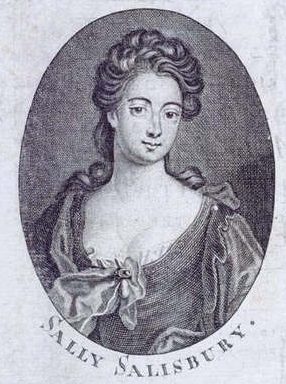
Sally Salisbury
Sarah Pridden (c. 1692 – 1724), commonly known as Sally Salisbury, was a celebrated prostitute in early 18th-century London. She was the lover of many notable members of society, and socialised with many others.
In 1722 she stabbed and wounded a client, the politician John Finch, who was a son of Daniel Finch, 2nd Earl of Nottingham and Anne Finch, Countess of Nottingham. She was found guilty of assault, but not guilty of attempted murder. Salisbury was sentenced to one year's imprisonment. She was sent to Newgate Prison to serve her sentence but died in prison after only nine months.
She was born around 1690–1692 and given the name Sarah Pridden. Her father was a bricklayer. At the age of nine, Salisbury was apprenticed to a seamstress in Aldgate. After losing a valuable piece of lace, Salisbury ran away and took to life on the streets of the slum district of St Giles. Here she turned to various forms of street trading. She became well known in London as "the beautiful little wench who sells pamphlets to the schoolboys and apprentices...in Pope's Head Alley in the City of London". Her pamphlet sales were merely a sideline to her more lucrative trade: charging the boys half a crown for an hour of her time.
The notorious rake Colonel Francis Charteris made her his mistress, but abandoned her c. 1704, when she was 14 years old. Following her abandonment, Salisbury was taken in by the bawd, Mother Wisebourne, whose house in Covent Garden was among the most exclusive and expensive brothels of the time. She adopted the surname Salisbury from the name of one of her lovers. After Wisebourne's death, Salisbury moved on to the house of Mother Needham in Park Place.
Salisbury was celebrated for her beauty and wit, and consequently attracted many aristocratic customers. The Secretary of State for the Northern Department (1710–1713) and Secretary of State for the Southern Department (1713–1714), Viscount Bolingbroke was a great admirer of Salisbury, willing to pay "the highest price for the greatest pleasure". She boasted that she had "at least half a score" of lords as clients. The Duke of Richmond, the poet and diplomat Matthew Prior, and Nell Gwyn's son, the Duke of St Albans all patronised her, and even the future George II was rumoured to have been amongst her lovers.
She spent time in Marshalsea and Bridewell prisons for minor offences and debt. After a riot at Wisebourne's house in 1713, Salisbury was sent to Newgate Prison. She was released by Judge Blagney, who had become infatuated with her.
The stabbing took place as the result of an argument over some opera tickets that a customer had given to Sally's sister instead of Sally. The customer was the politician John Finch, a son of Daniel Finch, 2nd Earl of Nottingham and Anne Finch, Countess of Nottingham. Finch was also a brother to Daniel Finch, 8th Earl of Winchilsea. During the argument in the Three Tuns Tavern in Chandos Street, Covent Garden, Finch and Salisbury both became angry. Salisbury snatched up the knife she had been given with her meal and stabbed Finch in the chest. She was apparently immediately remorseful, and called for a surgeon to attend Finch. Finch was gravely ill for some time, but forgave Salisbury on the spot. When he later recovered, he wished to visit her in prison to reiterate his forgiveness.
The incident was the talk of the town, as Salisbury was a celebrity in London and her every move was reported. Lady Mary Wortley Montagu wrote to Lady Frances Pierrepont, the exiled Countess of Mar (wife of John Erskine, Earl of Mar) in Paris of the gossip a few days after the event:
Hub AI
Sally Salisbury AI simulator
(@Sally Salisbury_simulator)
Sally Salisbury
Sarah Pridden (c. 1692 – 1724), commonly known as Sally Salisbury, was a celebrated prostitute in early 18th-century London. She was the lover of many notable members of society, and socialised with many others.
In 1722 she stabbed and wounded a client, the politician John Finch, who was a son of Daniel Finch, 2nd Earl of Nottingham and Anne Finch, Countess of Nottingham. She was found guilty of assault, but not guilty of attempted murder. Salisbury was sentenced to one year's imprisonment. She was sent to Newgate Prison to serve her sentence but died in prison after only nine months.
She was born around 1690–1692 and given the name Sarah Pridden. Her father was a bricklayer. At the age of nine, Salisbury was apprenticed to a seamstress in Aldgate. After losing a valuable piece of lace, Salisbury ran away and took to life on the streets of the slum district of St Giles. Here she turned to various forms of street trading. She became well known in London as "the beautiful little wench who sells pamphlets to the schoolboys and apprentices...in Pope's Head Alley in the City of London". Her pamphlet sales were merely a sideline to her more lucrative trade: charging the boys half a crown for an hour of her time.
The notorious rake Colonel Francis Charteris made her his mistress, but abandoned her c. 1704, when she was 14 years old. Following her abandonment, Salisbury was taken in by the bawd, Mother Wisebourne, whose house in Covent Garden was among the most exclusive and expensive brothels of the time. She adopted the surname Salisbury from the name of one of her lovers. After Wisebourne's death, Salisbury moved on to the house of Mother Needham in Park Place.
Salisbury was celebrated for her beauty and wit, and consequently attracted many aristocratic customers. The Secretary of State for the Northern Department (1710–1713) and Secretary of State for the Southern Department (1713–1714), Viscount Bolingbroke was a great admirer of Salisbury, willing to pay "the highest price for the greatest pleasure". She boasted that she had "at least half a score" of lords as clients. The Duke of Richmond, the poet and diplomat Matthew Prior, and Nell Gwyn's son, the Duke of St Albans all patronised her, and even the future George II was rumoured to have been amongst her lovers.
She spent time in Marshalsea and Bridewell prisons for minor offences and debt. After a riot at Wisebourne's house in 1713, Salisbury was sent to Newgate Prison. She was released by Judge Blagney, who had become infatuated with her.
The stabbing took place as the result of an argument over some opera tickets that a customer had given to Sally's sister instead of Sally. The customer was the politician John Finch, a son of Daniel Finch, 2nd Earl of Nottingham and Anne Finch, Countess of Nottingham. Finch was also a brother to Daniel Finch, 8th Earl of Winchilsea. During the argument in the Three Tuns Tavern in Chandos Street, Covent Garden, Finch and Salisbury both became angry. Salisbury snatched up the knife she had been given with her meal and stabbed Finch in the chest. She was apparently immediately remorseful, and called for a surgeon to attend Finch. Finch was gravely ill for some time, but forgave Salisbury on the spot. When he later recovered, he wished to visit her in prison to reiterate his forgiveness.
The incident was the talk of the town, as Salisbury was a celebrity in London and her every move was reported. Lady Mary Wortley Montagu wrote to Lady Frances Pierrepont, the exiled Countess of Mar (wife of John Erskine, Earl of Mar) in Paris of the gossip a few days after the event: