Hubbry Logo
Sam MussabiniSam MussabiniMain
Open search
Sam Mussabini
Community hub
Sam Mussabini
logo
8 pages, 0 posts
0 subscribers
Be the first to start a discussion here.
Sam Mussabini
Sam Mussabini
from Wikipedia

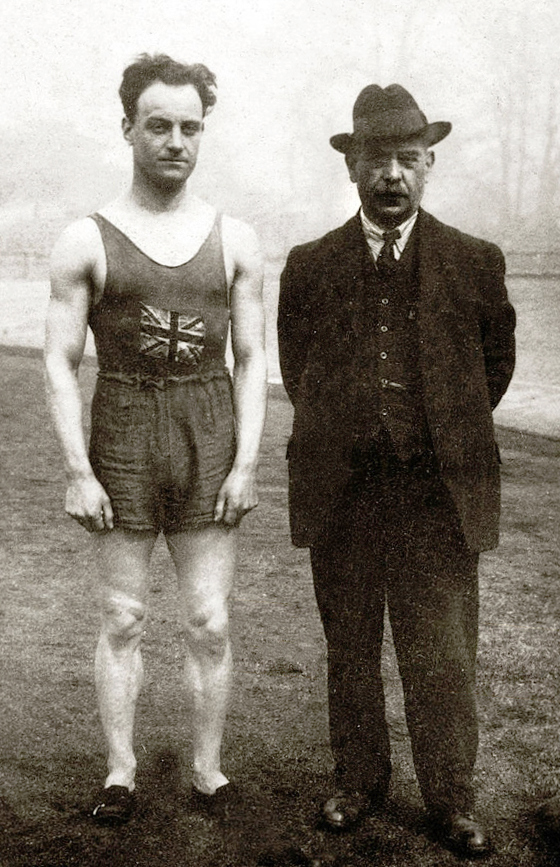
Willie Applegarth and Sam Mussabini at the 1912 Olympics

Scipio Africanus "Sam" Mussabini (6 August 1867 – 12 March 1927)[1] was an English athletics coach best known for his work with Harold Abrahams. In total, he led athletes to eleven medals over five Olympic Games. However, in an era where amateurism was prized, he was not officially recognised because he was a professional coach.[2]

Early life and career

[edit]

Mussabini was born in Blackheath, London to a family of Syrian, Italian and French descent.[3] Mussabini's father, Neocles Gaspard Mussabini (1827–1915), was born in Turkey to a Syrian father and Italian mother. Mussabini's mother, Aline Farcat (1839–1914), was French.[4][5][6] The Mussabini family was Christian and originally from Damascus, Syria. Mussabini's great-grandfather was a Syrian merchant who had altered his original surname, Mussa, to the Italian-sounding Mussabini.[7] Mussabini's great-uncle, Antonio Mussabini, was the Archbishop of the Roman Catholic Archdiocese of İzmir from 1838 to 1861. Mussabini was educated in France, and later followed his father into journalism.[8] In the 1890s he was also a professional sprinter for about five years. In 1894 he coached Bert Harris to the first professional cycling championship the same year he was employed as a cycling coach by the bicycle tyre company Dunlop Pneumatic Tyre Company.[8]

Mussabini played billiards to a high standard and reported on matches as a sports journalist during the winter months. In 1897 he co-authored a technical book on billiards and began writing articles for a billiards journal. In 1902, he became its assistant editor and later the joint proprietor and editor. In 1904 he wrote a two-volume book on the technicalities of billiards. He was also one of the top billiard referees.

Olympic athlete coaching

[edit]

It has been widely stated that he coached the South African sprinter Reggie Walker to a gold medal at the 1908 Olympic Games in London but this is an error and Walker was actually coached by former sprinter Sam Wisdom.[9] He coached further gold medal winners at the 1912 Olympic Games, including Willie Applegarth.[10] He was appointed as full-time coach by Polytechnic Harriers from 1913 until his death from diabetes in 1927[8] aged 59.

He brought a systematic approach to coaching, rather than just being a masseur. For example, he used the techniques of Eadweard Muybridge to photograph runners' actions and techniques at the finish.[8]

At the 1920 Olympic Games in Antwerp, Belgium, he coached Albert Hill to two gold medals in the 800 m and 1500 m, and Harry Edward, third in the 100 m. He led Harold Abrahams to win a gold medal in the 100 m and silver in the 4 × 100 m at the 1924 Olympic Games in Paris, France.

Legacy and honours

[edit]

Mussabini's success at the 1924 Olympics was portrayed in the film Chariots of Fire in which Mussabini is played by Ian Holm. After filming, Holm exchanged letters with living relatives of Mussabini concerned about accuracy.[citation needed]

His trainees won further medals at the 1928 Olympic Games after his death.[8][10]

In 1998, the Mussabini Medal was created, to celebrate the contribution of coaches of UK performers who have achieved outstanding success on the world stage. In 2011, Sam Mussabini was inducted into the England Athletics Hall of Fame.[10]

English Heritage installed a blue plaque at 84 Burbage Road, Herne Hill, on 11 July 2012.[1][8] The house was Mussabini's home from 1911 until about 1916 and backs on to the Herne Hill Stadium, where he worked as a cycling and athletics coach from the 1890s until his death and trained several medal-winning Olympic athletes, including the young Harold Abrahams.[11] The plaque was unveiled by Lord Terence Higgins, who competed in the 1948 and 1952 Olympics, and Ben Cross, who played Abrahams in the film Chariots of Fire.[12]

Mussabini was quoted as saying, "Only think of two things – the gun and the tape. When you hear the one, just run like hell until you break the other."

Archives

[edit]

Sam Mussabini's papers are held at the Cadbury Research Library (University of Birmingham), along with the papers of his father, Neocles. This collection includes material related to Neocles Mussabini's journalistic career at the Pall Mall Gazette, during the era that its editor W. T. Stead was involved with the Eliza Armstrong scandal.[13]

References

[edit]
[edit]
Revisions and contributorsEdit on WikipediaRead on Wikipedia
from Grokipedia
Scipio Africanus Mussabini (1867–1927), commonly known as Sam Mussabini, was a pioneering British athletics and coach celebrated for his innovative training methods, including the use of cine-cameras and stopwatches, and for guiding athletes to 11 Olympic medals—five golds, two silvers, and four bronzes—across five Games. Born in , to a Syrian-Italian father, Neocles Gaspard Mussabini, a , and a French mother, Aline Farçat, he was originally named Scipio Arnaud Godolphin Mussabini and educated in before spending most of his life in . Mussabini began his coaching career in the as a trainer for the Polytechnic Cycling Club, where he helped Bert Harris win the first professional championship in 1894 and later worked for the Dunlop tyre company in 1896, before transitioning to athletics around 1900 and basing his practice at Stadium until his death. Among his most notable pupils were South African sprinter Reggie Walker, whom he coached to the gold at the 1908 London Olympics; British runners Albert Hill, who won the and golds in 1920, and Harry Edward, who took bronze in the that year; and , whose victory and 4×100 metres relay silver at the 1924 Paris Olympics were dramatized in the 1981 film , with Mussabini portrayed by . He also mentored female athlete Vera Palmer-Searle, who set three world sprint records between 1923 and 1924, and served as a member of the British Olympic Commission for the 1924 Games. In 1913, Mussabini was appointed coach to the Polytechnic Harriers and published The Complete Athletic Trainer, a seminal work on coaching techniques that reflected his scientific approach to the sport. Despite facing as a professional coach of mixed heritage in an amateur-dominated era, his methods revolutionized British athletics and earned him a at his former Herne Hill residence in 2012. Mussabini died of diabetes on 12 March 1927 near , , at age 59, and was buried in , .

Early life and education

Family background

Scipio Arnaud Godolphin Mussabini (later known as Mussabini) was born on 6 1867 at 6 Collyer Buildings, Blackheath Hill, , into a Christian family of Syrian-Italian-French heritage. His father, Neocles Gaspard Mussabini (1827–1915), was born in Smyrna, Ottoman , to Syrian parents and worked as a and after naturalizing as a British citizen in 1852. Mussabini's mother, Aline Farçat (1839–1914), was French, infusing the household with continental European customs and linguistic influences alongside the family's Levantine roots. As the fourth of six children, Mussabini grew up in a London-based immigrant navigating the cultural intersections of their Middle Eastern, Italian, and French backgrounds amid Victorian and Edwardian society's evolving attitudes toward foreign-born residents.

Childhood and education

Scipio Arnaud Godolphin Mussabini, later known as and then Sam, was born in 1867 in , the fourth of six children in a family marked by international roots. His father, Neocles Gaspard Mussabini (1827–1915), was a Syrian-born and who naturalized as a British citizen in 1852 after arriving in , and his mother, Aline Farçat (1839–1914), originated from , . Raised in the burgeoning Victorian suburb of Blackheath, Mussabini grew up in a multilingual household shaped by his parents' diverse backgrounds, where French and English were commonly spoken alongside potential influences from his father's Syrian heritage. This environment subtly honed his adaptability, a trait evident in his later career transitions. Mussabini received his formal education in , returning to as a young adult to pursue opportunities in , following in his father's profession. His time abroad exposed him to continental approaches to youth development, including structured physical activities that were central to French schooling during the late .

Journalism career

Entry into sports journalism

Scipio Africanus Mussabini, born in 1867 to a Syrian-Italian father and French mother, followed his father's profession into journalism after receiving his education in France, where he honed an analytical writing style that would define his sports commentary. In the late 19th century, he began contributing to general publications before transitioning to specialized sports reporting around the 1890s, focusing on coverage for both French and British outlets. Mussabini's early roles in British centered on and billiards, with articles appearing in sports magazines that detailed events and techniques in these fields. He reported on meets and races, informed by his personal participation as a professional sprinter during the decade, while winter coverage often turned to billiards matches, where he drew on his proficiency as a player and referee. These contributions helped him build a reputation in the niche of documentation within London's sporting press. As a multicultural individual in the predominantly British press landscape of the era, Mussabini encountered tied to his heritage, sometimes employing aliases to facilitate his professional opportunities. His shift to specialization marked a pivotal phase, aligning his writing with his growing involvement in athletic circles and laying the groundwork for deeper explorations of the field.

Contributions to billiards literature

In 1897, Mussabini co-edited the handbook Billiards with W. H. Robbins, a concise 64-page guide published as part of Dean's Champion Handbooks series that outlined fundamental rules, stroke techniques, and positional play for aspiring players, emphasizing practical instruction through diagrams and examples. This early work established his reputation for analytical writing in the sport, bridging basic mechanics with strategic decision-making. By 1902, Mussabini had advanced to assistant editor of the prominent billiards journal New World of Billiards, where he contributed regular articles on match analyses and player profiles; he later became joint proprietor and full editor, shaping its content to include innovative technical breakdowns and tournament coverage that elevated the publication's authority. His most substantial literary contribution came in 1904 with the two-volume Billiards Expounded to All Degrees of Amateur Players, written by champion J. P. Mannock and meticulously arranged by Mussabini. Volume I focused on elementary aspects, such as cue control and basic shots, while Volume II delved into advanced strategies, historical developments of the game, and complex positional tactics. Mussabini's arrangement emphasized precision and science, as seen in instructions like striking the ball "low at its base" for better control (p. 80) or recovering position by "tak[ing] the ball to the D and play[ing] off the red after a losing in pocket" (p. 52). These publications played a key role in popularizing billiards in Britain as a intellectually demanding sport, shifting perceptions from mere recreation to a pursuit requiring and technical mastery; Mussabini's detailed expositions, such as Mannock's praising him as a "Boswell" to the game's nuances, encouraged wider amateur engagement and influenced subsequent instructional .

Coaching career

Transition to coaching

In the early , Sam Mussabini shifted from his established career in —where he had specialized in billiards and general athletics coverage—to professional coaching, motivated by his growing dissatisfaction with the haphazard nature of amateur training practices and his conviction that systematic, scientific methods could elevate athletic performance. This transition was informed by insights gained through his journalistic observations of athletes' technical flaws and inconsistent preparation, which he believed were undermining British success in international competitions. Leveraging his extensive network of contacts from , Mussabini secured initial coaching roles with local athletes in , beginning around 1900 when he formally identified as an athletics coach after earlier work with cycling teams in the . He based his efforts at venues like Stadium, focusing on amateur runners from clubs such as the Polytechnic Harriers, where he applied emerging principles of and structured regimens to address common deficiencies in speed and endurance. Despite these early steps, Mussabini encountered substantial barriers as a paid professional in an era dominated by amateur ideals, which stigmatized coaches as incompatible with the ethos of gentlemanly sport and resulted in limited official recognition or institutional support for his work.

Training philosophy and methods

Sam Mussabini pioneered a systematic approach to athletic training in an era dominated by intuitive, amateur-led methods, advocating for structured regimens that integrated scientific analysis and precise technique refinement to optimize performance. Drawing from his background in sports journalism, which honed his observational acuity, Mussabini emphasized breaking away from haphazard practices toward methodical preparation encompassing diet, conditioning, and race strategy. In his seminal work The Complete Athletic Trainer (1913), he outlined these principles, arguing that British athletics could reclaim dominance through standardized coaching rather than relying on innate talent alone. Central to Mussabini's methods was the application of scientific tools, notably adapting Eadweard Muybridge's sequential photography to dissect sprinting biomechanics, allowing for detailed examination of stride length, arm action, and overall form. This innovative use of enabled him to identify inefficiencies invisible to the , fostering corrections that enhanced efficiency and speed. He prioritized technique over raw physical power, developing targeted drills for sprint starts—such as the position for explosive launches—stride optimization to minimize energy waste, and finishes focused on maintaining momentum through the tape. Mussabini's philosophy underscored mental discipline as equally vital to physical preparation, encapsulated in his advice: "Only think of two things—the gun and the tape. When you hear one, just run like hell until you break the other." This promoted singular focus during races, instilling self-belief and eliminating distractions to capture the "decisive one per cent" advantage in competition. He further integrated precision from his expertise in billiards—where he excelled as a player and —into athletic form correction, treating sprint like cue requiring exact alignment and controlled execution to avoid flaws. Techniques such as the "Poly swing," a coordinated arm-pumping motion, exemplified this crossover, ensuring fluid, error-free movement under pressure.

Pre-Olympic coaching achievements

Mussabini's transition to athletics coaching in the early 1900s marked the beginning of his efforts to apply systematic training principles to sprinters and middle-distance runners at Stadium in , where he had previously worked as a cycling coach since the . By around 1910, he was actively involved in preparing athletes for domestic competitions, emphasizing technical refinement and physical conditioning to elevate performance beyond traditional approaches. A persistent claims that Mussabini coached South African sprinter Reggie Walker to victory in the at the 1908 London Olympics, but archival research confirms that Walker was trained by the experienced coach Sam Wisdom, who focused on improving his starting technique. This misconception likely arose from confusion between the two coaches' names and their overlapping professional circles in British athletics. In the years leading up to his formal Olympic involvement, Mussabini coached early athletes such as Harry Edward in national meets, helping the young sprinter develop his form through targeted drills at Polytechnic Harriers events starting around 1913. Edward's successes under this guidance included strong performances in AAA qualifiers and regional relays, laying the groundwork for his later national dominance. Mussabini also achieved notable wins in British championships and international relays with sprinter Willie Applegarth during the , including Applegarth's triumphs in the AAA 100 yards in 1913 and 1914, as well as the 220 yards from 1912 to 1914. These victories highlighted Mussabini's ability to produce consistent results in high-stakes domestic competitions, where Applegarth often equaled or broke records in sprint events. Overall, athletes under Mussabini's guidance amassed numerous non-Olympic medals and records in AAA championships, international invitationals, and team relays across , underscoring his role in professionalizing British sprint training by integrating scientific analysis, such as early use of to dissect running mechanics. His work with club teams like the Polytechnic Harriers for events further demonstrated this shift, fostering a more structured approach that contrasted with the era's prevailing ideals.

Olympic coaching

1912 and 1920 Olympics

Mussabini's involvement with the British athletics at the 1912 Olympics marked one of his early international successes as a coach, where he guided sprinter Willie Applegarth to a in the 200 meters event, clocking a time of 22.0 seconds behind American Ralph Craig. Applegarth, under Mussabini's systematic training methods developed prior to the Games, also anchored the British 4x100 meters to a victory, finishing in 42.4 seconds and contributing to Britain's sprint dominance. At the 1920 Antwerp Olympics, held in the aftermath of , Mussabini coached middle-distance runner Albert Hill to double gold medals, securing victory in the 800 meters with a time of 1:53.4 and the 1500 meters in 4:01.8, achievements attributed to Mussabini's emphasis on pacing and endurance techniques refined in pre-Olympic sessions. Harry Edward, building on his earlier experience, earned a in the 200 meters event with a time of 22.2 seconds, placing third behind Americans Allen Woodring and Charles Paddock, further demonstrating Mussabini's influence on British sprinting. Edward also claimed in the 100 meters, though a subsequent injury sidelined him from the relay. Mussabini's presence at both Olympics faced logistical hurdles, including arduous trans-European travel—by ship to in 1912 and through war-ravaged routes to in —which complicated equipment transport and athlete acclimatization. More significantly, strict amateurism rules enforced by the Amateur Athletic Association prohibited official professional coaches, forcing Mussabini to travel and operate covertly as a "trainer" or masseur to evade scrutiny and support his athletes without violating eligibility codes. This evasion allowed him to provide on-site guidance, such as biomechanical adjustments and recovery techniques, despite establishment opposition to paid expertise. Through his coaching at these Games, Mussabini contributed to Britain's medal tally with Applegarth's two medals in and Hill's two golds plus Edward's bronze in 1920, forming part of the 11 Olympic medals (including five golds) his protégés ultimately secured across five editions.

1924 Paris Olympics

In preparation for the 1924 Paris Olympics, Sam Mussabini focused his coaching on , emphasizing refinements to his sprint technique to address weaknesses in starts, stride efficiency, and arm action. Using innovative tools like a cine-camera for biomechanical analysis, Mussabini shortened Abrahams' stride length to optimize power output and introduced the "Poly swing"—a pendulum-like arm motion to enhance balance and propulsion during sprints. These tailored adjustments, combined with intensive drills on reaction times to the starting gun, transformed Abrahams' form, enabling him to achieve a wind-assisted 9.6 seconds in the 100 yards earlier that year. Mussabini's methods built on his prior expertise from coaching athletes to medals in earlier Olympics, underscoring his reputation for scientific precision in athletics training. Mussabini's behind-the-scenes role extended to psychological motivation, supporting Abrahams amid personal drives rooted in overcoming societal prejudices as a Jewish athlete in Britain. He provided the "decisive one per cent" improvement that Abrahams credited for elevating him from national prominence to international victory, fostering a disciplined regimen that prioritized even pacing via monitoring. Despite the era's strict amateurism rules, which stigmatized professional coaches and barred Mussabini from entering the , he contributed as a member of the British Olympic Commission, influencing team preparations. Abrahams ultimately won gold in the men's 100 meters with a time of 10.6 seconds, equaling the Olympic record, and contributed to a in the 4x100 meters relay, setting a British record of 41.2 seconds that stood for 28 years. These achievements marked the pinnacle of Mussabini's Olympic influence, adding to his career total of 11 medals across five Games. The successes garnered immediate media acclaim in Britain, with newspapers highlighting Abrahams' upset over American favorites and subtly acknowledging Mussabini's unconventional guidance despite the professional stigma. This recognition helped challenge the amateur establishment's resistance to paid coaching, positioning Mussabini as a trailblazer whose systematic approach had proven indispensable to British athletic triumphs.

Personal life

Marriage and residence

Scipio Africanus Mussabini married Emma Nicholls on 14 September 1885 in , , when he was eighteen but recorded his age as twenty-one; she was nineteen and the daughter of Samuel Nicholls, a farmer from , . Emma was pregnant with their first child at the time of the . The couple had seven children together. From 1911 until about 1916, Mussabini resided at 84 Burbage Road in Herne Hill, south London, a location that backed directly onto the grounds of the Herne Hill Stadium and velodrome. This proximity to the athletic facilities made the home a convenient base for his daily routines amid his coaching and journalistic pursuits. His residence in Herne Hill integrated him into local athletic circles, including ties to the Polytechnic Harriers club, where he engaged with the broader London sports community.

Illness and death

In his later years, Scipio Africanus "Sam" Mussabini suffered from diabetes, a condition that contributed to his declining health following the 1924 Paris Olympics. Despite this, he continued his role as full-time coach for the Polytechnic Harriers at the Herne Hill athletics track, where he resided in the nearby area, maintaining his systematic approach to training athletes until shortly before his death. Mussabini died of on 25 March 1927, at the age of 59, while near , , during a journey back from a visit. He was buried in the family grave at in . He was survived by his wife, Emma Nicholls, whom he had married in 1885, and their seven children. The family's papers, including Mussabini's passport from the 1924 Olympics, are preserved in the Cadbury Research Library at the , though no specific unpublished writings from his final years are noted.

Legacy

Influence on athletics

Sam Mussabini pioneered professional coaching in British athletics during an era dominated by strict amateurism, where the Amateur Athletic Association (AAA) prohibited paid trainers from official involvement in competitions. By the early , he openly advocated for systematic coaching despite AAA rules that marginalized professionals, arguing that British methods could surpass American ones if properly applied, as detailed in his 1913 book The Complete Athletic Trainer. His approach challenged the prevailing ethos that athletes should rely solely on innate talent, positioning coaches as essential for competitive success and gradually shifting perceptions toward professional standards. Mussabini's introduction of scientific methods, including biomechanical analysis through photographic sequences and early cine-camera footage, marked a transformative adoption in British athletics. He emphasized analyzing stride length, arm action—such as his "Poly swing" technique—and deceleration patterns to optimize performance, methods that were revolutionary for the time and laid groundwork for evidence-based training. These innovations, briefly referencing his use of to dissect running form, influenced the integration of technology into coaching practices long after his era. Through , Mussabini fostered a new generation of coaches, notably guiding F.A.M. Webster in to blend empirical and scientific traditions, which accelerated the shift toward structured training programs in Britain. His emphasis on comprehensive preparation—encompassing technique, fitness, stamina, and pacing with stopwatches—encouraged formalized regimens over ad-hoc preparation. Overall, Mussabini's athletes secured 11 Olympic medals, including five golds, across five between 1908 and 1928, including medals won posthumously by his trainees in 1928, underscoring his impact and contributing to the modernization of sports development in the post-World War I period. Note that the attribution of coaching Reggie Walker to the 1908 gold medal is disputed by some historians, who credit Sam instead. This success helped elevate British athletics by promoting professionalized, scientifically informed coaching as a norm.

Awards and memorials

In recognition of his pioneering contributions to athletics coaching, a Sam Mussabini was awarded posthumously in for the best individual performance of that year by the Polytechnic Harriers, honoring his influence on British track and field shortly after his death. To commemorate his legacy, the National Coaching Foundation (now ) established the Mussabini in December 1998 as an annual award for the UK's Coach of the Year, named in his honor to celebrate excellence in sports ; the medal was presented from 1998 to 2007. Mussabini was inducted into the Athletics Hall of Fame in 2011, acknowledging his role in guiding athletes to 11 Olympic medals, including five golds, between 1908 and 1928. In 2012, unveiled a at 84 Burbage Road, , —his former residence from 1915 to 1924—to mark his significant advancements in scientific training methods that transformed the sport. Sam Mussabini is most prominently depicted in the 1981 film , directed by , where he is portrayed by as the professional coach to sprinter . The portrayal emphasizes Mussabini's innovative, scientific approach to training, including scenes where he analyzes Abrahams' form on film and refines his technique to shave seconds off his times, contributing to Abrahams' victory in the 100 meters. Holm's nuanced performance, which captured Mussabini's outsider status and determination, earned him an Academy Award nomination for Best Supporting Actor. The film's dramatization of Mussabini's role has sparked debates over historical accuracy, as it centers his contributions almost solely on Abrahams while omitting his coaching of other athletes, such as the British 4×100-meter relay team that also won silver in 1924. Critics note that exaggerates Mussabini's portrayal as a marginalized figure facing institutional , though this reflects some real societal biases against professional trainers of his multicultural background; however, it simplifies his broader legacy of guiding athletes to 11 Olympic medals across five Games. Overall, the movie prioritizes narrative tension over precise biography, blending fact with fiction to heighten the story's inspirational arc. Post-1981, Mussabini has appeared in various books on Olympic history that reference the film to contextualize his influence, such as accounts of the 1924 Paris Games that credit for preserving his story amid amateur athletics lore. He is also mentioned in documentaries exploring British sports heritage and the real events behind the movie, including retrospectives on the 1924 Olympics broadcast by outlets like , where his coaching techniques are highlighted alongside film clips. The cinematic legacy of played a key role in reviving public interest in Mussabini's methods during the athletics boom, as the film's success—grossing over $59 million and winning four Oscars—introduced his emphasis on technique and preparation to a wider audience amid rising popularity of events like the 1984 Los Angeles Olympics. This portrayal solidified Mussabini as a symbol of innovative , influencing perceptions of athletics training in popular media and encouraging renewed appreciation for his trailblazing contributions.

References

Add your contribution
Related Hubs
User Avatar
No comments yet.