Hubbry Logo
Saraswathi Mahal LibrarySaraswathi Mahal LibraryMain
Open search
Saraswathi Mahal Library
Community hub
Saraswathi Mahal Library
logo
8 pages, 0 posts
0 subscribers
Be the first to start a discussion here.
Saraswathi Mahal Library
from Wikipedia

Saraswathi Mahal Library, also called Thanjavur Maharaja Serfoji's Saraswathi Mahal Library is a library located in Thanjavur (Tanjore), Tamil Nadu, India. It is one of the oldest subsisting libraries in Asia[1] established during 16th century by the Nayak kings of Thanjavur and has on display a rare collection of Palm leaf manuscripts and paper written in Tamil and Sanskrit and a few other indigenous languages of india (especially southern regional languages). The collection comprises well over 49,000 volumes, though only a tiny fraction of these are on display. The library has a complete catalog of holdings, which is being made available online. Some rare holdings can be viewed on site by prior arrangement.[2] Encyclopedia Britannica mentions the library as the "Most remarkable library of India".[3]

Key Information

History

[edit]

The Saraswathi Mahal library was started by Nayak Kings of Tanjavur as a Royal Library for the private intellectual enrichment of Kings and their family of Thanjavur (see Nayaks of Tanjore) who ruled from 1535 CE till 1676 CE.[4] The Maratha rulers who captured Thanjavur in 1675 promoted local culture and further developed the Royal Palace Library until 1855. Most notable among the Maratha Kings was Serfoji II (1798–1832), who was an eminent scholar in many branches of learning and the arts. In his early age Sarfoji studied under the influence of the German missonary Christian Friedrich Schwartz, and learned many languages including English, French, Italian and Latin. He enthusiastically took special interest in the enrichment of the Library, employing many Pandits to collect, buy and copy a vast number of works from all renowned Centres of Sanskrit learning in Northern India and other far-flung areas.

During 1918 the Saraswathi Mahal Library was open to public.[5] The Library is located within the campus of Tanjavur palace.[6]

Security

[edit]
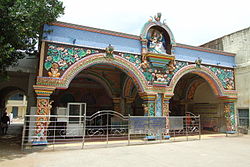
Painting outside the Sarasvati Mahal Library.

The library is open to the public; it also supports efforts to publish rare manuscripts from the collection, as well as ensuring all volumes are preserved on microfilm. The Library has installed computers in 1998 for the Computerisation of Library activities. As a first phase, the Library catalogues are being stored in the Computer for easy information retrieval. It is also proposed to digitalise the manuscripts of this Library shortly.[7]

The Collection

[edit]

The bulk of the manuscripts (39,300) are in Tamil and Sanskrit. Manuscripts number over 4500, comprising titles in literature and medicine. The Library has a collection of 3076 Marathi manuscripts from the South Indian Maharastrian of the 17th, 18th, and 19th centuries; this includes the hierarchy of the Saints of Maharashtra belonging to Sri Ramadasi and Dattatreya Mutts. The Marathi manuscripts are mostly on paper but a few were written in Telugu script on palm-leaf. There are 846 Telugu manuscripts in the holdings, mostly on palm leaf. There are 22 Persian and Urdu manuscripts mostly of 19th century also within the collection. The library also holds medical records of Ayurveda scholars, including patient case studies and interviews in the manuscripts classified under the Dhanvantari section.

Apart from these manuscripts there are 1342 bundles of Maratha Raj records available at the Library. The Raj records were written in the Modi script (fast script for Devanagari) of the Marathi language. These records encompass the information of the political, cultural and social administration of the Maratha kings of Thanjavur.[8]

Some of the rare books and manuscripts

[edit]
  • Dr. Samuel Johnson's dictionary published in 1784
  • The pictorial Bible printed in Amsterdam in the year 1791
  • The Madras Almanac printed in 1807
  • Lavoisier's Traité Élémentaire de Chimie ("Elements of Chemistry")
  • The notes of Bishop Heber on Raja Serfoji II
  • The correspondence letters of William Torin of London who purchased a lot of books for Raja Serfoji II and the Saraswathi Mahal Library
  • Ancient maps of the world
  • Town planning documents of Thanjavur including the underground drainage system, the fresh water supply ducting system

Library museum

[edit]

Efforts were made to microfilm and catalogue the contents way back in 1965 when Indira Gandhi was Information and Broadcasting Minister, Government of India who sanctioned the fund for the library's development. Since then no efforts were made to scan the documents and computerise the same using present day technology. It is also a designated 'Manuscript Conservation Centre' (MCC) under the National Mission for Manuscripts established in 2003.[9]

References

[edit]
[edit]
Revisions and contributorsEdit on WikipediaRead on Wikipedia
from Grokipedia
The Saraswati Mahal Library, located within the historic Palace complex in , , , is one of Asia's oldest surviving libraries, renowned for its vast collection of ancient manuscripts and books that preserve centuries of South Indian knowledge and culture. Established in the by the Nayak kings of , the library began as a royal repository for scholarly works and was substantially expanded during the Maratha rule from 1675 to 1855, with King (r. 1798–1832) playing a pivotal role in enriching its holdings through acquisitions, commissions, and collaborations influenced by European scholars like Reverend Friedrich Schwartz. The collection, totaling approximately 60,000 volumes, includes over 49,000 rare manuscripts—primarily on palm leaves and paper—in languages such as , Tamil, Marathi, Telugu, and English, encompassing diverse subjects like , (with detailed case studies), , astronomy, and . Originally a private royal library, it was opened to the public in 1918 under the management of the government and continues to operate as a research center, offering access to digitized materials and housing ancillary facilities like a of artifacts, paintings, and maps. Its significance lies in safeguarding medieval and pre-colonial texts, making it a key institution for scholars studying Indian , , and traditional sciences, with ongoing conservation efforts to protect its fragile holdings from environmental threats.

History

Founding under Nayak Kings

The Saraswathi Mahal Library traces its origins to the during the rule of the Nayak kings in , who established the dynasty as viceroys of the . The Telugu-speaking Nayaks governed from approximately 1535 to 1676 CE, fostering an environment for scholarly accumulation amid their administrative and artistic endeavors. The library was formally organized during the reign of Raghunatha Nayak (r. 1600–1634 CE) as the "Saraswati Bhandar," a dedicated storehouse for knowledge, reflecting the dynasty's commitment to intellectual pursuits. The initial holdings were modest, estimated at a few hundred items, primarily consisting of palm-leaf manuscripts in Tamil and , sourced from local scribes and regional centers to support the court's needs. The library's early purpose centered on serving as a hub for Vedic and classical studies, catering to the royal family's scholarly interests and ritual requirements. These manuscripts covered subjects such as , , , and religious texts, aiding in the preservation of Dravidian and Indo-Aryan traditions under Nayak . This foundational emphasis on acquiring and maintaining such materials for elite use laid the groundwork for its later growth, including expansions under Maratha rule after 1676 CE.

Expansion during Maratha Rule

The Maratha takeover of in 1676, led by Venkoji (Ekoji I), brother of Chhatrapati Shivaji, marked a significant phase in the library's development, as the new rulers assimilated and built upon the existing collections established under the Nayak kings. Under Shahuji I (r. 1686–1712), the second Maratha ruler, and his successors, the library saw active expansion through royal patronage, with efforts to acquire diverse regional materials that enhanced its scholarly scope. A key aspect of this growth involved the acquisition of Marathi and Telugu manuscripts, reflecting the Marathas' cultural ties to their origins while integrating local traditions. The collection includes 3,076 Marathi manuscripts, primarily on paper and some on palm-leaf in , alongside 846 Telugu manuscripts mostly on palm-leaf, which broadened the library's linguistic and regional diversity. Additionally, the integration of administrative records from the Maratha Raj—comprising 1,342 bundles in —provided valuable documentation of political, cultural, and social governance, enriching the library's archival holdings. Systematic cataloging practices were established during this period, beginning under Shahuji I around 1707, to organize the growing inventory and facilitate access for scholars and administrators. By the early , these efforts had propelled the collection to several thousand volumes, including over 2,000 items documented by 1707, underscoring the library's transformation into a major repository of knowledge under Maratha administration.

Patronage of Serfoji II

During the reign of Maharaja (1798–1832), the Saraswati Mahal Library reached its zenith as a center of intellectual pursuit, building upon the pre-existing collections amassed during Maratha rule. As a fluent in multiple European languages, personally authored numerous works in Marathi and , often autographing them, and commissioned pandits to copy and translate thousands of manuscripts, including during his 1820 pilgrimage to Benares, which contributed significantly to the library's total of over 39,300 manuscripts. Serfoji II significantly expanded the library through targeted acquisitions from , amassing around 4,500 books and journals in English, French, Latin, and Italian, alongside texts, astronomical treatises, and artistic manuscripts that bridged Eastern and Western scholarship. These imports, facilitated by his correspondence with European scholars and missionaries, introduced advanced knowledge in sciences and arts, enriching the library's holdings to over 60,000 volumes in total. Key initiatives under his patronage included the establishment of a in 1805, which enabled the reproduction and dissemination of texts in script for wider access. He also oversaw the creation of illustrated atlases, such as detailed geographical maps from the late , and encyclopedic compilations that synthesized diverse fields of study. These efforts not only preserved knowledge but also fostered innovation in documentation and visual representation. By integrating his personal collection into the library, transformed it into a vital hub for interdisciplinary exploration, particularly in , , and , where European treatises complemented indigenous manuscripts on , illustrations, and . This fusion underscored his vision of a comprehensive repository that advanced Tamil and Maratha cultural synthesis with global insights.

Transition to Public Institution

Following the patronage of , who significantly expanded the library's collections in the early , the institution began its shift toward broader accessibility in the early . In 1918, the Saraswathi Mahal Library was officially opened to the public for the first time, marking a pivotal transition from a private royal repository to a shared cultural resource, though initial access was primarily granted to researchers and scholars under controlled policies to protect the fragile holdings. After India's independence in 1947, the library was integrated into the state heritage systems of and placed under the administrative control of the District Collector of , ensuring its preservation as a public asset amid the reorganization of properties. This period saw initial cataloging efforts in the mid-20th century, including the publication of descriptive catalogues of manuscripts to facilitate scholarly access and inventory management. Post-1947 management faced funding challenges typical of heritage institutions transitioning to state oversight, with limited resources straining and expansion until targeted government grants began supporting operations. In the , the library underwent reorganization, culminating in its formal registration in 1986 under the Societies Registration Act of 1975, which established a structured through an expert committee to enhance administrative efficiency and research capabilities. In August 2025, the Tamil Nadu government declared the Thanjavur Maharaja Serfoji's Sarasvati Mahal Library and Research Centre a "library of historical and cultural importance," recognizing its enduring value and supporting enhanced preservation and public engagement efforts.

The Collection

Overview and Scope

As of recent inventories, the library's collection includes over 47,500 manuscripts and approximately 81,400 printed books, encompassing a vast array of materials that reflect centuries of scholarly patronage and intellectual exchange in South India. The holdings are dominated by manuscripts, with approximately 39,200 in and 4,300 in Tamil, forming the core of the collection. Additional linguistic diversity includes 3,141 Marathi manuscripts, primarily from the 17th to 19th centuries, 834 Telugu works mostly on palm leaves, 22 items from the 19th century, and 1,342 bundles of Maratha Raj administrative records in the . These figures underscore the library's role as a multilingual , capturing the region's political, literary, and administrative history. The materials span various formats, including palm-leaf and paper manuscripts, printed books, maps, paintings, and official documents, highlighting the library's comprehensive scope beyond mere textual records. Among its treasures are rare illustrated works, such as pictorial Bibles commissioned by Maharaja Serfoji II.

Diversity of Materials

The Saraswathi Mahal Library's collection exemplifies a rich tapestry of knowledge preservation, encompassing materials in multiple languages that reflect the cultural exchanges of southern and beyond. Primarily featuring works in Tamil and , the library holds significant holdings in Telugu, Marathi, and , alongside texts that highlight Islamic and administrative influences from the region's history. European languages such as English, French, German, and Italian are also represented, particularly in printed books acquired during the 18th and 19th centuries, underscoring the library's role as a bridge between indigenous and global intellectual traditions. The subjects covered span a multidisciplinary spectrum, with substantial emphasis on literature and religion, including Vedic texts, epics, and philosophical treatises that form the core of classical Indian thought. Scientific domains are well-represented through works on astronomy, (such as Ayurvedic and traditions), and , demonstrating the library's commitment to empirical . Additional areas include and administration, with records of royal decrees and regional chronicles; , encompassing , , and performing traditions; and even and , which illustrate the holistic worldview of pre-modern South Asian scholarship. In terms of formats, the collection diversifies across traditional and transitional media, with over 47,500 manuscripts in total, the majority on palm leaves inscribed in scripts like Grantha, , and Telugu to suit various languages. These are complemented by paper codices, which became prevalent during the Maratha period for more durable storage of administrative and literary works. Printed books from the 18th and 19th centuries, numbering around 81,400, introduce modern dissemination methods, including illustrated scrolls and early atlases that blend cartographic precision with artistic rendering. This variety not only preserves fragile ancient formats but also integrates imported techniques, showcasing the library's evolution as a multicultural repository. A distinctive feature of the collection lies in its fusion of regional Indian traditions—such as Tamil devotional poetry and Telugu poetic forms—with global imports like European scientific treatises, fostering a unique synthesis of Eastern and Western epistemologies under royal patronage. This multicultural and multidisciplinary breadth, with approximately 47,500 manuscripts overall, positions the library as a vital archive for understanding historical knowledge flows in .

Notable Holdings

Rare Manuscripts

The Saraswathi Mahal Library houses one of the world's most significant collections of rare manuscripts, comprising over 47,500 items on palm leaf and paper, many of which are fragile and date back several centuries, underscoring their antiquity and scholarly value. These handwritten works, primarily in regional scripts, represent invaluable repositories of ancient knowledge across , , and . Among them are standout examples of palm-leaf manuscripts, often etched with styluses and inked for durability, with some featuring intricate miniature paintings that enhance their artistic and historical significance. The library's Tamil manuscripts include rare copies and commentaries on , alongside Saiva Siddhanta texts and other classical works that provide critical insights into early Dravidian literary traditions and Shaivite theology. These items, numbering over 3,500, encompass unpublished portions of ancient epics and treatises, offering unique perspectives on Tamil cultural heritage. Saiva Siddhanta manuscripts, in particular, highlight medieval theological developments, with some preserved in for cross-linguistic accessibility. Sanskrit manuscripts form the core of the collection, totaling around 39,300 volumes written in scripts such as Grantha, , and Telugu, covering foundational texts on the , , and Tantras. These works, some as early as the 11th century, include rare commentaries and ritual manuals that illuminate Vedic rituals, mythological narratives, and tantric practices, making them essential for Indological research. The diversity extends to over 20 illustrated manuscripts, where miniature paintings depict deities, astronomical diagrams, and narrative scenes, adding layers of visual scholarship. Regional rarities further enrich the holdings, with Telugu manuscripts in featuring epic narratives like adaptations of the and , totaling about 846 items mostly on palm leaves. The collection also includes 3,076 Marathi manuscripts, many comprising devotional poetry collections from South Indian sources, such as verses dedicated to Vitthala and other deities, reflecting Maratha cultural exchanges in the region. These over 40,000 fragile items, vulnerable to , are preserved under strict conditions to maintain their uniqueness as irreplaceable artifacts of pre-modern Indian .

Unique Books and Artifacts

The Saraswathi Mahal Library's collection of unique printed books includes notable European works acquired during the late 18th and early 19th centuries, reflecting the scholarly interests of its patrons. Among these is the fifth edition of Dr. Samuel Johnson's Dictionary (1784), a two-volume set bearing the signature of Raja Serfoji II, which underscores his enthusiasm for English language and literature. Another standout item is a pictorial Bible printed in Amsterdam in 1791, featuring engravings that provide visual interpretations of biblical narratives, adding to the library's diverse printed holdings from the Enlightenment era. Raja Serfoji II (r. 1798–1832) personally commissioned several illustrated works that blend artistic and scientific elements, significantly enriching the library during its peak expansion. These include illustrated medical treatises housed in the section, which document case studies, patient interviews, and treatments in and other fields, demonstrating Serfoji's of indigenous and Western . Botanical atlases form another key category, with three volumes containing 92 hand-painted herbarium illustrations of rendered in natural colors, aiding in the study of regional flora. Additionally, architectural plans and original drawings preserved in the museum section detail palace and fort designs from the Maratha period, offering insights into 18th- and 19th-century South Indian engineering. The library's visual and cartographic artifacts further highlight its role as a repository of historical geography and portraiture. It holds 18th-century European maps of India, including depictions of colonial routes and regional boundaries, which provide valuable context for understanding early modern trade and exploration. Paintings from the Maratha era include royal portraits of kings such as Chhatrapati Shivaji and Sambhaji, preserved in bound albums alongside Thanjavur-style paper, wooden, canvas, and glass paintings that capture the opulence of the court. Other rarities encompass Persian astronomical texts from the 19th century, part of a collection of 22 Persian and Urdu manuscripts that explore celestial observations and scientific treatises, bridging Islamic scholarly traditions with local knowledge. Complementing these are Maratha administrative scrolls, written in Modi script within the 3,076 Marathi manuscripts spanning the 17th to 19th centuries, which include official records, seals, and decrees detailing governance and hierarchy under the Thanjavur rulers.

Preservation and Access

Security Measures

The Saraswathi Mahal Library employs stringent physical security protocols to safeguard its invaluable collection, including restricted entry to sensitive areas and the deployment of systems. Access to the library's premises is controlled, with visitors required to adhere to designated pathways, and certain sections, particularly those housing rare manuscripts, are off-limits without special permission. In 2019, following a security review by the State Security Police, officials mandated the installation of additional CCTV cameras at key vantage points within the library hall and entrance to enhance monitoring and deter unauthorized activities. The palace complex, which encompasses the library, maintains a presence of personnel to oversee visitor movement and prevent potential threats, a measure reinforced after global incidents like the 2019 bombings prompted heightened vigilance. Access policies are designed to minimize handling risks for fragile items, requiring prior arrangement and approval from library authorities for viewing rare holdings such as palm-leaf manuscripts. is strictly prohibited throughout the facility to protect the artifacts from flash damage and unauthorized reproduction. These rules apply universally, with enforcement by on-site staff who monitor compliance during visits. In response to past thefts, the library collaborates with for swift incident recovery, exemplified by the 2022 tracing of a stolen 19th-century depicting Maharaja and his son . The artwork, missing from the library's collection and believed stolen prior to 2017, was identified at the in the United States through an investigation by the Tamil Nadu Idol Wing CID; it was subsequently surrendered to U.S. for . Such cases underscore the library's vulnerability due to the irreplaceable nature of its historical artifacts. Administrative safeguards include routine inventory checks to track holdings and ensure accountability, supported by ongoing collaboration with state authorities to maintain comprehensive records of the collection's 60,000-plus volumes and manuscripts. While specific insurance details for high-value items are not publicly detailed, these protocols form a multi-layered defense against loss or damage.

Conservation and Digitization Efforts

The Saraswathi Mahal Library initiated a microfilming program in to create backup copies of its rare manuscripts, particularly the palm-leaf documents, as a means to protect them from physical degradation and ensure long-term preservation. This effort focused on cataloging and reproducing the collection's most vulnerable items, marking an early step toward systematic archival safeguarding. In 1998, the library began computerization of its operations, installing systems to digitize catalog records and facilitate scanned images of select holdings. Subsequent projects expanded this initiative, including the development of online catalogs for public access and high-resolution scans of manuscripts to mitigate handling risks. These technological advancements have enabled broader dissemination while preserving the originals. The library established a dedicated conservation in 2003 as a Conservation Centre under India's National Mission for Manuscripts, emphasizing traditional techniques such as to eliminate pests, for structural reinforcement, and meticulous binding repairs. These methods, often using natural materials like and herbal pastes, address common threats to palm-leaf and artifacts, including damage and humidity-induced brittleness. Recent efforts as of 2025 have advanced of palm-leaf manuscripts, creating electronic records and scans for global online access through government-supported portals, with grants allocated for preservation under the National Mission for Manuscripts. In 2025, the library generated 35,914 digital entries for Tamil and related manuscripts as part of the National Mission's integrated system, enhancing research accessibility while allocating grants for ongoing preservation.

Facilities and Significance

Library Museum

The Library Museum within the Saraswathi Mahal Library complex serves as a dedicated space for showcasing select treasures from the institution's vast collection, allowing visitors to engage with its historical and cultural heritage without accessing the full archives. Established as part of the library's public-facing facilities, the museum features glass-encased exhibits that protect and display delicate items such as ancient manuscripts, intricate paintings, and royal artifacts, highlighting the scholarly legacy of the Thanjavur Maratha rulers. Key displays include beautifully illustrated palm-leaf manuscripts, many painted with vibrant illustrations depicting religious, medical, and astronomical themes, alongside royal artifacts from the era of Maharaja Serfoji II (r. 1798–1832), such as antique globes, detailed maps used for town planning, and personal correspondence that reflect his patronage of knowledge. These exhibits also encompass Thanjavur-style paper paintings, canvass works, and wooden artifacts, providing insight into the artistic techniques preserved over centuries. Since 2003, when the library was designated as a Manuscript Conservation Centre under the National Mission for Manuscripts, the museum has emphasized conservation efforts, though specific interactive models are not prominently featured in current descriptions. Visitors experience the through guided tours, often recommended with a historian to contextualize the displays, offering an educational journey that underscores the library's role in safeguarding medieval texts and artifacts. Open daily except Wednesdays, the functions as an inviting entry point for public engagement, fostering appreciation for the library's heritage while maintaining restricted access to the core collection for preservation purposes.

Cultural and Research Importance

The Saraswati Mahal Library stands as a vital repository for South Indian , housing an extensive collection of over 47,500 palm-leaf and paper manuscripts that span literature, science, and religion, thereby profoundly influencing scholarly studies in these domains. Its holdings include rare works in Tamil, , Telugu, and Marathi, such as commentaries on , treatises on and astronomy, and religious texts from Saivite and Vaishnavite traditions, which have served as foundational resources for researchers exploring the intellectual legacy of the Nayak and Maratha rulers of . Under Raja (r. 1798–1832), the library's expansion incorporated European scientific texts alongside , fostering interdisciplinary insights into historical advancements in , , and philosophy. In supporting academic pursuits, the library has facilitated the publication of rare manuscripts since the , transforming its palm-leaf collections into accessible printed volumes that aid global scholarship. These efforts, including the Thanjavur Sarasvati Mahal Series, have enabled collaborations with linguists and historians, providing restricted access to experts for transcription and analysis of texts on diverse subjects like epics and Sastras. More recently, partnerships such as the Gyan Bharatam Mission have involved joint initiatives with other national repositories, enhancing research accessibility while preserving the originals. Recent developments underscore the library's growing policy recognition, with the Tamil Nadu government declaring it a "library of historical and cultural importance" via Government Order 181 on August 1, 2025, and classifying it as an aided institution under the Public Libraries Rules, 1950. This status has unlocked grants, including ₹1.4 allocated in August 2025 for salaries, administration, research, publications, and manuscript conservation. In July 2025, restoration projects were announced as part of 17 statewide heritage initiatives, with ₹12.50 earmarked for repairing the library's vault roof, walls, and structures to combat water seepage and structural decay, aiming for completion by mid-2027. Concurrently, a litigation filed in July 2025 urged its designation as a model under the National Mission on Libraries, highlighting needs for enhanced digitization and staffing to safeguard its cultural rights under Article 29 of the Indian Constitution. On the global stage, the library contributes to UNESCO heritage discussions through its role in preserving Oriental manuscripts, recognized as one of the world's premier collections that attracts international researchers for exchanges on South Asian intellectual history. Its participation in initiatives like the , via nominations of key Indian texts, amplifies its influence in cross-cultural manuscript studies and conservation dialogues.

References

Add your contribution
Related Hubs
User Avatar
No comments yet.