Hubbry Logo
Scallop theoremScallop theoremMain
Open search
Scallop theorem
Community hub
Scallop theorem
logo
8 pages, 0 posts
0 subscribers
Be the first to start a discussion here.
Scallop theorem
Scallop theorem
from Wikipedia
A scallop swims by slowly opening its two halves, then quickly closing them. This is a successful swimming method because the inertial force of the surrounding water dominates over the viscous force. In a low Reynolds number environment, a scallop would only oscillate in place.

In physics, the scallop theorem states that a swimmer that performs a reciprocal motion cannot achieve net displacement in a low-Reynolds number Newtonian fluid environment, i.e. a fluid that is highly viscous. Such a swimmer deforms its body into a particular shape through a sequence of motions and then reverts to the original shape by going through the sequence in reverse. At low Reynolds number, time or inertia does not come into play, and the swimming motion is purely determined by the sequence of shapes that the swimmer assumes.

Edward Mills Purcell stated this theorem in his 1977 paper Life at Low Reynolds Number explaining physical principles of aquatic locomotion.[1] The theorem is named for the motion of a scallop which opens and closes a simple hinge during one period. Such motion is not sufficient to create migration at low Reynolds numbers. The scallop is an example of a body with one degree of freedom to use for motion. Bodies with a single degree of freedom deform in a reciprocal manner and subsequently, bodies with one degree of freedom do not achieve locomotion in a highly viscous environment.

Background

[edit]
Animation of a Najafi-Golestanian 3-sphere microswimmer.[2] It has one degree of freedom where the left arm extends and retracts. In low Reynolds number environments, this leads to no net displacement of the whole body as the arm completes a cycle of extension and retraction.

The scallop theorem is a consequence of the subsequent forces applied to the organism as it swims from the surrounding fluid. For an incompressible Newtonian fluid with density and dynamic viscosity , the flow satisfies the Navier–Stokes equations:

where denotes the velocity of the fluid. However, at the low Reynolds number limit, the inertial terms of the Navier-Stokes equations on the left-hand side tend to zero. This is made more apparent by nondimensionalizing the Navier–Stokes equations. By defining a characteristic velocity and length, and , we can cast our variables to dimensionless form:

where the dimensionless pressure is appropriately scaled for flow with significant viscous effects. Plugging these quantities into the Navier-Stokes equations gives us:

And by rearranging terms, we arrive at a dimensionless form:

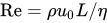
where is the Reynolds number. In the low Reynolds number limit (as ), the LHS tends to zero and we arrive at a dimensionless form of Stokes equations. Redimensionalizing yields:
Statement

[edit]

The consequences of having no inertial terms at low Reynolds number are:

  • One consequence means that the swimmer experiences virtually no net force or torque.
  • A second consequence tells us that the velocity is linearly proportional to the force (same can be said about angular velocity and torque).
  • The Stokes equations become are linear and independent of time.

In particular, for a swimmer moving in the low Reynolds number regime, its motion satisfies:

  • Independent of time: The same motion may be sped up or slowed down, and it would still satisfy the Stokes equations. More geometrically, this means that the motion of a swimmer in the low Reynolds number regime is purely determined by the shape of its trajectory in configuration space.
  • Kinematic reversibility: The same motion may be reversed. Any instantaneous reversal of the forces acting on the body will not change the nature of the fluid flow around it, simply the direction of the flow. These forces are responsible for producing motion. When a body has only one degree of freedom, reversal of forces will cause the body to deform in a reciprocal fashion. For instance, a scallop opening its hinge will simply close it to try to achieve propulsion. Since the reversal of forces does not change the nature of the flow, the body will move in the reverse direction in the exact same manner, leading to no net displacement. This is how we arrive at the consequences of the scallop theorem.[3]

Proof by scaling

[edit]

This is closer in spirit to the proof sketch given by Purcell.[1] The key result is to show that a swimmer in a Stokes fluid does not depend on time. That is, a one cannot detect if a movie of a swimmer motion is slowed down, sped up, or reversed. The other results then are simple corollaries.

The stress tensor of the fluid is .

Let be a nonzero real constant. Suppose we have a swimming motion, then we can do the following scaling:and obtain another solution to the Stokes equation. That is, if we scale hydrostatic pressure, flow-velocity, and stress tensor all by , we still obtain a solution to the Stokes equation.


Since the motion is in the low Reynolds number regime, inertial forces are negligible, and the instantaneous total force and torque on the swimmer must both balance to zero. Since the instantaneous total force and torque on the swimmer is computed by integrating the stress tensor over its surface, the instantaneous total force and torque increase by as well, which are still zero.

Thus, scaling both the swimmer's motion and the motion of the surrounding fluid scales by the same factor, we still obtain a motion that respects the Stokes equation.

Proof by vector calculus

[edit]

The proof of the scallop theorem can be represented in a mathematically elegant way. To do this, we must first understand the mathematical consequences of the linearity of Stokes equations. To summarize, the linearity of Stokes equations allows us to use the reciprocal theorem to relate the swimming velocity of the swimmer to the velocity field of the fluid around its surface (known as the swimming gait), which changes according to the periodic motion it exhibits. This relation allows us to conclude that locomotion is independent of swimming rate. Subsequently, this leads to the discovery that reversal of periodic motion is identical to the forward motion due to symmetry, allowing us to conclude that there can be no net displacement.[3]

Rate-independence

[edit]

The reciprocal theorem describes the relationship between two Stokes flows in the same geometry where inertial effects are insignificant compared to viscous effects. Consider a fluid filled region bounded by surface with a unit normal . Suppose we have solutions to Stokes equations in the domain possessing the form of the velocity fields and . The velocity fields harbor corresponding stress fields and respectively. Then the following equality holds:

The reciprocal theorem allows us to obtain information about a certain flow by using information from another flow. This is preferable to solving Stokes equations, which is difficult due to not having a known boundary condition. This is particularly useful if one wants to understand flow from a complicated problem by studying the flow of a simpler problem in the same geometry.

One can use the reciprocal theorem to relate the swimming velocity, , of a swimmer subject to a force to its swimming gait :

Now that we have established that the relationship between the instantaneous swimming velocity in the direction of the force acting on the body and its swimming gait follow the general form
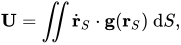
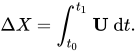
where and denote the positions of points on the surface of the swimmer, we can establish that locomotion is independent of rate. Consider a swimmer that deforms in a periodic fashion through a sequence of motions between the times and The net displacement of the swimmer is

Now consider the swimmer deforming in the same manner but at a different rate. We describe this with the mapping

Using this mapping, we see that

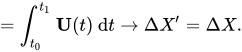
This result means that the net distance traveled by the swimmer does not depend on the rate at which it is being deformed, but only on the geometrical sequence of shape. This is the first key result.

Symmetry of forward and backward motion

[edit]

If a swimmer is moving in a periodic fashion that is time invariant, we know that the average displacement during one period must be zero. To illustrate the proof, let us consider a swimmer deforming during one period that starts and ends at times and . That means its shape at the start and end are the same, i.e. Next, we consider motion obtained by time-reversal symmetry of the first motion that occurs during the period starting and ending at times and Using a similar mapping as in the previous section, we define and and define the shape in the reverse motion to be the same as the shape in the forward motion, Now we find the relationship between the net displacements in these two cases:


This is the second key result. Combining with our first key result from the previous section, we see that We see that a swimmer that reverses its motion by reversing its sequence of shape changes leads to the opposite distance traveled. In addition, since the swimmer exhibits reciprocal body deformation, the sequence of motion is the same between and and and Thus, the distance traveled should be the same independently of the direction of time, meaning that reciprocal motion cannot be used for net motion in low Reynolds number environments.

Exceptions

[edit]

The scallop theorem holds if we assume that a swimmer undergoes reciprocal motion in an infinite quiescent Newtonian fluid in the absence of inertia and external body forces. However, there are instances where the assumptions for the scallop theorem are violated.[4] In one case, successful swimmers in viscous environments must display non-reciprocal body kinematics. In another case, if a swimmer is in a non-Newtonian fluid, locomotion can be achieved as well.

Types of non-reciprocal motion

[edit]

In his original paper, Purcell proposed a simple example of non-reciprocal body deformation, now commonly known as the Purcell swimmer. This simple swimmer possess two degrees of freedom for motion: a two-hinged body composed of three rigid links rotating out-of-phase with each other. However, any body with more than one degree of freedom of motion can achieve locomotion as well.

In general, microscopic organisms like bacteria have evolved different mechanisms to perform non-reciprocal motion:

  • Use of a flagellum, which rotates, pushing the medium backwards — and the cell forwards — in much the same way that a ship's screw moves a ship. This is how some bacteria move; the flagellum is attached at one end to a complex rotating motor held rigidly in the bacterial cell surface.[5][6]
  • Use of a flexible arm: this could be done in many different ways. For example, mammalian sperm have a flagellum which, whip-like, wriggles at the end of the cell, pushing the cell forward.[7] Cilia are quite similar structures to mammalian flagella; they can advance a cell like paramecium by a complex motion not dissimilar to breast stroke.

Geometrically, the rotating flagellum is a one-dimensional swimmer, and it works because its motion is going around a circle-shaped configuration space, and a circle is not a reciprocating motion. The flexible arm is a multi-dimensional swimmer, and it works because its motion is going around a circle in a square-shaped configuration space. Notice that the first kind of motion has nontrivial homotopy, but the second kind has trivial homotopy.

Non-Newtonian fluids

[edit]

The assumption of a Newtonian fluid is essential since Stokes equations will not remain linear and time-independent in an environment that possesses complex mechanical and rheological properties. It is also common knowledge that many living microorganisms live in complex non-Newtonian fluids, which are common in biologically relevant environments. For instance, crawling cells often migrate in elastic polymeric fluids. Non-Newtonian fluids have several properties that can be manipulated to produce small scale locomotion.[4]

First, one such exploitable property is normal stress differences. These differences will arise from the stretching of the fluid by the flow of the swimmer. Another exploitable property is stress relaxation. Such time evolution of such stresses contain a memory term, though the extent in which this can be utilized is largely unexplored. Last, non-Newtonian fluids possess viscosities that are dependent on the shear rate. In other words, a swimmer would experience a different Reynolds number environment by altering its rate of motion. Many biologically relevant fluids exhibit shear-thinning, meaning viscosity decreases with shear rate. In such an environment, the rate at which a swimmer exhibits reciprocal motion would be significant as it would no longer be time invariant. This is in stark contrast to what we established where the rate in which a swimmer moves is irrelevant for establishing locomotion. Thus, a reciprocal swimmer can be designed in a non-Newtonian fluid. Qiu et al. (2014) were able to design a micro scallop in a non-Newtonian fluid.[8]

See also

[edit]

References

[edit]
[edit]
Revisions and contributorsEdit on WikipediaRead on Wikipedia
from Grokipedia
The scallop theorem, proposed by physicist Edward M. Purcell in 1977, asserts that in a at low —where viscous forces overwhelmingly dominate inertial effects—a swimmer executing purely reciprocal deformations, such as the symmetric opening and closing of a shell, cannot achieve net locomotion over a complete cycle. This outcome arises because the governing Stokes equations for fluid flow are time-reversible, ensuring that the forward and reverse strokes generate identical flows in opposite directions, resulting in exact cancellation and zero average displacement. Purcell's theorem, introduced in his seminal lecture-turned-paper "Life at Low ", underscores fundamental constraints on microscale , relevant to environments like those inhabited by and spermatozoa, where Reynolds numbers typically range from 10510^{-5} to 10210^{-2}. It highlights why effective biological swimmers, such as , rely on non-reciprocal kinematics—like the rotation of helical flagella or coordinated beating of multiple cilia—rather than simple back-and-forth motions that would fail in viscous-dominated regimes. The theorem assumes an infinite, quiescent fluid without external forces or inertia, emphasizing shape configuration over timing or speed. Extensions and exceptions to the theorem have been explored in subsequent research. For instance, at slightly higher Reynolds numbers (around 10210^{-2}), inertial effects can break time-reversibility, enabling net motion from reciprocal deformations in asymmetric swimmers. In non-Newtonian fluids, such as viscoelastic or shear-thinning media common in biological contexts, reciprocal motions can induce due to normal stress differences or elasticity. Additionally, collective hydrodynamic interactions among multiple reciprocal swimmers can yield emergent locomotion, as unsteady flows decay slowly over distances. These insights have influenced the design of synthetic microswimmers and nanorobots for biomedical applications, prioritizing multi-linkage or asymmetric mechanisms to circumvent the theorem's limitations.

Background and Fundamentals

Historical Development

The foundations of the scallop theorem trace back to 19th-century studies of viscous , particularly George Gabriel Stokes' seminal work on the slow motion of spheres and pendulums in 1851, which established the mathematical description of flows dominated by viscosity over inertia, known as . This framework provided the essential hydrodynamic principles for understanding motion at microscopic scales, where the is much less than unity, influencing later biophysical analyses of locomotion. The theorem itself was formally introduced by physicist Edward M. Purcell in his 1977 paper "Life at Low Reynolds Number," originally delivered as a lecture on bacterial motility at a 1976 conference on topics in nonlinear dynamics. In this work, Purcell articulated the principle using the intuitive analogy of a scallop undergoing reciprocal hinge-like opening and closing motions, demonstrating that such time-reversible deformations yield no net displacement in a viscous fluid at low Reynolds numbers, thereby highlighting the constraints on microscopic swimming. Following Purcell's contribution, the scallop theorem became a cornerstone of biophysical hydrodynamics research in the late 20th and early 21st centuries, with refinements addressing its implications for swimmer design and propulsion mechanisms. Early post-1977 publications, such as those by J. R. Blake in 1979 on surface swimmers and S. Gueron and R. Liron in 1992 on flagellar hydrodynamics, built upon the theorem to explore non-reciprocal motions required for effective locomotion. By the early 2000s, the theorem's scope expanded through works like A. D. Samuel and H. C. Berg's 1996 analysis of bacterial flagellar propulsion and J. E. Avron et al.'s 2004 geometric proof, solidifying its role in the field. A comprehensive review by E. Lauga and T. R. Powers in 2009 further established the theorem's enduring impact, surveying its applications in microbial swimming and artificial microswimmers.

Low Reynolds Number Physics

In low Reynolds number flows, characteristic of microscopic aquatic environments such as those encountered by microorganisms, the Re\mathrm{Re} is much less than unity (Re1\mathrm{Re} \ll 1). The is defined as Re=ρULμ\mathrm{Re} = \frac{\rho U L}{\mu}, where ρ\rho is the fluid density, UU is a , LL is a scale, and μ\mu is the ; this represents the ratio of inertial forces to viscous forces in the fluid. At such small scales, typical for bacterial where L1μmL \sim 1 \, \mu\mathrm{m} and U10μm/sU \sim 10 \, \mu\mathrm{m/s} in , viscous forces overwhelmingly dominate, rendering inertial effects negligible. The governing equations for these flows are derived from the Navier-Stokes equations by neglecting the inertial terms when Re1\mathrm{Re} \ll 1. The incompressible Navier-Stokes momentum equation is ρ(ut+(u)u)=p+μ2u,\rho \left( \frac{\partial \mathbf{u}}{\partial t} + (\mathbf{u} \cdot \nabla) \mathbf{u} \right) = -\nabla p + \mu \nabla^2 \mathbf{u}, along with the u=0\nabla \cdot \mathbf{u} = 0; at low Reynolds numbers, the time-dependent term ut\frac{\partial \mathbf{u}}{\partial t} and the convective term (u)u(\mathbf{u} \cdot \nabla) \mathbf{u} are both approximated as zero, yielding the Stokes equations: p+μ2u=0,u=0.-\nabla p + \mu \nabla^2 \mathbf{u} = 0, \quad \nabla \cdot \mathbf{u} = 0. This approximation holds because the inertial terms scale with Re\mathrm{Re}, becoming vanishingly small compared to the viscous term μ2u\mu \nabla^2 \mathbf{u}. The resulting Stokes equations are linear in both the velocity u\mathbf{u} and pressure pp, which permits the superposition principle for solutions. Consequently, the velocity field can be constructed as a linear combination of fundamental solutions, such as Stokeslets or higher-order multipoles, facilitating analytical and numerical treatments of complex geometries. Moreover, the linearity implies that the flow is rate-independent: scaling the driving velocities by a constant factor scales the entire velocity field proportionally, without altering the flow structure. Physically, this regime is dominated by viscous drag, where the fluid has no memory of past motions due to the absence of ; the velocity field is determined instantaneously by the current boundary conditions, preventing from being stored or carried away. As a result, net locomotion depends only on changes in the swimmer's geometry, independent of the speed or timing of those changes.

Formal Statement and Consequences

Core Theorem

The scallop theorem, formulated by E. M. Purcell in , states that a swimmer undergoing reciprocal deformation achieves zero net displacement in a at low . This prohibition applies specifically to self-propelled microswimmers operating under force-free and torque-free boundary conditions, where no external forces or torques act on the body. Reciprocal motion is defined as a time-reversible deformation cycle, in which the sequence of shapes adopted by the swimmer is geometrically identical when the motion is reversed in time—meaning the backward stroke mirrors the forward stroke exactly. Such motions, characterized by a single degree of freedom like a simple , fail to break the required for directed in viscous-dominated flows. An intuitive illustration of the theorem is provided by the namesake , a bivalve mollusk that opens and closes its shell in a symmetric manner. During the opening phase, the fluid drag pushes the scallop backward, but the closing phase produces an identical drag in the opposite direction, resulting in symmetric forces that cancel over the cycle and yield no net progress. This outcome stems from the underlying physics at low Reynolds numbers, where the flow is governed by the Stokes equations, which exhibit time-reversibility and linear superposition of drag forces.

Kinematic Reversibility

In low flows, known as , the governing equations exhibit kinematic reversibility, meaning that the velocity field u(r,t)\mathbf{u}(\mathbf{r}, t) satisfies u(r,t)=u(r,t)\mathbf{u}(\mathbf{r}, -t) = -\mathbf{u}(\mathbf{r}, t) when the boundary conditions are time-reversed. This property arises from the and time-independence of the Stokes equations, σ=0\nabla \cdot \boldsymbol{\sigma} = 0 and u=0\nabla \cdot \mathbf{u} = 0, where the stress tensor σ=pI+μ(u+(u)T)\boldsymbol{\sigma} = -p\mathbf{I} + \mu (\nabla \mathbf{u} + (\nabla \mathbf{u})^T), ensuring that reversing the time direction simply negates the velocities without altering the field. Consequently, the flow patterns produced by a given deformation sequence are exactly mirrored when the sequence is played backward, leading to symmetric hydrodynamic interactions. For swimmers employing reciprocal motions—defined as time-reversible deformations where the shape sequence forward in time is identical to that backward—the kinematic reversibility implies zero net displacement over a complete cycle. The forward generates a displacement d\mathbf{d}, while the backward , due to the reversed velocity field, produces d-\mathbf{d}, resulting in exact cancellation. This cancellation occurs because the instantaneous swimming velocity U(t)\mathbf{U}(t) at any time tt during the backward phase equals U(t)-\mathbf{U}(-t) from the forward phase, so the net displacement X=0TU(t)dt=0\mathbf{X} = \int_{0}^{T} \mathbf{U}(t) \, dt = 0 for a periodic reciprocal cycle of period TT. The mathematical insight stems from the linearity of the Stokes equations, which allows the velocity field to be superimposed and scaled directly with the rate of deformation; reversing the deformation sequence thus instantaneously reverses the velocity everywhere. In reciprocal actuation, this linearity ensures that the hydrodynamic forces and resulting motions are odd functions under time reversal, enforcing symmetry in the propulsion. A classic example is a hypothetical with a single , which opens slowly and closes quickly: the forward open-to-close stroke yields a small displacement d\mathbf{d} due to the slower motion, but the backward close-to-open stroke, despite being faster, produces d-\mathbf{d} of equal magnitude because the reversed negate the velocity field precisely. This netting to zero displacement illustrates why such reciprocal mechanisms fail for locomotion in , necessitating non-reciprocal strategies for effective .

Proofs of the Theorem

Scaling Argument

The scaling argument provides an intuitive, non-rigorous demonstration of the scallop theorem by exploiting the dimensional properties and symmetries of low Reynolds number flows, showing that reciprocal deformations cannot yield net locomotion. At low Reynolds numbers, the governing Stokes equations lack a characteristic time scale because inertial terms are negligible, making the fluid dynamics rate-independent: the net displacement of a swimmer depends only on the sequence of shapes it adopts, not on the speed at which it transitions between them. This invariance implies that accelerating or decelerating a deformation cycle produces the same overall effect as the original, and for reciprocal motion—where the backward stroke mirrors the forward one exactly—the displacements cancel, resulting in zero net motion. To formalize this via dimensional scaling, consider the Stokes equations for incompressible flow: u=0,p+μ2u=0,\nabla \cdot \mathbf{u} = 0, \quad -\nabla p + \mu \nabla^2 \mathbf{u} = 0, where u\mathbf{u} is the velocity field, pp is pressure, and μ\mu is viscosity. These equations are invariant under the rescaling u=λu\mathbf{u}' = \lambda \mathbf{u}, p=λpp' = \lambda p, with lengths unchanged, because the pressure gradient scales as μU/L\mu U / L (where UU is a characteristic velocity and LL a length scale), matching the viscous term μ2uμU/L2\mu \nabla^2 \mathbf{u} \sim \mu U / L^2. The stress tensor σ=pI+μ(u+(u)T)\boldsymbol{\sigma} = -p \mathbf{I} + \mu (\nabla \mathbf{u} + (\nabla \mathbf{u})^T) thus scales as λσ\lambda \boldsymbol{\sigma}. Due to the linearity of the Stokes equations (as discussed in the context of low Reynolds number physics), the velocity field induced by a deforming swimmer scales proportionally with the boundary deformation rates. Applying this to a swimmer executing a reciprocal deformation cycle over time TT, the instantaneous swimming velocity v(t)\mathbf{v}(t) arises from the hydrodynamic interactions of the shape changes. If the cycle is scaled in time by a factor 1/λ1/\lambda (speeding it up by λ\lambda), the deformation rates increase by λ\lambda, so v(t)=λv(λt)\mathbf{v}'(t') = \lambda \mathbf{v}(\lambda t'), but the integration time shrinks to T/λT/\lambda. The net displacement d=0Tv(t)dt\mathbf{d} = \int_0^T \mathbf{v}(t) \, dt thus remains unchanged: d=0T/λλv(λt)dt=0Tv(s)ds=d\mathbf{d}' = \int_0^{T/\lambda} \lambda \mathbf{v}(\lambda t') \, dt' = \int_0^T \mathbf{v}(s) \, ds = \mathbf{d}, where s=λts = \lambda t'. For reciprocal motion, the cycle is symmetric under time reversal (tTtt \to T - t), which reverses velocities (v(Tt)=v(t)\mathbf{v}(T - t) = -\mathbf{v}(t)) while preserving the shape sequence, yielding d=d\mathbf{d} = -\mathbf{d} and hence d=0\mathbf{d} = 0. The total and integrals over the cycle must also vanish for swimming, consistent with this invariance, as non-zero integrals would violate the scaled force balance. A step-by-step outline of the contradiction assuming non-zero net displacement illustrates this: (1) Suppose a reciprocal cycle produces d0\mathbf{d} \neq 0. (2) Scale the cycle time by 1/λ>11/\lambda > 1 (slowing it down), yielding the same d\mathbf{d} by rate-invariance. (3) Time-reversing the slowed cycle (equivalent to the original reciprocal backward stroke) produces d-\mathbf{d}. (4) But reciprocity implies the reversed cycle is identical to the forward one (up to rate, which does not matter), so d=d\mathbf{d} = -\mathbf{d}, forcing d=0\mathbf{d} = 0 to avoid contradiction. This argument relies on the absence of , which would introduce a time scale and break the scaling invariance.

Reciprocal Theorem Approach

The Lorentz reciprocal theorem provides a foundational tool for proving the scallop theorem in the context of low Reynolds number hydrodynamics. This theorem, derived from the linearity of the Stokes equations, states that for two solutions (superscripts 1 and 2) to the Stokes flow problem over the same boundary surface SS, the surface integral of the stress tensor σ\sigma from one solution dotted with the velocity u\mathbf{u} from the other is symmetric: S(σ1n)u2dS=S(σ2n)u1dS,\int_S (\sigma^1 \cdot \mathbf{n}) \cdot \mathbf{u}^2 \, dS = \int_S (\sigma^2 \cdot \mathbf{n}) \cdot \mathbf{u}^1 \, dS, where n\mathbf{n} is the outward normal to the surface. In the case of a force- and torque-free microswimmer, this reciprocity relates the rigid-body velocity of the swimmer to the stresses induced by its surface deformations. To apply this to the scallop theorem, consider a reciprocal deformation cycle where the swimmer transitions from configuration A to B during the forward stroke and returns from B to A during the backward stroke. The surface u\mathbf{u} during the forward stroke induces a flow field, and the reciprocal theorem is used to compute the resulting swimmer V\mathbf{V} by considering an auxiliary problem where the swimmer undergoes rigid-body motion (e.g., translation with ei\mathbf{e}_i in direction ii) while the surface deformation is held fixed. The theorem yields V\mathbf{V} proportional to the integral over SS of the deformation-induced dotted with the stress from the rigid motion, showing that the contributions to V\mathbf{V} from the forward stroke are equal in magnitude but opposite in direction to those from the backward stroke due to the time-reversal symmetry of the deformations. The proof's rate-independence arises from the linearity of the Stokes equations, which lack an intrinsic timescale; the flow response scales directly with the deformation rate q˙(t)\dot{q}(t), where q(t)q(t) parameterizes the shape, but the geometric factor determining the direction and magnitude of V\mathbf{V} depends only on the instantaneous configuration q(t)q(t), not the speed of deformation. Thus, V(t)q˙(t)F(q(t))\mathbf{V}(t) \propto \dot{q}(t) \mathbf{F}(q(t)), where F(q)\mathbf{F}(q) is a configuration-dependent vector obtained via reciprocity. For a reciprocal cycle over period TT, the forward and backward phases traverse the same qq values with opposite q˙\dot{q}, ensuring cancellation. Forward and backward motions act as problems under the reciprocal theorem: the velocity field and stresses for one serve as the "" fields for the other, enforcing in their hydrodynamic interactions. This relationship guarantees that the net velocity over the cycle satisfies Vnet=0\mathbf{V}_\text{net} = 0. The net displacement is then 0TV(t)dt=0Tq˙(t)F(q(t))dt=0,\int_0^T \mathbf{V}(t) \, dt = \int_0^T \dot{q}(t) \mathbf{F}(q(t)) \, dt = 0, as the integral decomposes into equal and opposite contributions from the forward and backward segments, completing the proof for reciprocal actuation in Newtonian fluids at low .

Exceptions and Extensions

Non-Reciprocal Actuation Mechanisms

Non-reciprocal actuation mechanisms enable net locomotion at low Reynolds numbers by breaking the time-reversibility inherent in reciprocal motions, which, as stated in the core scallop theorem, produce zero displacement over a deformation cycle. In these mechanisms, the swimmer's shape changes follow asymmetric cycles where the forward and backward strokes differ either geometrically—such as through varying angles or lengths—or temporally, via phase shifts in oscillatory components. This asymmetry exploits hydrodynamic interactions to generate a directed flow, circumventing the theorem's restriction on time-reversible deformations. A primary mechanism involves phase differences or multiple degrees of freedom that create non-reciprocal deformations, leading to net fluid displacement through far-field hydrodynamic coupling. For instance, in systems with two or more actuators, out-of-phase oscillations prevent the reversal of flow patterns, resulting in . These interactions are governed by the linearity of Stokes equations, where the velocity field from one component influences others asymmetrically over the cycle. Seminal theoretical work has shown that such phase lags can yield directed motion even in simple geometries, with the net velocity scaling linearly with the deformation amplitude in low-Re flows. Purcell's three-link swimmer exemplifies this, consisting of three rigid links connected by two hinges that oscillate out of phase, producing a non-reciprocal with net displacement proportional to the phase difference and deformation rate. Similarly, the Najafi-Golestanian three-sphere swimmer uses two telescoping rods connecting three spheres, alternating lengths asymmetrically to achieve along the line of spheres, with calculated speeds on the order of the actuation frequency times sphere radius. In biological contexts, rotary flagella generate helical waves through continuous rotation, breaking reciprocity via the chiral filament shape and motor torque, as observed in bacterial where flagellar bundles counter-rotate relative to the cell body for forward thrust. Ciliary arrays, meanwhile, employ metachronal waves—coordinated beats propagating across the surface with a fixed phase lag—to produce directed flows, as demonstrated in model systems where antiplectic waves enhance net transport by up to 50% compared to synchronous beating. Artificial analogs, such as magnetically actuated cilia, replicate these waves to enable low-Re locomotion in engineered devices.

Behavior in Non-Newtonian Fluids

In non-Newtonian fluids, such as those exhibiting or shear-thinning , the scallop theorem no longer holds, allowing reciprocal motions to generate net displacement at low Reynolds numbers. fluids, common in biological and industrial contexts, display elastic properties alongside , leading to normal stress differences that arise from polymer chain deformations under flow. Shear-thinning fluids, on the other hand, exhibit a viscosity that decreases with increasing , altering the drag experienced during motion. The breakdown occurs because non-Newtonian fluids possess time-dependent , violating the kinematic reversibility assumed in Newtonian . In a reciprocal cycle, and backward strokes encounter different fluid resistances due to this memory: elastic stresses built up during extension do not fully relax before retraction, creating an that produces net . For instance, in viscoelastic media, the backward stroke of a flapping faces heightened polymeric drag compared to stroke, resulting in forward . Mathematical models, such as the Oldroyd-B constitutive equation for linear , demonstrate this effect by predicting a net swimming velocity VV proportional to the deformation rate in elastic fluids, in contrast to the zero velocity mandated by the linearity of Stokes equations in Newtonian cases. This proportionality arises from the viscoelastic relaxation time, which introduces nonlinearities absent in inertialess Newtonian flow. Experimental studies confirm these predictions, particularly for reciprocal scallop-like swimmers in polymeric solutions. In elastic fluids, such devices achieve forward locomotion due to elastic turbulence and stress asymmetries, with velocities scaling with the fluid's elasticity . Biological examples include in cervical mucus, a viscoelastic medium where reciprocal flagellar beating exploits normal stresses to enhance penetration and net progression. Lauga's investigations from to 2009 on microswimmers in elastic media provided key evidence, showing that reciprocal flapping generates directed flow and displacement proportional to the , a measure of elasticity relative to the motion timescale.

Recent Developments in Applications

In microrobotics, recent advances have leveraged non-reciprocal actuation mechanisms inspired by the scallop theorem to design swimmers for in complex biological fluids mimicking blood's non-Newtonian properties. For instance, helical microrobots propelled by rotating have demonstrated effective through viscoelastic environments. These designs, such as those developed by Qiu and Nelson in 2015, employ asymmetric deformations to circumvent the theorem's constraints in low-Reynolds-number regimes, enabling precise control in microvascular networks for therapeutic applications. Simulations and experimental studies in the have further quantified scallop-like efficiency in viscoelastic fluids using finite element models, revealing net for reciprocal motions due to elastic normal stresses. A 2022 study on a freely suspended robotic swimmer showed that such devices can achieve forward velocities of order 1-10 μm/s in solutions, where the fluid's effects break time-reversal . Complementing this, research has explored collective behaviors, with 2024 experiments demonstrating locomotion of scallop-inspired particles in granular media, where interparticle interactions enable emergent directed motion at mesoscales. These findings, supported by computational models of three-sphere swimmers in shear-thinning viscoelastic fluids, highlight enhancements of up to 50% compared to Newtonian cases. At transitional Reynolds numbers between 10^{-3} and 1, inertial effects partially relax the , allowing reciprocal swimmers to generate modest net displacements through fluid inertia coupling. Numerical analyses from indicate that mesoscale devices, such as flapping foils, can achieve speeds scaling with Re^{1/2}, transitioning from zero in to inertial-dominated regimes. This regime is particularly relevant for larger microrobots, where partial reciprocity enables hybrid locomotion strategies without full non-reciprocal redesign. Looking ahead, hybrid environments combining Newtonian and non-Newtonian properties offer tunable micropropulsion, as explored in recent experiments where fluid gradients modulate swimmer trajectories. These setups, leveraging active particles in structured fluids, suggest for biomedical tasks by dynamically altering elasticity to enforce or evade constraints. Such innovations point toward versatile platforms for navigation, building on anisotropic fluid models that generalize rules beyond uniform media.

Biological and Engineering Relevance

Natural Examples in Microorganisms

In microorganisms operating at low Reynolds numbers, where viscous forces dominate and inertial effects are negligible, the scallop theorem necessitates non-reciprocal deformation strategies for net locomotion, as reciprocal motions yield zero displacement in Newtonian fluids. such as exemplify this through their flagellar propulsion system. Each bacterium possesses multiple helical flagella powered by rotary motors that rotate unidirectionally, generating thrust via the corkscrew-like motion of the helices. This rotation is inherently non-reciprocal, as the helical shape breaks time-reversal symmetry, enabling forward "run" phases in straight lines. Periodically, the flagella undergo a polymorphic transition, causing a "tumble" that reorients the cell randomly, allowing biased random walks toward favorable environments without violating the theorem's constraints. This run-tumble motility achieves speeds of approximately 20 body lengths per second, demonstrating efficient navigation in inertialess aqueous media. Ciliates like employ coordinated ciliary beating to circumvent reciprocity. Covering their surface are thousands of cilia that beat in a rhythmic, asymmetric pattern, producing metachronal waves—traveling waves of oscillation where adjacent cilia are phase-shifted, creating a propagating envelope across the cell body. This phased coordination introduces non-reciprocity through the directional propagation of the waves, which combine effective and recovery strokes in a manner that generates net forward thrust. Unlike isolated reciprocal beating, the metachronal arrangement exploits hydrodynamic interactions between cilia to break time-reversal invariance, propelling the organism at speeds up to 1 mm/s in water. Such collective dynamics are evolutionarily optimized for rapid escape responses and feeding in viscous environments. Eukaryotic sperm cells also adhere to the theorem via non-reciprocal tail undulation. The , a flexible whip-like structure, propagates planar or helical bending waves from base to tip, driven by motors along the . This traveling wave motion is non-reciprocal because the wave's propagation direction imparts a consistent hydrodynamic force, pushing fluid rearward and propelling the cell forward at low Reynolds numbers. In Newtonian fluids, this undulation enables straight-line at velocities around 50–100 μm/s, essential for fertilization. However, in non-Newtonian fluids like cervical mucus, exceptions to strict adherence occur, as can enable limited propulsion from near-reciprocal deformations by introducing elastic memory that breaks flow reversibility. Overall, these natural designs underscore how inertialess conditions universally demand non-reciprocal actuation, with rare circumventions tied to complex fluid rheologies.

Artificial Microswimmers and Microrobotics

Artificial microswimmers are engineered systems designed to operate at low Reynolds numbers, where the imposes strict constraints on propulsion by prohibiting net displacement from reciprocal deformations in Newtonian fluids. To circumvent this limitation, many designs incorporate non-reciprocal actuation mechanisms, such as continuous rotation or deformation sequences that break time-reversal . These microswimmers draw inspiration from the theorem to optimize locomotion for biomedical tasks, enabling precise in viscous biological environments like vessels or layers. A prominent example is the magnetic helical swimmer developed by Zhang et al. in 2009, consisting of a soft-magnetic head attached to a fabricated via glancing deposition and self-scrolling of nanobelts. This achieves through induced by an external , generating corkscrew-like motion that evades the reciprocity constraint of the scallop theorem by maintaining a continuous, non-reciprocal deformation. Speeds up to 180 body lengths per second have been reported in water, demonstrating effective low-Re swimming suitable for microscale maneuvering. In biomedical applications, such helical microswimmers facilitate in low flows, such as those in microvasculature, where they can transport payloads to specific sites like tumors while minimizing off-target effects. For instance, optimization studies have shown these swimmers can navigate networks with speeds of several hundred micrometers per second under controlled , enhancing precision in therapeutic delivery. Acoustic-activated reciprocal microswimmers, which leverage ultrasound-induced asymmetric flows around symmetric structures, also enable without violating the theorem's implications in Newtonian media by exploiting acoustic streaming for non-reciprocal effective motion. Similarly, light-activated designs in elastic fluids allow reciprocal deformations to yield net displacement, as elasticity breaks the time-reversibility assumed by the theorem. Challenges in developing these systems include scaling fabrication techniques to achieve sub-micron precision required by the theorem's constraints on deformation modes, often necessitating advanced methods like 3D nanoprinting or to ensure non-reciprocal geometries. Integration with simulations is another hurdle, as biological media like or gels introduce viscoelastic effects that alter efficiency and demand coupled hydrodynamic models for accurate prediction. For example, reciprocal micro-scallop designs, featuring a magnetic that opens and closes under oscillating fields, propel effectively in viscoelastic solutions at speeds of 10-20 body lengths per second, highlighting the need for such simulations in applications like . These soft robotic scallops, fabricated via two-photon , offer potential for minimally invasive procedures by navigating gel-like tissues.

References

Add your contribution
Related Hubs
User Avatar
No comments yet.