
Hubbry Logo
Shear rateShear rateMain
Open search
Shear rate
Community hub
Shear rate
logo
7 pages, 0 posts
0 subscribers
Be the first to start a discussion here.
Shear rate
Shear rate
from Wikipedia

In physics, mechanics and other areas of science, shear rate is the temporal rate at which a progressive shear strain is applied to some material, causing shearing to the material. Shear rate has quantity dimension of velocity per distance, which simplifies to reciprocal time.

Simple shear

[edit]

The shear rate for a fluid flowing between two parallel plates, one moving at a constant speed and the other one stationary (Couette flow), is defined by

where:

  • is the shear rate, measured in reciprocal seconds;
  • v is the velocity of the moving plate, measured in meters per second;
  • h is the distance between the two parallel plates, measured in meters.

Or:
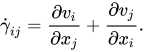
For the simple shear case, it is just a gradient of velocity in a flowing material. The SI unit of measurement for shear rate is s−1, expressed as "reciprocal seconds" or "inverse seconds".[1] However, when modelling fluids in 3D, it is common to consider a scalar value for the shear rate by calculating the second invariant of the strain-rate tensor

.

The shear rate at the inner wall of a Newtonian fluid flowing within a pipe[2] is

where:

  • is the shear rate, measured in reciprocal seconds;
  • v is the linear fluid velocity;
  • d is the inside diameter of the pipe.

The linear fluid velocity v is related to the volumetric flow rate Q by

where A is the cross-sectional area of the pipe, which for an inside pipe radius of r is given by

thus producing

Substituting the above into the earlier equation for the shear rate of a Newtonian fluid flowing within a pipe, and noting (in the denominator) that d = 2r:
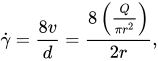
which simplifies to the following equivalent form for wall shear rate in terms of volumetric flow rate Q and inner pipe radius r:

For a Newtonian fluid wall, shear stress (τw) can be related to shear rate by where μ is the dynamic viscosity of the fluid. For non-Newtonian fluids, there are different constitutive laws depending on the fluid, which relates the stress tensor to the shear rate tensor.

References

[edit]

See also

[edit]
Revisions and contributorsEdit on WikipediaRead on Wikipedia
from Grokipedia
Shear rate is the velocity gradient in a flowing fluid, representing the rate at which adjacent layers of fluid move past one another, typically expressed in units of reciprocal seconds (s⁻¹). It quantifies the deformation rate under applied shear stress and is central to understanding fluid behavior in mechanics and rheology. In fluid mechanics, shear rate arises in shear flows where velocity varies across the flow direction, such as between parallel plates or in pipe flow. For a simple case, it is calculated as the difference in velocities between two layers divided by the distance separating them, as in γ˙=v1v2h\dot{\gamma} = \frac{v_1 - v_2}{h}, where v1v_1 and v2v_2 are velocities of the layers and hh is the gap width. This concept stems from the rate of strain dγdt=dudy\frac{d\gamma}{dt} = \frac{du}{dy}, where uu is the velocity component parallel to the flow and yy is perpendicular to it. Shear rate plays a pivotal role in , the study of material flow and deformation, particularly for non-Newtonian fluids where varies with shear rate—a phenomenon known as (viscosity decreases) or shear thickening (viscosity increases). For Newtonian fluids, however, τ\tau is directly proportional to shear rate via dynamic μ\mu, following Newton's law: τ=μγ˙\tau = \mu \dot{\gamma}. This relationship is crucial for predicting flow in industrial processes like pumping, mixing, and , where shear rates can range from low values (e.g., 0.1 s⁻¹ in ) to extremely high ones (e.g., 10,000 s⁻¹ in adhesive spreading). Beyond engineering applications, shear rate influences biological systems, such as flow in vessels where it affects platelet and risk, and in for modeling lava flows or drilling muds. Accurate measurement of shear rate using rheometers, often via rotational geometries like cone-and-plate, ensures reliable characterization of complex fluids, aiding in formulation optimization and process design.

Fundamentals

Definition

Shear rate is the velocity within a deforming or , quantifying the with which adjacent layers of the material slide relative to one another. In , it functions as a fundamental kinematic quantity that describes the rate of shear deformation in materials subjected to tangential forces. This concept originated in the context of viscous flow studies during the , with key formalizations by in 1822 and George Gabriel Stokes in 1845, who incorporated velocity gradients into the equations governing fluid motion, thereby extending Isaac Newton's 1687 postulate on the proportionality of viscous resistance to relative motion in fluids. Shear rate differs from , which is the tangential force per unit area acting on a surface, and from shear strain, which measures the angular distortion or change in angle between originally perpendicular material lines. As a rate quantity, it captures the time-dependent aspect of deformation, with units typically expressed as inverse seconds (s⁻¹). A straightforward example is the configuration of between two parallel plates, one fixed and the other translating at constant speed parallel to the first, where the resulting linear variation in across the gap exemplifies pure shearing motion without rotational components.

Units and Dimensions

The SI unit of shear rate is the reciprocal second (s⁻¹), derived from the ratio of , measured in per second (m/s), to a scale, such as the between layers in (m). This unit reflects the fundamental nature of shear rate as a , quantifying how rapidly adjacent elements slide past one another. The dimensional formula for shear rate is [T⁻¹], where T denotes time, indicating that it is a kinematic quantity solely dependent on temporal scales and independent of length in homogeneous flows. This time-inverse dimension arises because shear rate normalizes velocity differences over spatial separations, canceling length dimensions and emphasizing its role as a rate of deformation per unit time. In non-SI systems, such as the centimeter-gram-second (cgs) framework, shear rate retains the unit of reciprocal seconds (s⁻¹), consistent with the SI derivation since velocity in cm/s divided by distance in cm yields the same temporal inverse. Shear rates span a wide range across flow regimes, providing scale for applications. Low shear rates, typically below 1 s⁻¹, characterize creeping flows where viscous forces dominate and inertial effects are negligible, such as in slow or microfluidic channels. In contrast, high shear rates exceeding 10⁶ s⁻¹ occur near the wall in turbulent boundary layers of high-Reynolds-number flows, like those in or high-speed , where sharp velocity gradients drive intense mixing and . These extremes highlight shear rate's utility in for predicting flow behavior without specific geometric details.

Shear Rate in Fluid Mechanics

Simple Shear Flow

Simple shear flow constitutes a fundamental type of unidirectional motion in which the velocity field varies solely in the direction perpendicular to the primary flow direction, exhibiting no acceleration and lacking rigid-body rotational components. This configuration represents an idealized case where layers slide parallel to one another, enabling the isolation of shear effects without complicating influences from or pressure-driven variations. The shear rate in simple shear flow is quantified by the velocity gradient perpendicular to the flow, expressed as γ˙=dudy,\dot{\gamma} = \frac{du}{dy}, where uu denotes the velocity component aligned with the flow direction and yy is the coordinate transverse to it. This measure captures the rate at which adjacent fluid layers deform relative to each other. For an incompressible Newtonian fluid under low Reynolds number conditions, where inertial effects are negligible, the velocity profile arises from the and the simplified momentum balance. The for , v=0\nabla \cdot \mathbf{v} = 0, is inherently satisfied by a unidirectional field u(y)u(y) with no variations in the flow direction. The steady-state x-momentum equation, neglecting gradients and body forces, reduces to ddy(μdudy)=0\frac{d}{dy} \left( \mu \frac{du}{dy} \right) = 0, implying a constant shear rate since μ\mu is uniform. Integrating twice yields a linear profile u(y)=γ˙y+cu(y) = \dot{\gamma} y + c, with constants determined by boundary conditions. A canonical example is planar , occurring between two infinite parallel plates separated by a gap hh, where the lower plate remains stationary and the upper plate translates at constant speed VV. The resulting uniform shear rate is γ˙=Vh.\dot{\gamma} = \frac{V}{h}. This setup produces a linear velocity profile u(y)=Vhyu(y) = \frac{V}{h} y, directly linking the imposed motion to the deformation rate. In Newtonian fluids, the shear stress τ\tau relates linearly to the shear rate via τ=μγ˙\tau = \mu \dot{\gamma}, establishing the proportionality that defines viscous behavior in such flows.

General Shear Flows

In general shear flows, the shear rate is represented tensorially as the rate-of-strain tensor, which is the symmetric portion of the gradient tensor. This tensor, denoted as ϵ˙\dot{\epsilon}, is defined as ϵ˙=12(u+(u)T)\dot{\epsilon} = \frac{1}{2} \left( \nabla \mathbf{u} + (\nabla \mathbf{u})^T \right), where u\mathbf{u} is the field. The off-diagonal components of ϵ˙\dot{\epsilon} capture the shear deformation, while the diagonal elements represent extensional rates. This formulation generalizes the concept beyond unidirectional flows, accounting for the full deformation in multi-dimensional scenarios. In three-dimensional flows, the shear rate tensor can be decomposed into its magnitude and principal directions to analyze local deformation characteristics. The magnitude of the shear rate is typically computed as γ˙=2ϵ˙:ϵ˙\dot{\gamma} = \sqrt{2 \dot{\epsilon} : \dot{\epsilon}}
Add your contribution
Related Hubs
User Avatar
No comments yet.