Hubbry Logo
SchukoSchukoMain
Open search
Schuko
Community hub
Schuko
logo
8 pages, 0 posts
0 subscribers
Be the first to start a discussion here.
Schuko
Schuko
from Wikipedia

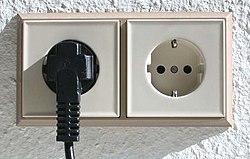
Double Schuko socket with one plug inserted. The dot in the middle of the socket is a screw head, not a third hole.
Illustration of the originally two Schuko plug and socket designs from the patent specification of patent DE567906 granted on 22 December 1932. The right-hand column shows the design that prevailed and is in use today.

Schuko (/ˈʃk/) or type F, is a connector (plug/socket) system used in much (but not all) of Europe. It is a registered trademark[1] referring to a system of AC power plugs and sockets that is defined as "CEE 7/3" (sockets) and "CEE 7/4" (plugs). A Schuko plug features two round pins of 4.8 mm diameter (19 mm long, centres 19 mm apart) for the line and neutral contacts, plus two flat contact areas on the top and bottom side of the plug for protective earth (ground). The socket (which is often, in error, also referred to as CEE 7/4) has a predominantly circular recess which is 17.5 mm deep with two symmetrical round apertures and two earthing clips on the sides of the socket positioned to ensure that the earth is always engaged before live pin contact is made. Schuko plugs and sockets are symmetric AC connectors. They can be mated in two ways, therefore line can be connected to either pin of the appliance plug. As with most types of European sockets, Schuko sockets can accept Europlugs. Schuko plugs are considered a very safe design when used with Schuko sockets, but they can also mate with other sockets to give an unsafe result.

Schuko is a shortening of the German term Schutzkontakt (literally: protective contact),[1] which indicates that plug and socket are equipped with protective-earth contacts (in the form of clips rather than pins). Schuko connectors are normally used on circuits with 230 V, 50 Hz, for currents up to 16 A, although e.g. South Korea uses them at 60 Hz for historical reasons.

History

[edit]
Currently used AC mains plugs in Europe:
  Schuko (Type F, CEE 7/4 plug, CEE 7/7 plug)
  British (Type G, BS 1363)
  Swiss (Type J, SN 441011)
  Danish 107-2-D1 (Type K)
  Italian CEI 23-50 (Type L)

The Schuko system originated in Germany. It is believed to date from 1925 and is attributed to Albert Büttner, a Bavarian manufacturer of electrical accessories.[2] Büttner's company, Bayerische Elektrozubehör AG, was granted patent DE 489 003 in 1930 for a Stecker mit Erdungseinrichtung ('plug with earthing device').[3] Büttner's patent DE 370 538[4] is often quoted as referring to Schuko, but it actually refers to a method of holding together all of the parts of a plug or socket with a single screw which also provides clamping for the wires; there is no mention of an earth connection in DE 370538. At this time Germany used a 220 V centre tap giving 127 V from current pins to earth,[citation needed] which meant that fuse links were required in both sides of the appliance and double pole switches. Variations of the original Schuko plug are used today in more than 40 countries, including most of Continental Europe.

France, Belgium, Czechia, Slovakia and Poland use the CEE 7/6 plug and CEE 7/5 socket (Type E) with the same size and spacing of the main pins but with a male protective-earth pin on the socket instead of the earth clips, and without the guiding notches at the sides. Most modern moulded Schuko plugs, and good-quality rewirable replacements, are a hybrid version ("CEE 7/7") with an aperture that accommodates the earth pin of CEE 7/5 sockets. CEE 7/6 plugs that need to be polarised are configured in such a way as to only be inserted correctly in earthed sockets, however the old CEE 7/1 2-pin unearthed socket is inherently dangerous with equipment that should be polarised, for example table lamps with an Edison screw lamp but only a single pole inline cord switch in lieu of a double pole switch. The safety of polarisation was not helped by several years of confusion when the correct connection of sockets was transposed.

Early in the 21st century, CEE 7/7 [clarification needed] became the de facto plug standard in many European countries, and in some other countries that follow CENELEC standards. European countries that do not use CEE 7/7 are:

  • Denmark (CEE 7/17 and Danish standard 107-2-D1 are widely used, they accept CEE 7/7 plugs but without compatibility for earth connections. CEE 7/5 and CEE 7/3 sockets with child-proof shutters have been allowed since 2008/2011, but are uncommon in buildings constructed before these dates).
  • Ireland (BS 1363 – equivalent Irish Standard: IS 401) but see below,
  • Italy (CEI 23-50 – includes Schuko),
  • Malta (BS 1363),
  • Cyprus (BS 1363),
  • The United Kingdom, including Gibraltar (BS 1363)
  • Switzerland (SN 441011)

In Italy, CEI 23-50 is the dominant standard and it also includes Schuko sockets (P 30 = CEE 7/3) and plugs (S 30 = CEE 7/4, S 31 = CEE 7/7, S 32 = CEE 7/17). Appliances are commonly sold with Schuko-type plugs (as well as Europlugs), while Italian-type plugs have become rare today and almost only power strips, cable reels and adaptors are sold with them. Some sockets (P 30 and P 40) accept both types, the remainder accepting one or the other. Schuko sockets are most commonly used for larger-rated appliances such as washing machines, and are particularly common in South Tyrol, with its cultural, economic and tourist connections with Austria.

Although Schuko has never been a standard (or the de facto norm) in Belgium or France, it is sometimes encountered in older installations in eastern regions of Belgium and Alsace.

In Ireland, Schuko was commonly installed until the 1960s.[5][6][7] For safety reasons and to harmonize with the UK and thereby avoid having a different outlet type in Northern Ireland and the Republic of Ireland, the Republic standardized on BS 1363 (transposed into Irish Standards as IS 401 (Plug) and IS 411 (Socket outlet). Schuko has been phased out of use in Ireland and will be rarely encountered. Some hotels provide a Schuko outlet alongside BS 1363 outlets for the convenience of visitors from the Continent.

Russia, while maintaining its own mains connector standard, has it largely harmonised with the relevant European regulations since Soviet times. The original Soviet standard was mostly compatible with Europlug (the traditional Soviet plug used straight 4 mm pins with 19 mm spacing and thus Soviet sockets were able to easily accept europlugs), and has been modified to accept 4.8 mm pins, due to the large volume of imported appliances equipped with the Schuko plug. Nowadays most sold and installed sockets in Russia are Schuko ones, though they may lack a connection to earth, especially in older buildings, as this wasn't required by the Soviet wiring regulations.

Denmark gave full permission to install Schuko wall sockets in 2011, and such sockets can be found for sale at some Danish hardware stores,[8] but the Danish Type K remains the most common earthed socket type in Denmark by far.

Safety features

[edit]

CEE 7/3 refers to sockets, CEE 7/4 to plugs.

When inserted into the socket, the Schuko plug covers the socket cavity (1), thereby preventing users from touching connected pins. It also establishes protective-earth connection through the earth clips (2) before the line and neutral pins (3) establish contact. A pair of non-conductive guiding notches (4) on the left and right side provides extra stability, enabling the safe use of large and heavy plugs (e.g. with built-in transformers or timers).

Some countries, including Portugal, Finland, Denmark,[9] Norway, Sweden, and Italy require child-proof socket shutters; the German DIN 49440-1:2006-01 standard does not have this requirement.

Compatibility with other plug/socket types

[edit]

Schuko sockets can accept two-pin unearthed Europlug (CEE 7/16) and CEE 7/17. Less safely, Schuko plugs can be inserted into many two-pin unearthed CEE 7/1 sockets and into some sockets with a different form of earth connection that will not mate with the earth contacts on the Schuko plug (e.g., some variants of the Danish socket). Many such sockets also lack the cavity required to prevent users from touching the pins whilst inserting the plug.

CEE 7/7 plug, compatible with both CEE 7/3 (Schuko) and CEE 7/5 sockets

The CEE 7/7 plug is a hybrid which includes both side earthing strips, as in CEE 7/4 Schuko, and an earthing aperture, as in the CEE 7/6 plug. It can therefore achieve an earth contact with both CEE 7/3 (Schuko) and CEE 7/5 sockets.

In Italy, Chile, Peru and Uruguay, hybrid versions of Schuko sockets (called P 30) are seen with an extra hole that will take the smaller variant of Italian CEI 23-50 plugs. There are also hybrid Schuko sockets (called P 40) with three extra holes and a wider cavity that will also accept the larger variant of Italian plugs.

Schuko sockets are unpolarised; there is no way of differentiating between the two live contacts (line which is approximately 230 V to earth and neutral which is approximately 0 V to earth) unless the voltage to earth is measured prior to use.

Although Schuko is incompatible and the pin spacing should not allow it, as the Schuko pins are slightly closer together, it is possible to dangerously force many Schuko round pin plugs (where the plastic is compliant enough) into many UK BS 1363 rectangular pin sockets, using a match or other probe to push into the earth shutter release. Due to the minimal contact area that must transmit high current, there is risk of overheating and thus fire. Where earthing is required, no earth contact will be made as Schuko plugs use side contacts for earthing rather than a third pin, and BS 1363 sockets have shutters that require the longer earth pin to be entered to open the line and neutral shutters, which prevent Europlugs and Schuko plugs from being inserted.

The IEC 60906-1 standard was intended to address some of the issues regarding polarisation and replace Schuko, but the only countries that have adopted it are South Africa and Brazil.

See also

[edit]

References

[edit]
Revisions and contributorsEdit on WikipediaRead on Wikipedia
from Grokipedia
The Schuko, an abbreviation of the German term Schutzkontakt meaning "protective contact," is a standardized electrical plug and socket system featuring two symmetrical round pins and lateral grounding clips that ensure earthing before live contacts engage, prioritizing user safety in both and industrial settings. Developed in during the 1920s amid growing concerns over electrical accidents in expanding domestic networks, the system originated with Albert Büttner's 1925 introduction of an earthed domestic plug at the Fair, patented as DRP No. 489,003 in 1926. It was subsequently refined by Wilhelm Klement at Siemens-Schuckertwerke, culminating in patent DRP 567,906 filed in 1929 and granted in 1932, which incorporated recessed earth strips for enhanced protection. Adoption accelerated in 1930 when the Rhenish-Westphalian Electric Company () mandated Schuko sockets for new installations, standardizing it initially for 250 V at 10 A DC or 15 A AC. Technically designated as Type F under international classifications, the Schuko plug uses two 4.8 mm diameter round pins spaced 19 mm apart and measuring 19 mm in length, paired with offset grounding clips 16 mm from the pin centerline, supporting currents up to 16 A at 230 V and 50 Hz. Its unpolarized design allows insertion in either orientation, with side notches and indentations for secure retention, and it accommodates conductor cross-sections from 1.5 to 2.5 mm². Widely employed in Germany, Austria, the Netherlands, Sweden, Finland, Norway, Portugal, Spain, and much of Eastern Europe—covering approximately 49% of EU households—the system has seen minimal modifications since the 1930s and is used in around 70 countries globally, often via hybrid CEE 7/7 plugs compatible with Type E sockets.

Overview

Technical Specifications

The Schuko plug and socket system is rated for a nominal voltage of 230 V AC (maximum 250 V) and a maximum current of 16 A, making it suitable for household and light industrial applications in . This rating aligns with the requirements of the VDE 0620 standard, ensuring safe operation under typical mains conditions. The pin configuration consists of two symmetrical round pins for line and neutral, each with a of 4.8 mm and a length of 19 mm, spaced 19 mm apart center-to-center. Additionally, the plug includes a pair of U-shaped lateral grounding clips that engage with corresponding contacts in the socket for protective connection; the grounding clips are offset 16 mm from the pin centerline. Overall dimensions of the plug body measure approximately 43-44 mm in width and 48 mm in height, with an insertion depth of 19 mm to facilitate secure mating with the socket recess. These specifications promote ease of use while maintaining compatibility across standardized outlets. Pins are constructed from or equivalent conductive alloys to ensure low resistance and durability, while socket contacts are typically made of for reliable spring action and corrosion resistance. The system is primarily designed for 50 Hz AC frequency, as prevalent in European grids, though export variants demonstrate tolerance for 60 Hz operation without performance degradation, supporting use in regions like .

Physical Characteristics

The Schuko plug features a compact rectangular body with rounded edges for comfortable handling and reduced risk of , incorporating two parallel round pins of 4.8 mm spaced 19 mm apart on their centers, each measuring 19 mm in length. These pins are flanked by two lateral grounding clips, which are flat metallic contact areas on the sides of the plug that engage U-shaped contacts in the socket upon insertion, ensuring protective earthing connects before live contacts. Many modern sockets include additional safety shutters to prevent access to live parts. The corresponding socket is designed with recessed circular holes to accommodate the round pins, positioned horizontally and spaced to match the plug's configuration, while the side-mounted U-shaped earth contacts ensure reliable grounding without protruding elements. Sockets are typically flush-mounted into walls or panels, providing a low-profile installation that integrates seamlessly with building and minimizes exposed components. Ergonomically, the Schuko system supports reversible insertion due to its non-polarized design, allowing the plug to be oriented in either direction without affecting functionality, which enhances user convenience in everyday applications. Plugs generally weigh between 30 and 50 grams, contributing to their lightweight and portable nature for household and use. Standard color coding for sockets emphasizes neutral tones such as white or ivory to blend with interior decor, while plugs are commonly produced in black or regionally varied colors for identification in multi-device setups. Manufacturing typically involves molded plastic housings made from materials like , offering , electrical insulation, and heat resistance up to 70°C to withstand operational demands.

History

Origins and Development

The Schuko plug and socket system originated in during the mid-1920s, driven by growing concerns over electrical safety as household electrification expanded rapidly after . Albert Büttner, founder of the ABL company—a Bavarian manufacturer of electrical accessories—developed the first earthed design specifically for domestic use, featuring side-mounted earth clips on a metal plug shell and a recessed socket to prevent accidental contact. This innovation addressed the risks of shock and fire from ungrounded systems, which were prevalent at the time. Büttner's prototype was publicly debuted at the in August 1925 and received German patent DRP No. 489,003 in January 1926. The system evolved from earlier ungrounded plugs that had been standard in since the , primarily two-pin round-pin designs lacking protective earthing and often relying on improvised grounding methods like water pipes. These predecessors, introduced around the for low-power appliances, proved inadequate for the increasing power demands and safety needs of the , prompting calls for grounded alternatives inspired by industrial three-phase connectors from the 1900s. Büttner's grounded version built on this foundation by integrating symmetrical round pins spaced 19 mm apart with earth contacts, though initial designs used a circular base and 90-degree rotated clips for compatibility. Early development faced significant challenges, including high manufacturing costs, resistance from consumers accustomed to cheaper ungrounded plugs, and the absence of mandatory earthing regulations, which limited widespread uptake. The VDE (Association for Electrical, Electronic and Information Technologies) played a pivotal role by forming a commission in 1927 to revise installation norms, culminating in the KPI 1928 guidelines that required earthed sockets in hazardous areas like bathrooms and kitchens while promoting 10A minimum ratings and . Refinements continued with Wilhelm Klement of Siemens-Schuckertwerke patenting the near-final design (DRP No. 567,906, filed 1929 and granted 1932), which added socket grooves to ensure only grounded plugs could connect fully. Key milestones included the utility company's adoption of the Siemens-Klement variant in 1930 for 250V domestic networks, marking the start of commercial production by multiple VDE-approved manufacturers such as AEG and , with pins standardized at 4.8 mm diameter for 10A DC or 15A AC loads.

Standardization and Adoption

The Schuko plug and socket system received formal standardization in through the Verband der Elektrotechnik (VDE), with the first edition of DIN VDE 0620 published in July 1959 as VDE 0620-1, establishing requirements for household plugs and sockets up to 250 V and 16 A. This standard emphasized safety features like grounding and insulation, building on earlier national regulations from the 1920s, and has since been updated regularly, with the current version DIN VDE 0620-1:2021-02 maintaining . In 1963, the Schuko design was incorporated into broader European standards by the International Commission on Rules for the Approval of Electrical Equipment (CEE), now under CENELEC, as CEE 7/3 for sockets and CEE 7/4 for plugs in the second edition of CEE 7, published in May 1963. This designation facilitated cross-border compatibility, defining the symmetrical two-pin configuration with side grounding clips for 230 V, 50 Hz systems rated at 16 A. Schuko became the predominant standard for household electrical installations in several European countries, including , , the , , and , where it replaced or supplemented earlier ungrounded systems to enhance safety. In other nations like , adoption remained voluntary alongside the Type E system, though hybrid plugs (CEE 7/7) enabled interoperability. The system's global spread extended beyond Europe through exports and colonial influences, finding use in parts of the (e.g., ), (e.g., , ), and Asia (e.g., , ), where it supported 230 V . Recent developments include harmonization of Schuko manufacturing with the Low Voltage Directive (2014/35/EU), which, while excluding fixed domestic installations, influences safety standards for portable devices and new production to ensure and risk assessment post-2020. This alignment supports ongoing for compliant products across the .

Design and Safety Features

Protective Earth Contact

The protective earth contact in Schuko plugs, known as Schutzkontakt, features two U-shaped metal clips positioned on the sides of the plug body, which make contact with corresponding spring-loaded earth terminals in the socket to establish a low-impedance path to ground. During insertion, the U-shaped clips engage the socket's recessed earth terminals first due to the socket's deeper design, ensuring the grounding connection is made before the live and neutral pins contact the power terminals, thereby prioritizing fault protection. This sequential engagement opens any protective shutters in the socket and prevents partial insertion that could expose live parts. The primary safety function of the protective earth contact is to divert fault currents, such as those arising from insulation failure in the connected appliance, safely to , which activates protection devices like circuit breakers or residual current devices (RCDs) to interrupt the supply and prevent shock or fire risks. To ensure effectiveness, the earth path must maintain low resistance; for example, in testing portable appliances, VDE 0701-0702 requires protective conductor resistance below 0.3 Ω for connections up to 5 m, with additional 0.1 Ω per 7.5 m up to 1 Ω maximum.

Insulation and Strain Relief

Schuko plugs and sockets employ robust insulation features to protect users from electrical hazards by enclosing live parts in non-conductive materials. The design incorporates reinforced plastic barriers around the live and neutral pins, providing basic insulation that, in conjunction with the protective contact, meets Class I safety construction requirements under standards such as DIN VDE 0620-1. These barriers prevent accidental contact with energized components during insertion or removal, enhancing overall safety in and similar environments. Many modern Schuko sockets incorporate an optional integrated shutter system that covers the live contacts and only opens when a compatible plug is fully inserted. This mechanism blocks access to the slots, reducing the risk of electric shock from foreign objects, particularly by children, in compliance with child safety provisions in IEC 60884-1. The shutters typically open only when the plug's pins and grounding clips are properly aligned and engaged, ensuring controlled access to the electrical contacts. For mechanical integrity, Schuko plugs include strain relief at the cable entry point, featuring clamps or cord grips that secure the flexible cord against pull-out and twisting. In rewirable designs, this anchorage must provide relief from strain and prevent twisting, tested per IEC 60884-1 clause 23 by applying a pull force of 60 N (for PVC insulation) or 75 N (for rubber insulation) for 1 minute, followed by a test and repeated pull. The housing materials, often (PC) or (PA) with a V-0 flammability rating, further support durability by resisting ignition and self-extinguishing quickly if exposed to arcing, capable of withstanding 2 kV stress without breakdown as per the electric strength test in IEC 60884-1. Regarding ingress protection, standard indoor Schuko sockets achieve an IP20 rating, safeguarding against insertion of solid objects larger than 12.5 mm while offering no water resistance. Weatherproof variants, suitable for outdoor or damp locations, incorporate seals and covers to reach IP44 or higher, protecting against water splashes from any direction and solid objects over 1 mm. These IP-rated designs ensure reliable performance in varied environments without compromising insulation integrity.

Compatibility and Usage

Integration with Other European Plugs

The Schuko system, designated as CEE 7/4 for plugs and CEE 7/3 for sockets, integrates with other continental European standards primarily through hybrid socket designs that accommodate multiple plug types. CEE 7/3 hybrid sockets accept both Schuko plugs (CEE 7/4) and French plugs (CEE 7/5) due to standardized pin spacing of 19 mm between the live and neutral contacts, allowing for broader compatibility across , , , and other nations without requiring full replacement of existing infrastructure. Adapters play a key role in facilitating integration, particularly for the ungrounded Type C (CEE 7/16), which is commonly adapted for use in Schuko sockets for low-power devices; these adapters are typically rated for 2.5 A and emphasize ungrounded loads to prevent risks from improper earthing. A notable difference arises in polarization: Schuko's symmetrical, non-polarized design permits plug reversal, potentially leading to reversed polarity in appliances, whereas French variants (CEE 7/5 and 7/6) enforce polarization through the offset earth pin, ensuring consistent live-neutral orientation for in polarized circuits. Compatibility has limits with other European standards; Schuko plugs do not mate directly with the UK's Type G (BS 1363) rectangular-pin sockets or non-230 V systems outside standard continental voltages, necessitating adapters and, in voltage-mismatched regions like certain Eastern European outliers, converters to avoid equipment damage. As of recent analyses, Schuko-compatible sockets account for approximately 49% of household installations in the due to their widespread adoption in major economies like , the , and .

Regional Variations and Global Use

In and , the Schuko plug adheres to the pure Type F standard with side-positioned earthing clips for grounding, and it has been the required type for all new electrical installations since to ensure safety and compatibility across . In the and , Schuko implementations frequently incorporate hybrid variants, such as the CEE 7/7 plug design featuring an additional female grounding contact alongside the standard side earthing clips, enhancing connection stability and compatibility with Type E sockets prevalent in these regions. Spain primarily employs the standard Schuko Type F for household and commercial use, aligning with broader continental European practices. In Italy, Schuko is integrated into hybrid sockets that accommodate both Type F plugs and the traditional Type L, with these universal designs—such as the P30 Standard—becoming predominant in modern constructions to support diverse plug types while prioritizing safety. Beyond , Schuko enjoys widespread adoption in and , where it serves as the primary plug type for 230V systems, and it is utilized in over 40 countries globally, including various Eastern European nations. In parts of , such as , Schuko plugs exhibit partial compatibility with Type N sockets via adapters, facilitating use in imported appliances despite the prevalence of local standards. For export markets like the and , 110V-rated Schuko variants are uncommon due to voltage differences, but most contemporary Schuko-compatible devices are designed to tolerate 50/60 Hz frequencies, enabling broader international applicability with appropriate adapters.

Standards and Regulations

Relevant IEC and CEE Standards

The Schuko plug and socket system is governed by several key international and European standards that ensure safety, interoperability, and performance for household and similar applications. The primary international standard is IEC 60884-1, which provides general requirements for plugs and socket-outlets rated for alternating current up to 440 V and 32 A, including those with earthing contacts like Schuko. This standard specifies dielectric strength tests at 2 000 V a.c. for 1 minute for accessories with rated voltages above 130 V to verify insulation integrity under electrical stress. Within the European framework, the CEE 7 series forms the foundational specifications for Schuko components. CEE 7/3, introduced in 1963, defines the requirements for Schuko sockets with protective earth clips and recessed pin holes, while CEE 7/4 from the same year outlines the corresponding plugs with 4.8 mm diameter pins and symmetrical earth contacts. These specifications are implemented in national standards, such as DIN VDE 0620 in . CENELEC HD 21 serves as the harmonized document for flexible cables used with household plugs and socket-outlets, including Schuko assemblies, limiting the rated current to 16 A for 1.5 mm² conductors to prevent overheating in typical installations. Complementary testing protocols under IEC 60884-1 include endurance requirements of 10 000 insertion and withdrawal cycles to assess mechanical durability without excessive or contact degradation. Additionally, temperature rise limits are set at under 45 K for pins and accessible parts during full-load operation for one hour, ensuring thermal safety. The CEE 7/7 hybrid plug, designed for compatibility with both Schuko (Type F) and French (Type E) sockets, has faced scrutiny for safety concerns related to inconsistent earthing when used with Type E sockets.

Safety Certifications and Updates

Schuko plugs and sockets undergo rigorous certification processes in , primarily through the VDE Institute and Rheinland, which verify compliance with electrotechnical standards such as those outlined in DIN VDE 0620-1:2021-02 for plugs and sockets. These certifications ensure protection against electrical hazards, including proper insulation and grounding integrity. For the broader European market and exports, the is mandatory, indicating conformity with EU health, , and environmental requirements under the Directive (2014/35/EU) and related harmonized standards, even though domestic plugs and sockets are excluded from the directive's direct scope and rely on national implementations. To further mitigate risks of electric shock from earth faults, modern Schuko sockets frequently integrate residual current devices (RCDs) that trip at 30 mA, aligning with the requirements of IEC 61008-1 for residual current operated circuit-breakers without integral overcurrent protection. These devices provide additional leakage current protection beyond the inherent grounding of the Schuko design, and their inclusion is common in contemporary installations to meet enhanced safety norms like those in DIN EN 61008-1 (VDE 0664-10). Since the early 2000s, regulatory updates have focused on environmental and safety enhancements for Schuko components. The 's Restriction of Hazardous Substances (RoHS) Directive (2011/65/EU), effective from 2006, mandates the elimination of lead and other hazardous materials in electrical equipment, including plugs and sockets, to reduce environmental impact during manufacturing and disposal. Additionally, EU member states, through national wiring regulations harmonized with IEC standards, have prohibited ungrounded retrofits in new or significantly modified electrical installations, requiring protective earth connections to comply with low-voltage safety objectives. Looking ahead, innovations in Schuko technology include smart sockets equipped with USB ports for device charging and built-in energy monitoring capabilities, which allow real-time consumption tracking via apps. These advancements maintain safety through compliance with standards for external power supplies, such as IEC 62684 for USB interfaces, ensuring seamless integration into modern smart home ecosystems.

References

Add your contribution
Related Hubs
User Avatar
No comments yet.