Hubbry Logo
EuroplugEuroplugMain
Open search
Europlug
Community hub
Europlug
logo
8 pages, 0 posts
0 subscribers
Be the first to start a discussion here.
Contribute something
Europlug
Europlug
from Wikipedia
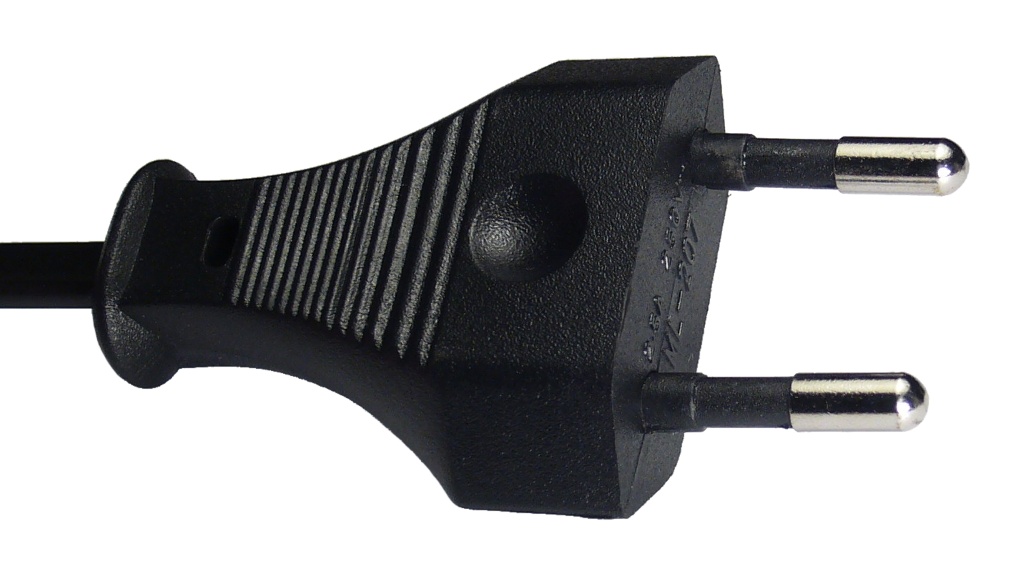
Example of a Europlug
An unofficial double "Eurosocket". While these are not defined by any standard, they are nevertheless produced and sold by some companies. Since they will also accept Swiss Type 11 plugs due to the nearly identical form factor, they should be rated for at least 10 A to allow safe usage (this one is rated for 16 A).

The Europlug is a flat, non-rewirable two-pole, round-pin domestic AC power plug, rated for voltages up to 250 V and currents up to 2.5 A.[1] It is a compromise design for low-power Class II appliances that is compatible with all round-pin domestic power socket used across Europe (though not the rectangular-pin BS 1363 sockets found in the United Kingdom or the former British colonies of Cyprus, Ireland, and Malta). By the standard, Europlugs must be non-rewirable and must be supplied attached to a power cord; anything else is non-compliant.[1]

The plug is often used on the housing of small plug-in power supplies. Though standardization excludes it, there are cable couplings for Europlugs and rewireable plugs available.

History

[edit]

The Europlug design, intended for use with socket-outlets meeting other standards, appeared first in 1963 as Alternative II of Standard Sheet XVI in the second edition of CEE Publication 7 by the contributing members of Austria, Belgium, Czechoslovakia, Denmark, Federal Republic of Germany, Finland, France, Greece, Hungary, Italy, Netherlands, Norway, Poland, Portugal, Sweden, Switzerland, United Kingdom, and Yugoslavia.[2] The Europlug is therefore sometimes also referred to as the "CEE 7/16 Alternative II plug" or simply as the "CEE 7/16 plug". It was also described in 1975 as plug C5 in IEC Technical Report 83.[citation needed] In 1990 it was defined by Cenelec standard EN 50075[1] which has national equivalents in most European countries, as described in IEC 60083[3] which superseded IEC/TR 83 (and no longer uses the C5 designation).[citation needed]

The Europlug is unusual as the standard specifies a plug only; there is no socket/outlet defined specifically for use with it. The Europlug is attached to the housing of small power devices of Class II with maximal current of 2.5 A.

Design considerations

[edit]

The dimensions of the Europlug were chosen for compatibility and safe use, such that with continental European domestic power sockets:

  • reliable contact is established when the plug is fully inserted;
  • no live conductive parts are accessible while the plug is inserted into each type of socket;
  • it is not possible to establish a connection between one pin and a live socket contact while the other pin is accessible.

Additionally, the design allows for a more compact and less bulky design of mobile phone chargers, than the BS 1363 form factor in the UK.

Europlugs are only designed for low-power (less than 2.5 A) Class II (double-insulated) devices that operate at normal room temperature and do not require a protective-earth connection.

Details

[edit]
Diagram of the Europlug specifications

The pins of the Europlug are 19 mm long. They consist of a 9 mm long conductive tip of 4 mm diameter with a rounded ending, followed by a 10 mm long flexible insulated shaft of not more than 3.8 mm diameter. The two pins are not exactly parallel and converge slightly; their centres are 17 to 18 mm apart at the tip and 18 to 19 mm apart at the base. The elasticity of the converging pins provides sufficient contact force for the Europlug's current rating with a variety of socket-hole arrangements. The entire plug is 35.3 mm wide and 13.7 mm high, and must not exceed these dimensions within 18 mm behind its front plane (this allows for the recesses on many European socket types). The left and right side of the plug are formed by surfaces that are at 45° relative to the horizontal plane.[1]

Compatibility

[edit]
Map of Europlug-compatible sockets

Types C, E, F, and K

[edit]

The Europlug is designed to be compatible with these sockets. They have 4.8 mm holes with centres spaced 19 mm apart. The minimum distance between the holes is thus 14.2 mm, while the minimum distance between the converged pins on the Europlug is 13.5 mm, allowing it to grip the socket despite its smaller pin width.

Type D

[edit]

The Europlug is not compatible with type D sockets, used in e.g. India and South Africa. These sockets have 5.1 mm holes with centres spaced 19.1 mm apart, which means a Europlug can be inserted if the sockets do not have protective shutters. However, the socket design might not allow the plug to grip it.

Type G

[edit]

The Europlug is physically not compatible with BS 1363 13 A sockets, used in e.g. the UK and Ireland. UK law requires a suitable fuse to be fitted in each plug to protect the appliance's flexible cord; Europlugs do not contain such fuses. BS 1363 sockets contain a child-safety shutter; clause 13.7.2 of BS 1363-2 requires that Europlugs will not open the shutters.[4] In some types of BS 1363 sockets (but not all) the safety mechanism can be tampered with so that a Europlug may then be forced into the open line and neutral ports. The UK Electrical Safety Council has drawn attention to the fire risk associated with forcing Europlugs into BS 1363 sockets.[5] There is also a risk of damage to both the plug and socket.

UK consumer protection legislation requires that most domestic electrical goods sold must be provided with fitted plugs to BS 1363-1.[6] The exception is that shavers, electric toothbrushes and similar personal hygiene products may be supplied with a Europlug as an alternative to the BS 4573 plug (see below).

The Europlug fits BS 1363 sockets without shutters, but the plug is only rated for 2.5 A and the UK sockets are fused at 32 A. The round pins have only a very small contact area with the rectangular sockets.

Fused conversion plugs to BS 1363-5 are available for Europlugs, and equipment fitted with these may be legally sold in the UK.[7]

Adaptors sold with SAA approval in Australia, despite failing to comply with 'BS 8546: 2016 - Travel adaptors compatible with UK plug and socket system' due to not having shutters, accept Europlugs in the UK position.[8]

BS 4573 (UK shaver)

[edit]

The Europlug is not designed to be compatible with BS 4573 sockets. These sockets have 5.1 mm holes with centres spaced 16.7 mm apart, meaning a reliable contact might not be possible.

Most 2-pin UK shaver sockets will accept either BS 4573 plugs or Europlugs, but are rated for a maximum of 0.2 A. UK consumer protection legislation allows for shavers, electric toothbrushes and similar personal hygiene products to be supplied with a Europlug as an alternative to the BS 4573 plug. This has the advantage that these devices can then also be used in other European countries.

Type H

[edit]

Originally these sockets had flat openings and were not compatible with the Europlug. In 1989, a new version was designed to be compatible with the Europlug. Newer sockets have 4.5 mm holes with centres spaced 19 mm apart. The minimum distance between the holes is thus 14.5 mm, while the minimum distance between the converged pins on the Europlug is 13.5 mm, allowing it to grip the socket despite its smaller pin width.

SN 441011 (Switzerland), Type J

[edit]

The Europlug is designed to be compatible with Type 11 and 12 (outdated single-phase sockets, 10 A) and Type 13 (recessed single-phase socket, 10 A; Type J) and is consequently compatible with all socket types defined by SN 441011,[2] also including Type 15 (three-phase, 10 A), Type 21 and 23 (single-phase, 16 A) and Type 25 (three-phase, 16 A).[9] The diameter of the openings of the 10 A sockets is 4.5 mm and the openings of the 16 A sockets are 4.5 x 5.5 mm wide. The norm space between line (one-phase) or L1 (three-phase) and neutral is 19 mm.

Type L

[edit]

The Europlug is designed to be compatible with 10 A Type L sockets, commonly found in Italy. They have 4.0 mm holes with centres spaced 19 mm apart. It is also compatible with dual 10 A/16 A sockets, but it does not fit into the 16 A only variant.

Type N

[edit]

All variants of type N sockets as used in South Africa, Brazil, and Paraguay (rated for 10 to 20 A and with a pin diameter of 4 to 4.8 mm) accept Europlugs.

Type O

[edit]

Thailand uses hybrid receptacles which accept Europlugs. However, since Thai sockets also accept NEMA connectors (type A and B), whose blades are closer together, Europlugs might experience loose contact.[10]

See also

[edit]

References

[edit]
[edit]
Revisions and contributorsEdit on WikipediaRead on Wikipedia
from Grokipedia
The Europlug is a compact, non-rewirable two-pole plug featuring two thin, round pins measuring 4 mm in and spaced 19 mm apart on centers, designed primarily for ungrounded, low-power applications. It is unpolarized and rated for a maximum voltage of 250 V and current of 2.5 A, making it suitable for double-insulated (Class II) devices such as chargers, lamps, and small electronics. Standardized under CEE 7/16, the Europlug serves as the de facto non-earthed plug for such appliances across . The design of the Europlug emphasizes compatibility and safety, with its flexible pins allowing insertion into a range of socket types, including the ungrounded Type C as well as grounded Type E and Type F outlets commonly found in . This versatility stems from the pins' ability to fit into larger 4.8 mm holes without requiring a dedicated socket, though it is not compatible with British Type G or other non-round-pin systems. Originating as part of efforts to harmonize European electrical standards in the mid-20th century, the CEE 7 series—including the 7/16 specification—aimed to facilitate cross-border use while prioritizing simplicity and cost-effectiveness in manufacturing. Widely adopted in over 30 European countries, including , , , , and the , the Europlug powers everyday low-current items but is limited to 2.5 A to prevent overheating in universal sockets. Its prevalence reflects ongoing standardization initiatives by bodies like CENELEC, though it coexists with national variants like the plug, and is absent from the , , , and where Type G dominates. Despite its age, the Europlug remains a cornerstone of European electrical infrastructure due to its reliability for modern portable devices.

Overview

Definition and Purpose

The Europlug is a non-rewirable, two-pole, round-pin (AC) power plug without grounding provisions, officially classified as Type C in the IEC 60083 for plugs and socket-outlets for domestic and similar general use. This design consists of two cylindrical pins intended for connection to ungrounded electrical systems, distinguishing it from earthed plugs used for higher-power or safety-critical applications. Its primary purpose is to provide a safe and standardized means of powering low-current domestic devices in regions with 220–240 V mains voltage, rated for a maximum of 250 V and 2.5 A. It is particularly suited for Class II appliances—double-insulated equipment that relies on reinforced insulation rather than grounding for safety—such as battery chargers, table lamps, and small electronics that draw minimal power. As a harmonized European design, the Europlug promotes by fitting into a wide range of continental socket types, including those compliant with the standard. Its unpolarized configuration, where the pins are identical and interchangeable, combined with a compact flat profile, facilitates easy insertion and removal while minimizing the need for country-specific adapters in much of .

Key Specifications

The Europlug is defined by precise dimensional standards to ensure compatibility and safety in low-power applications. It features two round pins with diameters of 4.0 mm, spaced 19 mm apart at their centers (converging to 17.5 mm at the tips), and pin lengths of 19 mm from the plug body. Pins are fitted with insulating sleeves covering at least 10 mm of their length. The overall plug body measures 35.3 mm in width and 13.7 mm in height, with depth varying by manufacturer but typically not exceeding 20 mm to maintain a compact, flat profile. Electrically, the Europlug is rated for a maximum current of 2.5 A at 250 V AC and frequencies of 50/60 Hz, with insulation capable of withstanding 500 V. Construction adheres to material standards specifying thermoplastic or rubber for the non-conductive insulation components, while the pins are formed from conductive metals such as or similar alloys, often with partial insulating sleeves.

History and Standardization

Origins and Development

The Europlug emerged in the early 1960s as part of broader efforts to harmonize electrical standards across post-World War II Europe, where rapid electrification highlighted the incompatibilities of diverse national plug designs that impeded trade and consumer convenience. Developed through the International Commission on the Rules for the Approval of Electrical Equipment (CEE), the plug addressed the need for a simple, ungrounded connector suitable for low-power appliances compatible with multiple socket types prevalent in . This initiative responded to the fragmentation caused by country-specific systems, aiming to facilitate cross-border use without requiring extensive retooling of existing . The design was first formally specified in May 1963 as Alternative II of Standard Sheet XVI in the second edition of CEE Publication 7, which outlined plugs and socket-outlets for domestic and similar purposes. This specification introduced the Europlug's characteristic two round pins of 4 mm diameter spaced 19 mm apart, with flexible insulating sleeves to enhance and ensure fit in sockets designed for slightly larger pins. The development drew directly from the longstanding Type C plug, a two-pin ungrounded design that originated in the early and was widely used since the in countries such as and for general applications, but refined for greater across the continent by reducing pin rigidity and adding protective features. Initial prototypes emphasized compatibility with existing European sockets, including those for 16 A ratings, through converging pins that allowed secure insertion despite dimensional variations. By the late , the Europlug gained traction in manufacturing for Class II devices (double-insulated appliances up to 2.5 A), reflecting its role in promoting amid Europe's growing electrical appliance market. Its voluntary adoption accelerated in the , supported by the plug's versatility and the absence of grounding requirements, which minimized production costs compared to earthed alternatives.

Adoption by CENELEC and IEC

The Europlug was formally established as a through CENELEC's EN 50075 in 1990, which specifies flat, non-rewirable two-pole plugs rated at 2.5 A and 250 V for connecting class II equipment in household and similar applications. This standard harmonized national variants across CENELEC member states, building on its earlier description as plug C5 in the 1975 IEC Technical Report 83, and aligned with the evolving IEC 60083 series on plugs and socket-outlets for domestic use. In the 1990s, the Europlug gained further regulatory backing through its integration into the European Union's Directive 73/23/EEC, which set essential safety requirements for electrical equipment operating between 50 V and 1,000 V AC, including plugs like the Europlug defined in EN 50075 to ensure compliance with protection against electric shock and other hazards. This directive, amended multiple times in the 1990s (e.g., by 93/68/EEC for ), mandated that products bearing the Europlug meet harmonized standards for market placement across member states. The framework was later recast as Directive 2014/35/ in 2014, maintaining EN 50075's role in demonstrating conformity for low-power, ungrounded plugs while emphasizing risk-based assessments for safety. On the international front, the Europlug achieved global recognition as Type C in the IEC 60083 standard, a cataloging plugs and socket-outlets worldwide, with its designation solidified in editions from the onward to promote . The 2015 edition of IEC/TR 60083 (seventh edition) included refinements such as updated notes on safety features and country lists, including enhanced details on pin dimensions and insulation to mitigate risks like overheating or insertion errors in compatible sockets, but retained the core Type C specifications unchanged. Enforcement of the Europlug standard became mandatory in most countries by the early , as national regulations aligned with CENELEC and EU directives required compliance for low-voltage appliances, prohibiting non-conforming plugs in class II devices to ensure uniform safety. Outside the , adoption remains voluntary but widespread in countries like and , where it is permitted alongside national types for compatibility with European-style outlets, without formal IEC-mandated enforcement. As of November 2025, the core specifications in EN 50075 and IEC 60083 persist without major revisions, reflecting the plug's established stability in global electrical systems.

Design Features

Physical Characteristics

The Europlug features two symmetrical round pins of 4.0 mm diameter, spaced 19 mm center-to-center, with no earth pin, enabling a non-polarized design that allows 180-degree rotation for insertion into compatible sockets. The pins measure 19 mm in length overall, consisting of a 9 mm conductive tip followed by a 10 mm flexible insulated section to ensure secure contact and adaptability to varying socket depths. The insulated sleeves on the pins are mandatory per EN 50075 to prevent electric shock if the plug is not fully inserted. Its body adopts a flat profile with hexagonal sides approximately 35.3 mm wide by 13.7 mm high, with chamfered edges that promote smooth insertion and prevent snagging. The rear cord entry is configured for flexible cords typically rated at 0.75 mm² cross-section, such as H03VVH2-F types, supporting the plug's low-power applications. Europlugs commonly use white or transparent insulation for visibility and durability, and include mandatory manufacturer markings, including the EN 50075 compliance , to indicate adherence to and dimensional standards. This design emphasizes compactness and universality across European Type C, E, and F sockets.

Safety and Ergonomic Considerations

The Europlug's ungrounded design is specifically tailored for Class II (double-insulated) electrical devices, where protective earthing is unnecessary due to the inherent double insulation that prevents access to live parts under normal conditions or a single fault. This approach minimizes the risk of electric shock for low-power applications by eliminating the need for a ground pin, which could otherwise introduce complexity and potential failure points in portable, low-current equipment rated up to 2.5 A at 250 V. However, this design prohibits its use with Class I appliances that require grounding for safety, as the absence of an earth connection could leave faults unmitigated, potentially leading to hazardous conditions if metal casings become live. Insertion safety is enhanced by the plug's rounded pin tips and slightly flexible construction, which facilitate smooth entry into compatible sockets while reducing the likelihood of bending or damage during handling. The two round pins, measuring 4.0 mm in with rounded or conical ends, converge slightly toward their free ends over a 19 mm center distance, allowing self-alignment and reliable contact even in sockets with larger 4.8 mm apertures, such as those in outlets. The flat, non-rewirable body, often molded directly onto the cord, further prevents accidental exposure of live parts during partial insertion, as the insulating housing covers the base and limits accessibility to the pins. Ergonomically, the Europlug's compact dimensions—approximately 35.3 mm wide, 13.7 mm thick, and with 19 mm pins—promote portability and ease of use in consumer applications, making it suitable for travel adapters and low-power devices like chargers and lamps. The hexagonal or rectangular body profile provides a secure grip without protruding elements, allowing straightforward insertion and removal by end users, including in confined spaces. This prioritizes simplicity and reliability for everyday handling, aligning with its role as a high-volume, non-professional connector. A known concern with the Europlug arises from its smaller pin relative to some host sockets, potentially resulting in a loose fit that could cause intermittent contact and arcing under load, particularly in oversized 16 A outlets. To mitigate this, the standard incorporates converging, flexible pins that expand slightly upon insertion to ensure adequate pressure and electrical continuity, reducing arcing risks in compatible European socket types. While no specific EU-wide tolerance revisions were enacted in the , ongoing adherence to EN 50075 ensures manufacturing consistency to address fit variations.

Technical Details

Electrical Ratings

The Europlug is rated for a maximum voltage of 250 V AC and a continuous current of 2.5 A, as specified in the EN 50075 standard for flat non-rewirable two-pole plugs. This rating ensures safe operation for low-power domestic appliances, with the standard applying to class II (double-insulated) equipment. The plug's power handling capacity is up to 625 VA at nominal voltage and current, making it appropriate for devices consuming less than 500 W, particularly when considering typical power factors below unity and voltage drops due to cord impedance over longer lengths (e.g., 1–2 m cords). Performance is maintained through low contact resistance, which minimizes voltage drop and heat generation during use. Testing protocols under EN 50075 verify these ratings through several key assessments. The test applies 2 kV AC for 1 minute between pins and accessible parts, requiring no or breakdown. Insulation resistance must exceed 5 MΩ when measured at 500 V DC for 1 minute. Additionally, the heat rise test under full rated load (2.5 A) limits temperature increase to 45 above ambient for current-carrying parts, conducted at an ambient of 20 ± 5 °C to ensure reliable operation without excessive thermal stress.

Construction and Variants

The Europlug features a standard construction consisting of a molded thermoplastic body, typically made from materials such as (PVC) or (), which provides electrical insulation, mechanical strength, and resistance to environmental factors. The two round pins are constructed from , often with a to enhance corrosion resistance and ensure reliable over time. Integral to its design is the fixed cord integration, where a flexible H03VV-F cable with a 2x0.75 mm² cross-section is attached, incorporating strain relief at the entry point to the plug body; this prevents wire fatigue and maintains integrity during repeated flexing. The assembly process involves injection molding for the body and precise insertion of the pins, ensuring compliance with EN 50075 dimensions for non-rewirable, flat two-pole plugs rated at 2.5 A and 250 V. Minor variants of the Europlug maintain the core ungrounded, non-polarized design but include adaptations such as colored cable insulation—often in black, white, or gray—for easy identification in multi-device or extension setups. These color options do not alter electrical performance but aid in organization and compliance with installation guidelines. Following the implementation of the EU RoHS Directive in 2006, all Europlugs manufactured for the European market must use compliant materials, restricting hazardous substances like lead and in the thermoplastic body, pins, and cable to minimize environmental impact.

Compatibility

European Socket Types (C, E, F, K)

The Europlug, standardized as CEE 7/16, is engineered for compatibility with the predominant ungrounded and grounded socket types in , including Types , , , and , facilitating its use for low-power appliances without the need for adapters in most settings. Its symmetrical design with two round pins eliminates polarity concerns, as the pins can be inserted in either orientation. This compatibility stems from the plug's dimensions, which align with the standard 19 mm pin spacing and 4.0–4.8 mm hole diameters found in these sockets. Type C sockets, also known as CEE 7/1, are legacy two-pin ungrounded outlets featuring circular holes spaced 19 mm apart, commonly found in older installations in countries such as and . The Europlug achieves a direct and secure fit into these sockets, with its 4 mm diameter pins inserting fully to ensure stable electrical contact rated up to 2.5 A at 250 V. Types E and F sockets, designated as CEE 7/5 (French) and CEE 7/3 or 7/4 (/German), incorporate side or central earthing mechanisms alongside two 4.8 mm diameter holes spaced 19 mm apart, prevalent in nations like , , , , and much of . The Europlug provides a reliable fit in both earthed and unearthed variants of these sockets, as its 4 mm pins align with the holes to maintain electrical connectivity, though limited to 2.5 A. Type K sockets, standardized under DS 60884-2-D1 in and also used in and the , feature two round pin holes identical to those in Types E and F, combined with flat earth clips for grounding. The Europlug provides a reliable fit into these sockets without grounding connection, allowing use for its rated 2.5 A capacity. Overall, the Europlug's design ensures compatibility with the vast majority of household sockets in and EEA countries, where Types C, E, F, and K collectively dominate installations outside the British-influenced regions, supporting its role as a universal low-current solution across the continent.

British and Commonwealth Types (D, G, BS 4573)

The Europlug demonstrates partial but unsafe compatibility with Type D sockets, prevalent in , parts of , and some South Asian countries. These sockets feature three round holes in a triangular configuration, with the live and neutral holes spaced 19 mm apart to match the Europlug's pin centers; however, the holes are larger at approximately 5 mm in diameter compared to the Europlug's 4 mm pins, resulting in a loose and insecure fit that compromises . Direct insertion bypasses grounding and exposes users to risks from the uninsulated design of Type D systems, including potential arcing, overheating, and fire, especially if the device draws current beyond the Europlug's 2.5 A rating. For safe use, a full is required to ensure proper alignment and protection against overload. Compatibility with Type G sockets, the standard in the , , , and various nations, is limited and not recommended without adaptation. Type G outlets have three rectangular slots designed for flat pins, with safety shutters that require insertion of the longer earth pin to access the live and neutral slots; the Europlug's round pins fit loosely into these slots if the shutters are manually bypassed (e.g., by inserting an object into the earth slot), but this practice creates high resistance at the contact points, leading to arcing, overheating, and fire hazards. The design mismatch prevents full insertion and secure connection, restricting safe use to extremely low-power devices under 2.5 A, while adapters with fuses and proper pin conversion are essential for compliance with standards like BS 1363. BS 4573 sockets, dedicated to shaver and low-voltage outlets in bathrooms across the and select regions, offer a more direct but imperfect fit for the Europlug. These outlets are strictly limited to 200 mA to minimize shock risk in wet environments and accept two round pins, but the standard specifies 5.1 mm diameter pins spaced 16.7 mm apart, differing from the Europlug's 4 mm pins at 19 mm spacing. The smaller, thinner pins allow insertion, though the loose contact can result in unreliable performance and intermittent power; this configuration is commonly exploited via adapters for devices like electric toothbrushes, but only for currents well below 0.2 A to avoid tripping the outlet's protective limits. In broader Commonwealth contexts, where British-influenced wiring dominates, adapters bridging Europlugs to Types D and G are readily available and frequently employed for portable electronics. However, in high-humidity settings like bathrooms or tropical areas, ungrounded configurations heighten risks, necessitating adapters with connections or avoidance of such outlets altogether for enhanced safety.

Other International Types (H, J, L, N, O)

The Europlug demonstrates limited compatibility with Type H sockets, which are unique to and territories. Modern Type H outlets, updated since 1989 to feature round pin holes, accept the Europlug's two 4 mm diameter round pins spaced 19 mm apart, enabling direct insertion for ungrounded devices rated up to 2.5 A. However, older ungrounded Type H sockets with flat blade slots provide only a partial fit, as the Europlug's thinner round pins fail to engage securely, potentially leading to loose connections or accidental disconnection. Voltage alignment poses no challenge, with 's 230 V, 50 Hz supply matching European norms. In , the Europlug integrates well with both legacy two-pin Type C sockets and contemporary Type J (T13) sockets, the latter serving as a hybrid design that accommodates ungrounded two-pin plugs alongside three-pin grounded variants. This compatibility stems from the 19 mm pin spacing shared with the Europlug, allowing it to occupy the live and neutral positions in Type J outlets without issue. Nonetheless, the absence of an earth pin in the Europlug means it cannot leverage the grounding capability of modern T13 sockets, which is a consideration for safety in applications where earthing is recommended, though the plug remains suitable for its intended low-power, Class II device use. For Italy's Type L sockets, the Europlug aligns directly with the older 10 A ungrounded versions, which feature 4 mm diameter pin holes spaced 19 mm apart, matching the Europlug's dimensions for a stable connection at up to 10 A. In contrast, the 16 A Type L variants employ larger 5 mm pins with 26 mm spacing, rendering the Europlug incompatible without an , thus favoring dedicated Type L plugs for higher-current demands to ensure secure engagement and prevent overload risks. Type N sockets, governed by Brazil's NBR 14136 standard and implemented in as part of electrical updates, provide growing compatibility for the Europlug in 10 A ungrounded setups, where the 19 mm pin spacing and 4 mm hole diameter permit straightforward insertion for low-amperage appliances. This design facilitates transitional use in regions adopting Type N since around 2010, though variations in the 20 A configuration or manufacturing tolerances may necessitate adapters to bridge minor pin spacing discrepancies and maintain reliable contact. Thailand's Type O sockets offer physical accommodation for the Europlug via their round pin receptacles, but compatibility is often loose in older installations due to broader tolerances in socket dimensions, which can result in wobbly fits prone to vibration-induced disconnection. These limitations heighten concerns in Thailand's humid , where moisture may promote or arcing at imperfect connections, underscoring the need for adapters to enhance stability in such environments.

References

Add your contribution
Related Hubs
Contribute something
User Avatar
No comments yet.