


Community hub
Recent from talks
Contribute something
Nothing was collected or created yet.
Scratchcard
View on Wikipedia | This article needs additional citations for verification. (June 2008) |

A scratchcard[a] is a card designed for competitions, often made of thin cardstock or plastic, where one or more areas contain concealed information which can be revealed by scratching off an opaque covering.
Applications include cards sold for gambling (especially, lottery games and quizzes), free-of-charge cards for quizzes, fraudulent free cards encouraging calls to premium rate phone services, and to conceal confidential information such as PINs for telephone calling cards (otherwise known as recharge cards) and other prepaid services.
In some cases, the entire scratchable area needs to be scratched to see whether a prize has been won—the card is printed either to be a winner or not—or to reveal the secret code; the result does not depend upon what portions are scratched off. In other cases, some but not all areas have to be scratched; this may apply in a quiz, where the area corresponding to the right answer is scratched, or in some gambling applications where, depending on which areas are scratched, the card wins or loses. In these cases, the card becomes invalid if too many areas are scratched. After losing, one can scratch all areas to see if, how, and what one could have won with this card.
Technology
[edit]
 | This section has multiple issues. Please help improve it or discuss these issues on the talk page. (Learn how and when to remove these messages)
|
![[icon]](https://en.wikipedia.org/wiki/File:Wiki_letter_w_cropped.svg)

The scratchcard itself is made of paper-based card, or plastic, with hidden information such as PIN or HRN (Hidden Recharge Number) printed on it, covered by an opaque substance (usually latex). The original cards were covered with an environmentally unsafe solvent based coating. In the late 1980s, adhesive specialist Jerome Greenfield invented a safe water-based coating still used in scratchers today that can be scratched off relatively easily, while resistant to normal abrasion. Other types of scratch panel are scratch labels, hot stamp foil or 'sandwich' label which are technologies that is easy to produce for manufacturers without specialised equipment for applying latex panels.[1] Unlike silkscreen latex panels that bond with the card body, labels are distinctly separate to the card body and applied by adhesion which makes them prone to sophisticated and fraudulent manipulation.[2]
Another technology-enabled form of scratch card can also be found online in the form of mobile applications. They are usually programmed by game developers and published on appropriate app stores such as the Apple App Store or Google Play Store for review and publication.[3]
Gambling and quizzes
[edit]Origins
[edit]The original game tickets were produced using manual randomization techniques. In 1974 the American company Scientific Games Corporation led by scientist John Koza and retail promotions specialist Daniel Bower produced the first computer-generated instant lottery game.[4] In 1987, Astro-Med, Inc. of West Warwick, Rhode Island, received the U.S. Patent for the instant scratch-off lottery ticket, but the patent acknowledges that "instant-game tickets comprising a card having game-playing indicia imprinted on a window thereon and a removable opaque layer covering the window" had already been available for a number of years.[5]

Simple prize scratchcards require the player, for example, to scratch off three (or more) areas hiding numbers, symbols, etc. If all the items revealed are the same, a prize has been won. More complicated scratchcards have several different ways to win on one card. Other scratchcards involve matching symbols, pictures or words, or are adaptations of popular (card-)games such as blackjack, poker or Monopoly. Games are also tied to popular themes such as Harley Davidson, Major League Baseball, NASCAR, the National Hockey League, Marvel Comics and FIFA World Cup.
There are currently two major manufacturers of game tickets: Scientific Games Corporation, with production facilities in the US, Chile, UK, Germany, Canada, Brazil and Australia; and Pollard Banknote, with production facilities in the US and Canada. There are several other smaller manufacturers in North America, Europe, and Asia.
Popularity
[edit]Scratchcards are a very popular form of gambling due to their low cost, their distribution in many corner stores and gas stations, and the opportunity to win instantly, as opposed to waiting for a draw like many lotteries. There is a trend[citation needed] towards more expensive scratchcards (20–50 USD) that have prizes in the millions of dollars. However, many such "instant" tickets sold in the US, especially in Massachusetts and New York, do not pay top prizes "instantly," but rather over many years, with no cash lump sum option.
The popularity of lottery scratchcards has been increasing at a greater rate than any other form of lottery.[citation needed]
Predictability
[edit]In the 21st century there have been attempts to increase the odds on finding a prize-winning card based on statistics, by tracking the amount of prize money won and cards sold to calculate accurate current odds. There have been a number of instances where a series of cards are still available although all major prizes have been won. Some lotteries make this information available to all free of charge to help promote their games.[6] Hypothetically, large early payouts may exceed ultimate sales before expiration of the game card series. However, the low odds of winning – typically from less than 1 in 5 to about 1 in 2.5 – and players who buy cards unaware of the low return offset these losses, so the lottery still makes a profit.
Second-chance sweepstakes
[edit]Many state lotteries also run a second-chance sweepstakes in conjunction with the retail sale of state lottery scratchcards in an effort to increase consumer demand for scratchcards and to help control the litter problems associated with the improper disposal of non-winning lottery tickets.[7] Since lottery tickets and scratchcards are considered in the United States to be bearer instruments under the Uniform Commercial Code,[citation needed] these scratchcard promotions can be entered with non-winning tickets that are picked up as litter.
Break opens
[edit]
Break Opens, also known as breakopens, break open cards, strip tickets, pull-tabs, nevada tickets or in some Bingo Halls as "pickles" are lottery or bingo cards on which there are concealed letters, numbers, or symbols that have been predetermined as winners. The cards are often made of cardboard and contain perforated cover window tabs, behind which the combinations are printed. The purchaser must "break open" the card, or pull up the pull-tabs, to see the information printed within, and then must confirm with winning combinations printed on the back of the card, various cards may have come from the printer highlighted as winning under the tabs. The winning combination will be highlighted, making the identification of winning tickets easier.
Online gambling scratchcards
[edit]By around 2010 online versions of virtual "scratchcard" (not physical cards) gambling games which utilized Macromedia Flash and Java to simulate scratching a card on a computer were available. Virtual cards could be bought, and prizes collected, over an Internet connection.[8]
Fraudulent practices
[edit]A widespread misuse of scratchcards is the free-of-charge distribution of cards offering a range of prizes, ranging from extremely low-value to very desirable; for example from time-limited discount vouchers redeemable only through a specified agent to cars. Cards always reveal that a prize has been won, but the nature and value of the prize can only be determined by phoning a premium rate telephone claim line costing a significant sum per minute. Calls to this number are designed by the promoter always to take several minutes, and the prize won is, in reality, always of far less value than the cost of the call, and usually not worth claiming. Regulatory authorities for telephone services have been taking action against such schemes, issuing warnings and large fines.[9]
Games sold with claimed jackpots
[edit]Over the years, many lotteries have continued to sell scratch games, while failing to disclose that the larger prizes or jackpot have already been claimed in order to discourage players from no longer playing a won scratch game, though before the 2000s and direct connections between the lottery and their sales terminals could be made, there was no expectation of this to be known. In February 2018 it was reported that some scratch cards in the UK are still sold even after the jackpots have already been won. Research by The Guardian newspaper found that the £250,000 Gold game, which advertises 15 top prizes worth a quarter of a million pounds each, were still being sold after all 15 jackpots had been claimed.[10]
This happened again in May 2018, in which the 20X Cash Scratchcard was still being sold after the last jackpot prize was claimed.[11] Many lotteries since the start of the 2010s have begun to have their retailers print out up-to-date game lists from their terminals daily or weekly (often with the force of state, provincial, or national law after consumer watchdog organizations or television station investigative units have exposed the practice), which note games where jackpots have already been won or which have large prizes left, along with up-to-date winners' lists on their websites.
Cards hiding confidential information
[edit] |
Scratchcards can also be used to distribute confidential information, without any element of chance. A common example is the phone card or recharge card sold for a price which provides specified phone call usage. The card itself, unlike a credit card, has no function in itself; it is simply a vehicle to inform the purchaser confidentially of the PIN required to make the phone calls paid for.
Gallery
[edit]-
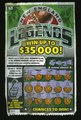
-

-
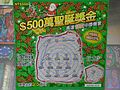
-
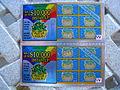
-

-
 Front side of a National Lottery scratchcard (United Kingdom)
 -
 Reverse side of a National Lottery scratchcard (United Kingdom)


See also
[edit]References
[edit]- ^ Haugley, John (25 October 2018). "Manufacturer seeks to make a mint off making scratch off lottery cards". Business Observer Florida. Retrieved 12 March 2024.
- ^ "Scratching the Surface_ White Paper_Recharge Card Security n_page_dec…". 25 April 2017.
- ^ Stack, Shaun (1 November 2023). "The Best Scratch off Apps for Real Money". Gambling Sites. Retrieved 12 March 2024.
- ^ "John Koza Interview – Scratchcards.org". Retrieved 10 January 2016.
- ^ "United States Patent: 4643454". patft.uspto.gov. Archived from the original on 2017-07-29. Retrieved 2026-02-23.
- ^ Washington's Lottery. Financial Report 2016.
- ^ Tennessee Lottery. Play It Again Program – FAQ. Archived 2007-09-28 at the Wayback Machine
- ^ www.play-scratchcards.co.uk describing different Internet scratchcards. Encourages play, but not associated with any one provider.
- ^ "Scratchcard prizes may be misleading, OFT warns". The Guardian. 28 July 2004. Retrieved 10 January 2016.
- ^ "Jackpots on some National Lottery scratchcards impossible to win". 16 February 2018. Retrieved 16 February 2018.
- ^ "Man Wins £1,000,000 On The Last 20X Cash Scratchcard". Retrieved 8 September 2018.
Footnotes
[edit]- ^ Also called a scratch off, scratch ticket, scratcher, scratchum, scratch-it, scratch game, scratch-and-win, instant game, instant lottery, scratchie, lot scrots, or scritchies

| Venues | |||||||||||||
|---|---|---|---|---|---|---|---|---|---|---|---|---|---|
| Science |
| ||||||||||||
| By region |
| ||||||||||||
| Games | |||||||||||||
| Issues | |||||||||||||


Scratchcard
View on GrokipediaHistory
Origins and Invention
The modern scratchcard, also known as a scratch-off lottery ticket, was invented in the early 1970s by American computer scientist John Koza and retail promotions specialist Daniel Bower. Koza, who held a Ph.D. in computer science from the University of Michigan, had previously developed computerized systems for secure ticket printing while working at companies like J&H International. Bower contributed expertise in marketing and promotions. Together, they founded Scientific Games Corporation in 1973 to produce instant-win tickets featuring a latex-based opaque coating that players could remove to reveal hidden symbols or numbers, enabling immediate result verification without relying on scheduled draws.[7][8] Their innovation addressed limitations in traditional lotteries, which depended on manual draws and delayed payouts, by using early computer algorithms to pre-generate and distribute winning tickets in precise ratios—ensuring, for example, that a fixed percentage of tickets in a print run were winners. This randomization was secured against counterfeiting through encoded validation features, such as microprinted serial numbers verifiable by lottery terminals. Scientific Games patented aspects of this system, emphasizing tamper-evident materials and probabilistic distribution to maintain game integrity.[9][1] The first commercial deployment occurred on May 29, 1974, when the Massachusetts State Lottery Commission introduced "The Instant Game," a $1 ticket printed by Scientific Games. This marked the world's inaugural instant scratch-off lottery product, sold starting at 6 a.m. and rapidly boosting sales in a market previously dominated by slower draw games. Massachusetts selected the format after Koza and Bower pitched it as a competitive alternative to illegal betting operations, with initial print runs designed for high-volume distribution through retailers.[4][10][11]Global Adoption and Popularity
Scratchcards achieved rapid global adoption following their introduction in the United States, where the Massachusetts State Lottery launched the first commercially successful instant-win tickets on January 13, 1974, generating long lines and immediate popularity due to their simplicity and instant gratification.[12] By the late 1970s and early 1980s, lottery organizations worldwide began incorporating scratchcards to boost revenue, capitalizing on the format's appeal over traditional draw-based games.[13] The format spread to Europe in 1985, with the United Kingdom introducing printed scratchcard games through its nascent national lottery system, marking the beginning of widespread European uptake.[14] In Europe, scratchcards have become a staple of national lotteries, with significant popularity in countries like Portugal, where "raspadinhas" (scratch-and-win tickets) are ubiquitous and sold at kiosks, tobacconists, and supermarkets, contributing to high participation rates but also associated gambling problems affecting nearly 100,000 individuals as of 2024.[15] France and Spain report strong cultural embedding of scratchcards alongside national lotteries and EuroMillions, with sales reflecting broad appeal across demographics.[16] The European instant games market generated approximately €20.6 billion in 2022, underscoring their economic significance within the broader lottery sector.[16] Beyond Europe, adoption has expanded to Asia, particularly China, where scratchcards have surged in popularity among young adults amid economic pressures and a challenging job market, leading to reported shortages and headlines in 2024 as sales of instant lotteries like those from the China Sports Lottery spiked.[17] In Brazil and other Latin American markets, scratchcards feature prominently in regulated lottery offerings, while Australia and New Zealand integrate them into established gaming cultures.[18] Globally, the instant scratchcard games market continues to grow at an estimated annual rate of 6.8% through 2032, driven by their accessibility and the allure of immediate results, though they remain a subset of the larger lottery industry valued at over USD 350 billion in 2024.[19][20]Evolution to Digital Formats
The advent of digital scratchcards occurred in the early 2000s, driven by the proliferation of broadband internet and the maturation of online gambling infrastructure, which enabled the simulation of instant-win mechanics without physical media.[21] These virtual formats first appeared around 2000 on casino websites, replicating the reveal process through mouse drags or clicks to "scratch" opaque digital layers, thereby preserving the tactile anticipation of traditional cards while eliminating printing and distribution costs.[22][21] Digital iterations introduced enhancements absent in paper versions, such as animated reveals, audio feedback, and integrated bonus rounds triggered by winning combinations, which increased player retention and allowed for dynamic prize structures like progressive jackpots.[21] Outcomes are determined by certified random number generators (RNGs) compliant with standards from bodies like eCOGRA or iTech Labs, ensuring probabilistic integrity equivalent to physical draws while permitting real-time auditing and scalability for high-volume play.[23] Adoption accelerated in the mid-2000s as jurisdictions legalized online lotteries, with platforms like those from Microgaming and Playtech pioneering browser-based games that expanded accessibility beyond retail outlets.[24] By the 2010s, mobile optimization via HTML5 and app-based delivery—such as iOS and Android lottery apps—further democratized access, enabling geofenced play in regulated markets like the UK and select U.S. states, where annual digital instant sales reached billions by 2020.[21][25] This shift reduced environmental impact from discarded cards and facilitated data-driven personalization, though it raised concerns over problem gambling due to 24/7 availability, prompting regulatory caps on stakes and session times in regions like the European Union.[26]Technology and Manufacturing
Materials and Design
Scratchcards typically consist of a multi-layered structure beginning with a base substrate of coated cardstock, such as 350 gsm silk paper, which provides durability and printability.[27] This paper is chosen for its smoothness and ability to accept high-quality printing, with variations available based on specific requirements like thickness or finish.[27] The key concealing element is an opaque scratch-off coating applied over designated areas, formulated from latex-based inks blended with pigments such as carbon black or aluminum paste, acrylic resins, and solvents to achieve removability by friction while maintaining opacity.[28] [29] These coatings, often in silver, gold, or black variants, use water-based acrylic dispersions for environmental compliance and ease of application, ensuring the layer adheres firmly yet peels away cleanly without damaging underlying prints when scratched with a coin or fingernail.[30] [27] The latex component provides the rub-removable property, with additives controlling scratch resistance and residue minimization.[31] Design integrates variable data printing on the base layer to encode prizes, symbols, or codes beneath the opaque panel, enabling randomization and security against pre-reveal tampering.[27] Panels are precisely screen-printed with a transparent varnish base followed by the latex ink, allowing overprinting of graphics or instructions directly on the coating for aesthetic integration without compromising concealability.[27] Features like defined scratch zones, color-coded layers, and foil alternatives for enhanced security ensure functionality, with the overall layout balancing visual appeal, user interaction, and fraud prevention through tamper-evident properties.[28]Production Processes
The production of scratchcards, particularly for lottery applications, employs a multi-layered printing and coating process to embed variable game data, apply opaque coverings, and incorporate anti-tampering features. This typically occurs on high-speed presses capable of producing up to 1 million tickets per hour, utilizing paper stock as the substrate along with specialized inks, adhesives, and acrylic resins for the removable opaque layer.[32][28] The process begins with the design and base printing of the ticket's static elements, such as graphics, rules, and pricing, using either a continuous feed method with computer-controlled sequencers or a sheet-fed approach with engraved plates. Variable data, including winning symbols or numbers, is then generated algorithmically and printed randomly to ensure an even distribution of prizes across ticket packs, often via industrial inkjet printers that apply serial numbers simultaneously on both sides.[28][33] Subsequent steps involve applying multiple security coatings over the play area: a primer layer followed by a confusion pattern (to obscure symbols under casual inspection), the game data reprint if needed, a sealing coat, and finally the thick opaque scratch-off material—typically a latex or acrylic-based ink mixed with pigments like carbon black or aluminum paste—using automated cover applicators. Up to 21 print units per press handle these layers, including lower opaque black security coatings and white or tinted primers, with inline drying, curing, and inspection systems verifying adhesion and integrity to prevent issues like delamination or wicking.[32][28][33] After coating, tickets undergo slicing into rolls or perforation into sheets, followed by stacking, shuffling for randomization, and boxing for distribution; quality controls, such as camera inspections and data encryption under standards like ISO 27001, ensure prize predictability and fraud resistance throughout.[32][28]Security and Anti-Fraud Measures
Scratchcards are produced using high-security printing techniques in controlled facilities to minimize risks of insider fraud and ensure prize randomization, with winning tickets distributed non-sequentially across packs to prevent predictability.[34] High-value prizes are often "seeded" by assigning them to validation numbers originally tied to non-winning tickets, stored in separate secure files on isolated servers, which disconnects prize data from visible ticket patterns and voids altered tickets if scratch-off coatings are tampered with. Overt security features include holograms that exhibit color-shifting or dynamic images under varying light angles, making replication difficult without specialized equipment.[36] Covert elements incorporate special inks visible only under ultraviolet light or with metallic sheens, alongside microprinting and guilloche patterns that reveal irregularities under magnification if forged.[36] Substrates employ unique paper with embedded fibers, watermarks, or security threads sourced from limited suppliers to hinder duplication.[36] Machine-readable components, such as barcodes or QR codes printed alongside unique serial numbers, enable retailer scanners to verify authenticity against central databases, confirming prize validity without revealing outcomes prematurely.[37] [36] Advanced forensic measures, like randomized micro-perforations (e.g., Cryptoglyph technology), create unique, irreproducible patterns detectable via apps or scanners, integrating seamlessly with existing validation systems.[36] Tamper-evident packaging on ticket books or rolls prevents resealing after theft or substitution, with seals that indicate breach.[38] These multilayered approaches, combining physical, digital, and procedural safeguards, have proven effective in official lotteries, where products are engineered explicitly to resist counterfeiting and alteration.[37]Types and Applications
Lottery and Gambling Scratchcards
Lottery scratchcards, commonly known as scratch-off tickets, are instant-win games distributed by state or national lotteries, allowing players to reveal symbols or numbers by scratching a latex coating to determine prizes immediately. Invented in 1974 by computer scientists John Koza and Daniel Bower, these tickets employed a computerized randomization algorithm to assign winning tickets securely, resolving fraud vulnerabilities in prior manual prize distribution methods used by Massachusetts Lottery suppliers.[7] [1] The first such tickets debuted in the Massachusetts Lottery that year, marking the transition to automated, verifiable instant games that boosted sales through perceived fairness and excitement.[12] In the United States, scratch-off tickets constitute the majority of lottery sales volume, contributing substantially to the $113.3 billion in total lottery revenue recorded in fiscal year 2023.[39] States like Massachusetts derive significant per capita spending from these games, with adults averaging $1,037 annually on tickets, predominantly scratch-offs, which fund public programs such as education.[11] Prize structures vary by game, but top awards can reach $10 million or more, as seen in New York Lottery offerings, though overall odds of winning any prize typically range from 1 in 3 to 1 in 5, far superior to draw-based lotteries but still yielding negative expected value due to house edges of 50-70%.[40] [41][42] Beyond state lotteries, scratchcards appear in commercial gambling contexts, particularly online platforms licensed for casino-style operations, where digital variants use random number generators to mimic physical scratching and offer rapid, repeated play.[43] These differ from lottery products in being privately operated under gambling regulations rather than public monopoly frameworks, often featuring higher volatility and themes tied to slots or other games.[44] Research characterizes scratchcards as a potentially "hard" gambling form, akin to electronic gaming machines, due to their instant feedback loop encouraging compulsive behavior, with studies noting elevated problem gambling risks compared to slower-paced lotteries.[45] In jurisdictions like the UK, National Lottery scratchcards operate under strict oversight, but online gambling scratchcards face separate licensing to ensure fairness via independent audits.[3]Promotional and Quiz Variants
Promotional scratchcards differ from lottery variants by offering non-monetary incentives such as discounts, free products, or entry into contests, primarily to drive consumer engagement and brand loyalty rather than generate gambling revenue.[46] These cards are distributed via product packaging, direct mail, or in-store promotions to create immediate excitement and encourage repeat purchases.[47] For instance, businesses use them for product launches or seasonal events, where scratching reveals offers like percentage discounts or complementary upgrades, with prize rates controlled to ensure profitability.[48] In loyalty programs, they foster customer retention by tying reveals to accumulated points or purchases, as seen in retail campaigns where cards accompany receipts.[49] Quiz variants employ scratchcards to conceal multiple-choice answers or trivia outcomes, facilitating interactive learning or entertainment without financial stakes. These are applied in educational settings to test knowledge, with gamification elements proven to enhance cognitive retention through active revelation.[50] Examples include trivia cards for events or classrooms, where users scratch to match questions with facts, often customized for themes like history or science to promote engagement over chance.[49] Unlike promotional types, quiz cards prioritize verification of understanding, with designs allowing sequential scratching to build progressive difficulty, though they share manufacturing techniques for secure concealment.[51] Both variants avoid regulatory gambling oversight by limiting prizes to nominal or experiential rewards, enabling broader use in marketing and non-commercial contexts.[52]Non-Gambling Uses for Information Concealment
Scratch-off labels, utilizing a removable opaque coating, serve to conceal sensitive alphanumeric data such as personal identification numbers (PINs) and activation codes in various commercial and security applications, ensuring privacy until intentional revelation by the authorized user.[53] This method relies on a latex- or foil-based layer applied over printed information, which can be scratched away without damaging the underlying substrate, thereby minimizing risks of premature exposure or tampering.[54] A primary non-gambling use involves prepaid telecommunications services, where scratch-off coverings hide PINs on calling cards to prevent theft of airtime credits before purchase or activation; for instance, these cards typically feature a foil laminate that reveals a unique 10- to 20-digit code upon scratching. Similarly, gift cards from retailers employ scratch-off panels over magnetic stripe or barcode data to safeguard stored value against skimming or unauthorized redemption, with the coating designed to leave residue if forcibly removed, indicating tampering.[53][55] In software and digital services, activation code cards for products like antivirus programs or online subscriptions use scratch-off labels to protect serialized keys, which are often printed in variable data formats for individual validation; this application gained prominence in the 1990s with the rise of retail software distribution, reducing fraud rates by concealing codes until point-of-sale handover.[56] Security-enhanced variants integrate holographic overlays beneath or above the scratch layer, providing multi-tiered authentication for high-value items such as secure access tokens or verification numbers in financial instruments.[57][58] These labels also appear in tamper-evident packaging for confidential documents or medical prescriptions, where the concealed information—such as batch numbers or patient-specific codes—ensures chain-of-custody integrity; the coating's formulation, often incorporating metallic pigments, resists see-through scanning techniques like infrared imaging, enhancing concealment efficacy.[55] Manufacturers report that such applications prioritize adhesion strength and residue formation upon invalid removal to deter counterfeiting, with production scales reaching millions of units annually for global prepaid markets.[54][53]Gameplay Mechanics
Revealing and Winning Criteria
Players reveal hidden elements on a scratchcard by gently scratching the opaque latex or foil coating over designated play areas using a coin, fingernail, or similar tool, as instructed on the ticket.[59] This process uncovers symbols, numbers, or prize indicators without damaging the underlying substrate.[60] Specific panels, often marked, must be fully scratched to determine outcomes, while avoiding excessive force to prevent invalidation.[61] Winning criteria vary by game design but typically require matching predefined patterns or thresholds, detailed in rules printed on the ticket. Common formats include aligning three or more identical symbols in a row or grid; matching player-revealed symbols or numbers against designated winning ones; or exposing explicit prize amounts or bonus indicators like "WIN" or multipliers.[62] [59] For instance, in symbol-match games, prizes correspond to the matched set's value, potentially escalated by bonus features. Non-winning tickets reveal losing combinations, such as mismatches or nil prizes. To claim prizes, particularly those exceeding retailer thresholds (e.g., $600 in many U.S. states), players must reveal and present the ticket's validation panel or barcode, often under a separate scratch area, for scanning or manual entry into lottery systems.[63] This confirms authenticity and prize eligibility, preventing fraud; incomplete revelation may void claims.[62] Smaller wins are verified at point-of-sale via the same mechanism.[64]Odds, Predictability, and Prize Distribution
Scratchcard games feature predetermined outcomes established during manufacturing, with fixed odds of winning any prize typically ranging from 1 in 3 to 1 in 5 across various jurisdictions and ticket prices.[65][66] These overall odds are calculated by dividing the total number of prizes available by the total number of tickets printed for the game, and they are often printed on the ticket or disclosed in official rules.[67] For lower-price tickets (e.g., $1–$2), odds may hover around 1 in 4.5 to 5, while higher-denomination games can offer slightly better probabilities for smaller prizes but steeper odds for jackpots, such as 1 in 200,000 or worse for top prizes in print runs of millions of tickets.[41][67] Prize distribution follows a tiered structure where a predetermined number of winning tickets is allocated across prize levels, ensuring a fixed prize pool percentage—often 50–70% of total sales—payout in prizes.[68] Manufacturers print exact quantities for each tier (e.g., multiple low-value winners like $1 prizes alongside fewer high-value ones), with the total prizes divided evenly or randomly within ticket rolls to prevent clustering.[68] These winning tickets are then randomized into packs and distributed to retailers, maintaining uniform odds per ticket regardless of location.[69] Games may end when all top prizes are claimed, though low-tier prizes often persist until the print run depletes.[70] While designed for unpredictability through randomization and security features, scratchcard outcomes have occasionally proven predictable via statistical analysis of visible elements. In 2003, statistician Mohan Srivastava identified non-random patterns in Ontario's tic-tac-toe scratch tickets, using visible numbers on unscratched portions to predict winners with approximately 90% accuracy without revealing the full card, leading to the game's immediate withdrawal.[71] Such vulnerabilities arise from flawed validation number sequences or correlated symbols failing to adequately mask predetermined results, prompting lotteries to refine algorithms for better entropy and independence in future designs.[72] Nonetheless, modern games incorporate multiple layers of randomization, making exploitation rare without insider access or manufacturing defects.[69]Economic and Regulatory Aspects
Revenue Generation and State Funding
Scratchcards, primarily sold as instant-win games within state-run lotteries, generate revenue through direct ticket sales, with proceeds allocated after deducting prizes, retailer commissions, and operational costs. In the typical model, approximately 50-70% of gross sales returns as prizes, 5-8% as retailer commissions, and the remainder—often 20-30%—flows to state funds or designated public programs, providing a stable income stream less dependent on jackpot-driven draw games.[73][74] This structure positions scratchcards as a key revenue driver, contributing steadily to government budgets without the volatility of traditional lotteries. In the United States, instant scratch-off games account for a substantial share of lottery sales, often exceeding 60% in many states, fueling billions in net proceeds for public funding. For fiscal year 2024, total U.S. lottery sales reached $98 billion, with instant games forming the bulk alongside draw-based products, yielding net transfers to states estimated at around $25-30 billion annually across all games, directed primarily to education, infrastructure, and general funds.[75] In Maryland, scratch-off sales hit $1.061 billion in fiscal year 2024 out of $2.732 billion total lottery sales, supporting allocations to school construction, stadium debt repayment, and the state general fund.[76] Similarly, New York's lottery, where scratchers play a prominent role, contributed $3.6 billion to education aid in fiscal year 2024-2025, illustrating how such revenue supplements tax dollars for K-12 and higher education without fully replacing traditional funding mechanisms.[77] In the United Kingdom, the National Lottery's scratchcard sales contribute to a broader pool that has raised over £50 billion for good causes since 1994, including sports, arts, heritage, and charities, with allocations mandated at a minimum of 20% of proceeds though averaging higher.[78] Scratchcards, however, feature higher prize ratios—around 68% of sales—compared to 49% for draw games, resulting in a lower proportional yield to good causes per ticket sold, prompting operator strategies to balance sales growth with funding goals.[79] In quarter 4 of 2024-2025, scratchcard sales generated £22.7 million toward good causes, amid overall lottery sales supporting £479.2 million in that period for public and charitable initiatives.[80] Government revenue from lottery duty, applicable to scratchcards, has totaled £21.4 billion to date, underscoring dual benefits to state coffers and specified causes.[78]| Jurisdiction | Fiscal Year | Scratchcard/Instant Sales | Total Lottery Sales | Net to State/Good Causes (All Games) |
|---|---|---|---|---|
| U.S. (Aggregate) | 2024 | Major component of $98B total | $98 billion | ~$25-30B (est.)[75] |
| Maryland, USA | 2024 | $1.061 billion | $2.732 billion | $1.585B (incl. other gaming)[76] |
| New York, USA | 2024-25 | Significant share | N/A | $3.6B to education[77] |
| UK National Lottery | Q4 2024-25 | Contrib. £22.7M to causes | N/A | £479.2M to good causes[80] |
Regulatory Frameworks and Legal Status
Scratchcards, as instant-win lottery products, are subject to gambling and lottery-specific regulations that emphasize licensing, fairness, prize distribution integrity, and consumer protection, with frameworks designed to prevent fraud and underage access. In jurisdictions where permitted, operators must obtain licenses from designated authorities, undergo independent audits for random number generation and prize allocation, and adhere to predetermined odds and payout structures. For instance, certification bodies like Gaming Laboratories International provide compliance testing to ensure tickets meet security standards before distribution.[81] In the United States, scratchcards are exclusively managed by state-run lotteries, with each of the 45 participating states establishing its own regulatory body to oversee production, sales, and validation processes. Federal law under 18 U.S. Code § 1302 prohibits the mailing of lottery tickets or related materials across state lines or internationally, aiming to preserve state monopolies and curb unauthorized interstate gambling. Participation is restricted to individuals aged 18 or 21 depending on the state, and tickets must feature fixed prize pools with verifiable odds, as exemplified by Kansas regulations mandating uniform prize structures across ticket print runs of 300,000 units. Promotional scratch-offs for businesses are permissible only if structured as sweepstakes without purchase requirements, thereby avoiding classification as illegal lotteries under state anti-gambling statutes.[82][83][84] The United Kingdom regulates scratchcards through the Gambling Commission, established under the Gambling Act 2005, which licenses operators like the National Lottery for game procedures including ticket validation and dispute resolution. Sales are confined to those 18 and older, with strict prohibitions on advertising to minors and requirements for responsible gambling messaging on packaging. Unauthorized lotteries, including unlicensed scratchcard promotions, constitute offenses punishable by fines or imprisonment. Export or international distribution of UK-issued scratchcards is restricted to prevent evasion of domestic controls.[62][85][86] Across the European Union, legal status varies by member state, with scratchcards generally lawful under national gambling authorities but subject to harmonized directives on consumer protection and anti-money laundering. Recent initiatives by regulators in six countries—including enhanced monitoring for youth-oriented designs—reflect concerns over impulsive play and minor accessibility, prompting stricter marketing and design oversight as of June 2024. In contrast, scratchcards remain prohibited in nations with blanket gambling bans, such as many Islamic states, where lotteries are deemed incompatible with religious principles. Globally, international operators must navigate cross-border restrictions, as foreign participation in domestic lotteries is often invalidated to uphold sovereignty over gaming revenues.[87][88]Market Trends and Sales Data
In the United States, scratch-off tickets constituted 60 to 65 percent of total state lottery sales, which reached $113.3 billion in fiscal year 2023.[89][39] This implies scratch-off sales of approximately $68 billion to $74 billion for that period, underscoring their role as the dominant product category ahead of draw-based games.[89] Traditional lottery sales, excluding video lottery terminals, totaled $104.6 billion in 2024, with consolidated revenues hitting $115.6 billion amid ongoing post-pandemic recovery.[90] In the United Kingdom, National Lottery scratchcard and interactive instant win game sales amounted to £1.67 billion for the year ending March 2022, reflecting a 3.7 percent year-over-year decline driven by reduced retail impulse purchases.[91] Total National Lottery sales for 2023-2024 stood at approximately £8 billion, but instant products including physical scratchcards experienced lower volumes compared to the prior year, partly offset by digital alternatives.[92][93] Globally, the broader lottery market, encompassing scratchcards as a key instant-win segment, was valued at $353.29 billion in 2024, projected to grow to $483.93 billion by 2030 at a 5.3 percent compound annual growth rate (CAGR), fueled by expansion in emerging markets and technological integration.[20] The instant-win lottery games subcategory, including both physical and digital scratch formats, reached $5.31 billion in 2024 and is forecast to expand to $8.52 billion by 2032 at a 6.1 percent CAGR, though physical variants face headwinds from the rise of e-instant games.[94][95] Recent trends highlight a bifurcation: while overall lottery revenues grow via online and hybrid models, physical scratchcard sales in mature markets like the US and UK show stagnation or modest declines, with some jurisdictions reporting year-over-year drops of 3 to 5 percent in 2024 due to shifting consumer preferences toward app-based instants and broader economic pressures on discretionary spending.[95][96] This digital pivot, evident in 57 percent of UK draw-based sales occurring online by 2024, pressures traditional scratchcard volumes but sustains category relevance through innovation in prize structures and themes.[97]Controversies and Criticisms
Fraud Cases and Manipulation Allegations
In 2003, Canadian geologist Mohan Srivastava identified a predictable pattern in the visible serial numbers on unscratched tic-tac-toe scratch-off tickets from the Ontario Lottery and Gaming Corporation, enabling him to forecast winners with approximately 90% accuracy without revealing the latex coating.[71] He notified authorities rather than exploiting the flaw, prompting a redesign of the game to eliminate the vulnerability, which stemmed from flawed randomization in ticket printing algorithms rather than intentional rigging.[98] This incident underscored potential for manipulation through statistical analysis of pre-printed tickets, though no widespread fraud resulted. A prominent insider fraud scheme unfolded in Massachusetts, where Ali Jaafar and his sons, Mohamed and Yousef, operated a network of convenience stores from 2011 to 2021, illegally cashing over 13,000 winning scratch-off and other lottery tickets on behalf of prize recipients who paid them a 10% fee to evade state taxes.[99][100] The operation defrauded the state of more than $20 million in uncollected taxes, with the family convicted in 2022 on conspiracy, wire fraud, and tax evasion charges; Ali Jaafar received a 10-year sentence, while his sons got 3 and 4 years.[101] Prosecutors noted the scheme relied on complicit winners, often immigrants wary of tax scrutiny, and store control to validate claims without proper reporting.[102] Ticket theft by retailers has surfaced in multiple incidents, such as in July 2024, when a Tennessee gas station clerk was charged with stealing a customer's $1 million scratch-off ticket and attempting to claim the prize himself.[103] Similarly, in March 2024, a Florida couple, Dakota Jones and Kira Enders, faced felony fraud charges for altering a losing scratch-off ticket by taping pieces together and submitting it for a $1 million prize.[104] In the UK, two men were imprisoned in December 2021 for fraudulently purchasing a £4 million winning scratchcard using stolen debit card details from the National Lottery.[105] Allegations of broader manipulation, such as lottery operators intentionally clustering winners in specific ticket rolls to boost sales, have occasionally arisen but lack substantiated evidence of illegality, often conflating designed prize distribution with fraud; pre-printed scratch-offs inherently allow pack-level predictability to ensure payout quotas, though this has fueled claims of deceptive marketing in low-odds games.[71] Retailer schemes, including swapping winning tickets for losers, have been documented in consumer alerts, but convictions typically involve isolated theft rather than systemic operator collusion.[106]Social Impacts Including Addiction Claims
Scratchcards, as a form of instant-win gambling, have been linked to various social impacts, including patterns of consumption among lower-income groups and potential contributions to broader gambling participation. Empirical analyses show that lottery products like scratchcards are disproportionately purchased by individuals in disadvantaged neighborhoods, with one study finding that neighborhood disadvantage significantly predicts the frequency of lottery gambling days.[107] However, state-sponsored lotteries, including scratchcards, exhibit limited adverse effects on the personal, familial, or occupational situations of the average bettor, according to socioeconomic evaluations of legalized gambling.[108] Revenue from scratchcard sales often funds public goods such as education and social programs, potentially offsetting some negative externalities through indirect societal benefits, though this does not mitigate individual financial losses, which can represent substantial opportunity costs for low-income households engaging in high-frequency play.[109] Claims of addiction specifically tied to scratchcards have been prominent in public discourse, often portraying them as highly compulsive due to their rapid feedback and near-miss features, which can physiologically and psychologically encourage continued purchasing.[110] Laboratory and field studies demonstrate that near-miss outcomes in scratchcards increase subjective urges to gamble, potentially driving repeated buys in susceptible individuals by mimicking wins and fostering illusions of control.[111] Nonetheless, epidemiological data consistently indicate low prevalence of pathological gambling attributable to scratchcards alone. A Dutch population survey estimated that only 0.24% of adults met DSM-IV criteria for pathological scratchcard gambling, with just 0.09% addicted exclusively to this form.[112] [113] Comparative risk assessments rank scratchcards among the lowest-risk gambling activities for developing problem gambling, with structural characteristics like fixed odds and lack of skill elements reducing their harm potential relative to electronic gaming machines or sports betting.[114] [115] This pattern holds across jurisdictions, including Australia, Canada, and the UK, where scratchcard players show lower problem gambling rates than participants in continuous-play forms, though frequency of play can predict broader gambling issues over time.[116] In a sample of regular scratchcard buyers, potential problematic gambling reached 2.68%, but full pathological cases remained rare at under 0.3%.[112] Early exposure to scratchcards, such as through youth access to lottery products, correlates with elevated future problem gambling risk, underscoring the need for age restrictions.[117] Critics argue that addiction claims are sometimes amplified by anti-gambling advocacy, yet peer-reviewed evidence tempers this by highlighting scratchcards' lower association with severe harms compared to other lotteries or casino games.[118] Among lottery-loyalty program members, problem gambling prevalence was 14%, higher than general population estimates of 1-2%, but this reflects self-selected frequent players rather than causal attribution to scratchcards specifically.[119] Overall, while scratchcards contribute to gambling-related social costs like financial strain in vulnerable populations, substantiated addiction rates remain empirically modest, suggesting that policy responses should prioritize targeted interventions over blanket stigmatization.[120]Debates on Economic Equity and Manipulation
Critics of scratchcard lotteries argue that they function as a regressive tax, disproportionately burdening lower-income households who allocate a higher percentage of their earnings to purchases compared to wealthier individuals. Empirical analyses, such as a study of Texas lottery games including instant scratch-offs, demonstrate vertical inequity where participation rates and expenditures rise inversely with income levels, with low-income counties exhibiting higher per capita spending.[121] Similarly, national data indicate that households in the lowest income quintile spend up to 13% of their income on lotteries, versus less than 1% for the highest quintile, exacerbating wealth disparities rather than alleviating them.[122] This pattern persists despite lotteries' marketing as voluntary entertainment, as lower socioeconomic groups perceive them as viable escape routes from poverty, a view unsupported by the low odds of significant wins—typically 1 in millions for top prizes.[123] Proponents counter that scratchcard revenues fund public goods like education without mandating participation, citing $25 billion in U.S. state lottery income in 2019 that offset tax burdens.[124] However, causal examination reveals limited net equity benefits, as funds often flow to wealthier districts or administrative costs, with low-income areas subsidizing broader systems while facing amplified opportunity costs from forgone savings or essentials.[125] Peer-reviewed equity assessments consistently affirm the regressive incidence, particularly for instant games like scratchcards, where opaque prize distributions obscure the effective tax rate on participants.[126] On manipulation, research highlights deliberate design elements in scratchcards that exploit cognitive biases to sustain play. Near-miss outcomes—where two of three jackpot symbols appear—occur more frequently than chance would dictate, fostering an illusion of control and heightening the urge to continue gambling, as evidenced by controlled experiments showing increased frustration and persistence post-near-miss.[5][127] Instant gratification from rapid reveals and small-win reinforcements further amplifies this, with event frequencies far exceeding draw-based lotteries, potentially conditioning habitual expenditure among vulnerable players.[110] While operators maintain these features enhance engagement without deception, independent analyses question their neutrality, arguing they prioritize revenue over transparent risk disclosure, especially given the fixed low return-to-player ratios (often 60-70%) that guarantee house profits.[128] Debates intensify over regulatory oversight, with calls for redesigns to mitigate psychological hooks, though empirical welfare losses from over-engagement underscore the causal link between such mechanics and inequitable outcomes.[129]References
- https://patents.[google](/page/Google).com/patent/US8267766B2/en