



Community hub
Recent from talks
Knowledge base stats:
Talk channels stats:
Members stats:
Seabee
United States Naval Construction Battalions, better known as the Navy Seabees, form the U.S. Naval Construction Forces (NCF). The Seabee nickname is a heterograph of the initial letters "CB" from the words "Construction Battalion". Depending upon context, "Seabee" can refer to all enlisted personnel in the USN's occupational field 7 (OF-7), all personnel in the Naval Construction Force (NCF), or Construction Battalion. Seabees serve both in and outside the NCF. During World War II they were plank-holders of both the Naval Combat Demolition Units and the Underwater Demolition Teams (UDTs). The men in the NCF considered these units to be "Seabee". In addition, Seabees served as elements of Cubs, Lions, Acorns and the United States Marine Corps. They also provided the manpower for the top secret CWS Flame Tank Group. Today the Seabees have many special task assignments starting with Camp David and the Naval Support Unit at the Department of State. Seabees serve under both Commanders of the Naval Surface Forces Atlantic/Pacific fleets as well as on many base Public Works and USN diving commands.
Naval Construction Battalions were conceived of as replacements for civilian construction companies in combat zones after the attack on Pearl Harbor. At the time civilian contractors had roughly 70,000 men working U.S.N. contracts overseas. International law made it illegal for civilian workers to resist an attack. Doing so would classify them as guerrillas and could lead to summary execution. The formation of the Seabees amidst the aftermath of the Battle of Wake Island inspired the backstory for the World War II movie The Fighting Seabees. They also feature prominently in the wartime musical drama (and subsequent film) South Pacific.
Adm. Moreell's concept model CB was a USMC trained military equivalent of those civilian companies: able to work anywhere, under any conditions or circumstances. They have a storied legacy of creative field ingenuity, stretching from Normandy and Okinawa to Iraq and Afghanistan. Adm. Ernest King wrote to the Seabees on their second anniversary, "Your ingenuity and fortitude have become a legend in the naval service." They were unique at conception and remain unchanged from Adm. Moreell's model today. In the October 1944 issue of Flying, the Seabees are described as "a phenomenon of WWII".
CB Conceptual Formation
In the 1930s Bureau of Yards and Docks (BuDocks) began providing for "Navy Construction Battalions" (CB) in contingency war plans. In 1934, Capt. Carl Carlson's version of the CB was approved by Chief of Naval Operations In 1935, RADM. Norman Smith, head of BuDocks, selected Captain Walter Allen, War Plans Officer, to represent BuDocks on the War Plans Board. Capt. Allen presented the bureau's CB concept with the Board including it in the Rainbow war plans. The Seabees named their first training center for Capt. Allen. A criticism of the proposal was CBs would have a dual command; military control administrated by fleet line Officers while construction operations would be administrated by Civil Engineer Corps officers. Additional criticisms were no provisions for the military organization or military training necessary to provide unit structure, discipline, and esprit de corps. In December 1937, RADM. Ben Moreell became BuDocks Chief and the lead proponent of the CB proposal.
In 1941, the Navy and BuDocks decided to improve project oversight of civilian contractors by creating "Headquarters Construction Companies". These companies would have 2 officers and 99 enlisted, but would do no actual construction. On 31 October 1941, RADM. Chester Nimitz, Chief of the Bureau of Navigation, authorized the formation of the 1st Headquarters Construction Company. Recruiting began in November while boot training began 7 December 1941 at Naval Station Newport. By 16 December, four additional companies had been authorized, but Pearl Harbor changed everything.
The Seabee skillset became multi-faceted with all advanced military training being USMC instruction. That training led to CBs being tasked as USMC Pioneers (Shore party) in multiple landings. They added pontoon development, fabrication, and combat utilization. The military training added frontline combat with both the Marine Corps and the Army during WWII and the Marines and Army Special forces during Vietnam. It also led to combat as machine gunners on USN LCVP and PT boats during WWII. On the construction side of their toolbox the NCF CBs were formed with skilled tradesmen making the NCF competent in all types of vertical and horizontal civil construction as well as the associated engineering. The newly formed Naval Construction Force (NCF) toolbox quickly focused on airfield and harbor construction. The toolbox was expanded to include underwater construction, demolition, as well as the related combat applications used by the Seabees that comprised the NCDU's and UDTs. The toolbox was further expanded by the creation of Public works units to maintain the facilities they constructed. In addition mosquito/malaria control was added to their Public works skillset. The NCF added traditional fleet salvage, repair, and maintenance as needed. Combat engineering was added to the toolbox when CBs were transferred to the Marine Corps as elements of USMC engineering regiments. War demands added stevedoring to the toolbox both in USMC assault operations and at forward operating facilities. Weapons development and manufacture were added by the USA Chemical Warfare Service. Polar petroleum exploration and construction were specialties that were also added. Postwar the National Science Foundation would take advantage of those skillsets. Ingenuity and resourcefulness were tools they became famous for. Postwar assignments with the CIA and State Department added further to the toolbox in electronic fields related to national security.
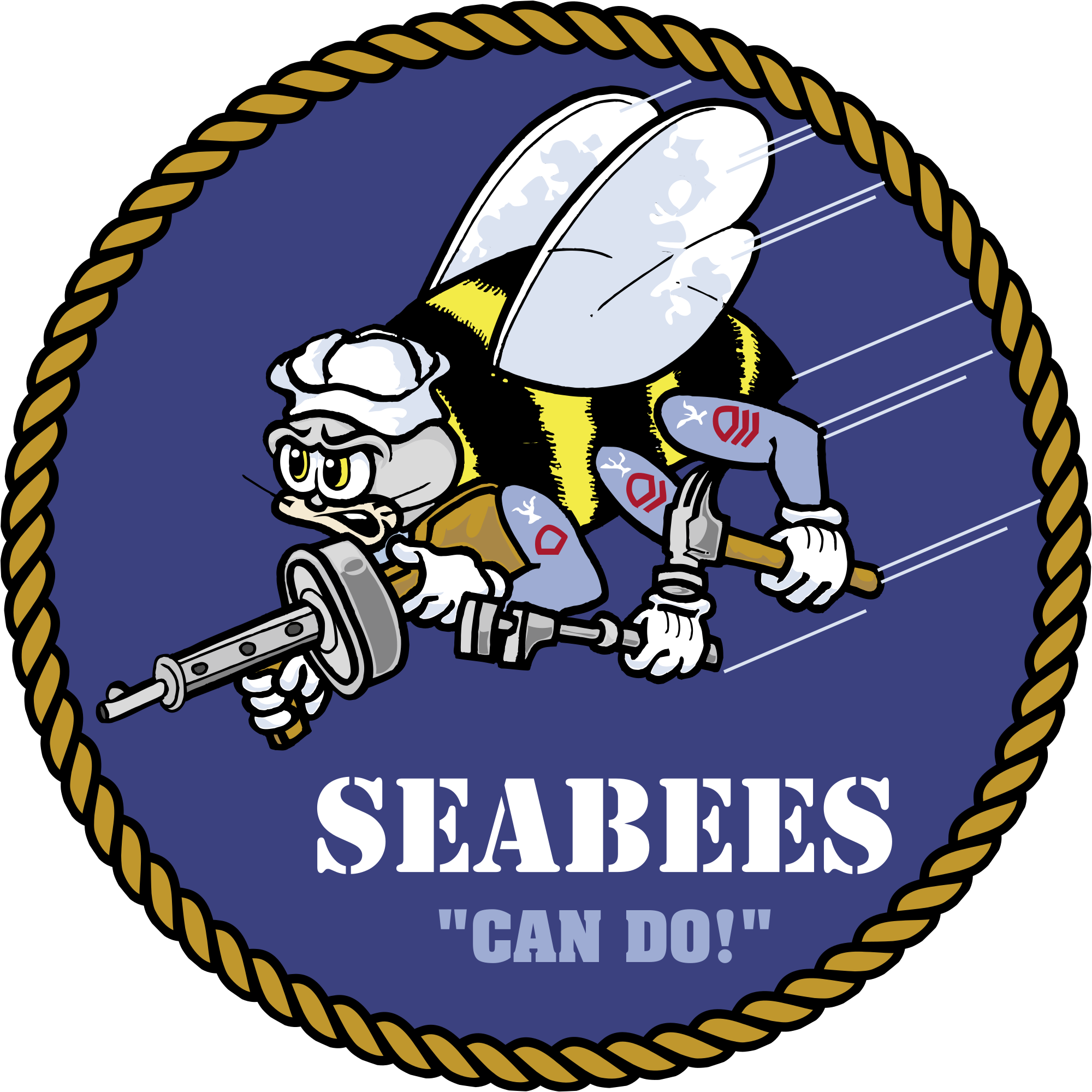
Their official motto is "We build, we fight." The NCF also adopted the motto "Can Do" as the force believed it could do anything it was tasked with. The Seabees boasted of this by posting signs reading: "The difficult we Can Do now, The impossible takes a little longer".
Hub AI
Seabee AI simulator
(@Seabee_simulator)
Seabee
United States Naval Construction Battalions, better known as the Navy Seabees, form the U.S. Naval Construction Forces (NCF). The Seabee nickname is a heterograph of the initial letters "CB" from the words "Construction Battalion". Depending upon context, "Seabee" can refer to all enlisted personnel in the USN's occupational field 7 (OF-7), all personnel in the Naval Construction Force (NCF), or Construction Battalion. Seabees serve both in and outside the NCF. During World War II they were plank-holders of both the Naval Combat Demolition Units and the Underwater Demolition Teams (UDTs). The men in the NCF considered these units to be "Seabee". In addition, Seabees served as elements of Cubs, Lions, Acorns and the United States Marine Corps. They also provided the manpower for the top secret CWS Flame Tank Group. Today the Seabees have many special task assignments starting with Camp David and the Naval Support Unit at the Department of State. Seabees serve under both Commanders of the Naval Surface Forces Atlantic/Pacific fleets as well as on many base Public Works and USN diving commands.
Naval Construction Battalions were conceived of as replacements for civilian construction companies in combat zones after the attack on Pearl Harbor. At the time civilian contractors had roughly 70,000 men working U.S.N. contracts overseas. International law made it illegal for civilian workers to resist an attack. Doing so would classify them as guerrillas and could lead to summary execution. The formation of the Seabees amidst the aftermath of the Battle of Wake Island inspired the backstory for the World War II movie The Fighting Seabees. They also feature prominently in the wartime musical drama (and subsequent film) South Pacific.
Adm. Moreell's concept model CB was a USMC trained military equivalent of those civilian companies: able to work anywhere, under any conditions or circumstances. They have a storied legacy of creative field ingenuity, stretching from Normandy and Okinawa to Iraq and Afghanistan. Adm. Ernest King wrote to the Seabees on their second anniversary, "Your ingenuity and fortitude have become a legend in the naval service." They were unique at conception and remain unchanged from Adm. Moreell's model today. In the October 1944 issue of Flying, the Seabees are described as "a phenomenon of WWII".
CB Conceptual Formation
In the 1930s Bureau of Yards and Docks (BuDocks) began providing for "Navy Construction Battalions" (CB) in contingency war plans. In 1934, Capt. Carl Carlson's version of the CB was approved by Chief of Naval Operations In 1935, RADM. Norman Smith, head of BuDocks, selected Captain Walter Allen, War Plans Officer, to represent BuDocks on the War Plans Board. Capt. Allen presented the bureau's CB concept with the Board including it in the Rainbow war plans. The Seabees named their first training center for Capt. Allen. A criticism of the proposal was CBs would have a dual command; military control administrated by fleet line Officers while construction operations would be administrated by Civil Engineer Corps officers. Additional criticisms were no provisions for the military organization or military training necessary to provide unit structure, discipline, and esprit de corps. In December 1937, RADM. Ben Moreell became BuDocks Chief and the lead proponent of the CB proposal.
In 1941, the Navy and BuDocks decided to improve project oversight of civilian contractors by creating "Headquarters Construction Companies". These companies would have 2 officers and 99 enlisted, but would do no actual construction. On 31 October 1941, RADM. Chester Nimitz, Chief of the Bureau of Navigation, authorized the formation of the 1st Headquarters Construction Company. Recruiting began in November while boot training began 7 December 1941 at Naval Station Newport. By 16 December, four additional companies had been authorized, but Pearl Harbor changed everything.
The Seabee skillset became multi-faceted with all advanced military training being USMC instruction. That training led to CBs being tasked as USMC Pioneers (Shore party) in multiple landings. They added pontoon development, fabrication, and combat utilization. The military training added frontline combat with both the Marine Corps and the Army during WWII and the Marines and Army Special forces during Vietnam. It also led to combat as machine gunners on USN LCVP and PT boats during WWII. On the construction side of their toolbox the NCF CBs were formed with skilled tradesmen making the NCF competent in all types of vertical and horizontal civil construction as well as the associated engineering. The newly formed Naval Construction Force (NCF) toolbox quickly focused on airfield and harbor construction. The toolbox was expanded to include underwater construction, demolition, as well as the related combat applications used by the Seabees that comprised the NCDU's and UDTs. The toolbox was further expanded by the creation of Public works units to maintain the facilities they constructed. In addition mosquito/malaria control was added to their Public works skillset. The NCF added traditional fleet salvage, repair, and maintenance as needed. Combat engineering was added to the toolbox when CBs were transferred to the Marine Corps as elements of USMC engineering regiments. War demands added stevedoring to the toolbox both in USMC assault operations and at forward operating facilities. Weapons development and manufacture were added by the USA Chemical Warfare Service. Polar petroleum exploration and construction were specialties that were also added. Postwar the National Science Foundation would take advantage of those skillsets. Ingenuity and resourcefulness were tools they became famous for. Postwar assignments with the CIA and State Department added further to the toolbox in electronic fields related to national security.
Their official motto is "We build, we fight." The NCF also adopted the motto "Can Do" as the force believed it could do anything it was tasked with. The Seabees boasted of this by posting signs reading: "The difficult we Can Do now, The impossible takes a little longer".