Hubbry Logo
Derivative testDerivative testMain
Open search
Derivative test
Community hub
Derivative test
logo
7 pages, 0 posts
0 subscribers
Be the first to start a discussion here.
Derivative test
Derivative test
from Wikipedia

In calculus, a derivative test uses the derivatives of a function to locate the critical points of a function and determine whether each point is a local maximum, a local minimum, or a saddle point. Derivative tests can also give information about the concavity of a function.

The usefulness of derivatives to find extrema is proved mathematically by Fermat's theorem of stationary points.

First-derivative test

[edit]

The first-derivative test examines a function's monotonic properties (where the function is increasing or decreasing), focusing on a particular point in its domain. If the function "switches" from increasing to decreasing at the point, then the function will achieve a highest value at that point. Similarly, if the function "switches" from decreasing to increasing at the point, then it will achieve a least value at that point. If the function fails to "switch" and remains increasing or remains decreasing, then no highest or least value is achieved.

One can examine a function's monotonicity without calculus. However, calculus is usually helpful because there are sufficient conditions that guarantee the monotonicity properties above, and these conditions apply to the vast majority of functions one would encounter.

Precise statement of monotonicity properties

[edit]

Stated precisely, suppose that f is a real-valued function defined on some open interval containing the point x and suppose further that f is continuous at x.

  • If there exists a positive number r > 0 such that f is weakly increasing on (xr, x] and weakly decreasing on [x, x + r), then f has a local maximum at x.
  • If there exists a positive number r > 0 such that f is strictly increasing on (xr, x] and strictly increasing on [x, x + r), then f is strictly increasing on (xr, x + r) and does not have a local maximum or minimum at x.

Note that in the first case, f is not required to be strictly increasing or strictly decreasing to the left or right of x, while in the last case, f is required to be strictly increasing or strictly decreasing. The reason is that in the definition of local maximum and minimum, the inequality is not required to be strict: e.g. every value of a constant function is considered both a local maximum and a local minimum.

Precise statement of first-derivative test

[edit]

The first-derivative test depends on the "increasing–decreasing test", which is itself ultimately a consequence of the mean value theorem. It is a direct consequence of the way the derivative is defined and its connection to decrease and increase of a function locally, combined with the previous section.

Suppose f is a real-valued function of a real variable defined on some interval containing the critical point a. Further suppose that f is continuous at a and differentiable on some open interval containing a, except possibly at a itself.

  • If there exists a positive number r > 0 such that for every x in (ar, a) we have f(x) ≥ 0, and for every x in (a, a + r) we have f(x) ≤ 0, then f has a local maximum at a.
  • If there exists a positive number r > 0 such that for every x in (ar, a) we have f(x) ≤ 0, and for every x in (a, a + r) we have f(x) ≥ 0, then f has a local minimum at a.
  • If there exists a positive number r > 0 such that for every x in (ar, a) ∪ (a, a + r) we have f(x) > 0, then f is strictly increasing at a and has neither a local maximum nor a local minimum there.
  • If none of the above conditions hold, then the test fails. (Such a condition is not vacuous; there are functions that satisfy none of the first three conditions, e.g. f(x) = x2 sin(1/x)).

Again, corresponding to the comments in the section on monotonicity properties, note that in the first two cases, the inequality is not required to be strict, while in the third, strict inequality is required.

Applications

[edit]

The first-derivative test is helpful in solving optimization problems in physics, economics, and engineering. In conjunction with the extreme value theorem, it can be used to find the absolute maximum and minimum of a real-valued function defined on a closed and bounded interval. In conjunction with other information such as concavity, inflection points, and asymptotes, it can be used to sketch the graph of a function.

Second-derivative test (single variable)

[edit]

After establishing the critical points of a function, the second-derivative test uses the value of the second derivative at those points to determine whether such points are a local maximum or a local minimum.[1] If the function f is twice-differentiable at a critical point x (i.e. a point where f(x) = 0), then:

  • If , then has a local maximum at .
  • If , then has a local minimum at .
  • If , the test is inconclusive.

In the last case, Taylor's theorem may sometimes be used to determine the behavior of f near x using higher derivatives.

Proof of the second-derivative test

[edit]

Suppose we have (the proof for is analogous). By assumption, . Then

Thus, for h sufficiently small we get
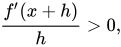
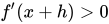
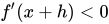
which means that if (intuitively, f is decreasing as it approaches from the left), and that if (intuitively, f is increasing as we go right from x). Now, by the first-derivative test, has a local minimum at .
Concavity test

[edit]

A related but distinct use of second derivatives is to determine whether a function is concave up or concave down at a point. It does not, however, provide information about inflection points. Specifically, a twice-differentiable function f is concave up if and concave down if . Note that if , then has zero second derivative, yet is not an inflection point, so the second derivative alone does not give enough information to determine whether a given point is an inflection point.

Higher-order derivative test

[edit]

The higher-order derivative test or general derivative test is able to determine whether a function's critical points are maxima, minima, or points of inflection for a wider variety of functions than the second-order derivative test. As shown below, the second-derivative test is mathematically identical to the special case of n = 1 in the higher-order derivative test.

Let f be a real-valued, sufficiently differentiable function on an interval , let , and let be a natural number. Also let all the derivatives of f at c be zero up to and including the n-th derivative, but with the (n + 1)th derivative being non-zero:

There are four possibilities, the first two cases where c is an extremum, the second two where c is a (local) saddle point:

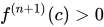
  • If (n+1) is even and , then c is a local maximum.
  • If (n+1) is even and , then c is a local minimum.
  • If (n+1) is odd and , then c is a strictly decreasing point of inflection.
  • If (n+1) is odd and , then c is a strictly increasing point of inflection.
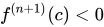
Since (n+1) must be either odd or even, this analytical test classifies any stationary point of f, so long as a nonzero derivative shows up eventually, where is the first non-zero derivative.

Example

[edit]

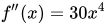
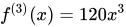
Say we want to perform the general derivative test on the function at the point . To do this, we calculate the derivatives of the function and then evaluate them at the point of interest until the result is nonzero.
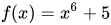
,
,
,
,
,
,

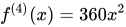
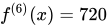
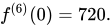
As shown above, at the point , the function has all of its derivatives at 0 equal to 0, except for the 6th derivative, which is positive. Thus n = 5, and by the test, there is a local minimum at 0.

Multivariable case

[edit]

For a function of more than one variable, the second-derivative test generalizes to a test based on the eigenvalues of the function's Hessian matrix at the critical point. In particular, assuming that all second-order partial derivatives of f are continuous on a neighbourhood of a critical point x, then if the eigenvalues of the Hessian at x are all positive, then x is a local minimum. If the eigenvalues are all negative, then x is a local maximum, and if some are positive and some negative, then the point is a saddle point. If the Hessian matrix is singular, then the second-derivative test is inconclusive.

See also

[edit]

Further reading

[edit]

References

[edit]
[edit]
Revisions and contributorsEdit on WikipediaRead on Wikipedia
from Grokipedia
In , derivative tests are analytical methods employed to classify critical points of a , determining whether they represent local maxima, local minima, or points of by examining the behavior of the function's first, second, or higher-order . These tests are fundamental tools in optimization and , relying on the signs and changes in to infer the function's monotonicity and concavity without evaluating the function extensively. The first derivative test focuses on the sign of the first derivative f(x)f'(x) around a critical point cc, where f(c)=0f'(c) = 0 or f(c)f'(c) is undefined. If f(x)>0f'(x) > 0 for x<cx < c (near cc) and f(x)<0f'(x) < 0 for x>cx > c (near cc), then ff has a local maximum at cc; conversely, if f(x)<0f'(x) < 0 for x<cx < c and f(x)>0f'(x) > 0 for x>cx > c, then ff has a local minimum at cc. If the sign does not change, the test is inconclusive for extrema. This test is always applicable where the first derivative exists and is particularly useful for functions where higher derivatives may be difficult to compute. The second derivative test provides a quicker alternative by evaluating the second derivative f(c)f''(c) at the critical point cc. If f(c)>0f''(c) > 0, then ff has a local minimum at cc; if f(c)<0f''(c) < 0, then ff has a local maximum at cc; and if f(c)=0f''(c) = 0, the test is inconclusive, requiring further analysis. Beyond extrema, the second derivative also determines concavity: f(x)>0f''(x) > 0 indicates the function is concave up (like a cup), while f(x)<0f''(x) < 0 indicates concave down, helping identify inflection points where concavity changes. For cases where the second derivative test fails (i.e., f(c)=0f''(c) = 0), higher-order derivative tests extend the approach using . Suppose the first nn derivatives of ff at cc are zero, with the (n+1)(n+1)-th derivative f(n+1)(c)0f^{(n+1)}(c) \neq 0. If n+1n+1 is even and f(n+1)(c)>0f^{(n+1)}(c) > 0, then cc is a local minimum; if even and f(n+1)(c)<0f^{(n+1)}(c) < 0, a local maximum. If n+1n+1 is odd, cc is typically a point of inflection rather than an extremum. These tests assume sufficient differentiability and are grounded in the function's Taylor expansion around the critical point.

Single-Variable First-Derivative Test

Monotonicity Properties

A function ff defined on an interval II is said to be increasing on II if for all x1,x2Ix_1, x_2 \in I with x1<x2x_1 < x_2, it holds that f(x1)f(x2)f(x_1) \leq f(x_2). Similarly, ff is decreasing on II if f(x1)f(x2)f(x_1) \geq f(x_2) whenever x1<x2x_1 < x_2. The function is strictly increasing on II if the inequality is strict, i.e., f(x1)<f(x2)f(x_1) < f(x_2) for x1<x2x_1 < x_2, and strictly decreasing if f(x1)>f(x2)f(x_1) > f(x_2). These definitions capture the intuitive notion that the function values grow or shrink consistently as the input advances across the interval, without requiring epsilon-delta criteria beyond the direct order preservation. A fundamental result connecting to these properties is the following : Suppose ff is continuous on a closed interval [a,b][a, b] and differentiable on the open interval (a,b)(a, b). If f(x)>0f'(x) > 0 for all x(a,b)x \in (a, b), then ff is strictly increasing on [a,b][a, b]; if f(x)<0f'(x) < 0 for all x(a,b)x \in (a, b), then ff is strictly decreasing on [a,b][a, b]. This extends to open intervals where ff is differentiable, and the conclusion holds even if f(x)=0f'(x) = 0 at a finite number of isolated points, provided the derivative does not change sign across the interval. The proof relies on the Mean Value Theorem (MVT), which states that if ff is continuous on [x1,x2][x_1, x_2] and differentiable on (x1,x2)(x_1, x_2) with x1<x2x_1 < x_2, then there exists c(x1,x2)c \in (x_1, x_2) such that f(c)=f(x2)f(x1)x2x1.f'(c) = \frac{f(x_2) - f(x_1)}{x_2 - x_1}. Assume f(x)>0f'(x) > 0 on (a,b)(a, b). For any x1,x2[a,b]x_1, x_2 \in [a, b] with x1<x2x_1 < x_2, MVT yields c(x1,x2)c \in (x_1, x_2) where f(c)>0f'(c) > 0, so f(x2)f(x1)x2x1>0\frac{f(x_2) - f(x_1)}{x_2 - x_1} > 0. Since x2x1>0x_2 - x_1 > 0, it follows that f(x2)>f(x1)f(x_2) > f(x_1), establishing strict increase. The case for f(x)<0f'(x) < 0 is analogous, yielding strict decrease. Points where f(x)=0f'(x) = 0 or ff' is undefined do not disrupt overall monotonicity if the sign of ff' remains consistent in the surrounding subintervals. For instance, isolated zeros of ff' allow the MVT application across them without sign reversal, preserving the inequality direction; similarly, points of non-differentiability (e.g., cusps where the tangent exists but is vertical) maintain monotonicity provided the left- and right-hand behaviors align with the derivative's sign elsewhere. This ensures the function's global interval behavior is determined by the predominant sign of the first derivative.

Statement for Local Extrema

A critical point of a function ff is a point cc in the domain of ff where either f(c)=0f'(c) = 0 or f(c)f'(c) does not exist. These points are the only candidates for local extrema, as established by Fermat's theorem, which states that if ff has a local extremum at cc and ff' exists there, then f(c)=0f'(c) = 0. The first derivative test provides conditions for identifying local maxima and minima at such critical points. Suppose ff is continuous at a critical point cc and differentiable in some open interval around cc except possibly at cc itself. If f(x)>0f'(x) > 0 for all xx in (cδ,c)(c - \delta, c) and f(x)<0f'(x) < 0 for all xx in (c,c+δ)(c, c + \delta) for some δ>0\delta > 0, then ff has a local maximum at cc. Conversely, if f(x)<0f'(x) < 0 for all xx in (cδ,c)(c - \delta, c) and f(x)>0f'(x) > 0 for all xx in (c,c+δ)(c, c + \delta), then ff has a local minimum at cc. If f(x)f'(x) does not change sign at cc (i.e., it remains positive or negative on both sides), then f(c)f(c) is neither a local maximum nor a local minimum. To apply the test, a sign chart is constructed by evaluating the sign of f(x)f'(x) in intervals determined by the critical points. This involves factoring f(x)f'(x) or using test values in each interval adjacent to cc, often summarized in a table:
IntervalTest ValueSign of f(x)f'(x)Behavior of ff
(cδ,c)(c - \delta, c)x1<cx_1 < cPositiveIncreasing
(c,c+δ)(c, c + \delta)x2>cx_2 > cNegativeDecreasing
Such a chart reveals sign changes, confirming a local maximum in this case. When f(c)f'(c) does not exist, the test still applies by examining the sign of f(x)f'(x) in intervals around cc, provided ff is continuous at cc. Points where f(c)f'(c) is undefined often correspond to cusps (sharp points where the tangent is vertical) or corners (discontinuities in ff'). To assess these, the limits of the difference quotient limh0f(c+h)f(c)h\lim_{h \to 0} \frac{f(c + h) - f(c)}{h} are evaluated from the left and right; if they have opposite signs or one is infinite with appropriate direction, a sign change in the slope behavior indicates an extremum. For example, at a cusp like f(x)=x2/3f(x) = |x|^{2/3} at x=0x = 0, the function has a local minimum despite f(0)f'(0) undefined, as the slopes approach negative infinity from the left and positive infinity from the right, indicating a sign change from negative to positive and confirming a local minimum. The proof of the first derivative test relies on the definition of local extrema and the relationship between the sign of the and monotonicity. For the local maximum case, assume f(x)>0f'(x) > 0 on (cδ,c)(c - \delta, c) and f(x)<0f'(x) < 0 on (c,c+δ)(c, c + \delta). By the increasing function theorem, ff is increasing on (cδ,c)(c - \delta, c), so f(x)<f(c)f(x) < f(c) for x(cδ,c)x \in (c - \delta, c). Similarly, ff is decreasing on (c,c+δ)(c, c + \delta), so f(x)<f(c)f(x) < f(c) for x(c,c+δ)x \in (c, c + \delta). Thus, there exists a neighborhood around cc where f(x)f(c)f(x) \leq f(c), confirming a local maximum. The local minimum case follows analogously by reversing the inequalities. This uses one-sided limits implicitly through the monotonicity on each side.

Applications and Examples

To illustrate the first-derivative test, consider the function f(x)=x33xf(x) = x^3 - 3x. The derivative is f(x)=3x23=3(x21)f'(x) = 3x^2 - 3 = 3(x^2 - 1), which equals zero at the critical points x=1x = -1 and x=1x = 1. A sign chart for f(x)f'(x) reveals that f(x)>0f'(x) > 0 for x<1x < -1 and x>1x > 1, while f(x)<0f'(x) < 0 for 1<x<1-1 < x < 1. Thus, f(x)f(x) changes from increasing to decreasing at x=1x = -1, indicating a local maximum there, and from decreasing to increasing at x=1x = 1, indicating a local minimum. Another example is f(x)=sinxf(x) = \sin x on the interval [0,2π][0, 2\pi]. The derivative f(x)=cosxf'(x) = \cos x equals zero at the critical points x=π/2x = \pi/2 and x=3π/2x = 3\pi/2. The sign of f(x)f'(x) is positive on (0,π/2)(0, \pi/2) and (3π/2,2π)(3\pi/2, 2\pi), and negative on (π/2,3π/2)(\pi/2, 3\pi/2). Therefore, f(x)f(x) transitions from increasing to decreasing at x=π/2x = \pi/2, confirming a local (and global) maximum of 1, and from decreasing to increasing at x=3π/2x = 3\pi/2, confirming a local (and global) minimum of -1. In optimization, the first-derivative test identifies maximum area for a rectangle with fixed perimeter PP. Let the sides be xx and yy, so P=2x+2yP = 2x + 2y implies y=P/2xy = P/2 - x, and the area is A(x)=x(P/2x)A(x) = x(P/2 - x). Then A(x)=P/22x=0A'(x) = P/2 - 2x = 0 gives x=P/4x = P/4, a critical point. Since A(x)>0A'(x) > 0 for x<P/4x < P/4 and A(x)<0A'(x) < 0 for x>P/4x > P/4, this is a maximum, yielding a square with side P/4P/4. In economics, profit maximization occurs where marginal revenue equals marginal cost, or equivalently, where the derivative of the profit function π(q)=R(q)C(q)\pi(q) = R(q) - C(q) is zero. The first-derivative test classifies this critical point: if π(q)\pi'(q) changes from positive to negative, it is a maximum profit quantity. The first-derivative test facilitates by delineating intervals of increase and decrease, as well as locating extrema, which guide the placement of key points and overall shape. A common pitfall arises when f(x)=0f'(x) = 0 over an entire interval, as in a where the graph is flat; here, there are no local extrema because the function neither strictly increases nor decreases around any point, though it is non-strictly monotonic.

Single-Variable Second-Derivative Test

Statement and Proof

The second-derivative test provides a method to classify critical points of a ff by evaluating the sign of the second at those points. Suppose cc is a critical point of ff, meaning f(c)=0f'(c) = 0, and assume f(c)f''(c) exists. If f(c)>0f''(c) > 0, then ff has a local minimum at x=cx = c; if f(c)<0f''(c) < 0, then ff has a local maximum at x=cx = c; if f(c)=0f''(c) = 0, the test is inconclusive, as the point may be a local extremum, an inflection point, or neither. The proof relies on the continuity of ff'' in a neighborhood of cc to ensure the sign of f(c)f''(c) determines the local behavior. One approach uses Taylor's theorem with remainder. By Taylor's expansion around cc, for xx near cc, f(x)=f(c)+f(c)(xc)+12f(ξ)(xc)2,f(x) = f(c) + f'(c)(x - c) + \frac{1}{2} f''(\xi) (x - c)^2, where ξ\xi lies between cc and xx. Since f(c)=0f'(c) = 0, this simplifies to f(x)f(c)=12f(ξ)(xc)2f(x) - f(c) = \frac{1}{2} f''(\xi) (x - c)^2. Continuity of ff'' at cc implies f(ξ)f''(\xi) has the same sign as f(c)f''(c) for xx sufficiently close to cc. Thus, if f(c)>0f''(c) > 0, then f(ξ)>0f''(\xi) > 0, so f(x)>f(c)f(x) > f(c) nearby, confirming a local minimum; similarly, f(c)<0f''(c) < 0 yields a local maximum. An alternative proof applies the mean value theorem to ff' on intervals around cc, assuming f(x)<0f''(x) < 0 (or >0> 0) in an open interval (a,b)(a, b) containing cc. For a<x<ca < x < c, there exists d(x,c)d \in (x, c) such that f(d)=f(c)f(x)cx=f(x)cxf''(d) = \frac{f'(c) - f'(x)}{c - x} = -\frac{f'(x)}{c - x}. Since f(d)<0f''(d) < 0 and cx>0c - x > 0, it follows that f(x)<0f'(x) < 0. For c<x<bc < x < b, a similar application yields f(x)>0f'(x) > 0. Thus, ff' changes from negative to positive, indicating a local maximum by the first-derivative test (or minimum if f>0f'' > 0). If ff'' does not exist at cc or is not continuous nearby, the test cannot be applied, and one must resort to other methods like the first-derivative test. Compared to the first-derivative test, which requires checking sign changes of ff' on either side of cc, the second-derivative test offers faster classification when computing f(c)f''(c) is straightforward.

Concavity and Inflection Points

In calculus, a function ff is defined as concave up (also known as convex) on an open interval II if its second derivative satisfies f(x)>0f''(x) > 0 for all xIx \in I. Conversely, ff is concave down on II if f(x)<0f''(x) < 0 for all xIx \in I. These conditions indicate the curvature of the graph: positive f(x)f''(x) implies the graph lies above its tangent lines, resembling a U-shape, while negative f(x)f''(x) means it lies below them. The theorem establishing this relationship states that if f(x)>0f''(x) > 0 on an open interval II, then ff is concave up on II; if f(x)<0f''(x) < 0 on II, then ff is concave down on II. The proof relies on the Mean Value Theorem applied to ff': for points a,xIa, x \in I with xax \neq a, there exists cc between them such that f(c)=f(x)f(a)xaf'(c) = \frac{f(x) - f(a)}{x - a}; since f>0f'' > 0 implies ff' is increasing, this ensures the tangent line at aa lies below the graph for concave up, and above for concave down. An inflection point occurs at x=cx = c where the concavity of ff changes, typically where f(c)=0f''(c) = 0 or ff'' is undefined, provided ff'' changes around cc. For the change to qualify as an inflection, the function must be continuous at cc, and the sign switch in ff'' confirms the transition from concave up to down or vice versa. To identify intervals of concavity and inflection points, compute f(x)f''(x) and create a sign chart: locate or discontinuities of f(x)f''(x) to divide the domain into intervals, then test the sign of f(x)f''(x) at a point in each interval. Concavity is constant where the sign is uniform, and potential inflection points at sign-change locations must be verified by checking both sides. This analysis aids in graphing by revealing curvature: concave up regions curve upward like a cup, supporting local minima, while concave down regions curve downward, often near maxima, enhancing accurate sketches alongside first-derivative information.

Limitations and Higher-Order Extensions

The second-derivative test becomes inconclusive at a critical point cc where f(c)=0f''(c) = 0, providing no information about whether cc is a local maximum, minimum, or neither. This limitation arises because the second-order Taylor approximation does not sufficiently capture the function's behavior near cc when the second derivative vanishes. For instance, the function f(x)=x4f(x) = x^4 has a critical point at x=0x = 0 since f(0)=0f'(0) = 0, and f(0)=0f''(0) = 0, yet x=0x = 0 is a local minimum, as f(x)0=f(0)f(x) \geq 0 = f(0) for all xx. In such cases, the first-derivative test can serve as a reliable fallback, revealing that f(x)=4x3<0f'(x) = 4x^3 < 0 for x<0x < 0 and f(x)>0f'(x) > 0 for x>0x > 0, confirming the minimum at x=0x = 0. To overcome this, the higher-order derivative test examines successive derivatives beyond the second order. Suppose ff is sufficiently differentiable at a critical point cc with f(c)=0f'(c) = 0, and the first non-zero derivative of order n2n \geq 2 occurs at f(n)(c)0f^{(n)}(c) \neq 0, with all lower-order derivatives f(k)(c)=0f^{(k)}(c) = 0 for 1<k<n1 < k < n. If nn is even and f(n)(c)>0f^{(n)}(c) > 0, then cc is a local minimum; if f(n)(c)<0f^{(n)}(c) < 0, then cc is a local maximum. If nn is odd, then cc is a point of inflection, neither a local minimum nor maximum. The proof relies on Taylor's theorem with remainder, expanding f(x)f(x) around cc: f(x)=f(c)+f(n)(c)n!(xc)n+o((xc)n)f(x) = f(c) + \frac{f^{(n)}(c)}{n!}(x - c)^n + o((x - c)^n) as xcx \to c. The dominant term f(n)(c)n!(xc)n\frac{f^{(n)}(c)}{n!}(x - c)^n determines the sign of f(x)f(c)f(x) - f(c). For even nn, (xc)n>0(x - c)^n > 0 for xcx \neq c, so the sign matches that of f(n)(c)f^{(n)}(c), indicating a minimum if positive or maximum if negative. For odd nn, (xc)n(x - c)^n changes sign across cc, so f(x)f(c)f(x) - f(c) changes sign, confirming an . Applying this to f(x)=x4f(x) = x^4, we have f(0)=0f''(0) = 0 and f(0)=0f'''(0) = 0, but f(4)(x)=24f^{(4)}(x) = 24, so f(4)(0)=24>0f^{(4)}(0) = 24 > 0 with even n=4n=4, verifying a local minimum at x=0x=0. This test is particularly useful for polynomials or analytic functions where higher derivatives are straightforward to compute and remain non-zero at finite orders, allowing precise classification without relying on sign charts from the first-derivative test.

Multivariable Derivative Tests

Critical Points and Gradient

In , for a function f:RnRf: \mathbb{R}^n \to \mathbb{R}, a critical point is defined as a point x=(x1,,xn)\mathbf{x} = (x_1, \dots, x_n) where the f(x)=0\nabla f(\mathbf{x}) = \mathbf{0}, meaning all partial derivatives f/xi=0\partial f / \partial x_i = 0 for i=1,,ni = 1, \dots, n. This condition generalizes the single-variable case where critical points occur when the first derivative is zero or undefined. The vector of ff is given by f(x)=(fx1,,fxn)\nabla f(\mathbf{x}) = \left( \frac{\partial f}{\partial x_1}, \dots, \frac{\partial f}{\partial x_n} \right), which points in the direction of steepest ascent of the function at x\mathbf{x}, with its magnitude indicating the rate of that increase. At a critical point, the vanishes, implying no direction of immediate increase or decrease, analogous to a horizontal tangent in one dimension. To find critical points, one computes the and solves the system f/xi=0\partial f / \partial x_i = 0 for all ii. For example, consider f(x,y)=x2+y2f(x,y) = x^2 + y^2; the partials are f/x=2x\partial f / \partial x = 2x and f/y=2y\partial f / \partial y = 2y, yielding the critical point (0,0)(0,0) upon setting them to zero. Each partial derivative f/xi\partial f / \partial x_i behaves like the first derivative of ff when varying only along the xix_i-axis while holding other variables fixed. Critical points may also occur where the partial derivatives are undefined, similar to cusps or corners in single-variable functions where the derivative fails to exist. This first-order condition identifies candidate points for local extrema, much like the first-derivative test in one variable.

Hessian Matrix Test

The Hessian matrix of a twice continuously differentiable function f:RnRf: \mathbb{R}^n \to \mathbb{R} is the n×nn \times n of second partial derivatives, defined as Hf(x)=[2fxixj]i,j=1n,H_f(\mathbf{x}) = \left[ \frac{\partial^2 f}{\partial x_i \partial x_j} \right]_{i,j=1}^n, where symmetry follows from Clairaut's theorem on the equality of mixed partials under the continuity assumption. This matrix encodes the local of the function at a point and plays a central role in classifying critical points, where the f=0\nabla f = \mathbf{0}. The second derivative test using the Hessian classifies a critical point x0\mathbf{x}_0 as follows: if Hf(x0)H_f(\mathbf{x}_0) is positive definite (all eigenvalues positive), then ff has a local minimum at x0\mathbf{x}_0; if negative definite (all eigenvalues negative), a local maximum; if indefinite (eigenvalues of mixed signs), a ; and if singular (zero , at least one zero eigenvalue), the test is inconclusive. For functions of two variables, f(x,y)f(x,y), the Hessian is Hf=(fxxfxyfyxfyy),H_f = \begin{pmatrix} f_{xx} & f_{xy} \\ f_{yx} & f_{yy} \end{pmatrix}, with D=fxxfyyfxy2D = f_{xx} f_{yy} - f_{xy}^2; the classification simplifies to: local minimum if D>0D > 0 and fxx>0f_{xx} > 0; local maximum if D>0D > 0 and fxx<0f_{xx} < 0; if D<0D < 0; and inconclusive if D=0D = 0. A proof sketch relies on the second-order Taylor expansion of ff around a critical point x0\mathbf{x}_0, where f(x0)=0\nabla f(\mathbf{x}_0) = \mathbf{0}: f(x0+h)=f(x0)+12hTHf(x0)h+o(h2).f(\mathbf{x}_0 + \mathbf{h}) = f(\mathbf{x}_0) + \frac{1}{2} \mathbf{h}^T H_f(\mathbf{x}_0) \mathbf{h} + o(\|\mathbf{h}\|^2). The sign of the quadratic form hTHf(x0)h\mathbf{h}^T H_f(\mathbf{x}_0) \mathbf{h} for small h0\mathbf{h} \neq \mathbf{0} determines the behavior: positive for all h\mathbf{h} if positive definite (local minimum), negative for all h\mathbf{h} if negative definite (local maximum), and changing sign if indefinite (). Higher-order terms become negligible near x0\mathbf{x}_0, confirming the classification when the Hessian is nonsingular. For example, consider f(x,y)=x2+y2f(x,y) = x^2 + y^2; at the critical point (0,0)(0,0), Hf=(2002)H_f = \begin{pmatrix} 2 & 0 \\ 0 & 2 \end{pmatrix}, which is positive definite (eigenvalues 2, 2), yielding a local minimum. In contrast, for f(x,y)=x2y2f(x,y) = x^2 - y^2, at (0,0)(0,0), Hf=(2002)H_f = \begin{pmatrix} 2 & 0 \\ 0 & -2 \end{pmatrix}, which is indefinite (eigenvalues 2, -2; D=4<0D = -4 < 0), indicating a .

Applications in Optimization

Multivariable derivative tests, particularly those involving the , play a central role in unconstrained optimization by classifying critical points of multivariable functions as local minima, maxima, or saddle points, enabling the identification of optimal solutions in high-dimensional spaces. These tests are especially valuable for smooth, twice-differentiable objective functions where the vanishes at candidate points. In contrast, often employs methods like Lagrange multipliers to incorporate boundary conditions, leaving the interior Hessian analysis for unconstrained subproblems or the Lagrangian function itself. A representative example is the unconstrained minimization of the quadratic function f(x,y)=x2+2xy+y2f(x, y) = x^2 + 2xy + y^2, which simplifies to (x+y)2(x + y)^2. The f=(2x+2y,2x+2y)\nabla f = (2x + 2y, 2x + 2y) equals zero along the line x+y=0x + y = 0, yielding a continuum of critical points. The is H=(2222)H = \begin{pmatrix} 2 & 2 \\ 2 & 2 \end{pmatrix}, with eigenvalues 4 and 0, indicating positive semi-definiteness; this confirms a global minimum of 0 achieved along the critical line, as f(x,y)0f(x, y) \geq 0 everywhere. In , Hessian-based tests verify second-order conditions for utility maximization problems, such as profit or models, by ensuring the objective function's concavity through positive definiteness of the bordered or standard Hessian. In physics, particularly molecular simulations, the Hessian characterizes surfaces, where a at a critical point signals a minimum corresponding to equilibrium molecular geometries. In , these tests analyze landscapes, identifying critical points to inform second-order optimization techniques that accelerate convergence beyond first-order . Saddle points, detected when the Hessian has both positive and negative eigenvalues, reveal directions of ascent and descent in the function, which can stall algorithms by creating flat regions with vanishing gradients; this motivates perturbed variants to efficiently escape such points in non-convex settings. When computing the analytic Hessian proves challenging due to function complexity, numerical approximations via finite differences or quasi-Newton updates (such as BFGS) provide practical alternatives, maintaining efficiency in large-scale problems. Inconclusive cases, like degenerate Hessians with zero eigenvalues, often necessitate higher-order tests or global search methods to resolve the nature of critical points.

References

Add your contribution
Related Hubs
User Avatar
No comments yet.