



Community hub
Recent from talks
Contribute something
Nothing was collected or created yet.
Definite matrix
View on Wikipedia
In mathematics, a symmetric matrix with real entries is positive-definite if the real number is positive for every nonzero real column vector where is the row vector transpose of [1] More generally, a Hermitian matrix (that is, a complex matrix equal to its conjugate transpose) is positive-definite if the real number is positive for every nonzero complex column vector where denotes the conjugate transpose of


Positive semi-definite matrices are defined similarly, except that the scalars and are required to be positive or zero (that is, nonnegative). Negative-definite and negative semi-definite matrices are defined analogously. A matrix that is not positive semi-definite and not negative semi-definite is sometimes called indefinite.
Some authors use more general definitions of definiteness, permitting the matrices to be non-symmetric or non-Hermitian. The properties of these generalized definite matrices are explored in § Extension for non-Hermitian square matrices, below, but are not the main focus of this article.
Definitions
[edit]In the following definitions, is the transpose of is the conjugate transpose of and denotes the n dimensional zero-vector.

Definitions for real matrices
[edit]An symmetric real matrix is said to be positive-definite if for all non-zero in Formally,


An symmetric real matrix is said to be positive-semidefinite or non-negative-definite if for all in Formally,


An symmetric real matrix is said to be negative-definite if for all non-zero in Formally,


An symmetric real matrix is said to be negative-semidefinite or non-positive-definite if for all in Formally,


An symmetric real matrix which is neither positive semidefinite nor negative semidefinite is called indefinite.
Definitions for complex matrices
[edit]The following definitions all involve the term Notice that this is always a real number for any Hermitian square matrix


An Hermitian complex matrix is said to be positive-definite if for all non-zero in Formally,


An Hermitian complex matrix is said to be positive semi-definite or non-negative-definite if for all in Formally,


An Hermitian complex matrix is said to be negative-definite if for all non-zero in Formally,


An Hermitian complex matrix is said to be negative semi-definite or non-positive-definite if for all in Formally,


An Hermitian complex matrix which is neither positive semidefinite nor negative semidefinite is called indefinite.
Consistency between real and complex definitions
[edit]Since every real matrix is also a complex matrix, the definitions of "definiteness" for the two classes must agree.
For complex matrices, the most common definition says that is positive-definite if and only if is real and positive for every non-zero complex column vectors This condition implies that is Hermitian (i.e. its transpose is equal to its conjugate), since being real, it equals its conjugate transpose for every which implies


By this definition, a positive-definite real matrix is Hermitian, hence symmetric; and is positive for all non-zero real column vectors However the last condition alone is not sufficient for to be positive-definite. For example, if

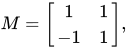
then for any real vector with entries and we have which is always positive if is not zero. However, if is the complex vector with entries 1 and , one gets


which is not real. Therefore, is not positive-definite.
On the other hand, for a symmetric real matrix the condition " for all nonzero real vectors " does imply that is positive-definite in the complex sense.


Notation
[edit]If a Hermitian matrix is positive semi-definite, one sometimes writes and if is positive-definite one writes To denote that is negative semi-definite one writes and to denote that is negative-definite one writes


The notion comes from functional analysis where positive semidefinite matrices define positive operators. If two matrices and satisfy we can define a non-strict partial order that is reflexive, antisymmetric, and transitive; It is not a total order, however, as in general, may be indefinite.


A common alternative notation is and for positive semi-definite and positive-definite, negative semi-definite and negative-definite matrices, respectively. This may be confusing, as sometimes nonnegative matrices (respectively, nonpositive matrices) are also denoted in this way.


Ramifications
[edit]It follows from the above definitions that a Hermitian matrix is positive-definite if and only if it is the matrix of a positive-definite quadratic form or Hermitian form. In other words, a Hermitian matrix is positive-definite if and only if it defines an inner product.
Positive-definite and positive-semidefinite matrices can be characterized in many ways, which may explain the importance of the concept in various parts of mathematics. A Hermitian matrix M is positive-definite if and only if it satisfies any of the following equivalent conditions.
- is congruent with a diagonal matrix with positive real entries.
- is Hermitian, and all its eigenvalues are real and positive.
- is Hermitian, and all its leading principal minors are positive.
- There exists an invertible matrix with conjugate transpose such that


A matrix is positive semi-definite if it satisfies similar equivalent conditions where "positive" is replaced by "nonnegative", "invertible matrix" is replaced by "matrix", and the word "leading" is removed.
Positive-definite and positive-semidefinite real matrices are at the basis of convex optimization, since, given a function of several real variables that is twice differentiable, then if its Hessian matrix (matrix of its second partial derivatives) is positive-definite at a point then the function is convex near p, and, conversely, if the function is convex near then the Hessian matrix is positive-semidefinite at


The set of positive definite matrices is an open convex cone, while the set of positive semi-definite matrices is a closed convex cone.[2]
Examples
[edit]- The identity matrix is positive-definite (and as such also positive semi-definite). It is a real symmetric matrix, and, for any non-zero column vector z with real entries a and b, one has
Seen as a complex matrix, for any non-zero column vector z with complex entries a and b one has
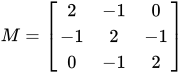
Either way, the result is positive since is not the zero vector (that is, at least one of and is not zero). - The real symmetric matrix is positive-definite since for any non-zero column vector z with entries a, b and c, we have This result is a sum of squares, and therefore non-negative; and is zero only if that is, when is the zero vector.
- For any real invertible matrix the product is a positive definite matrix (if the means of the columns of A are 0, then this is also called the covariance matrix). A simple proof is that for any non-zero vector the condition since the invertibility of matrix means that
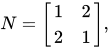
- The example above shows that a matrix in which some elements are negative may still be positive definite. Conversely, a matrix whose entries are all positive is not necessarily positive definite, as for example for which








Eigenvalues
[edit]Let be an Hermitian matrix (this includes real symmetric matrices). All eigenvalues of are real, and their sign characterize its definiteness:
- is positive definite if and only if all of its eigenvalues are positive.
- is positive semi-definite if and only if all of its eigenvalues are non-negative.
- is negative definite if and only if all of its eigenvalues are negative.
- is negative semi-definite if and only if all of its eigenvalues are non-positive.
- is indefinite if and only if it has both positive and negative eigenvalues.
Let be an eigendecomposition of where is a unitary complex matrix whose columns comprise an orthonormal basis of eigenvectors of and is a real diagonal matrix whose main diagonal contains the corresponding eigenvalues. The matrix may be regarded as a diagonal matrix that has been re-expressed in coordinates of the (eigenvectors) basis Put differently, applying to some vector giving is the same as changing the basis to the eigenvector coordinate system using giving applying the stretching transformation to the result, giving and then changing the basis back using giving


With this in mind, the one-to-one change of variable shows that is real and positive for any complex vector if and only if is real and positive for any in other words, if is positive definite. For a diagonal matrix, this is true only if each element of the main diagonal – that is, every eigenvalue of – is positive. Since the spectral theorem guarantees all eigenvalues of a Hermitian matrix to be real, the positivity of eigenvalues can be checked using Descartes' rule of alternating signs when the characteristic polynomial of a real, symmetric matrix is available.


Decomposition
[edit]Let be an Hermitian matrix. is positive semidefinite if and only if it can be decomposed as a product of a matrix with its conjugate transpose.

When is real, can be real as well and the decomposition can be written as

is positive definite if and only if such a decomposition exists with invertible. More generally, is positive semidefinite with rank if and only if a decomposition exists with a matrix of full row rank (i.e. of rank ). Moreover, for any decomposition [3]


If then so is positive semidefinite. If moreover is invertible then the inequality is strict for so is positive definite. If is of rank then


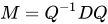
In the other direction, suppose is positive semidefinite. Since is Hermitian, it has an eigendecomposition where is unitary and is a diagonal matrix whose entries are the eigenvalues of Since is positive semidefinite, the eigenvalues are non-negative real numbers, so one can define as the diagonal matrix whose entries are non-negative square roots of eigenvalues. Then for If moreover is positive definite, then the eigenvalues are (strictly) positive, so is invertible, and hence is invertible as well. If has rank then it has exactly positive eigenvalues and the others are zero, hence in all but rows are all zeroed. Cutting the zero rows gives a matrix such that





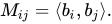
The columns of can be seen as vectors in the complex or real vector space respectively. Then the entries of are inner products (that is dot products, in the real case) of these vectors In other words, a Hermitian matrix is positive semidefinite if and only if it is the Gram matrix of some vectors It is positive definite if and only if it is the Gram matrix of some linearly independent vectors. In general, the rank of the Gram matrix of vectors equals the dimension of the space spanned by these vectors.[4]



Uniqueness up to unitary transformations
[edit]The decomposition is not unique: if for some matrix and if is any unitary matrix (meaning ), then for




However, this is the only way in which two decompositions can differ: The decomposition is unique up to unitary transformations. More formally, if is a matrix and is a matrix such that then there is a matrix with orthonormal columns (meaning ) such that [5] When this means is unitary.


This statement has an intuitive geometric interpretation in the real case: let the columns of and be the vectors and in A real unitary matrix is an orthogonal matrix, which describes a rigid transformation (an isometry of Euclidean space ) preserving the 0 point (i.e. rotations and reflections, without translations). Therefore, the dot products and are equal if and only if some rigid transformation of transforms the vectors to (and 0 to 0).


Square root
[edit]A Hermitian matrix is positive semidefinite if and only if there is a positive semidefinite matrix (in particular is Hermitian, so ) satisfying This matrix is unique,[6] is called the non-negative square root of and is denoted with When is positive definite, so is hence it is also called the positive square root of


The non-negative square root should not be confused with other decompositions Some authors use the name square root and for any such decomposition, or specifically for the Cholesky decomposition, or any decomposition of the form others only use it for the non-negative square root.


If then


Cholesky decomposition
[edit]A Hermitian positive semidefinite matrix can be written as where is lower triangular with non-negative diagonal (equivalently where is upper triangular); this is the Cholesky decomposition. If is positive definite, then the diagonal of is positive and the Cholesky decomposition is unique. Conversely if is lower triangular with nonnegative diagonal then is positive semidefinite. The Cholesky decomposition is especially useful for efficient numerical calculations. A closely related decomposition is the LDL decomposition, where is diagonal and is lower unitriangular.


Williamson theorem
[edit]Any positive definite Hermitian real matrix can be diagonalized via symplectic (real) matrices. More precisely, Williamson's theorem ensures the existence of symplectic and diagonal real positive such that .


Other characterizations
[edit]Let be an real symmetric matrix, and let be the "unit ball" defined by Then we have the following

- is a solid slab sandwiched between
- if and only if is an ellipsoid, or an ellipsoidal cylinder.
- if and only if is bounded, that is, it is an ellipsoid.
- If then if and only if if and only if
- If then for all if and only if So, since the polar dual of an ellipsoid is also an ellipsoid with the same principal axes, with inverse lengths, we have That is, if is positive-definite, then for all if and only if


Let be an Hermitian matrix. The following properties are equivalent to being positive definite:
- The associated sesquilinear form is an inner product
- The sesquilinear form defined by is the function from to such that for all and in where is the conjugate transpose of For any complex matrix this form is linear in and semilinear in Therefore, the form is an inner product on if and only if is real and positive for all nonzero that is if and only if is positive definite. (In fact, every inner product on arises in this fashion from a Hermitian positive definite matrix.)
- Its leading principal minors are all positive
- The kth leading principal minor of a matrix is the determinant of its upper-left sub-matrix. It turns out that a matrix is positive definite if and only if all these determinants are positive. This condition is known as Sylvester's criterion, and provides an efficient test of positive definiteness of a symmetric real matrix. Namely, the matrix is reduced to an upper triangular matrix by using elementary row operations, as in the first part of the Gaussian elimination method, taking care to preserve the sign of its determinant during pivoting process. Since the kth leading principal minor of a triangular matrix is the product of its diagonal elements up to row Sylvester's criterion is equivalent to checking whether its diagonal elements are all positive. This condition can be checked each time a new row of the triangular matrix is obtained.


A positive semidefinite matrix is positive definite if and only if it is invertible.[7] A matrix is negative (semi)definite if and only if is positive (semi)definite.

Quadratic forms
[edit]The (purely) quadratic form associated with a real matrix is the function such that for all can be assumed symmetric by replacing it with since any asymmetric part will be zeroed-out in the double-sided product.


A symmetric matrix is positive definite if and only if its quadratic form is a strictly convex function.
More generally, any quadratic function from to can be written as where is a symmetric matrix, is a real n vector, and a real constant. In the case, this is a parabola, and just like in the case, we have


Theorem: This quadratic function is strictly convex, and hence has a unique finite global minimum, if and only if is positive definite.
Proof: If is positive definite, then the function is strictly convex. Its gradient is zero at the unique point of which must be the global minimum since the function is strictly convex. If is not positive definite, then there exists some vector such that so the function is a line or a downward parabola, thus not strictly convex and not having a global minimum.


For this reason, positive definite matrices play an important role in optimization problems.
Simultaneous diagonalization
[edit]One symmetric matrix and another matrix that is both symmetric and positive definite can be simultaneously diagonalized. This is so although simultaneous diagonalization is not necessarily performed with a similarity transformation. This result does not extend to the case of three or more matrices. In this section we write for the real case. Extension to the complex case is immediate.
Let be a symmetric and a symmetric and positive definite matrix. Write the generalized eigenvalue equation as where we impose that be normalized, i.e. Now we use Cholesky decomposition to write the inverse of as Multiplying by and letting we get which can be rewritten as where Manipulation now yields where is a matrix having as columns the generalized eigenvectors and is a diagonal matrix of the generalized eigenvalues. Now premultiplication with gives the final result: and but note that this is no longer an orthogonal diagonalization with respect to the inner product where In fact, we diagonalized with respect to the inner product induced by [8]






Note that this result does not contradict what is said on simultaneous diagonalization in the article Diagonalizable matrix, which refers to simultaneous diagonalization by a similarity transformation. Our result here is more akin to a simultaneous diagonalization of two quadratic forms, and is useful for optimization of one form under conditions on the other.
Properties
[edit]Induced partial ordering
[edit]For arbitrary square matrices we write if i.e., is positive semi-definite. This defines a partial ordering on the set of all square matrices. One can similarly define a strict partial ordering The ordering is called the Loewner order.


Inverse of positive definite matrix
[edit]Every positive definite matrix is invertible and its inverse is also positive definite.[9] If then [10] Moreover, by the min-max theorem, the kth largest eigenvalue of is greater than or equal to the kth largest eigenvalue of


Scaling
[edit]If is positive definite and is a real number, then is positive definite.[11]


Addition
[edit]- If and are positive-definite, then the sum is also positive-definite.[11]
- If and are positive-semidefinite, then the sum is also positive-semidefinite.
- If is positive-definite and is positive-semidefinite, then the sum is also positive-definite.

Multiplication
[edit]- If and are positive definite, then the products and are also positive definite. If then is also positive definite.
- If is positive semidefinite, then is positive semidefinite for any (possibly rectangular) matrix If is positive definite and has full column rank, then is positive definite.[12]


Trace
[edit]The diagonal entries of a positive-semidefinite matrix are real and non-negative. As a consequence the trace, Furthermore,[13] since every principal sub-matrix (in particular, 2-by-2) is positive semidefinite, and thus, when




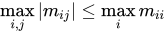
An Hermitian matrix is positive definite if it satisfies the following trace inequalities:[14]

Another important result is that for any and positive-semidefinite matrices, This follows by writing The matrix is positive-semidefinite and thus has non-negative eigenvalues, whose sum, the trace, is therefore also non-negative.


Hadamard product
[edit]If although is not necessary positive semidefinite, the Hadamard product is, (this result is often called the Schur product theorem).[15]


Regarding the Hadamard product of two positive semidefinite matrices there are two notable inequalities:




Kronecker product
[edit]If although is not necessary positive semidefinite, the Kronecker product

Frobenius product
[edit]If although is not necessary positive semidefinite, the Frobenius inner product (Lancaster–Tismenetsky, The Theory of Matrices, p. 218).

Convexity
[edit]The set of positive semidefinite symmetric matrices is convex. That is, if and are positive semidefinite, then for any between 0 and 1, is also positive semidefinite. For any vector :



This property guarantees that semidefinite programming problems converge to a globally optimal solution.
Relation with cosine
[edit]The positive-definiteness of a matrix expresses that the angle between any vector and its image is always


the angle between and


Further properties
[edit]- If is a symmetric Toeplitz matrix, i.e. the entries are given as a function of their absolute index differences: and the strict inequality holds, then is strictly positive definite.
- Let and Hermitian. If (resp., ) then (resp., ).[18]
- If is real, then there is a such that where is the identity matrix.
- If denotes the leading minor, is the kth pivot during LU decomposition.
- A matrix is negative definite if its kth order leading principal minor is negative when is odd, and positive when is even.
- If is a real positive definite matrix, then there exists a positive real number such that for every vector
- A Hermitian matrix is positive semidefinite if and only if all of its principal minors are nonnegative. It is however not enough to consider the leading principal minors only, as is checked on the diagonal matrix with entries 0 and −1 .











Block matrices and submatrices
[edit]A positive matrix may also be defined by blocks:
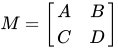
where each block is By applying the positivity condition, it immediately follows that and are hermitian, and


We have that for all complex and in particular for Then
![{\displaystyle \mathbf {z} =[\mathbf {v} ,0]^{\mathsf {T}}.}](https://wikimedia.org/api/rest_v1/media/math/render/svg/264f447fd2ba5cb20135f80ea39da8bcca0a1b61)

A similar argument can be applied to and thus we conclude that both and must be positive definite. The argument can be extended to show that any principal submatrix of is itself positive definite.

Converse results can be proved with stronger conditions on the blocks, for instance, using the Schur complement.
Local extrema
[edit]A general quadratic form on real variables can always be written as where is the column vector with those variables, and is a symmetric real matrix. Therefore, the matrix being positive definite means that has a unique minimum (zero) when is zero, and is strictly positive for any other


More generally, a twice-differentiable real function on real variables has local minimum at arguments if its gradient is zero and its Hessian (the matrix of all second derivatives) is positive semi-definite at that point. Similar statements can be made for negative definite and semi-definite matrices.
Covariance
[edit]In statistics, the covariance matrix of a multivariate probability distribution is always positive semi-definite; and it is positive definite unless one variable is an exact linear function of the others. Conversely, every positive semi-definite matrix is the covariance matrix of some multivariate distribution.
Extension for non-Hermitian square matrices
[edit]The definition of positive definite can be generalized by designating any complex matrix (e.g. real non-symmetric) as positive definite if for all non-zero complex vectors where denotes the real part of a complex number [19] Only the Hermitian part determines whether the matrix is positive definite, and is assessed in the narrower sense above. Similarly, if and are real, we have for all real nonzero vectors if and only if the symmetric part is positive definite in the narrower sense. It is immediately clear that is insensitive to transposition of


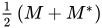


A non-symmetric real matrix with only positive eigenvalues may have a symmetric part with negative eigenvalues, in which case it will not be positive (semi)definite. For example, the matrix has positive eigenvalues 1 and 7, yet with the choice .
![{\textstyle M=\left[{\begin{smallmatrix}4&9\\1&4\end{smallmatrix}}\right]}](https://wikimedia.org/api/rest_v1/media/math/render/svg/99954e15253930e37fc41ab57e11a5072e8c558f)

![{\displaystyle \mathbf {x} =\left[{\begin{smallmatrix}-1\\1\end{smallmatrix}}\right]}](https://wikimedia.org/api/rest_v1/media/math/render/svg/1142a73c0981ac1bb48e99f598d5baca15fd2b84)
In summary, the distinguishing feature between the real and complex case is that, a bounded positive operator on a complex Hilbert space is necessarily Hermitian, or self adjoint. The general claim can be argued using the polarization identity. That is no longer true in the real case.
Applications
[edit]Heat conductivity matrix
[edit]Fourier's law of heat conduction, giving heat flux in terms of the temperature gradient is written for anisotropic media as in which is the thermal conductivity matrix. The negative is inserted in Fourier's law to reflect the expectation that heat will always flow from hot to cold. In other words, since the temperature gradient always points from cold to hot, the heat flux is expected to have a negative inner product with so that Substituting Fourier's law then gives this expectation as implying that the conductivity matrix should be positive definite. Ordinarily should be symmetric, however it becomes nonsymmetric in the presence of a magnetic field as in a thermal Hall effect.


More generally in thermodynamics, the flow of heat and particles is a fully coupled system as described by the Onsager reciprocal relations, and the coupling matrix is required to be positive semi-definite (possibly non-symmetric) in order that entropy production be nonnegative.
See also
[edit]References
[edit]- ^ van den Bos, Adriaan (March 2007). "Appendix C: Positive semidefinite and positive definite matrices". Parameter Estimation for Scientists and Engineers (.pdf) (online ed.). John Wiley & Sons. pp. 259–263. doi:10.1002/9780470173862. ISBN 978-047-017386-2. Print ed. ISBN 9780470147818
- ^ Boyd, Stephen; Vandenberghe, Lieven (8 March 2004). Convex Optimization. Cambridge University Press. doi:10.1017/cbo9780511804441. ISBN 978-0-521-83378-3.
- ^ Horn & Johnson (2013), p. 440, Theorem 7.2.7
- ^ Horn & Johnson (2013), p. 441, Theorem 7.2.10
- ^ Horn & Johnson (2013), p. 452, Theorem 7.3.11
- ^ Horn & Johnson (2013), p. 439, Theorem 7.2.6 with
- ^ Horn & Johnson (2013), p. 431, Corollary 7.1.7
- ^ Horn & Johnson (2013), p. 485, Theorem 7.6.1
- ^ Horn & Johnson (2013), p. 438, Theorem 7.2.1
- ^ Horn & Johnson (2013), p. 495, Corollary 7.7.4(a)
- ^ a b Horn & Johnson (2013), p. 430, Observation 7.1.3
- ^ Horn & Johnson (2013), p. 431, Observation 7.1.8
- ^ Horn & Johnson (2013), p. 430
- ^ Wolkowicz, Henry; Styan, George P.H. (1980). "Bounds for Eigenvalues using Traces". Linear Algebra and Its Applications. 29 (29). Elsevier: 471–506. doi:10.1016/0024-3795(80)90258-X.
- ^ Horn & Johnson (2013), p. 479, Theorem 7.5.3
- ^ Horn & Johnson (2013), p. 509, Theorem 7.8.16
- ^ Styan, G.P. (1973). "Hadamard products and multivariate statistical analysis". Linear Algebra and Its Applications. 6: 217–240. doi:10.1016/0024-3795(73)90023-2., Corollary 3.6, p. 227
- ^ Bhatia, Rajendra (2007). Positive Definite Matrices. Princeton, New Jersey: Princeton University Press. p. 8. ISBN 978-0-691-12918-1.
- ^ Weisstein, Eric W. "Positive definite matrix". MathWorld. Wolfram Research. Retrieved 26 July 2012.

Sources
[edit]- Horn, Roger A.; Johnson, Charles R. (2013). Matrix Analysis (2nd ed.). Cambridge University Press. ISBN 978-0-521-54823-6.
- Bhatia, Rajendra (2007). Positive Definite Matrices. Princeton Series in Applied Mathematics. ISBN 978-0-691-12918-1.
- Bernstein, B.; Toupin, R.A. (1962). "Some properties of the Hessian matrix of a strictly convex function". Journal für die reine und angewandte Mathematik. 210: 67–72. doi:10.1515/crll.1962.210.65.
External links
[edit]- "Positive-definite form", Encyclopedia of Mathematics, EMS Press, 2001 [1994]
- "Positive definite matrix". Wolfram MathWorld. Wolfram Research.
