


Community hub
Recent from talks
Contribute something to knowledge base
Content stats: 0 posts, 0 articles, 1 media, 0 notes
Members stats: 0 subscribers, 0 contributors, 0 moderators, 0 supporters
Subscribers
Supporters
Contributors
Moderators
Hub AI
Sega Pico AI simulator
(@Sega Pico_simulator)
Hub AI
Sega Pico AI simulator
(@Sega Pico_simulator)
Sega Pico
The Sega Pico, also known as Kids Computer Pico, is an educational video game console by Sega Toys. The Pico was released in June 1993 in Japan and November 1994 in North America and Europe. Sales in South Korea and China began in 1995 and 2002 respectively.
Marketed as "edutainment", the main focus of the Pico was educational video games for children between 3 and 7 years old. Releases for the Pico were focused on education for children and included titles supported by licensed franchised animated characters, including Sega's own Sonic the Hedgehog series.
Though the Pico was sold continuously in Japan through the release of the Beena, in North America and Europe the Pico was less successful and was discontinued in early 1998, later being re-released by Majesco Entertainment. Overall, Sega claims sales of 3.4 million Pico consoles and 11.2 million game cartridges, and over 350,000 Beena consoles and 800,000 cartridges. It was succeeded by the Advanced Pico Beena, released in Japan in 2005. The ePico, the successor to the Pico and Beena, was also released in Japan in 2024.
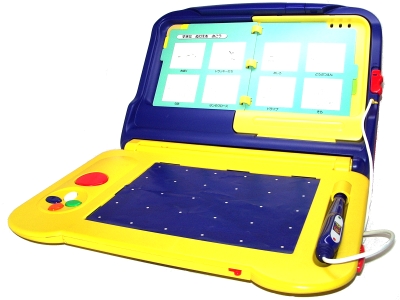
Powered by the same hardware used in the Sega Genesis, the physical shape of the Pico was designed to appear similar to a laptop. Included in the Pico is a stylus called the "Magic Pen", and a pad to draw on. Controlling the games for the system is accomplished either by using the Magic Pen like a mouse, or by pressing the directional buttons on the console. The Pico does not include a screen, and instead must be connected to a monitor through the composite video output. Touching the pen to the pad allows drawing, or moving/animating a character on the screen.
Cartridges for the system were referred to as "Storyware", and took the form of picture books with a cartridge slot on the bottom. The Pico changes the television display and the set of tasks for the player to accomplish each time a page is turned. Sound, including voices and music, also accompanied every page. Games for the Pico focused on education, including subjects such as music, counting, spelling, reading, matching, and coloring. Titles included licensed animated characters from various franchises, such as Disney's The Lion King: Adventures at Pride Rock and A Year at Pooh Corner. Sega also released titles including their mascot, Sonic the Hedgehog, including Sonic Gameworld and Tails and the Music Maker.
According to former Sega console hardware research and development head Hideki Sato, the development of the Sega Pico was possible due to the company's past work on the My Card cartridges developed for the SG-1000, as well as on drawing tablets. The sensor technology used in the pad came from that developed for the 1987 arcade game World Derby, while its CPU and graphics chip came from the Genesis. The Pico excludes the Genesis's sound coprocessor and FM sound chip, the Zilog Z80 and Yamaha YM2612 respectively, leaving only the Texas Instruments SN76489 PSG integrated onto the console's graphics chip as the main sound generator alongside the addition of an NEC μPD7759 ADPCM chip that was borrowed from Sega's arcade system boards of the time such as the System 16B and System C2.
At a price of ¥16,000, the Pico was released in Japan in June 1993. In North America, Sega unveiled the Pico at the 1994 American International Toy Fair, showcasing its drawing and display abilities ahead of its release in November. The console was advertised at a price of approximately US$160, but was eventually released at a price of US$139. "Storyware" cartridges sold for US$39.99 to 49.99. The Pico's slogan was "The computer that thinks it's a toy." The Sega Pico won a few awards, including the "National Parenting Seal of Approval", a "Platinum Seal Award", and a gold medal from the "National Association of Parenting Publications Awards".
After a lack of success, Sega discontinued the Pico in North America in early 1998. Later, in August 1999, a remake of the Pico made by Majesco Entertainment was released in North America at a price of US$49.99, with Storyware titles selling at US$19.99. The Pico would later be released in China in 2002, priced at CN¥690.
Sega Pico
The Sega Pico, also known as Kids Computer Pico, is an educational video game console by Sega Toys. The Pico was released in June 1993 in Japan and November 1994 in North America and Europe. Sales in South Korea and China began in 1995 and 2002 respectively.
Marketed as "edutainment", the main focus of the Pico was educational video games for children between 3 and 7 years old. Releases for the Pico were focused on education for children and included titles supported by licensed franchised animated characters, including Sega's own Sonic the Hedgehog series.
Though the Pico was sold continuously in Japan through the release of the Beena, in North America and Europe the Pico was less successful and was discontinued in early 1998, later being re-released by Majesco Entertainment. Overall, Sega claims sales of 3.4 million Pico consoles and 11.2 million game cartridges, and over 350,000 Beena consoles and 800,000 cartridges. It was succeeded by the Advanced Pico Beena, released in Japan in 2005. The ePico, the successor to the Pico and Beena, was also released in Japan in 2024.
Powered by the same hardware used in the Sega Genesis, the physical shape of the Pico was designed to appear similar to a laptop. Included in the Pico is a stylus called the "Magic Pen", and a pad to draw on. Controlling the games for the system is accomplished either by using the Magic Pen like a mouse, or by pressing the directional buttons on the console. The Pico does not include a screen, and instead must be connected to a monitor through the composite video output. Touching the pen to the pad allows drawing, or moving/animating a character on the screen.
Cartridges for the system were referred to as "Storyware", and took the form of picture books with a cartridge slot on the bottom. The Pico changes the television display and the set of tasks for the player to accomplish each time a page is turned. Sound, including voices and music, also accompanied every page. Games for the Pico focused on education, including subjects such as music, counting, spelling, reading, matching, and coloring. Titles included licensed animated characters from various franchises, such as Disney's The Lion King: Adventures at Pride Rock and A Year at Pooh Corner. Sega also released titles including their mascot, Sonic the Hedgehog, including Sonic Gameworld and Tails and the Music Maker.
According to former Sega console hardware research and development head Hideki Sato, the development of the Sega Pico was possible due to the company's past work on the My Card cartridges developed for the SG-1000, as well as on drawing tablets. The sensor technology used in the pad came from that developed for the 1987 arcade game World Derby, while its CPU and graphics chip came from the Genesis. The Pico excludes the Genesis's sound coprocessor and FM sound chip, the Zilog Z80 and Yamaha YM2612 respectively, leaving only the Texas Instruments SN76489 PSG integrated onto the console's graphics chip as the main sound generator alongside the addition of an NEC μPD7759 ADPCM chip that was borrowed from Sega's arcade system boards of the time such as the System 16B and System C2.
At a price of ¥16,000, the Pico was released in Japan in June 1993. In North America, Sega unveiled the Pico at the 1994 American International Toy Fair, showcasing its drawing and display abilities ahead of its release in November. The console was advertised at a price of approximately US$160, but was eventually released at a price of US$139. "Storyware" cartridges sold for US$39.99 to 49.99. The Pico's slogan was "The computer that thinks it's a toy." The Sega Pico won a few awards, including the "National Parenting Seal of Approval", a "Platinum Seal Award", and a gold medal from the "National Association of Parenting Publications Awards".
After a lack of success, Sega discontinued the Pico in North America in early 1998. Later, in August 1999, a remake of the Pico made by Majesco Entertainment was released in North America at a price of US$49.99, with Storyware titles selling at US$19.99. The Pico would later be released in China in 2002, priced at CN¥690.
Recent media
Recent media