Hubbry Logo
Seifert surfaceSeifert surfaceMain
Open search
Seifert surface
Community hub
Seifert surface
logo
8 pages, 0 posts
0 subscribers
Be the first to start a discussion here.
Seifert surface
Seifert surface
from Wikipedia
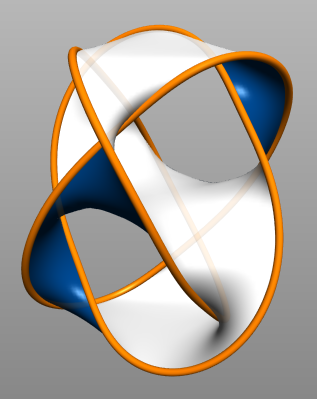
A Seifert surface bounded by a set of Borromean rings.

In mathematics, a Seifert surface (named after German mathematician Herbert Seifert[1][2]) is an orientable surface whose boundary is a given knot or link.

Such surfaces can be used to study the properties of the associated knot or link. For example, many knot invariants are most easily calculated using a Seifert surface. Seifert surfaces are also interesting in their own right, and the subject of considerable research.

Specifically, let L be a tame oriented knot or link in Euclidean 3-space (or in the 3-sphere). A Seifert surface is a compact, connected, oriented surface S embedded in 3-space whose boundary is L such that the orientation on L is just the induced orientation from S.

Note that any compact, connected, oriented surface with nonempty boundary in Euclidean 3-space is the Seifert surface associated to its boundary link. A single knot or link can have many different inequivalent Seifert surfaces. A Seifert surface must be oriented. It is possible to associate surfaces to knots which are not oriented nor orientable, as well.

Examples

[edit]
A Seifert surface for the Hopf link. This is an annulus, not a Möbius strip. It has two half-twists and is thus orientable.

The standard Möbius strip has the unknot for a boundary but is not a Seifert surface for the unknot because it is not orientable.

The "checkerboard" coloring of the usual minimal crossing projection of the trefoil knot gives a Mobius strip with three half twists. As with the previous example, this is not a Seifert surface as it is not orientable. Applying Seifert's algorithm to this diagram, as expected, does produce a Seifert surface; in this case, it is a punctured torus of genus g = 1, and the Seifert matrix is

Existence and Seifert matrix

[edit]

It is a theorem that any link always has an associated Seifert surface. This theorem was first published by Frankl and Pontryagin in 1930.[3] A different proof was published in 1934 by Herbert Seifert and relies on what is now called the Seifert algorithm. The algorithm produces a Seifert surface , given a projection of the knot or link in question.

Suppose that link has m components (m = 1 for a knot), the diagram has d crossing points, and resolving the crossings (preserving the orientation of the knot) yields f circles. Then the surface is constructed from f disjoint disks by attaching d bands. The homology group is free abelian on 2g generators, where

is the genus of . The intersection form Q on is skew-symmetric, and there is a basis of 2g cycles with equal to a direct sum of the g copies of the matrix

An illustration of (curves isotopic to) the pushoffs of a homology generator a in the positive and negative directions for a Seifert surface of the figure eight knot.

The 2g × 2g integer Seifert matrix

has the linking number in Euclidean 3-space (or in the 3-sphere) of ai and the "pushoff" of aj in the positive direction of . More precisely, recalling that Seifert surfaces are bicollared, meaning that we can extend the embedding of to an embedding of , given some representative loop which is homology generator in the interior of , the positive pushout is and the negative pushout is .[4]

With this, we have

where V = (v(j, i)) the transpose matrix. Every integer 2g × 2g matrix with arises as the Seifert matrix of a knot with genus g Seifert surface.

The Alexander polynomial is computed from the Seifert matrix by which is a polynomial of degree at most 2g in the indeterminate The Alexander polynomial is independent of the choice of Seifert surface and is an invariant of the knot or link.

The signature of a knot is the signature of the symmetric Seifert matrix It is again an invariant of the knot or link.

Genus of a knot

[edit]

Seifert surfaces are not at all unique: a Seifert surface S of genus g and Seifert matrix V can be modified by a topological surgery, resulting in a Seifert surface S′ of genus g + 1 and Seifert matrix

The genus of a knot K is the knot invariant defined by the minimal genus g of a Seifert surface for K.

For instance:

A fundamental property of the genus is that it is additive with respect to the knot sum:

In general, the genus of a knot is difficult to compute, and the Seifert algorithm usually does not produce a Seifert surface of least genus. For this reason other related invariants are sometimes useful. The canonical genus of a knot is the least genus of all Seifert surfaces that can be constructed by the Seifert algorithm, and the free genus is the least genus of all Seifert surfaces whose complement in is a handlebody. (The complement of a Seifert surface generated by the Seifert algorithm is always a handlebody.) For any knot the inequality obviously holds, so in particular these invariants place upper bounds on the genus.[5]

The knot genus is NP-complete by work of Ian Agol, Joel Hass and William Thurston.[6]

It has been shown that there are Seifert surfaces of the same genus that do not become isotopic either topologically or smoothly in the 4-ball.[7][8]

See also

[edit]

References

[edit]
[edit]
Revisions and contributorsEdit on WikipediaRead on Wikipedia
from Grokipedia
In mathematics, particularly in the field of , a Seifert surface is a compact, connected, orientable surface embedded in three-dimensional whose boundary is a given or link. Named after the German topologist Herbert Seifert (1907–1996), who formalized its study, the surface provides a geometric tool for analyzing the topological properties of knots and links. The existence of a Seifert surface for every or link was first established in 1930 by mathematicians F. Frankl and , who proved that any such embedding bounds an orientable surface. In 1934, Seifert independently confirmed this result and introduced a constructive algorithm—now known as Seifert's algorithm—that generates a Seifert surface from any by resolving crossings into Seifert circles and connecting them with twisted bands. This method, while not always yielding the surface of minimal complexity, guarantees the production of an explicit example and has become a cornerstone of computational . Seifert surfaces play a central role in defining key knot invariants, most notably the genus of a , which is the minimum (the number of "handles" or needed to form the surface) over all possible bounding Seifert surfaces for that . For instance, the has 1, meaning its minimal Seifert surface is a with one boundary component. Additionally, from a Seifert surface, one can derive the Seifert matrix, a that captures linking data between curves on the surface and enables the computation of polynomials like the , essential for distinguishing . These surfaces also extend to broader contexts, such as studying slice and fibered .

Definition and Basic Properties

Definition

A Seifert surface for a KK or link LL is a compact, connected, orientable surface SS embedded in R3\mathbb{R}^3 or S3S^3 such that its boundary S\partial S is exactly KK or LL, with the orientation on the boundary induced by the orientation of SS according to the . The surface SS must be a 2-manifold with no boundary components other than S\partial S, and the embedding is required to be without self-intersections in the interior, though the boundary may coincide with the knot or link. The concept is named after Herbert Seifert, who introduced it in his 1934 paper "Über das Geschlecht von Knoten," where he independently proved the existence of such surfaces for any knot and provided a constructive algorithm. This work built upon an earlier existence proof for any link (including knots) by Felix Frankl and Lev Pontryagin in their 1930 paper "Ein Knotensatz mit Anwendung auf die Dimensionstheorie." The existence of such a surface is formalized by the following theorem: Theorem. Let ι:S1S3\iota: S^1 \to S^3 be a smooth embedding and KK be the image of ι\iota. Then there is a compact orientable surface FF embedded in S3S^3 with KK as boundary. This existence is guaranteed by Seifert's algorithm, which provides a constructive method to build such a surface for any given knot. Not every compact surface bounded by a given knot KK qualifies as a Seifert surface, as the orientability condition excludes non-orientable examples, such as the Möbius strip bounding the unknot. Seifert's algorithm offers a systematic method to construct such an orientable surface from a knot diagram.

Orientability and Boundary Conditions

A Seifert surface must be orientable, which means it admits a continuous choice of normal that is consistent across the entire surface without reversal. This ensures that the orientation on the boundary or link is well-defined and compatible with key knot-theoretic invariants, such as linking numbers, by providing a direction for defining intersections and push-offs relative to the surface. Without this property, computations involving , like the Seifert matrix, would fail due to ambiguities in directional consistency. The orientation on the boundary S\partial S of a Seifert surface SS is induced by the surface's orientation through the : aligning the thumb with the positive normal vector to the surface causes the fingers to curl in the direction of the positive boundary traversal. This convention guarantees that the surface effectively orients the or link in a manner coherent with the ambient 3-space, facilitating the of invariants that depend on boundary behavior. Non-orientable surfaces, such as a or a with boundary, cannot qualify as Seifert surfaces because their lack of a global normal direction results in inconsistent linking numbers for curves on the surface and their push-offs. The existence of an orientable surface bounding every in the was first established by Frankl and Pontryagin in 1930 for links (including knots); Seifert independently confirmed this in 1934 with a , guaranteeing such a spanning surface for any given . While Seifert surfaces are required to be embedded—meaning they intersect themselves only along their boundaries—they differ from immersed surfaces by avoiding self-intersections in the interior. For links with multiple components, a Seifert surface may possess multiple boundary components while remaining a single connected, orientable, embedded surface in the .

Construction Methods

Seifert's Algorithm

Seifert's algorithm, introduced by Herbert Seifert in 1934, provides a systematic method to construct an orientable surface bounded by a given oriented or link from a of the link. The process begins with a diagram of the oriented link, where each crossing is resolved by performing an oriented smoothing: at each crossing, connect the incoming arc to the outgoing arc on the same side relative to the orientation, effectively replacing the crossing with two non-intersecting parallel strands that preserve the overall orientation of the link components. This smoothing step transforms the diagram into a collection of disjoint, oriented simple closed curves known as Seifert circles. Next, fill the interior of each Seifert circle with a disk to form a of surfaces. Then, for each original crossing in the , identify the two Seifert circles that the smoothed arcs belong to, and attach a rectangular band between the corresponding disks along the arcs that were adjacent at the crossing. The band is twisted by a half-twist whose matches the type of the original crossing (right-handed for positive crossings and left-handed for negative, consistent with the orientation). These twisted bands connect the disks into a single connected orientable surface whose boundary is precisely the original link. The resulting Seifert surface has χ=fd\chi = f - d, where ff is the number of Seifert circles and dd is the number of crossings in the . For a link with mm components, the gg of this surface satisfies χ=22gm\chi = 2 - 2g - m, yielding the formula g=12(df+2m)g = \frac{1}{2}(d - f + 2 - m). This construction always produces an orientable surface, as the consistent orientation and twisting ensure a coherent choice of normal vectors across the disks and bands. Although the algorithm guarantees a Seifert surface for any , the of the resulting surface depends on the choice of and may exceed the minimal Seifert of the link; thus, it provides an upper bound on the but not necessarily the minimal one. Different of the same link can yield Seifert surfaces of varying , yet all such surfaces constructed via the algorithm qualify as Seifert surfaces for the link.

Examples of Seifert Surfaces

The simplest example of a Seifert surface arises for the , where the surface is a disk bounded by the trivial knot, exhibiting 0. For the , Seifert's algorithm applied to its standard three-crossing diagram produces two Seifert circles filled with disks, connected by three half-twisted bands corresponding to the crossings, yielding a connected orientable surface of 1 that is topologically a punctured . This construction visually resembles two parallel disks linked by rectangular bands, each twisted once to align orientations and ensure the overall surface remains orientable without self-intersections. The Hopf link, consisting of two interlocked unknots, admits an annular Seifert surface of genus 0 that spans both components, formed by connecting the two link circles with half-twisted bands in a basic with two crossings. Conceptually, this appears as a flattened or ring-shaped band encircling the linked circles, with half-twists that together amount to a full twist, preserving as the total number of half-twists is even. For the , Seifert's algorithm on its standard four-crossing diagram constructs a 1 surface using three disks and four twisted bands, achieving the minimal for this . The surface can be envisioned as three nested or adjacent disks bridged by bands with appropriate half-twists (such as configurations yielding net twists of 1, 1, and -3 in a pretzel-like arrangement), where the twists maintain ; over-twisting any band, however, would inflate the beyond the minimum.

The Seifert Matrix

Construction of the Matrix

To construct the Seifert matrix for a Seifert surface SS of gg bounding an oriented KK in S3S^3, first select a basis for the group H1(S,S;Z)H_1(S, \partial S; \mathbb{Z}), which is free abelian of rank 2g2g. This basis consists of 2g2g simple closed oriented curves {a1,,a2g}\{a_1, \dots, a_{2g}\} on the interior of SS such that they generate H1(S,S;Z)H_1(S, \partial S; \mathbb{Z}) and pairwise intersect minimally according to the surface's . These curves can be derived from the disk-band of SS, ensuring they are disjoint from S=K\partial S = K. The Seifert matrix VV is then the 2g×2g2g \times 2g integer matrix defined by vi,j=\lk(ai,aj+)v_{i,j} = \lk(a_i, a_j^+), where \lk\lk denotes the linking number in S3S^3 and aj+a_j^+ is the positive pushoff of aja_j. The positive pushoff is obtained by displacing aja_j slightly off SS in the direction of the positive normal vector field induced by the orientation of SS (consistent with the orientation of KK); this creates a parallel curve in S3SS^3 \setminus S that is disjoint from SS. The linking number \lk(ai,aj+)\lk(a_i, a_j^+) counts the algebraic intersections of aia_i with a Seifert surface for aj+a_j^+, or equivalently, half the signed crossings between projections of aia_i and aj+a_j^+. For the transpose, VTV^T corresponds to negative pushoffs, where vj,iT=\lk(aj,ai)=\lk(ai+,aj)v_{j,i}^T = \lk(a_j, a_i^-) = \lk(a_i^+, a_j), with aia_i^- displaced in the negative normal direction. This basis {a1,,a2g}\{a_1, \dots, a_{2g}\} can be chosen to form a symplectic basis, where the intersection form Q(ai,ak)=0Q(a_i, a_k) = 0 for certain pairings and Q(ai,ai+g)=δi,iQ(a_i, a_{i+g}) = \delta_{i,i} or similar, satisfying the standard symplectic relations on SS. The matrix VV is well-defined up to S-equivalence under changes of basis that preserve this symplectic structure, meaning transformations by integer matrices PP such that PTJP=JP^T J P = J, where JJ is the block-diagonal matrix with gg copies of (0110)\begin{pmatrix} 0 & -1 \\ 1 & 0 \end{pmatrix}. A key property arising from this construction is that VVTV - V^T equals the intersection form QQ on H1(S;Z)H_1(S; \mathbb{Z}), which is skew-symmetric and congruent to the direct sum of gg copies of (0110)\begin{pmatrix} 0 & -1 \\ 1 & 0 \end{pmatrix}. This follows because the difference \lk(ai,aj+)\lk(aj,ai+)=\lk(a_i, a_j^+) - \lk(a_j, a_i^+) = algebraic intersection number of aia_i and aja_j on SS, as the pushoffs bound an annulus whose intersections capture the surface pairings. Thus, det(VVT)=(1)g\det(V - V^T) = (-1)^g, confirming the matrix's consistency with the surface's topology.

Algebraic Properties

The Seifert matrix VV associated to a Seifert surface of a gives rise to the Seifert intersection form Q=VVTQ = V - V^T, which is the matrix representation of the algebraic intersection on H1(F;Z)H_1(F; \mathbb{Z}). This form QQ is alternating, satisfying Q+QT=0Q + Q^T = 0, and unimodular with detQ=(1)g\det Q = (-1)^g. Two Seifert matrices are S-equivalent if one can be obtained from the other through a sequence of basis changes and stabilizations, where basis changes correspond to transformations VPTVPV \mapsto P^T V P for unimodular matrices PP (with detP=±1\det P = \pm 1), and stabilizations involve matrix enlargements that reflect adding handles to the surface, such as bordering VV with additional rows and columns (e.g., adding a block corresponding to new untwisted and linking bands, resulting in forms like \begin{pmatrix} V & \mathbf{0} \ * & \begin{matrix} 1 & 0 \ 0 & 0 \end{matrix} \end{pmatrix} or similar). S-equivalence captures the algebraic independent of the specific surface choice. The Seifert matrix determines the homology of the surface, as its size 2g×2g2g \times 2g reflects the rank of H1(F;Z)H_1(F; \mathbb{Z}), which is twice the gg. For links, the matrix is block-diagonal with respect to the components when the Seifert surface is disconnected, one block per link component. Seifert matrices can be normalized to a standard form through unimodular basis changes, which preserve the Blanchfield form—a on the torsion subgroup of the homology of the infinite cyclic cover of the complement. Seifert matrices exist for any knot, and any two such matrices for the same knot are unique up to S-equivalence.

Applications in Knot Theory

Determining Knot Genus

The genus of a knot KK, denoted g(K)g(K), is defined as the minimal genus among all Seifert surfaces bounding KK. This minimal genus equals half the rank of the first homology group H1H_1 of such a minimal Seifert surface, reflecting the topological complexity of the surface required to span the knot. The concordance genus gc(K)g_c(K), defined as the minimum Seifert genus over all knots concordant to KK, is a concordance invariant, and g(K)g(K) provides an upper bound for gc(K)g_c(K). The knot genus exhibits additivity under the connected sum operation: for knots K1K_1 and K2K_2, g(K1#K2)=g(K1)+g(K2)g(K_1 \# K_2) = g(K_1) + g(K_2). This property follows from the ability to combine minimal Seifert surfaces for each knot into a surface for the sum whose genus is exactly the total of the individual genera. In contrast, the genus is non-additive for satellite knots, where the construction intertwines a pattern knot around a companion knot in a way that does not preserve the additive structure seen in connected sums; for instance, the genus of a satellite can exceed or fail to align simply with the genera of its components. Determining whether g(K)kg(K) \leq k for a given KK and kk is NP-complete, as established by reducing the problem to known NP-complete decisions in topology. Several upper bounds on the knot genus arise from constructive methods. The algorithmic galg(K)g_{\text{alg}}(K), obtained by applying Seifert's to a knot , satisfies galg(K)g(K)g_{\text{alg}}(K) \geq g(K) and provides a computable upper bound, though it may not achieve minimality. Tighter bounds include the free gf(K)g_f(K), the minimal genus among free Seifert surfaces (those compressible only along the boundary in the knot complement), and the canonical gc(K)g_c(K), the minimal genus among surfaces produced by Seifert's over all diagrams of KK; these satisfy g(K)gf(K)gc(K)g(K) \leq g_f(K) \leq g_c(K), with examples showing the inequalities can be strict and arbitrarily large. A notable recent development is that some knots admit multiple non-isotopic minimal genus Seifert surfaces in S3S^3 that remain distinct even when extended to the 4-ball B4B^4, resolving a long-standing question posed by Livingston in 1982.

Computing the Alexander Polynomial

The Alexander polynomial of a knot KK, denoted ΔK(t)\Delta_K(t), is computed from a Seifert matrix VV associated to a Seifert surface bounding KK via the determinant formula ΔK(t)=det(VtVT)\Delta_K(t) = \det(V - t V^T). This Laurent polynomial in tt is normalized such that ΔK(1)=±1\Delta_K(1) = \pm 1 and it satisfies the symmetry ΔK(t1)=ΔK(t)\Delta_K(t^{-1}) = \Delta_K(t). The resulting polynomial is a knot invariant, independent of the choice of Seifert surface or basis for the first homology, up to multiplication by units ±tk\pm t^k in the ring Z[t,t1]\mathbb{Z}[t, t^{-1}]. The degree of ΔK(t)\Delta_K(t), understood as the difference between the highest and lowest powers of tt with nonzero coefficients, satisfies deg(ΔK)2g(K)\deg(\Delta_K) \leq 2g(K), where g(K)g(K) is the genus of KK, as the Seifert matrix VV is of size 2g(K)×2g(K)2g(K) \times 2g(K) and the determinant yields a Laurent polynomial of span at most 2g(K)2g(K). For alternating knots, equality often holds, with the span of ΔK(t)\Delta_K(t) achieving 2g(K)2g(K) in many cases. A concrete example is the right-handed trefoil knot, which admits a Seifert matrix V=(1011).V = \begin{pmatrix} -1 & 0 \\ -1 & -1 \end{pmatrix}. Substituting into the formula gives ΔK(t)=t11+t\Delta_K(t) = t^{-1} - 1 + t. The Seifert matrix also yields other knot invariants. The knot signature σ(K)\sigma(K) is the signature of the real symmetric matrix V+VTV + V^T, which counts the number of positive eigenvalues minus the number of negative eigenvalues. The Arf invariant of KK, a Z/2Z\mathbb{Z}/2\mathbb{Z}-valued invariant distinguishing certain knots, arises from the mod-2 reduction of the Seifert bilinear form on the homology of the surface. For links with multiple components, a multivariable version of the can be obtained using the Seifert matrix of an oriented surface spanning the link, via the of a suitable augmentation of the matrix, or alternatively through Fox's free applied to a of the link group.

References

Add your contribution
Related Hubs
User Avatar
No comments yet.