Hubbry Logo
VariogramVariogramMain
Open search
Variogram
Community hub
Variogram
logo
8 pages, 0 posts
0 subscribers
Be the first to start a discussion here.
Variogram
Variogram
from Wikipedia

In spatial statistics the theoretical variogram, denoted , is a function describing the degree of spatial dependence of a spatial random field or stochastic process . The semivariogram is half the variogram.

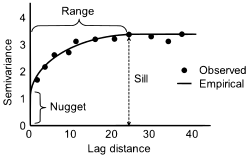
Schematisation of a variogram. The points represent the measured data points (observed) and the curve represents the model function used (empirical). Range stands for the range sought, sill for the plateau value reached at maximum range, nugget for the nugget effect.

For example, in gold mining, a variogram will give a measure of how much two samples taken from the mining area will vary in gold percentage depending on the distance between those samples. Samples taken far apart will vary more than samples taken close to each other.

Definition

[edit]

The semivariogram was first defined by Matheron (1963) as half the average squared difference between a function and a translated copy of the function separated at distance .[1][2] Formally

where is a point in the geometric field , and is the value at that point. The triple integral is over 3 dimensions. is the separation distance (e.g., in meters or km) of interest. For example, the value could represent the iron content in soil, at some location (with geographic coordinates of latitude, longitude, and elevation) over some region with element of volume . To obtain the semivariogram for a given , all pairs of points at that exact distance would be sampled. In practice it is impossible to sample everywhere, so the empirical variogram is used instead.

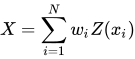
The variogram is twice the semivariogram and can be defined, differently, as the variance of the difference between field values at two locations ( and , note change of notation from to and to ) across realizations of the field (Cressie 1993):

If the spatial random field has constant mean , this is equivalent to the expectation for the squared increment of the values between locations and (Wackernagel 2003) (where and are points in space and possibly time):

In the case of a stationary process, the variogram and semivariogram can be represented as a function of the difference between locations only, by the following relation (Cressie 1993):

If the process is furthermore isotropic, then the variogram and semivariogram can be represented by a function of the distance only (Cressie 1993):

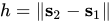
The indexes or are typically not written. The terms are used for all three forms of the function. Moreover, the term "variogram" is sometimes used to denote the semivariogram, and the symbol is sometimes used for the variogram, which brings some confusion.[3]

Properties

[edit]

According to (Cressie 1993, Chiles and Delfiner 1999, Wackernagel 2003) the theoretical variogram has the following properties:

  • The semivariogram is nonnegative , since it is the expectation of a square.
  • The semivariogram at distance 0 is always 0, since .
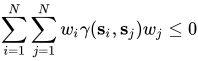
  • A function is a semivariogram if and only if it is a conditionally negative definite function, i.e. for all weights subject to and locations it holds:
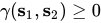
which corresponds to the fact that the variance of is given by the negative of this double sum and must be nonnegative.[disputeddiscuss]
  • Conversely, the covariance function C of a stationary process can be obtained from the semivariogram and variance as
  • If a stationary random field has no spatial dependence (i.e. if ), the semivariogram is the constant everywhere except at the origin, where it is zero.
  • The semivariogram is a symmetric function, .
  • Consequently, the isotropic semivariogram is an even function .
  • If the random field is stationary and ergodic, the corresponds to the variance of the field. The limit of the semivariogram with increasing distance is also called its sill.
  • As a consequence the semivariogram might be non continuous only at the origin. The height of the jump at the origin is sometimes referred to as nugget or nugget effect.

Parameters

[edit]

In summary, the following parameters are often used to describe variograms:

  • nugget : The height of the jump of the semivariogram at the discontinuity at the origin.
  • sill : Limit of the variogram tending to infinity lag distances.
  • range : The distance in which the difference of the variogram from the sill becomes negligible. In models with a fixed sill, it is the distance at which this is first reached; for models with an asymptotic sill, it is conventionally taken to be the distance when the semivariance first reaches 95% of the sill.

Empirical variogram

[edit]

Generally, an empirical variogram is needed for measured data, because sample information is not available for every location. The sample information for example could be concentration of iron in soil samples, or pixel intensity on a camera. Each piece of sample information has coordinates for a 2D sample space where and are geographical coordinates. In the case of the iron in soil, the sample space could be 3 dimensional. If there is temporal variability as well (e.g., phosphorus content in a lake) then could be a 4 dimensional vector . For the case where dimensions have different units (e.g., distance and time) then a scaling factor can be applied to each to obtain a modified Euclidean distance.[4]

Sample observations are denoted . Observations may be taken at total different locations (the sample size). This would provide as set of observations at locations . Generally, plots show the semivariogram values as a function of separation distance for multiple steps . In the case of empirical semivariogram, separation distance interval is used rather than exact distances, and usually isotropic conditions are assumed (i.e., that is only a function of and does not depend on other variables such as center position). Then, the empirical semivariogram can be calculated for each bin:

Or in other words, each pair of points separated by (plus or minus some bin width tolerance range ) are found. These form the set of points

The number of these points in this bin is (the set size). Then for each pair of points , the square of the difference in the observation (e.g., soil sample content or pixel intensity) is found (). These squared differences are added together and normalized by the natural number . By definition the result is divided by 2 for the semivariogram at this separation.

For computational speed, only the unique pairs of points are needed. For example, for 2 observations pairs [] taken from locations with separation only [] need to be considered, as the pairs [] do not provide any additional information.

Variogram models

[edit]

The empirical variogram cannot be computed at every lag distance and due to variation in the estimation it is not ensured that it is a valid variogram, as defined above. However some geostatistical methods such as kriging need valid semivariograms. In applied geostatistics the empirical variograms are thus often approximated by model function ensuring validity (Chiles&Delfiner 1999). Some important models are (Chiles&Delfiner 1999, Cressie 1993):

  • The exponential variogram model
  • The spherical variogram model
  • The Gaussian variogram model

The parameter has different values in different references, due to the ambiguity in the definition of the range. E.g. is the value used in (Chiles&Delfiner 1999). The indicator function is 1 if and 0 otherwise.

Discussion

[edit]

Three functions are used in geostatistics for describing the spatial or the temporal correlation of observations: these are the correlogram, the covariance, and the semivariogram. The last is also more simply called variogram.

The variogram is the key function in geostatistics as it will be used to fit a model of the temporal/spatial correlation of the observed phenomenon. One is thus making a distinction between the experimental variogram that is a visualization of a possible spatial/temporal correlation and the variogram model that is further used to define the weights of the kriging function. Note that the experimental variogram is an empirical estimate of the covariance of a Gaussian process. As such, it may not be positive definite and hence not directly usable in kriging, without constraints or further processing. This explains why only a limited number of variogram models are used: most commonly, the linear, the spherical, the Gaussian, and the exponential models.

Applications

[edit]

The empirical variogram is used in geostatistics as a first estimate of the variogram model needed for spatial interpolation by kriging.

  • Empirical variograms for the spatiotemporal variability of column-averaged carbon dioxide was used to determine coincidence criteria for satellite and ground-based measurements.[4]
  • Empirical variograms were calculated for the density of a heterogeneous material (Gilsocarbon).[5]
  • Empirical variograms are calculated from observations of strong ground motion from earthquakes.[6] These models are used for seismic risk and loss assessments of spatially-distributed infrastructure.[7]
[edit]

The squared term in the variogram, for instance , can be replaced with different powers: A madogram is defined with the absolute difference, , and a rodogram is defined with the square root of the absolute difference, . Estimators based on these lower powers are said to be more resistant to outliers. They can be generalized as a "variogram of order α",


,

in which a variogram is of order 2, a madogram is a variogram of order 1, and a rodogram is a variogram of order 0.5.[8]

When a variogram is used to describe the correlation of different variables it is called cross-variogram. Cross-variograms are used in co-kriging. Should the variable be binary or represent classes of values, one is then talking about indicator variograms. Indicator variograms are used in indicator kriging.

References

[edit]

Further reading

[edit]
[edit]
Revisions and contributorsEdit on WikipediaRead on Wikipedia
from Grokipedia
The variogram, also known as the semi-variogram, is a key statistical function in that quantifies the spatial dependence and variability of a regionalized variable, such as grades or environmental measurements, by calculating the expected squared difference between values at two locations separated by a given hh. Mathematically, it is defined as γ(h)=12E[(Z(x)Z(x+h))2]\gamma(h) = \frac{1}{2} \mathbb{E} \left[ (Z(\mathbf{x}) - Z(\mathbf{x} + \mathbf{h}))^2 \right], where ZZ represents the spatial , making it particularly useful for analyzing non-stationary processes without requiring a constant mean, unlike functions. Originating from the work of South African mining engineer D.G. Krige in the 1950s, who applied early geostatistical methods to gold ore valuation, the variogram was formalized by French mathematician Georges Matheron in the 1960s as part of the development of techniques. The empirical variogram, computed from observed data as γ^(h)=12N(h)N(h)[Z(xi)Z(xj)]2\hat{\gamma}(h) = \frac{1}{2|N(h)|} \sum_{N(h)} [Z(\mathbf{x}_i) - Z(\mathbf{x}_j)]^2 for pairs separated by lag hh, serves as the foundation for fitting theoretical models that capture spatial structure. Common models include the spherical, which rises smoothly to a plateau; the exponential, for gradual increases; and the Gaussian, which provides a smooth increase, each parameterized to reflect real-world behaviors. Central to the variogram's utility are its key components: the nugget effect, representing micro-scale variability or measurement error at zero lag; the sill, the total variance level where spatial correlation stabilizes; and the range, the distance beyond which observations become uncorrelated, adhering to Tobler's of that near things are more related than distant ones. These elements enable the variogram to model (directional dependence) and guide robust methods like the Cressie-Hawkins for noisy data. In practice, variograms underpin applications in resource estimation, such as and modeling, where they inform for predicting values at unsampled locations, as well as environmental monitoring and hydrological simulations to assess spatial patterns in pollutants or levels. For instance, in unconventional oil and gas reservoirs, variogram analysis supports sensitivity studies and cross-validation to improve prediction accuracy.

Definition and Fundamentals

Definition

In , the variogram serves as a key tool for quantifying the degree of spatial dependence or dissimilarity between observations of a regionalized variable—such as a spatially distributed like grades or environmental attributes—separated by a given lag distance hh. It captures how the variability in differences between points grows with increasing separation, thereby providing insight into the underlying structure of spatial continuity within the data. This measure is essential for understanding patterns in natural systems where nearby locations tend to exhibit more similarity than distant ones, a principle central to applications in , , and . The variogram is formally defined as the of the squared difference between values at points separated by hh, often expressed in relation to variance. A distinction exists between the full variogram, which corresponds to twice the semivariogram value (representing the complete variance of the difference), and the semivariogram itself, which is half that variance; this stems from early formulations where the semivariogram emphasized the incremental structure. Historically, the terms "variogram" and "semivariogram" have been used interchangeably in geostatistical , reflecting evolving conventions since Georges Matheron's foundational work, though precise usage helps avoid ambiguity in modeling spatial processes. The applicability of the variogram depends on specific statistical assumptions about the underlying . Under second-order stationarity, the process has a constant mean and a that varies solely with lag distance, ensuring the variogram's behavior is translation-invariant. More flexibly, the intrinsic hypothesis—introduced by Matheron—relaxes this to assume stationarity only in the increments (differences between points), allowing the variogram to model non-stationary fields where full variance may not exist but spatial differences remain well-behaved. A practical of the variogram's role appears in analyzing spatial continuity for phenomena like levels or deposit concentrations, where it delineates the beyond which observations become effectively independent, informing techniques for unsampled locations.

Mathematical Formulation

The semivariogram, denoted as γ(h)\gamma(\mathbf{h}), is defined for a spatial Z(x)Z(\mathbf{x}) as half the expected squared difference between values at two points separated by a lag vector h\mathbf{h}: γ(h)=12E[(Z(x)Z(x+h))2],\gamma(\mathbf{h}) = \frac{1}{2} \mathbb{E} \left[ \left( Z(\mathbf{x}) - Z(\mathbf{x} + \mathbf{h}) \right)^2 \right], where the expectation is taken over all possible locations x\mathbf{x} in the domain. This formulation arises under the assumption of intrinsic stationarity, which requires that the mean of the differences is zero, E[Z(x+h)Z(x)]=0\mathbb{E}[Z(\mathbf{x} + \mathbf{h}) - Z(\mathbf{x})] = 0, and that the variance of these differences depends only on h\mathbf{h}, not on x\mathbf{x}. Intrinsic stationarity does not assume a constant mean for Z(x)Z(\mathbf{x}) itself or the existence of a finite variance for the field, making it a weaker condition suitable for processes with possible trends or non-stationary means. The full variogram is then 2γ(h)=E[(Z(x)Z(x+h))2]2\gamma(\mathbf{h}) = \mathbb{E} \left[ \left( Z(\mathbf{x}) - Z(\mathbf{x} + \mathbf{h}) \right)^2 \right], representing the expected squared difference directly for point pairs separated by h\mathbf{h}. Under stronger second-order stationarity, the field Z(x)Z(\mathbf{x}) has a constant mean μ=E[Z(x)]\mu = \mathbb{E}[Z(\mathbf{x})] and a function C(h)C(\mathbf{h}) that depends only on h\mathbf{h}, with finite variance σ2=C(0)\sigma^2 = C(\mathbf{0}). In this case, the semivariogram relates to the via γ(h)=σ2C(h)\gamma(\mathbf{h}) = \sigma^2 - C(\mathbf{h}), allowing derivation from the covariance structure while ensuring the differences' second moments are well-defined. In the isotropic case, the semivariogram depends solely on the magnitude of the lag, γ(h)=γ(h)\gamma(\mathbf{h}) = \gamma(|\mathbf{h}|), implying no directional dependence in spatial continuity. For anisotropic processes, γ(h)\gamma(\mathbf{h}) varies with both the length and direction of h\mathbf{h}, generalizing the formulation to account for directional differences in spatial structure, such as elongation along geological features.

Properties

Basic Properties

The variogram function γ(h)\gamma(\mathbf{h}), which quantifies the average squared difference between values of a spatial separated by lag vector h\mathbf{h}, possesses several fundamental mathematical properties that underpin its use in . One key property is non-negativity, ensuring γ(h)0\gamma(\mathbf{h}) \geq 0 for all h\mathbf{h}, as it represents half the expected variance of increments and cannot be negative. This follows directly from the under the intrinsic of stationarity. A related property is the origin condition, where γ(0)=0\gamma(\mathbf{0}) = 0, reflecting that the squared difference at zero lag is zero since it compares a value to itself. This holds because E[(Z(s)Z(s))2]=0\mathbb{E}[(Z(\mathbf{s}) - Z(\mathbf{s}))^2] = 0 for any location s\mathbf{s}. Under micro-ergodicity assumptions, which imply local ergodicity and the absence of a discontinuity at the origin (nugget effect), the variogram is continuous at the origin. This continuity facilitates the separation of local mean fluctuations from spatial covariance structure, enabling reliable estimation of the underlying trend. The variogram is also a conditionally negative definite (CND) function, meaning that for any of locations s1,,sn\mathbf{s}_1, \dots, \mathbf{s}_n and real numbers λ1,,λn\lambda_1, \dots, \lambda_n satisfying i=1nλi=0\sum_{i=1}^n \lambda_i = 0, the satisfies i=1nj=1nλiλjγ(sisj)0\sum_{i=1}^n \sum_{j=1}^n \lambda_i \lambda_j \gamma(\mathbf{s}_i - \mathbf{s}_j) \leq 0. This CND property is crucial for , as it guarantees that the kriging weights produce non-negative prediction variances and unbiased estimators. For large lags, under second-order stationarity where the process has finite variance σ2\sigma^2, the variogram approaches the sill value σ2\sigma^2 as h\|\mathbf{h}\| \to \infty. This asymptotic behavior indicates that spatial dependence diminishes, and distant observations become uncorrelated, akin to independent realizations.

Model Parameters

In fitted variogram models, three primary parameters capture the essential features of spatial dependence: the nugget effect, the sill, and the range. These parameters provide interpretable insights into the underlying spatial structure of a stationary random process, linking mathematical descriptions to physical phenomena such as measurement inaccuracies and correlation distances. The nugget effect, denoted c0c_0, quantifies the apparent discontinuity in the variogram at lag distance h=0h = 0, arising from measurement errors or unresolved variability at scales finer than the sampling resolution. This parameter reflects short-range heterogeneity that cannot be modeled explicitly due to data limitations. The sill, given by c0+cc_0 + c where cc is the structural variance component, represents the asymptotic value that the variogram approaches as hh increases, corresponding to the total variance of the spatial process under second-order stationarity assumptions. It indicates the maximum dissimilarity between observations separated by large distances, equivalent to the a priori variance of the random field. The range, denoted aa, is the lag distance at which the variogram reaches approximately the sill value, marking the point where spatial dependence becomes negligible and observations can be treated as independent. Beyond this distance, correlations in the process dissipate, defining the practical extent of spatial continuity. These parameters collectively interpret the spatial correlation length through the range, which delineates zones of influence, and the error components via the nugget relative to the sill, where a high nugget-to-sill ratio signals substantial micro-scale noise or error. In practice, a prominent nugget effect implies the need for denser sampling to resolve fine-scale variations and reduce estimation uncertainty in applications like kriging.

Empirical Estimation

Computing the Empirical Variogram

The computation of the empirical variogram begins with pairing observed data points z(xi)z(\mathbf{x}_i) and z(xj)z(\mathbf{x}_j) based on their spatial separation distance, denoted as the lag h=xixjh = \|\mathbf{x}_i - \mathbf{x}_j\|. These pairs are then grouped into discrete bins where the lag distances are approximately equal, allowing for the aggregation of multiple pairs to stabilize estimates. Binning is essential because exact matches of distance are rare in continuous spatial data, so a (or bin width) defines the interval for grouping, typically starting from small values near zero to capture short-range behavior. A tolerance , often set to half the lag size, further allows inclusion of pairs whose distances fall within a small deviation from the bin center, ensuring sufficient data per bin without excessive smoothing. Within each bin, the empirical variogram value γ^(h)\hat{\gamma}(h) is calculated using Matheron's classical : γ^(h)=12N(h)N(h)[z(xi)z(xj)]2\hat{\gamma}(h) = \frac{1}{2 N(h)} \sum_{N(h)} [z(\mathbf{x}_i) - z(\mathbf{x}_j)]^2 where N(h)N(h) represents the number of pairs in the bin for lag hh. This measures half the squared difference between paired values to approximate the theoretical semivariance under second-order stationarity assumptions. The factor of 1/21/2 aligns the empirical estimate with the theoretical variogram , and the is over all qualifying pairs in the bin. Computationally, this involves iterating through all unique pairs of observations, computing Euclidean distances, assigning them to bins, and applying the formula per bin. To account for potential , directional variograms are computed by restricting pairs to those aligned within a specified angular tolerance (e.g., ±22.5°) around a chosen direction, such as north-south or east-west. This allows detection of direction-dependent spatial continuity, where the variogram shape may differ by , revealing structural features like elongated geological formations. Multiple directions are often evaluated at increments of 30° or 45° to map comprehensively. The selection of bin size and tolerance is guided by data density and sampling design; larger bins increase N(h)N(h) but may obscure fine-scale variation, while smaller bins risk instability from few pairs. A common guideline requires at least 30 pairs per bin for reliable estimates, as fewer can lead to high variance and poor approximation of the underlying structure. The maximum lag is typically half the domain extent to avoid edge effects, and omnidirectional variograms average over all directions when isotropy is assumed. Once computed, the empirical variogram is visualized by plotting γ^(h)\hat{\gamma}(h) against the midpoint lag distances hh, often with indicating the standard deviation within bins or N(h)N(h) for assessment. This reveals key trends, such as a nugget effect at small hh (discontinuity at the origin), a linear rise indicating increasing dissimilarity with distance, or a plateau approaching the sill (total variance). Such plots guide subsequent modeling by highlighting the range of spatial dependence.

Estimation Challenges and Robust Methods

Empirical variogram estimation is susceptible to several challenges that can introduce and variability in the results. Outliers, often present in geostatistical data due to errors or extreme events, can disproportionately inflate semivariance values, leading to distorted spatial structure representations. Clustering of sampling locations, common in exploratory surveys, causes over-representation of short-distance pairs and under-representation of longer ones, resulting in biased estimates of the nugget effect and range. Edge effects arise near study area boundaries, where fewer pairs are available for larger lags, restricting reliable to roughly half the domain size and introducing artificial . Additionally, insufficient pairs per lag class—typically fewer than 30—amplifies sampling variability, causing unstable and biased variograms that fail to capture true spatial dependence. To address these issues, robust estimators have been developed to reduce sensitivity to outliers and clustering. The Cressie-Hawkins robust estimator, which applies a fourth-root transformation to squared differences before averaging, provides greater stability for distributions with heavy tails compared to the classical method, though it remains somewhat vulnerable to severe contamination. For even higher robustness, estimators based on the median absolute deviation (MAD) use the median of absolute pairwise deviations as a scale measure, rescaled for consistency, outperforming the Cressie-Hawkins method in simulations with up to 30% outliers by preserving variogram shape and reducing mean squared error. Median polish, an iterative nonparametric technique, removes row and column effects (approximating trends) from gridded data before variogram computation, yielding residuals suitable for robust even with irregular sampling. Non-stationarity in the mean, manifesting as trends, further complicates global variogram estimation by violating the constant mean assumption and producing linearly increasing semivariances. To mitigate this, local variograms are computed within subregions assumed stationary, allowing spatially varying models, while global approaches involve detrending the data—via or universal kriging—to isolate residuals whose variogram reflects local variability without trend-induced bias. Adequate sample sizes are crucial for reliable , with at least 30 pairs recommended per lag class to minimize variance and bias; smaller datasets, such as those with fewer than 20 pairs, often exhibit erratic behavior, overestimating the sill or underestimating the range. Diagnostics like the variogram cloud plot all pairwise semivariances to reveal outliers, clustering artifacts, or non-ergodicity through scattered points deviating from the expected trend, while variogram maps visualize directional dependencies to detect edge-induced asymmetries. For instance, in small datasets from clustered soil sampling, classical variograms may show spurious nuggets due to insufficient long-range pairs, but mitigation via declustering weights or robust can reduce this bias, ensuring more accurate inputs.

Variogram Modeling

Common Theoretical Models

In , theoretical variogram models provide parametric functions to approximate the empirical variogram under the assumption of second-order stationarity and , enabling smooth and of spatial processes. These models typically incorporate a nugget effect c0c_0, representing micro-scale variability or measurement error that causes a discontinuity at the origin; a structured component that describes the rise in semivariance with lag distance hh; and a sill c+c0c + c_0, the plateau value approached as hh increases, corresponding to the total variance. Common models include bounded forms like spherical, exponential, and Gaussian, which reach a finite sill, and unbounded forms like linear for cases without clear spatial dependence limits, such as trends or patterns. The spherical model is one of the most widely used due to its realistic representation of many natural phenomena, featuring a linear rise near the origin followed by a smooth transition to the sill and a sharp cutoff at the range aa. Its equation is given by: γ(h)={c0+c[1.5(ha)0.5(ha)3]if hac0+cif h>a\gamma(h) = \begin{cases} c_0 + c \left[ 1.5 \left( \frac{h}{a} \right) - 0.5 \left( \frac{h}{a} \right)^3 \right] & \text{if } h \leq a \\ c_0 + c & \text{if } h > a \end{cases} where cc is the partial sill and aa is the range parameter. This model exhibits a parabolic shape near zero, mimicking moderate continuity before flattening abruptly. The exponential model captures processes with continuous but irregular variation, showing an initial rapid rise that asymptotically approaches the sill without a defined range, with the practical range defined as A=3aA = 3a where γ(h)\gamma(h) reaches about 95% of the sill. Its formulation is: γ(h)=c0+c[1exp(3hA)]\gamma(h) = c_0 + c \left[ 1 - \exp\left( -\frac{3h}{A} \right) \right] The curve starts steeply and decays exponentially toward the sill, suitable for datasets with high short-range variability. The Gaussian model describes smoothly varying phenomena, such as those influenced by diffusion, with a parabolic rise near the origin that transitions to an asymptotic approach to the sill; the practical range is r=a3r = a \sqrt{3}
Add your contribution
Related Hubs
User Avatar
No comments yet.