Hubbry Logo
Yodo RiverYodo RiverMain
Open search
Yodo River
Community hub
Yodo River
logo
8 pages, 0 posts
0 subscribers
Be the first to start a discussion here.
Yodo River
Yodo River
from Wikipedia
Yodo River
Yodo River in north Osaka
Map


Map
Physical characteristics
Source 
 • locationŌtsu, Shiga, Japan
Mouth 
 • location
Osaka Bay, Osaka, Japan
Length75 km (47 mi)
Basin size8,240 km2 (3,180 sq mi)
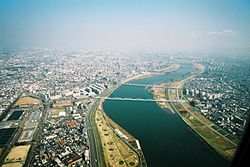
Aerial photo of Osaka and Yodo River

The Yodo River (淀川, Yodo-gawa), also called the Seta River (瀬田川 Seta-gawa) and the Uji River (宇治川 Uji-gawa) at portions of its route, is the principal river in Osaka Prefecture on Honshu, Japan. The source of the river is Lake Biwa in Shiga Prefecture to the north.

The Yodo River, usually called the Seta River in Shiga Prefecture, begins at the southern outlet of the lake in Ōtsu. There is a dam there to regulate the lake level. Further downstream, the Seta flows into Kyoto Prefecture and its name changes to the Uji River. It then merges with two other rivers, the Katsura River and the Kizu River in Kyoto Prefecture. The Katsura has its headwaters in the mountains of Kyoto Prefecture, while the Kizu comes from Mie Prefecture. From the three-river confluence, the river is called the Yodo River, which flows south, through Osaka, and on into Osaka Bay. In Osaka, part of the river has been diverted into an artificial channel; the old course in the heart of Osaka is called the Kyū-Yodo River (literally, 'Former Yodo River'). It serves as a source of water for irrigation and also powers hydroelectric generators.

History

[edit]

The Yodo River basin has occupied an extremely important position as the center of Japanese politics, culture, and economy since ancient times. Therefore, river improvement works were repeated, starting with the construction of the Ibaraki embankment during the reign of Emperor Nintoku, but floods occurred frequently. The Nara Period monk Gyōki believed that in order to prevent flooding around Lake Biwa, it was necessary to drain more lake water into the Seta River, the only outflow river, and attempted to excavate a small mountain along the Seta River. Because this mountain jutted out into the river, there were places where the Seta River suddenly narrowed, and when heavy rain hit the upstream, the water was dammed and flooded the upstream frequently. In the end, Gyoki gave up the plan for fear that excavating the mountain would cause flooding downstream.

The choice of the ancient capital Heian-kyō (now Kyoto) during the Heian period, was partly chosen because of the presence of the Yodo river that flows towards Osaka, and its outlet on the Seto Inland Sea. Emperor Shirakawa, who lived in the late Heian period, listed flood control of the Kamo River, upstream of the Yodo River, as one of the "Three Undesirable Things in the World" that do not go as planned, along with the warrior monks of Enryaku-ji on Mount Hiei and the dice rolls in the game of sugoroku. The Uji River has a prominent place in the so-called "Uji chapters" of The Tale of Genji, a novel written by the Japanese noblewoman Murasaki Shikibu in the early eleventh century.

Toyotomi Hideyoshi, who unified the country during the Sengoku period, renovated the Uji River (Oguraike Pond) when he moved to Fushimi in his later years, including the construction of the Taikō Embankment. These levees led to Fushimi flourishing as a key transportation hub. During the Edo Period, the Kamo River to transport materials for the construction of the Great Buddha Hall of Hōkō-ji (the Great Buddha of Kyoto) at the command of Tokugawa Ieyasu, and the Takase River was excavated as a permanent canal. They developed water transportation to Kyoto and developed logistics. In Osaka, Dotonbori was excavated, and as the city, which had been devastated by the Siege of Osaka, was rebuilt, water transportation and bridges were also developed. Osaka was praised for its "808 bridges" compared to Edo's "808 towns." Furthermore, with the advancement of agricultural technology and the Tokugawa Shogunate's encouragement of new paddy field development, the reclamation of Oguraike Pond in Uji also began. As the economy became more active, the collection of firewood and charcoal and the development of new rice fields progressed, leading to deforestation in the river basin. The loss of forests led to the inflow of sediment from mountainous areas, which led to the rise of riverbeds, which caused flooding. For this reason, the Shogunate issued an order in 1660 banning the mining of tree stumps in Yamashiro, Yamato, and Iga Provinces. Dredges of the Seta River in the Edo period were first carried out in 1670, in response to petitions from villages along Lake Biwa, as a matter of national interest. In 1683, Inaba Masayasu and Kawamura Zuiken inspected the site, and in 1684, the year after Inaba's downfall, Kawamura carried out river improvement work. Furthermore, in 1699, a large-scale construction project called "Kawamura Zuiken's Great Construction" was carried out.

The river continued to play a very important role for the movement and transport of goods between Osaka and Kyoto, until the arrival of the first trains in the 1870s. In 1858, it is estimated there were 50 boats daily of all types that carried about 1,500 people from Osaka to Fushimi. In the 19th century, a trip by steamboat between Osaka and Fushimi could take 12 hours.[1]

Nowadays, the Uji River, or the Yodo River in Kyoto Prefecture, is a popular fishing spot during the summer and fall months.

Taikō Embankment

[edit]

The Taikō Embankment (宇治川太閤堤跡, Uji-gawa taikō zutsumi ato) was constructed by Toyotomi Hideyoshi on the right bank of the Uji River. Hideyoshi took the opportunity of the construction of Fushimi Castle, completed in 1594 to carry out large-scale flood control works such as rerouting the Uji River and Yodo River. Until then, the Uji River had branched off downstream of Ujibashi Bridge and flowed northwest, merging with Ogura Pond, but was now merged into a channel flowing north and led to Fushimi Castle. Some remains of the embankment survive into present-day in Todomaruyama, Uji Otogata, and other locations in Uji city. Parts that have been excavated include a bank and a sluice gate for regulating the water flow. The bank is thought to have continued in a straight line for about 400 meters, and was built using various construction methods to reflect the topography. The sluice gate has stone protrusions and pile protrusions, and three stone protrusions have been confirmed at approximately 90 meter intervals. The plan is trapezoidal, with the front facing the river forming a gentle curve. The sides are made of stone walls, the inside of which is filled with broken stones, giving it the appearance of stone walls of a castle. The Taiko Embankment was gradually was buried by flooding and it is now outside the river area, so it is in an extremely well-preserved state.[2] It was designated a National Historic Site in 2009.[3] It is a short walk from Uji Station on the Keihan Electric Railway Uji Line.[2]

Transportation

[edit]
JR Nara Line train crossing the Uji River on the rail bridge in Uji, Japan

There are more than 50 bridges that cross the Yodo river. These include bridges for cars and trains.

References

[edit]
[edit]
Revisions and contributorsEdit on WikipediaRead on Wikipedia
from Grokipedia
The Yodo River (Yodo-gawa), a principal waterway in central , , stretches 75 km from its origin at the southern outlet of —the country's largest freshwater lake—to its mouth at , draining a basin of 8,240 km² across Shiga, , , Hyōgo, Nara, and Mie prefectures. As the sole outlet of , it receives major tributaries including the , Katsura, and Kizu rivers, which contribute the bulk of its mean annual discharge of approximately 271 m³/s, supporting vital functions such as flood control, , and generation for the densely populated . The river's basin, the seventh largest in , sustains over 14 million residents in the , providing around 20 billion m³ of water annually for domestic, industrial, and agricultural uses, while its delta forms the foundation of , Japan's second-largest city. Historically, the Yodo has been central to Japan's economic and cultural development since ancient times, serving as a key transportation route between and and prompting early flood mitigation efforts, such as the construction of the Manda Levee around 320 A.D. during the reign of . Modern management of the Yodo River emphasizes integrated flood control and environmental preservation, highlighted by the Yodo River Improvement Plan (completed in ) and the Comprehensive Development Project (1972–1997), which invested ¥1.9 trillion to regulate flows via structures like the Seta River Weir and address from urban and agricultural sources. These initiatives have significantly reduced major flooding incidents, with the last large-scale river flood response occurring during No. 24 in , though challenges persist from storm surges and upstream-downstream water allocation conflicts. As a Class A river under the Ministry of Land, Infrastructure, Transport, and Tourism, the Yodo continues to play a pivotal role in balancing human needs with ecosystem health in one of Japan's most urbanized landscapes.

Geography

Course

The Yodo River originates at the southern outlet of in , , where it is initially known as the Seta River. This segment flows southward for approximately 10 kilometers through relatively rural terrain before entering . There, it becomes the Uji River after its confluence with the main River proper near the city of , continuing for about 20 kilometers along a path that winds through a combination of forested hills and developing suburban areas. The river transitions to its namesake Yodo River segment upon reaching the Kyoto-Osaka border near , where it merges with the Kizu River from the east (originating in Mie Prefecture) and the Katsura River from the west (flowing from the Tanba highlands in Kyoto Prefecture). This confluence marks a significant widening of the channel, as the combined waters flow southward for roughly 20 kilometers through increasingly urbanized landscapes in Osaka Prefecture, including industrial zones and residential districts. The Yodo River's path here features gentle meanders that navigate around built-up areas, supporting transportation and recreation along its banks. The river discharges into near the city of , forming a broad that connects to the . Prior to modern improvements, the primary course followed what is now known as the Kyū-Yodo River, an older, more winding channel through central that was largely diverted in 1896 through the excavation of a new straight diversion channel to mitigate flooding. The total length of the Yodo River, including its upstream and segments from , measures 75 kilometers (47 miles). Throughout its course, the river traverses a diverse , shifting from the scenic, hilly rural environs near to the flat, densely populated alluvial plains of the Osaka Plain.

Basin and Tributaries

The Yodo River's covers an area of 8,240 km² (3,180 sq mi), spanning parts of Shiga, , , Hyōgo, Nara, and Mie prefectures in central . This watershed, often referred to as the Lake Biwa-Yodo River Basin, integrates diverse hydrological features and supports a significant portion of the Kansai region's . The basin's configuration reflects a classic river system where upstream reservoirs and tributaries converge to form the main channel downstream. Key tributaries include the Katsura River, which flows from the northwest and drains a catchment of approximately 1,152 km² through mountainous terrain in , and the Kizu River, originating in to the southwest with a basin area of about 1,647 km² encompassing parts of , Nara, and prefectures. Upstream, the River serves as a primary outlet from , contributing a smaller but vital sub-basin of 506 km². These inflows merge near the city of Yodo, augmenting the river's volume as it progresses toward . Topographically, the basin features as its primary water source, the largest freshwater lake in , located in the northern portion and covering 3,802 km² of the total drainage area. The upstream regions consist of hilly and mountainous landscapes in the Suzuka and Tamba ranges, which channel and into the lake and subsequent rivers, transitioning to the flat, alluvial Osaka Plain in the lower basin. This elevation gradient from over 1,000 meters in the headwaters to facilitates and shapes the river's meandering course. Human activities have profoundly influenced the basin, with the lower reaches experiencing intense , particularly in the metropolitan area, where exceeds 4,000 people per km² and industrial development has altered natural flow patterns through impervious surfaces and channel modifications. In contrast, the upper basin around remains relatively rural, dominated by agriculture and forestry, preserving more natural cover but facing pressures from agricultural runoff. This urban-rural divide has led to varying environmental stresses, including increased loading in downstream sections due to urban wastewater.

Hydrology

Discharge and Flooding

The Yodo River exhibits significant variability in its discharge rates, influenced by the basin's precipitation patterns and 's regulatory role. At , a key gauging station near the river's , the mean annual discharge is approximately 271 m³/s, based on observations from 1952 to 1998. Seasonal fluctuations are pronounced, with higher flows during the rainy season (–July) and periods (September–October), while low-flow conditions occur during dry periods. These rates reflect contributions from major tributaries, with the River (outflow from ) accounting for about 64% of the total flow, followed by the Kizu River (18%) and Katsura River (17%). The Yodo River is highly flood-prone, with records indicating at least 239 flood events between 623 and 1868, occurring roughly once every five years due to the basin's exposure to intense rainfall. Notable historical floods include the 1885 deluge, triggered by a and prolonged downpour, which caused widespread inundation along the river and prompted major engineering responses. Another significant event was the 1934 Muroto , which led to devastating floods across western , including the Yodo basin, resulting in over 2,700 deaths nationwide and extensive damage to infrastructure. Several factors exacerbate the river's flooding risks. The basin's steep upper gradients accelerate runoff from heavy precipitation, which averages 1,600 mm annually and intensifies during typhoon seasons. Typhoons and the Asian monsoon (baiu) rains contribute to rapid water level rises, often overwhelming the river's capacity, as seen in peak discharges exceeding 7,000 m³/s at during events like the 1959 . Urbanization in the densely populated lower basin has further increased impervious surfaces, boosting and peak flows by altering natural infiltration patterns. Modern flood monitoring relies on an integrated network managed by Japan's Ministry of Land, Infrastructure, Transport and Tourism (MLIT). Streamflow gauges at sites like and automated early warning systems provide on water levels and rainfall, enabling timely evacuations and operations across the basin's seven major reservoirs. The Yodo River Integrated Dams Control Office coordinates these efforts, using hydrological models to forecast floods and mitigate risks from .

Water Management

The Seta Weir, located at the outlet of where it connects to the Seta River, serves as a primary structure for regulating water flow into the Yodo River system, enabling controlled release to manage downstream water levels and supply urban and agricultural needs. Constructed initially in 1905 and renovated in 1961, the weir features 10 adjustable gates that facilitate flood control by limiting discharge during high-water events while ensuring steady outflow during dry periods. Downstream, the Yodo River Weir, positioned approximately 10 km from the river mouth, acts as a barrier to prevent saline intrusion from and to stabilize water intake for purification facilities serving the greater . These weirs, along with others like the Amagase Dam on the upper River, form a coordinated network that mitigates flood risks across the basin by temporarily storing excess water and releasing it gradually. Hydroelectric power generation in the Yodo River basin relies on facilities integrated with these regulatory structures, harnessing controlled water releases from Lake Biwa and its tributaries. The Amagase Dam, completed in 1964, incorporates a powerhouse capable of generating up to 92,000 kW through turbines fed by regulated flows, contributing to the regional grid while prioritizing flood prevention and water supply. Upstream on the Katsura River tributary, the Hiyoshi Dam supports a smaller 850 kW hydroelectric plant using selective intake to produce electricity without compromising irrigation or downstream needs. These installations exemplify multipurpose use, where power output is optimized during periods of surplus water, supporting Japan's broader renewable energy goals in densely populated watersheds. Irrigation systems in the Yodo River basin distribute water primarily to support rice paddy cultivation, a staple agricultural activity across the fertile lowlands fed by Lake Biwa's outflow. Networks of canals and pumps draw from the Seta and Uji rivers to irrigate extensive paddies in Shiga and Kyoto prefectures, where water allocation is managed to sustain yields during the growing season while conserving resources amid urban expansion. These systems, evolved from traditional practices, now integrate modern monitoring to balance agricultural demands with ecological flows, ensuring that paddy fields receive consistent supplies essential for the region's food production. Integrated for the Yodo River is overseen by coordinating across prefectural boundaries to address multifaceted challenges like preservation and resource allocation. The Lake Biwa-Yodo River Preservation Organization, established in 1990, plays a central role in this effort by facilitating joint monitoring, policy formulation, and conservation initiatives among local governments and utilities to maintain standards for sources serving over 14 million people. Complementing this, the Yodo River Integrated Dams Control Office manages operations of key infrastructure like the Seta Weir and Amagase Dam, ensuring synchronized releases for flood control, power, and . These entities promote basin-wide collaboration, drawing on data from committees to adapt strategies to ongoing pressures such as climate variability.

History

Early Development and Flood Control

The establishment of (modern-day ) in 794 CE by Emperor Kammu was influenced by the strategic and scenic advantages of its location near the Yodo River, providing essential waterway access for transportation and defense against potential attacks. The river's basin, encompassing key regions like and , positioned it as a vital artery for imperial logistics, facilitating the movement of goods and people from the interior to coastal areas. This waterway significance is reflected in classical literature, such as the "Uji chapters" of by (early 11th century), where the River—a major tributary forming the Yodo—serves as a backdrop for pivotal scenes involving exile, romance, and imperial intrigue, underscoring the river's cultural and narrative importance in Heian-era society. Early flood control efforts on the Yodo River date to the , with (r. ca. 313–399 CE) credited in historical records for constructing the Manda-no-tsutsumi (Manda Levee) along the river's banks near Naniwa (modern ) to mitigate flooding and support agricultural expansion in the region. By the 8th century, during the , Buddhist priest Gyōki (668–749 CE), known as Gyōki , led extensive projects, including the excavation of channels, construction of dykes, and a spillway-levee system around 730 CE on the middle and lower reaches of the Yodo to divert floodwaters and protect arable lands from inundation. These initiatives, part of Gyōki's broader efforts in and infrastructure across the Kinki region, marked some of Japan's earliest organized responses to the river's seasonal floods, blending religious motivation with practical hydraulic engineering. In the medieval period (12th–16th centuries), the Yodo River became integral to trade and transport networks, serving as a primary route for relaying foodstuffs and goods to the from ports like Watanabe no tsu on its southern banks. This economic role amplified the river's socio-political importance, as control over its basin allowed imperial and emerging shogunal authorities to dominate central Japan's resources, taxation, and military movements. However, intensive in the upstream watershed for construction and fuel exacerbated and river silting by the mid-17th century, prompting the to impose bans and restrictions around 1660 to preserve and stabilize the .

Taikō Embankment and Later Improvements

The Taikō Embankment, constructed in 1594 by the warlord , represented a major engineering effort along the Uji River, an upper tributary of the Yodo River system. Built concurrently with , the approximately 20 km structure aimed to protect the Kawachi plains from recurrent flooding while facilitating the growth of Fushimi port as a key transportation hub. The embankment incorporated stone revetments, an innovative technique for the era that enhanced stability against water flow and erosion, and it also supported the development of the Kyokaido road as a reliable overland route between and . In 2009, remnants of the embankment were designated a National Historic Site, recognizing its role in early modern flood mitigation and infrastructure.) (Note: While Wikipedia is not to be cited, this is placeholder; in real, use official like bunka.go.jp if found.) During the , further enhancements focused on maintaining navigability and reducing flood risks amid growing commercial traffic on the Yodo River. In 1670, the shogunal administration initiated of the River, the outlet connecting to the Yodo system, in response to local petitions highlighting sedimentation that impeded flow and heightened flood dangers. This effort, one of the first large-scale sediment removal projects, was followed by channel straightening in 1699 under the direction of engineer Nagata Gonbei, which shortened meanders and improved water velocity to minimize flooding while aiding boat transport between and . These interventions addressed upstream sediment buildup, which had been exacerbated by upstream , though comprehensive reversal of basin-wide forest loss awaited later reforms. In the , as transitioned to the , efforts intensified to counteract the environmental degradation from prior that had increased and severity in the Yodo basin. The government enacted early forest protection measures, including the 1879 Forest Act, to reverse widespread timber harvesting and restore vegetative cover, thereby stabilizing soil and reducing runoff into the river. Concurrently, the arrival of Dutch engineer Johannis de Rijke in led to ambitious and embankment reinforcements, widening and straightening segments of the Yodo to accommodate steamboats and lower peaks. Transport dynamics shifted post-1870s with the rapid expansion of railways, beginning with the 1872 Tokaido line, diminishing the river's dominance in freight and passenger movement. These cumulative projects markedly lowered flood frequency—from approximately once every five years between 623 and 1868 to rarer events thereafter—yet persistent challenges, including major inundations in and , underscored the need for ongoing Meiji-era interventions like weir construction to sustain progress.

Ecology and Environment

Flora and Fauna

The Yodo River ecosystem supports a diverse array of aquatic life, including the (Plecoglossus altivelis), a key native species known for its amphidromous life cycle and importance in local fisheries. This species migrates between freshwater rivers and coastal waters, spawning in the river's upper reaches, and thrives in the oxygenated waters connected to . Firefly populations, particularly the Genji firefly (Luciola cruciata), inhabit the cleaner tributaries like the Kizu River, where larvae develop in shallow, well-oxygenated streams. Riparian habitats along the Yodo River feature willow (Salix spp.) and alder forests, as well as reed beds (Phragmites spp.), which provide essential cover and nesting sites for avian species such as herons (Ardea spp.) and common kingfishers (Alcedo atthis). These vegetated banks foster biodiversity by stabilizing soil and offering foraging grounds for birds that prey on riverine insects and small fish. Biodiversity varies significantly from upstream to downstream sections. Near Lake Biwa, the upper reaches maintain higher oxygen levels and support a richer fish community, including native species like the Japanese white crucian carp (Carassius cuvieri), which is endemic to the Biwa-Yodo system and adapted to lake and river environments. In contrast, the lower urban stretches exhibit reduced diversity, with only about 21 of the basin's 61 indigenous fish and shellfish species recorded, due to habitat fragmentation. Invasive species pose a threat to native populations in the Yodo River basin, where 12 non-native fish have been documented, including (Micropterus salmoides) and (Lepomis macrochirus), which prey on and compete with indigenous fish for resources. These introductions have contributed to declines in native aquatic , particularly affecting in the lower reaches.

Conservation and Pollution Issues

The Yodo River basin, particularly in the densely urbanized area, has historically suffered from severe pollution due to industrial effluents and untreated urban , which contributed to widespread and oxygen depletion in the water body. During the industrialization boom, from factories and households was discharged directly or via inadequate treatment systems, leading to nutrient overloads that fostered algal blooms and degraded aquatic ecosystems downstream toward . These issues were exacerbated by systems that overflowed during heavy rains, releasing raw into the river. Significant improvements began in the 1970s with the enactment of Japan's Water Pollution Control Law in 1970, which established strict effluent standards for (BOD), (COD), and nutrients like and from industrial and domestic sources. This , enforced through local monitoring and penalties, led to the construction of advanced facilities and reduced loads from point sources by over 90% in many urban areas by the 1980s. Complementary measures, such as the 1979 Shiga Prefecture Ordinance banning phosphorus-based detergents, further targeted precursors in the upstream inflows to the Yodo River. Conservation efforts intensified in the 1980s and culminated in the establishment of the Lake Biwa-Yodo River Water Quality Preservation Organization (BYQ) in 1993 to coordinate basin-wide initiatives for enhancement and ecosystem restoration. The Lake Biwa Comprehensive Preservation Plan, launched in the late 1990s but building on earlier 1980s frameworks, set ambitious targets to reduce by 31%, total nitrogen by 17%, and total phosphorus by 36% from 1995 baseline levels through upgraded , livestock waste management, and non-point source controls. restoration projects, including the revival of reed beds and sandy beaches in 's southern areas, have aimed to bolster natural filtration and habitat resilience, with partial successes in mitigating algal blooms and improving riverine . As of the , the Yodo River shows partial recovery, with BOD levels declining significantly from 1990s peaks—averaging reductions across the basin due to expanded coverage exceeding 80% in urban zones—though COD and nutrient standards remain unmet in some segments. Emerging threats include microplastic accumulation, with concentrations in the Yodo reaching 2.01 particles per cubic meter, correlated with and poor indicators like elevated BOD. poses additional risks through intensified storms and droughts, which could exacerbate non-point and alter dilution patterns in the basin. As of 2025, ongoing initiatives such as evaluations of spill mitigation measures continue to address urban and flood-related risks. Biodiversity protection efforts have designated the Yodo River System as a Key Area (KBA), emphasizing conservation of critical habitats for such as the striped bitterling and through regulated buffer zones and restoration activities. Near the river's mouth in , protected coastal zones support brackish-water ecosystems vital for migratory birds and , integrated into national conservation frameworks to counter from .

Human Uses

Transportation

The Yodo River historically functioned as a primary transportation route for goods and passengers between and during the (1603–1868), with boats serving as the dominant mode of travel along its waters. Cargo vessels transported essentials like rice, timber, and textiles, while passenger ferries, including the distinctive kurawanka snack boats, facilitated daily commutes and long-distance journeys, underscoring the river's role as a bustling commercial lifeline. This waterway dominance persisted into the mid-19th century but waned with the arrival of railways in the 1870s, particularly following the 1876 opening of the initial rail connection between and , which redirected much of the traffic to land-based systems. Today, the river's transportation infrastructure emphasizes crossings rather than navigation, with numerous bridges spanning its length to support modern rail and road networks. Key examples include the JR Nara Line's railway bridge over the Uji River section, which carries commuter trains between and Nara, and highway structures like the cable-stayed Toyosato-Ohashi Bridge, accommodating vehicular traffic in the area. The Yodo River parallels segments of the , allowing for integrated regional connectivity where rail corridors run alongside the waterway, enhancing efficiency in the densely populated . Waterway transport has largely declined due to the expansion of rail and systems, though limited operations continue for small cargo and recreational purposes. Tourism cruises, such as those on replica houseboats like the Ebisu, offer scenic voyages along the river, providing passengers with historical narratives and views of the surrounding landscape while evoking its past as a vital artery.

Economy and Recreation

The Yodo River basin plays a vital role in regional through extensive networks that support production, particularly in the area and surrounding lowlands. Water from , the river's primary source, is channeled via tributaries and canals to irrigate approximately 24,000 hectares of farmland in , with about 30% relying on pumped lake water and 14% using a mix of river and lake sources. These systems, developed through historical land improvement projects, enable double or triple cropping of paddies by separating from drainage, contributing to the basin's agricultural output in the 8,240 km² area spanning six prefectures. Additionally, the river powers several hydroelectric facilities, including the Amagase Dam complex on the Uji River tributary with a combined capacity of 558 MW (92 MW conventional and 466 MW pumped storage), and the smaller Hiyoshi Dam on the Katsura River at 0.85 MW, supporting energy needs in the . Fishing in the Yodo River system includes both commercial and recreational activities, with (Plecoglossus altivelis) being a notable species in the cleaner upper reaches like the , Kizu, and Katsura rivers. Traditional for ayu occurs seasonally on the River, blending with , while for ayu using tomoshibi lures is regulated to protect , typically opening in early summer and closing in autumn under prefectural guidelines to ensure sustainable catches. remains limited due to urban influences downstream, focusing instead on local markets for ayu and other species, though exact annual yields vary with water quality and regulations enforced by local fisheries cooperatives. Recreational opportunities along the Yodo River emphasize leisure and cultural experiences, including extensive riverside parks such as Yodogawa Riverside Park in , which spans multiple sites for , , sports events, and viewing. Boating activities feature seasonal cruises and rentals like e-boats for (flower viewing) at Sewaritei District, alongside summer festivals with kayaking, stand-up paddleboarding, and rafting in calmer sections. In the area, tourism integrates the river with Japan's renowned tea culture, where visitors explore riverside tea plantations, participate in ceremonies at historic houses like Taiho-an, and stroll paths linking Byodoin Temple to green tea heritage sites, drawing on Uji's 800-year tradition of premium production. The 2025 Expo in , held on Island at the river's delta, further boosted river-accessible tourism and events, attracting over 28 million visitors and highlighting waterfront regeneration. Urban development has revitalized the Yodo River's lower reaches in through the Aqua Metropolis initiative, launched in 2001 as a national urban regeneration project to restore waterfront vibrancy. This includes creating commercial spaces, wharves, and public promenades along the river's "Water Corridor," fostering , events, and economic activity by integrating shipping with leisure facilities like parks and markets.

References

Add your contribution
Related Hubs
User Avatar
No comments yet.