Hubbry Logo
Four squareFour squareMain
Open search
Four square
Community hub
Four square
logo
8 pages, 0 posts
0 subscribers
Be the first to start a discussion here.
Four square
Four square
from Wikipedia
Four square
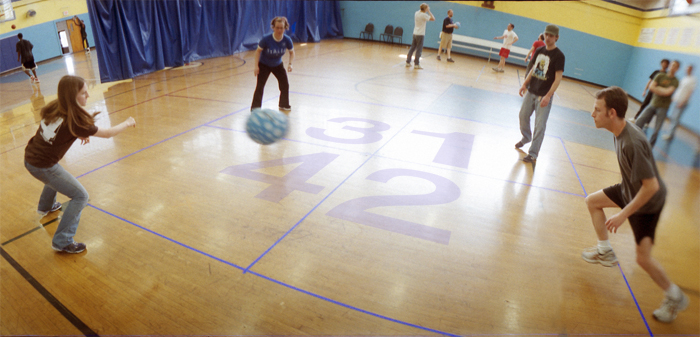
The layout of a four square court.
Players4
Setup time30 seconds
SkillsManual dexterity
Strategy
Social skills

Four square[1] (also called handball, champ, four squares or box ball) is a global sport played on a square court divided by two perpendicular lines into four identical boxes creating four squares labelled 1–4 or A–D.[2]

Four square is a popular game at elementary schools with little required equipment, almost no setup, and short rounds of play that can be ended at any time. The game also has a large following for adults in many communities.

History

[edit]

Four square dates to at least the 1950s. A game called four square is mentioned in newspapers in the northeastern United States at least as far back as the 1950s, but the rules are not explained.[3][4] A 1953 teacher's manual describes four square with the same rules used today.[5] However, it is possible this game could have evolved from "Jeu de paume", a game popular in France as early as the twelfth century.[6]

Rules

[edit]

One player occupies each of the 4 squares at a time; the other players wait in line. The player in square 4 serves the ball into another square. Once the ball bounces into a square, the player who occupies that square must hit the ball into another square with their hands, and so on, until someone gets out. Each time a player gets out, that player leaves the court and enters the back of the line and all remaining players advance to the higher numbered square (if applicable). Square 1 is then filled with a new player from the line of awaiting players.[7]

A player may get out as follows:

  • Failing to hit the ball into another square
  • Allowing the ball to bounce more than once in their own square
  • Hitting the ball out of the squares or hitting a line
  • Hitting the ball incorrectly such as by holding, catching, or carrying
  • Hitting the ball out of turn or committing interference
  • Hitting the ball one handed (in some versions of gameplay)

Variations

[edit]

Four square has inspired other similar games. One example is nine square, which uses a 3-by-3 grid instead of a 2-by-2 grid.[8] The 9 square is the middle and the ball is served from this position. Another version is played similar to the original in that four players occupy their respective spots, but they must keep the ball off the ground like in volleyball.[9]

The game is called King Out in Sweden. A similar schoolyard game is called handball.[10]

World Championships

[edit]

Since 2005, Bridgton, ME, has hosted the annual World Four Square Championships where adults and children compete to determine the world's best four square players.[citation needed]

World records

[edit]

On August 4–5, 2012, a group of 17 Needham High School students and alumni—assisted by 50 other Needham residents at various times—broke the previous world record by playing for 34 hours,[11] the previous record being held by 15 Manchester College students who played the game for 30 hours.[12] The world record was held by eight Argentinean players for 29 hours in 2008, as recognized by Guinness World Records. The Argentinean record was preceded by a group of teens from Youngstown, Ohio, who also played for 29 hours.[13]

Common terms for four square

[edit]

Many terms are used for specific techniques that can be allowed or banned by the primary square:[citation needed]

  • A "sticky" refers to holding the ball. Specified time (in seconds) is decided by the primary square.
  • "Popcorns" are taking the ball and throwing it in the air before hitting it. The amount of popcorns before returning the ball is also decided by the primary square.
  • A "school bus" is when a player calls out said phrase. All player in the four squares must run to the center of the four squares and put their foot at the intersection. The last to do so has lost the round.

See also

[edit]

References

[edit]
[edit]
Revisions and contributorsEdit on WikipediaRead on Wikipedia
from Grokipedia
Four square is a classic playground ball game typically played by four participants, each stationed in one of four equal squares on a marked , where players hit a with their hands into an opponent's square, aiming to force errors that eliminate them and allow advancement to higher-ranked squares. The emphasizes hand-eye coordination, quick reflexes, and strategic play, using a soft that must bounce once in the receiving square before being returned. Originating in the early as an evolution from games like boxball and , four square gained formal structure in the 1930s through programs and became a staple of schoolyards by the 1950s, spreading globally via summer camps and . The game dates to at least the 1950s and was mentioned in newspapers in the during that era; it was often played spontaneously on sidewalks or chalked courts without adult supervision. By the late 1950s, the game had achieved widespread popularity among children, particularly in and , due to its simplicity, low equipment needs—a and a flat surface—and adaptability for various ages starting from elementary . Common playground courts measure 10 feet by 10 feet, divided by perpendicular lines into four 5-foot squares labeled 1 (highest rank, server) through 4 (lowest), with the server initiating play by underhand striking the ball from square 1 into square 4 after a bounce; official competitive courts are 16 feet by 16 feet with 8-foot squares. Key rules prohibit double bounces, carrying or catching the ball, hitting out of turn (poaching), or failing to return the ball into another square after one bounce; violations result in elimination, with the lowest-ranked player rotating out and others advancing. The objective is to reach and maintain square 1, often called the "king" or "royalty," while enforcing or challenging custom rules like "no diagonals" or "blackjacks" (bouncing the ball high off the ground) to heighten competition. Four square's enduring appeal lies in its inclusivity and endless variations, such as team play (two players per square), expanded 9-square grids, or themed rules like "" incorporating overhand smashes, making it suitable for classes, recess, and recreational settings worldwide. It promotes skills like and , with minimal setup costs, and remains a low-barrier activity that evolves with player creativity.

Introduction

Description

Four square is a non-contact game typically played by four players on a divided into four equal squares. The objective is to eliminate opponents by hitting the ball in such a way that it bounces more than once in their square or goes out of bounds, with players aiming to advance to and hold the highest-ranked square. It is commonly enjoyed by elementary schoolchildren in settings like playgrounds and gymnasiums during classes or recess. The game develops key physical skills, including hand-eye coordination, , and quick reflexes, as players must react swiftly to return the ball after it bounces once in their square.

Equipment and court

The standard equipment for four square consists of a soft rubber playground , typically 8.5 inches in . The is a square measuring by , divided into four equal 5-foot by 5-foot squares, with lines marked using , tape, or paint on a flat surface such as or a floor. Numbering conventions vary, but the squares are commonly labeled sequentially from 1 (lowest-ranked) to 4 (highest-ranked, often called "royalty"), with the highest and lowest diagonal to each other. To set up the , draw the dividing lines to create the four quadrants and label them accordingly. Optional accessories include cones to delineate boundaries on unmarked or temporary playing areas and softer foam-covered balls for younger players to help reduce the risk of injury.

History

Origins

Four square emerged in the early 20th century as a popular playground game in the United States, evolving from earlier ball games including handball and the medieval French sport of jeu de paume, which involved striking a ball in confined spaces. Historians trace its development to urban schoolyards where space was limited, leading to adaptations of court-based games like a variation of French lawn tennis divided into four sections. The game's simplicity—requiring only a ball and a marked square court—made it ideal for children, and it quickly spread through informal play among kids before gaining structured recognition. Initially documented in during the early 1900s, four square was played under names such as "boxball" or "square ball," reflecting its origins in or boxed play areas in city centers. By the period around (circa 1914–1918), boxball had become a recognizable form, transforming gradually into the modern version by . These early iterations emphasized basic hitting and bouncing mechanics, often using a on asphalt or surfaces in school environments. Physical education teachers were instrumental in its early adoption, promoting four square as an accessible, inclusive activity that fostered motor skills, coordination, and social interaction among schoolchildren with minimal equipment needs. By the mid-20th century, it appeared in American manuals, such as a 1953 teacher's guide that outlined full rules and encouraged its use in settings to engage diverse groups of students. This endorsement helped solidify its place in educational programs, distinguishing it from more equipment-intensive sports.

Spread and popularity

Following , four square gained significant popularity in the 1950s and 1960s across the and , coinciding with the expansion of public school playground programs amid the era. The game's simplicity and minimal equipment requirements made it ideal for school settings, where it was introduced as a structured activity in elementary education. For instance, in 1953, physical education instructor Howard "Buzz" Wagner formalized rules for the game at Dunlap Elementary School in , contributing to its integration into recess and routines. By the late 1960s, it had become a common playground activity in Canadian schools, such as in , , where variations like "Champ" were played by students. This period marked a surge in adoption due to increased emphasis on outdoor group activities in educational systems. The game's spread accelerated internationally during the 1970s and 1980s, facilitated by youth programs, summer camps, and publications like the "New Games" books that promoted inclusive recreational activities. It reached regions including and the through camp staff exchanges and school curricula adaptations, evolving into a staple of childhood play in urban and suburban playgrounds. In , for example, four square was documented as a daily playground game in multiple s by the late , often played with local variations using rubber balls against walls. Similarly, in the UK, it appeared in resources as an accessible ball-handling exercise suitable for primary schools. Culturally, four square embedded itself in educational and media landscapes, becoming a fixture in physical education curricula to develop motor skills, , and among children. It symbolized unstructured playground fun in depictions of childhood, often evoking for communal play in school settings. The early 2000s marked a revival, driven by organized competitive events that elevated the game beyond casual play. The launch of the Four Square World Championships in 2008 in Bridgton, Maine, attracted participants from multiple countries and formalized rules for tournament play, reigniting interest among youth and adults alike. The event has continued annually as of 2025, supported by online communities and educational resources, helping to sustain four square's global appeal.

Rules and gameplay

Basic rules

Four square is typically played with four players, each occupying one of the four equal squares on the , labeled 1 through 4, with square 1 designated as the highest-ranking position and initial server, and square 4 the lowest; numbering conventions vary, with some sources reversing this. The game begins when the player in square 1 serves the ball by dropping it and striking it underhand after one bounce in their own square, directing it into square 4. Players handle the ball using only open hands—specifically, any part from the wrists to the fingertips—without catching, throwing, carrying, or holding it; the ball must bounce once in a player's square before they hit it into an opponent's square. Only the owner of the square where the ball lands may strike it next, and it must be returned to another square after exactly one bounce. When a player is eliminated due to a fault with exactly four players and no waiting line, they move to square 4 (the lowest rank), the players in squares 1, 2, and 3 advance to the next higher square (3 to 1, 2 to 3, 1 to 2), and the new server in square 1 initiates play. With a waiting line, the eliminated player goes to the end, others advance, and the front of the line enters square 4. This rotation maintains the hierarchy and ensures continuous play. The game has no fixed score or time limit and continues indefinitely until only one player remains in square 1 or participants agree to end it; the player holding square 1 is considered the "king of the court" for that round.

Serving and movement

In four square, the serving process begins with the player in square 1, who acts as the server. This player must bounce the ball once within their own square before striking it underhand into square 4. Serves are required to be underhand to promote fairness and accessibility, particularly in basic playground play, prohibiting overhand hits or spikes during the initial serve. Player movement occurs dynamically through rotation following each rally. Upon elimination, the affected player goes to the back of the waiting line, while the players in the active squares advance to the next higher square (e.g., 4 to 1? Wait, with 1 highest, advance means moving to lower number? No. Wait, if 1 highest, 4 lowest, then advancing means moving from higher number to lower number. So, player in 4 moves to 3? No. Standard: players move "up" to the higher rank square, which if 1 is highest, the squares adjacent are defined. Typically, the layout is square 1 top left (highest), 2 top right, 3 bottom left, 4 bottom right (lowest). When out, all players move to the clockwise or counterclockwise higher square. But to simplify, the text needs adjustment. From squarefour: "all remaining players advance to the next higher square" With 1 highest, next higher from 4 is 3, from 3 is 2, from 2 is 1. So, is towards lower numbers. Yes. In setups with more than four players, a line forms outside square 4, allowing waiting participants to rotate in sequentially as eliminations occur. Successful players who avoid elimination stay in their square or advance upward (to higher rank, lower number), aiming to reach and hold square 1.

Faults and elimination

In Four Square, faults are actions that violate the rules of play, resulting in the immediate elimination of the offending player. The primary faults include allowing the ball to bounce twice within one's own square, hitting the ball beyond the court's lines, or striking the ball before it has bounced once in the receiver's square. Additional basic faults consist of hitting the ball with a closed fist, carrying or throwing the ball rather than cleanly striking it, or allowing the ball to touch any body part other than the hands or arms. When a player commits a fault, they must immediately leave their square, and the remaining players rotate upward to the next higher square (towards square 1), with a new player entering square 4. Standard rules include no mercy provision, meaning there are no warnings or second chances for faults. The game resumes without delay, with the player now occupying square 1 serving the ball underhand into square 4.

Strategies and techniques

Serving strategies

Serving in Four Square provides an offensive opportunity to dictate the pace and placement of play, with strategies focused on exploiting opponent weaknesses through precise targeting and varied delivery. The server in the highest-ranked square (square 1, or the "king") bounces the ball once within their square before striking it underhand into the lowest-ranked square (square 4). Target selection is crucial for maximizing error chances; servers should aim for corners or edges of the receiving square, where the ball is more likely to bounce awkwardly or exit the boundaries, forcing the receiver into a defensive position or fault. This tactic prioritizes accuracy to the weaker areas of the opponent's control, such as away from their center stance, rather than direct hits on the player. Serve types balance control and pressure, always executed underhand to comply with standard rules, but varying in speed and trajectory for tactical advantage. Soft lobs, hit with a gentle arc to land softly in the target square, offer superior control for precise placement near lines or corners, allowing the server to set up difficult returns without risking their own position. In contrast, faster underhand hits generate by minimizing the receiver's preparation time, compelling quicker, less accurate responses—though emphasis remains on strategic placement over sheer to avoid self-faults. These approaches highlight that effective serving relies more on positioning the ball advantageously than on forceful strikes. Certain play styles and variations incorporate mechanisms for building "power," where consecutive successful serves or aces (direct faults on the receiver) permit escalating intensity, such as allowing harder underhand smashes or overhand elements in subsequent volleys. This progression rewards offensive consistency, enabling the server to intensify pressure and disrupt play flow as the rally builds. Psychological tactics enhance serving effectiveness by varying speed and type to unsettle the receiver's rhythm and expectations. Alternating between soft lobs for deceptive control and rapid hits for sudden aggression prevents opponents from settling into a predictable defensive pattern, increasing mental pressure and the probability of unforced errors.

Defensive techniques

Defensive techniques in four square emphasize maintaining control during rallies to prolong play and avoid elimination. Players adopt a centered stance within their square, typically at the back center to maximize reach across the full area while anticipating the of incoming balls from adjacent squares. This positioning allows for quicker adjustments to unpredictable serves or returns, reducing the risk of the ball bouncing twice or going . Effective return control involves using underhand, soft hits to direct the ball low and with a controlled bounce into an opponent's square, ideally targeting their weaker side or less-prepared area to force errors. By keeping shots precise and avoiding excessive force, defenders sustain longer exchanges without committing faults such as double bounces or out-of-bounds hits. This approach shifts pressure back to the attacker, promoting defensive sustainability over aggressive play. Reflex training enhances defensive prowess through drills that sharpen reaction times, such as practicing hand positioning to intercept the cleanly after its single required bounce, thereby preventing body contact faults. These exercises, often incorporated in settings, focus on agile footwork and immediate responses to high-speed or angled shots, building the needed for high-stakes rallies. To build , defenders cultivate mental focus during extended rallies by staying observant of opponents' patterns and conserving through efficient movements rather than frantic lunges. This sustained concentration helps outlast competitors in prolonged games, where fatigue can lead to lapses in or rule violations like improper returns.

Variations

Common rule variations

Common rule variations in Four Square modify the basic gameplay mechanics, often called by the player in the highest square (the "king") to introduce greater challenge, strategic depth, or enjoyment while maintaining the core objective of eliminating opponents through faults such as failing to return the ball properly. These universal add-ons are popular in schoolyards, gyms, and recreational settings, allowing players to customize the game without altering its fundamental structure. One widely adopted variation is , where a player may catch the ball cleanly before it bounces in their square, resulting in the sender being eliminated instead of the receiver committing a fault. This rule encourages aggressive, low-trajectory shots to force errors but requires precise timing to execute the catch legally, and it can be combined with other modifiers like double taps for added complexity. Double-touch, also known as double taps, permits a player to strike the ball twice in succession after it has bounced once in their square, providing an opportunity to control or redirect the shot more effectively before sending it to another square. Unlike the standard rule allowing only one hit per turn, this variation mimics volleyball-style play and is often called to assist less skilled players or to set up trickier returns, though excessive use can lead to disputes if not clearly announced. Power serves introduce intensified hitting options, such as the "" call, where a player grabs the ball after a successful return and hurls it forcefully into any square, often after a sequence of clean plays to build momentum. These can stack with other rules—for instance, combining with double-touch for even harder setups—escalating the game's pace and physical demands while rewarding skillful play, but they must be limited to prevent overuse and ensure safety.

International and regional variants

Regional variations of four square exist but are often undocumented and vary by local customs. In , the game sometimes uses a and includes techniques like "skimmers" (low, fast hits targeting diagonal squares), with serving requiring a bounce in the player's own square first.

Competitive four square

World championships

The World Four Square Championships were established in 2005 in , by organizer Peter Lowell, who initiated the event after discovering a lack of formal competitions through an online search. Hosted annually by the Lakes Environmental Association as a initiative for environmental conservation, the tournament has become the premier competitive gathering for the sport. The championships follow a standardized set of rules adapted for competitive play, featuring single-elimination bracket formats across multiple divisions, including men's, women's, senior, junior, and occasional team categories. Events typically occur in late winter or early spring at venues such as the gymnasium or town hall, with matches emphasizing quick reflexes, strategic serving, and avoidance of faults under timed or untimed rounds depending on the division. Notable editions include the 2008 men's division win by Cody MacDonald from Newfoundland, Canada, marking early international participation, and the 2010 men's title claimed by Christian Housh of , among over 60 competitors. In 2014, secured the men's Division I championship, while Tiffany Terrio won the women's Division I. The 2007 men's champion was Jasper Turner, a math teacher from . All events have been held in Bridgton, underscoring the town's role as the sport's competitive hub. Participation has expanded significantly since inception, growing from dozens of local entrants to over 85 players in the 2025 edition, drawing competitors from across the , , and select international locations. In the 2025 championships held on April 12, the winners included: in the children's division (age 14 and younger), boys' champions Oscar Houghton and Phan Thouret (Whitefield Elementary School) and girls' champions Isabella Gomez-Mancia and Brooke Sullivan (Whitefield Elementary School); in the women's division (age 15 and older), junior champion Brittany Dunay (New York) and senior (over 40) champion Anne Lowell (Bridgton); in the men's division (age 15 and older), junior champion Joseph Henson and senior (over 40) champion Eric Costanza (Northbridge, ). This increase reflects rising interest in organized four square, with the event fostering a of dedicated players while maintaining its roots as an accessible, low-barrier competition.

Notable records

The longest marathon playing four square is 30 hours and 2 minutes, achieved by a team of six players (Alex Grence, Chris Hetzel, Cole Hetzel, Grant McElwee, Andrew Harris, and Matt Harris) in in 2018. holds the record for most world championships won by an individual, with four titles in the men's Division I (2012, 2014, and two others).

Terminology

Positions and roles

In the game of four square, the is divided into four equal squares, typically labeled 1 through 4, with a clear where players advance upward through mechanics upon elimination of a higher-positioned player. Square 1 serves as the highest-ranked position and the server's spot, granting authority over initiating play, while square 4 is the lowest-ranked position and primary for new players joining from the waiting line, making it the most vulnerable spot where beginners can practice basic hitting without the pressure of serving. This square is often targeted by players in higher positions for straightforward eliminates, allowing for quick turnover and maintaining game flow. Square 2 occupies the lowest intermediate level in the hierarchy, providing a transitional space where players build foundational skills in volleying and positioning before advancing further. Responsibilities here focus on returning the ball accurately after one bounce, with the position offering moderate defensive demands compared to the entry level. Players in Square 2 rotate upward to Square 3 upon the elimination of the player ahead, fostering progressive skill development. Square 3 represents an intermediate defensive role, positioned just below the server, where players must exhibit greater control and anticipation to return challenging shots while indirectly pressuring the server through consistent play. This spot demands heightened focus on ball placement to avoid faults, serving as a for players aiming to reach the top. Square 4 holds the lowest rank as the entry position, where new players start and must survive to advance, with the occupant rotating out upon elimination to allow others to progress. Upon reaching square 1, the player controls serve intensity and direction, often directing easier serves to lower squares to facilitate rotation while challenging higher threats, thereby dictating the overall pace and strategic flow.

Game actions and calls

In Four Square, players employ a variety of terms and verbal calls to describe actions, enforce rules, and add excitement to . These terms often vary by region or group but serve to clarify intentions and outcomes during rapid exchanges. Common revolves around serves, hits, and faults, helping players communicate effectively without disrupting the flow. A key action is the "ace," defined as a serve that bounces twice in the receiver's square before they can return it, resulting in an immediate elimination for the receiver. This term highlights the strategic advantage of a well-placed, uncontested serve. The "" refers to a hard, fast serve or spike designed to intimidate and challenge the receiver's ability to respond. Players typically announce "" before executing this powerful overhead or slamming hit, which is permitted in many variations to allow aggressive play while underhand serves remain standard. Verbal calls like "clear" require the ball to fully cross over a line without touching it, ensuring fair play by preventing borderline hits from being contested. Similarly, "stacks" denotes escalating rules where the top player adds successive special conditions (such as no high hits or specific bounce requirements) to increase difficulty as the game progresses. These calls must be declared clearly before the serve to avoid disputes. Regional enriches the game's ; for instance, a "bump" describes a soft, controlled underhand hit to gently direct the ball, often used to set up a teammate or avoid aggressive returns in casual play. Likewise, "out" signals a boundary fault when the ball lands outside the court's lines or fails to stay in play, eliminating the offending player. Such terms, while informal, are essential for quick resolution of faults like double bounces or line violations.

References

Add your contribution
Related Hubs
User Avatar
No comments yet.