



Community hub
Recent from talks
Contribute something
Nothing was collected or created yet.
Overline
View on Wikipedia | This article needs additional citations for verification. (October 2009) |
| Description | Sample | Unicode | CSS/HTML |
|---|---|---|---|
| Overline (markup) |
Xx | — | text-decoration: overline;
|
| Overline (character) |
‾ | U+203E | ‾, ‾
|
| X̅x̅ (combining) | U+0305 | X̅
| |
| Double overline (markup) |
Xx | — | text-decoration: overline;
|
| Double overline (character) |
X̿x̿ (combining) | U+033F | X̿
|
| Macron (character) |
¯ | U+00AF | ¯, ¯
|
| X̄x̄ (combining) | U+0304 | X̄
| |
| X̄x̄ (precomposed) | varies | ||
An overline, overscore, or overbar, is a typographical feature of a horizontal line drawn immediately above the text. In old mathematical notation, an overline was called a vinculum, a notation for grouping symbols which is expressed in modern notation by parentheses, though it persists for symbols under a radical sign. The original use in Ancient Greek was to indicate compositions of Greek letters as Greek numerals.[1] In Latin, it indicates Roman numerals multiplied by a thousand and it forms medieval abbreviations (sigla). Marking one or more words with a continuous line above the characters is sometimes called overstriking, though overstriking generally refers to printing one character on top of an already-printed character.
An overline, that is, a single line above a chunk of text, should not be confused with the macron, a diacritical mark placed above (or sometimes below) individual letters. The macron is narrower than the character box.[2]
Uses
[edit]Medicine
[edit]In most forms of Latin scribal abbreviation, an overline or macron indicates omitted letters similar to use of apostrophes in English contractions. Letters with macrons or overlines continue to be used in medical abbreviations in various European languages, particularly for prescriptions. Common examples include
- a, a̅, or ā for ante ("before")
- c, c̅, or c̄ for cum ("with")
- p, p̅, or p̄ for post ("after")[3]
- q, q̅, or q̄ for quisque and its inflections ("every", "each")
- s, s̅, or s̄ for sine ("without")
- x, x̅, or x̄ for exceptus and its inflections ("except")
Note, however, that abbreviations involving the letter h take their macron halfway up the ascending line rather than at the normal height for Unicode overlines and macrons: ħ. This is separately encoded in Unicode with the symbols using bar diacritics and appears shorter than other overlines in many fonts.
Math and science
[edit]Decimal separator
[edit]In the Middle Ages, from the original Indian decimal writing, before printing, an overline over the units digit was used to separate the integral part of a number from its fractional part, as in 9995 (meaning 99.95 in decimal point format). A similar notation remains in common use as an underbar to superscript digits, especially for monetary values without a decimal separator, as in 9995.[citation needed]
Vinculum
[edit]In mathematics, an overline can be used as a vinculum.
The vinculum can indicate a line segment:[4]The vinculum can indicate a repeating decimal value: When it is not possible to format the number so that the overline is over the digit(s) that repeat, one overline character is placed to the left of the digit(s) that repeat: Historically, the vinculum was used to group together symbols so that they could be treated as a unit. Today, parentheses are more commonly used for this purpose.




Statistics
[edit]The overline is used to indicate a sample mean:[5]
- is the average value of


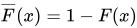
Survival functions or complementary cumulative distribution functions are often denoted by placing an overline over the symbol for the cumulative: .
Negation
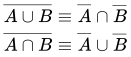
[edit]In set theory and some electrical engineering contexts, negation operators (also known as complement) can be written as an overline above the term or expression to be negated.[6] For example:
Common set theory notation:
Electrical engineering notation:
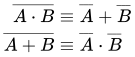
in which the dot means logical AND, and the plus sign means logical OR.
Both illustrate De Morgan's laws and its mnemonic, "break the line, change the sign".
Negative
[edit]In common logarithms, a bar over the characteristic indicates that it is negative—whilst the mantissa remains positive. This notation avoids the need for separate tables to convert positive and negative logarithms back to their original numbers.

Complex numbers
[edit]The overline notation can indicate a complex conjugate and analogous operations.[7]
- if , then


Vector
[edit]In physics, an overline sometimes indicates a vector, although boldface and arrows are also commonly used:

Congruence classes
[edit]Congruence modulo n is an equivalence relation, and the equivalence class of the integer a, denoted by an, is the set {... , a − 2n, a − n, a, a + n, a + 2n, ...}. This set, consisting of all the integers congruent to a modulo n, is called the congruence class, residue class, or simply residue of the integer a modulo n. When the modulus n is known from the context, that residue may also be denoted [a] or a.
Topological closure
[edit]In topology, the closure of a subset S of a topological space is often denoted S or .

Improper rotation
[edit]In crystallography, an overline indicates an improper rotation or a negative number:
- is the Hermann–Mauguin notation for a threefold rotoinversion, used in crystallography.
- is the direction with Miller indices , , .

![{\displaystyle [{\overline {1}}1{\overline {2}}]}](https://wikimedia.org/api/rest_v1/media/math/render/svg/aeb3455d75c86601595264c262be0d75d03f5888)


Maximal conductance
[edit]In computational neuroscience, an overline is used to indicate the "maximal" conductances in Hodgkin-Huxley models. This goes back to at least the landmark paper published by Nobel prize winners Alan Lloyd Hodgkin and Andrew Fielding Huxley around 1952.[8]

Antiparticles
[edit]Overlines are used in subatomic particle physics to denote antiparticles for some particles (with the alternate being distinguishing based on electric charge). For example, the proton is denoted as p, and its corresponding antiparticle is denoted as p.
Engineering
[edit]An active low signal is designated by an overline, e.g. RESET, representing logical negation.
Graphics Design
[edit]Overlining is also used in graphics design for decoration of text to help convey a message.[9]
Morse (CW)
[edit]Some Morse code prosigns can be expressed as two or three characters run together, and an overline is often used to signify this. The most famous is the distress signal, SOS.
Writing
[edit]An overline-like symbol is traditionally used in Syriac text to mark abbreviations and numbers. It has dots at each end and the center. In German it is occasionally used to indicate a pair of letters which cannot both be fitted into the available space (also see the use of macron in German writing).[10][11]
When Morse code is written out as text, overlines are used to distinguish prosigns and other concatenated character groups from strings of individual characters.
In Arabic writing and printing, overlines are traditionally used instead of underlines for typographic emphasis,[12] although underlines are used more and more due to the rise of the internet.

Linguistics
[edit]X-bar theory makes use of overbar notation to indicate differing levels of syntactic structure. Certain structures are represented by adding an overbar to the unit, as in X. Due to difficulty in typesetting the overbar, the prime symbol is often used instead, as in X′. Contemporary typesetting software, such as LaTeX, has made typesetting overbars considerably simpler; both prime and overbar markers are accepted usages. Some variants of X-bar notation use a double-bar (or double-prime) to represent phrasal-level units.
X-bar theory derives its name from the overbar. One of the core proposals of the theory was the creation of an intermediate syntactic node between phrasal (XP) and unit (X) levels; rather than introduce a different label, the intermediate unit was marked with a bar.
Implementations
[edit]HTML with CSS
[edit]In HTML using CSS, overline is implemented via the text-decoration property; for example, <span style="text-decoration: overline">text</span> results in: text.
The text decoration property supports also other typographical features with horizontal lines: underline (a line below the text) and strikethrough (a line through the text).
Unicode
[edit]Unicode includes two graphic characters, U+00AF ¯ MACRON and U+203E ‾ OVERLINE. They are compatibility equivalent to the U+0020 SPACE with non-spacing diacritics U+0304 ◌̄ COMBINING MACRON and U+0305 ◌̅ COMBINING OVERLINE respectively; the latter allows an overline to be placed over any character. There is also U+033F ◌̿ COMBINING DOUBLE OVERLINE. As with any combining character, it appears in the same character box as the character that logically precedes it: for example, x̅, compared to x‾. A series of overlined characters, for example 1̅2̅3̅, may result either in a broken or an unbroken line, depending on the font.
In Unicode, character U+FE26 COMBINING CONJOINING MACRON is conjoining (bridging) two characters: ◌︦◌.
In East Asian (CJK) computing, U+FFE3  ̄ FULLWIDTH MACRON is available. Despite the name, Unicode maps this character to both U+203E and U+00AF.[13]
Unicode maps the overline-like character from ISO/IEC 8859-1 and code page 850 to the U+00AF ¯ MACRON symbol mentioned above. In a reversal of its official name (and compatibility decomposition), it is much wider than an actual macron diacritic over most letters, and actually wider than U+203E ‾ OVERLINE in most fonts. In ChromeOS and Linux, the symbol can be added using the keystrokes Ctrl+⇧ Shift+U to activate Unicode input, then type "00AF" as the code for the character. On a Mac, with the ABC Extended keyboard, use ⌥ Option+a. In Microsoft Windows, U+00AF can be entered with the keystrokes Alt+0175 (where numbers are entered from the numeric keypad).
The Unicode character U+070F SYRIAC ABBREVIATION MARK is used to mark Syriac abbreviations and numbers. However, several computer environments do not render this line correctly or at all.
The Unicode character U+0B55 ୕ ORIYA SIGN OVERLINE is used as a length mark in Odia script.
Word processors
[edit]Collabora Online, an office suite for the web has direct menu support for several styles of Overline in the "Format" menu, with options available under "Format > Character" enabling the default solid Overline to be replaced with double overline, dots, dashes, waves, double waves, and the color of the Overline can be set.
Collabora Office and LibreOffice have direct menu support for several styles of Overline in the "Format" menu. The user-interface option is available in their word processors on Linux, macOS and Windows, and also in Android (in tablet format), ChromeOS and iPadOS with Collabora Office. Options for Overline are available under the menu: "Format > Character", enabling the default solid Overline to be replaced with double overline, dots, dashes, waves, double waves, and the color of the Overline can be set.
Microsoft Word does not have a menu option to edit Overlining in Microsoft Word for any operating system, or in Word for the web. Overlining can be added using fields codes, EQ \O(). The field code {EQ \O(x,¯)} produces x and the field code {EQ \O(xyz,¯¯¯)} produces xyz; However this does not work in Word on Android, ChromeOS, iPadOS, or Word for the web. In Word 2010 it is necessary to insert an MS Equation object.
Overstriking of longer sections of text, such as in 123, can also be produced in many text processors as text markup as a special form of understriking.
Spreadsheet, Presentation and Graphics office suite applications
[edit]Collabora Online, Collabora Office and LibreOffice have direct menu support for several styles of Overline in the "Format" menu within applications of their office suites, including spreadsheets, presentations and graphics applications. The user-interface option is available in the web based suite, and the locally installable applications for Linux, macOS and Windows, and with Collabora Office in Android (in tablet format), ChromeOS and iPadOS. Options for Overline are available under the menu: "Format > Character", enabling the default solid Overline to be replaced with double overline, dots, dashes, waves, double waves, and the color of the Overline can be set.
TeX
[edit]In LaTeX, a text <text> can be overlined with $\overline{\mbox{<text>}}$. The inner \mbox{} is necessary to
override the math-mode (here invoked by the dollar signs) which the \overline{} demands.
See also
[edit]
- Ā
- Titlo, an overline used to indicate numerals or abbreviations in Cyrillic
- Underscore
References
[edit]- ^ Smith, T. P. (2013). How Big is Big and How Small is Small: The Sizes of Everything and Why.
- ^ Wells, J.C. (2001). "Orthographic diacritics and multilingual computing". University College London. Retrieved 23 March 2014.
- ^ Cappelli, Adriano (1961). Manuali Hoepli Lexicon Abbreviature Dizionario Di Abbreviature Latine ed Italiane. Milan: Editore Ulrico Hoepli Milano. p. 256.
- ^ "Line Segment Definition - Math Open Reference". www.mathopenref.com. Retrieved 2020-08-24.
- ^ "Sample Means". www.stat.yale.edu. Retrieved 2020-08-24.
- ^ "Set Operations | Union | Intersection | Complement | Difference | Mutually Exclusive | Partitions | De Morgan's Law | Distributive Law | Cartesian Product". www.probabilitycourse.com. Retrieved 2020-08-24.
- ^ Weisstein, Eric W. "Complex Conjugate". mathworld.wolfram.com. Retrieved 2020-08-24.
- ^ Hodgkin, A. L.; Huxley, A. F. (1952). "A quantitative description of membrane current and its application to conduction and excitation in nerve". The Journal of Physiology. 117 (4): 500–544. doi:10.1113/jphysiol.1952.sp004764. PMC 1392413. PMID 12991237.
- ^ "Overline vs: Underline: Unraveling the Differences". Faster Capital. 18 June 2024. Retrieved 8 September 2024.
- ^ Hardwig, Florian (2011-11-23). "Gräfinnen". Flickr. Retrieved 26 December 2017.
- ^ Hardwig, Florian (2015-12-26). "Lieder zur Weihnachtszeit (1940)". Fonts in Use. Retrieved 26 December 2017.
It used to be common to mark omitted double letters with an overbar, especially for "mm" and "nn". These abbreviations come in handy when lyrics have to match the musical notes, see 'da kom[m]t er her'.
- ^ "Emphasis (typography)". Emphasis (typography). Retrieved 2020-09-02.
- ^ The Unicode Consortium (2012), "Halfwidth and Fullwidth Forms" (PDF), The Unicode Standard 6.1, Unicode Consortium, ISBN 978-1-936213-02-3,
FULLWIDTH MACRON • sometimes treated as fullwidth overline
Overline
View on GrokipediaEtymology and History
Etymology
The term "vinculum" originates from the Latin word vinculum, meaning "bond," "chain," or "tie," which aptly describes its function in mathematics as a line that binds or groups symbols together.[8] "Overline" and "overscore" are modern English descriptive terms referring to the placement of the line above text, while "overbar" emphasizes its bar-like appearance in notation. These terms evolved in the context of printing and typography to distinguish the feature from underlining or other diacritics.Origins in Ancient Notation
The overline, known historically as a vinculum, first appeared in ancient Greek manuscripts as a diacritical mark to distinguish sequences of letters representing numerals from ordinary words, facilitating clarity in mathematical and numerical contexts.[9] In works such as those of Heron of Alexandria around the 1st century AD, overlines and accents were employed in fraction notation, with single accents over numerators and double accents over denominators to denote unit fractions and divisions, as seen in his Metrica where such marks clarified reciprocal values in geometric calculations.[9] This usage extended to Roman manuscripts, where an overline above a numeral indicated multiplication by 1,000, with the earliest known example dating to approximately 50 BC in Cicero's De republica, allowing representation of larger quantities like CXX̅ for 120,000.[10] In medieval Arabic mathematics, vinculum-like notations emerged for grouping terms and marking fractions in algebraic expressions, building on earlier verbal traditions but incorporating horizontal bars for separation, as evidenced in 12th- and 13th-century texts influenced by foundational algebra from the 9th century onward.[11] Although Al-Khwarizmi's Al-Kitab al-mukhtasar fi hisab al-jabr wal-muqabala (c. 820 AD) relied primarily on rhetorical descriptions without symbolic overlines, later Arabic algebraists like al-Hassar (c. 1200) adopted horizontal bars between numerator and denominator for fractions, enhancing the vinculum's role in systematic equation solving.[9] The transition from handwritten overlines to early printed forms occurred during the incunabula period in the late 15th century, when printers reproduced manuscript notations in mathematical works but often simplified or omitted bars due to typographic challenges with movable type.[11] For instance, Erhard Ratdolt's 1482 edition of Euclid's Elements incorporated overlines from Greek and Latin sources for numerals and divisions, preserving ancient conventions while adapting them to print, though inconsistencies arose as seen in subsequent editions like those omitting bars in ordinary fractions.[9] This marked the vinculum's evolution into a standardized typographic element, briefly referencing its later mathematical role as a grouping symbol akin to parentheses.Evolution in Printing and Typewriting
The overline, a horizontal line placed above characters, transitioned from handwritten manuscripts to mechanical printing in the mid-15th century, primarily as a mark for abbreviations in Latin texts. In Johannes Gutenberg's 42-line Bible, printed around 1455 using movable lead type, overlines approximated scribal conventions for vowel length and omitted letters, such as in sacred names or common words, to save space and mimic the aesthetic of illuminated manuscripts. This adaptation highlighted the challenges of replicating fine diacritical details with coarse metal type, often resulting in thicker or irregular bars achieved by combining type elements or manual inking.[12] By the late 15th century, the overline appeared in early printed mathematical texts, where it served as a vinculum for grouping terms, evolving from manuscript notations. Regiomontanus (Johannes Müller von Königsberg), a pioneer in scientific printing, incorporated linear marks in his works like the 1474 Ephemerides and posthumously published De triangulis omnimodis (1533), using dashes and strokes to denote operations and aggregation, with implied overlines for roots and proportions in correspondence and tables. These lead type approximations, printed in Nuremberg around 1471–1476, marked a shift toward standardized mathematical notation, though inconsistencies arose due to type limitations, such as varying line thickness or alignment issues in complex expressions.[9][13] The 19th century brought further challenges with the advent of typewriters, which initially lacked dedicated keys for overlines, relying on manual innovations for technical writing. Early models like the 1870s Remington featured basic alphanumeric sets, but by the 1890s, Underwood typewriters—introduced in 1896 as the first successful frontstroke design—incorporated accent keys and overstrike techniques, allowing users to type a character, backspace, and strike a short bar or underline approximation to create overlines for diacritics or symbols in engineering and scientific documents. These adaptations, while imprecise and time-consuming, enabled broader use in professional settings, with special platen adjustments or custom type slugs for precise alignment in Underwood No. 1 and No. 5 models.[14][15] Standardization of the overline gained momentum in the early 20th century through international bodies addressing inconsistencies in diacritic reproduction across printing and typing technologies. The International Federation of the National Standardizing Associations (founded 1926, precursor to ISO) contributed to uniform character sets in multilingual printing.Typographic and Linguistic Uses
In Proofreading and Editorial Practices
In traditional proofreading, the overline functions as a key symbol for indicating deletions of spaces or the need to "close up" text, where a curved line or loop is drawn connecting the characters across the offending space to signal removal of gaps between words or characters. This mark is commonly paired with deletion symbols to refine spacing in manuscripts and print galleys, ensuring tight typographic alignment. The Chicago Manual of Style has standardized this usage since its inaugural 1906 edition, defining it as part of operational signs for copyediting, with the close-up mark illustrated to eliminate excess space.[16] During the 19th century, proofreading practices relied on notations to manage spacing and adjustments in composed type, evolving from hand-set printing conventions where such marks facilitated rapid corrections in high-volume editorial workflows. These techniques addressed common issues like unintended separations in text blocks, predating formal standardization but laying the groundwork for modern symbols. In contemporary digital editing environments, though automated features such as track changes have diminished the routine application of traditional marks to legacy or stylistic contexts.In Phonetics and Stress Marking
In phonetics, the overline, or macron (¯), functions as a diacritic to indicate vowel length, particularly in Indo-European languages where duration distinguishes meaning. In representations of Classical Latin, long vowels are marked with a macron above the letter, such as ā for /aː/, ē for /eː/, and ō for /oː/, aiding pronunciation and morphological analysis. This modern usage evolved from the ancient Roman apex, a slanted mark similar to an acute accent placed over vowels to denote length in inscriptions from the late Roman Republic, including examples from the 1st century BCE.[17] The apex appears in epigraphic evidence, such as monumental texts, confirming its role in marking select long vowels for clarity in public or formal writing.[18] The macron differs from diacritics like the acute accent (´), which typically signals stress, rising tone, or pitch rather than duration. For instance, in Polynesian languages like Hawaiian, the macron—known as kahakō—specifically denotes long vowels that alter word meaning (e.g., ka lā "the sun" vs. kalā "the money"), while the glottal stop is represented separately by the ʻokina (ʻ).[19] This distinction ensures precise phonetic transcription, avoiding confusion with acute-based systems in languages like French or Spanish, where the acute marks stressed syllables (e.g., café). In Samoan, a related Polynesian language, the macron similarly highlights elongated vowels, reinforcing prosodic patterns essential to oral tradition and poetry.[20] In proofreading linguistic texts, overlines may briefly note insertions of stress or length diacritics for editorial accuracy.In Graphic Design and Layout
In graphic design, the overline functions as a typographical embellishment that draws a horizontal line immediately above text to provide emphasis, establish visual hierarchy, or enhance readability without disrupting the baseline flow.[6] This technique contrasts with underlines by positioning the line superiorly, allowing designers to balance decorative elements in layouts while maintaining legibility.[21] During the 20th century, overlined typography gained prominence in graphic design movements, where it was employed to add structure and visual interest to headlines and logos through varied line styles such as solid or decorative variants.[22] Since the release of Adobe Illustrator in 1987, graphic designers have utilized its vector-based tools to create horizontal lines above text, enabling precise control over line placement and integration with typographic elements.[23] This capability has supported the creation of sophisticated logotypes where overlined accents contribute to brand identity and aesthetic cohesion. In contemporary UI/UX design, overlined text highlights blocks or annotations by drawing attention to secondary information, such as captions or labels, without overwhelming primary content. For instance, Google's Material Design specifies overline as the smallest text size for sparingly annotating imagery or introducing topics, often paired with sans-serif fonts for clarity.[24] CSS styling further facilitates this in digital interfaces, applying overlines to emphasize elements visually while adhering to accessibility standards.Mathematical Uses
As Vinculum for Grouping and Fractions
In mathematics, the overline, also known as a vinculum, functions as a horizontal bar placed above an expression to denote grouping, treating all elements beneath it as a unified term. For instance, represents the product , ensuring that the grouped symbols are evaluated together before further operations.[25] This notation originated from the Latin term vinculum, meaning "bond" or "tie," emphasizing its role in binding mathematical components.[25] In the context of fractions, the overline serves as the horizontal bar that separates the numerator from the denominator while simultaneously acting as a grouping symbol, clarifying the scope of operations within each part. For example, in a complex fraction like , the vinculum groups as the numerator, preventing misinterpretation of the addition's precedence.[26] This dual purpose distinguishes the vinculum from mere division lines in inline notations, as it enforces structural unity in arithmetic expressions.[27] Historically, the vinculum evolved from inline or underline forms in medieval mathematical texts to the modern overline usage in arithmetic, with the shift occurring prominently in the 17th century. The earliest recorded use of the overline vinculum for grouping appears in the works edited by Frans van Schooten in 1646, where it was applied to algebraic expressions such as to indicate multiplication of the grouped term.[28] This development addressed limitations in earlier notations, like those of Nicolas Chuquet in 1484, who employed underlines for similar purposes but in a less compact manner.[28] By the 18th century, as documented in standard histories of notation, the overline had become a preferred tool for arithmetic clarity, exemplified in expressions like treated as a single operand in larger calculations. (Cajori, A History of Mathematical Notations, Vol. 1, p. 152) The vinculum differs from parentheses by offering a more streamlined visual grouping without enclosing symbols, which is particularly advantageous in compact notations for continued fractions. In such contexts, an overline can span nested fractional terms to denote the entire structure as a cohesive unit, reducing clutter in extended expressions like infinite or periodic continued fractions.[29] This efficiency has persisted in modern mathematical writing, where the vinculum prioritizes readability in dense arithmetic over the bulkier paired brackets.[25]For Repeating Decimals
In mathematics, the overline, also known as a vinculum, is employed to indicate the repeating or periodic portion of a non-terminating decimal expansion. This notation allows for a compact representation of infinite sequences that cycle through a fixed set of digits after the decimal point. For instance, the decimal expansion of , which is 0.333..., is denoted as .[30] The overline notation for repeating decimals developed in the 17th century as an extension of the vinculum for grouping, becoming more standardized in the 18th century.[31] This notation extends naturally to longer repeating sequences, capturing the full repetend—the block of digits that repeats indefinitely. A classic example is the decimal for , which expands to 0.142857142857..., written as .[30] Such representations are particularly useful for rational numbers whose denominators, in lowest terms, contain prime factors other than 2 or 5, leading to non-terminating but periodic decimals. The overline's application here builds on its role as a vinculum for grouping in fractional expressions, providing a visual cue for the bounded repeating unit.[9] To convert a repeating decimal to its equivalent fraction, an algebraic method leveraging the properties of geometric series is commonly used. Consider , where is a single repeating digit from 1 to 9. Multiplying both sides by 10 yields . Subtracting the original equation gives , simplifying to , so . For example, .[30] This approach generalizes to longer repetends by multiplying by a power of 10 corresponding to the repetend's length, effectively isolating the repeating block through subtraction and solving the resulting linear equation.[30]Denoting Negation and Logical Complements
In the context of Boolean algebra, introduced by George Boole in his 1854 work An Investigation of the Laws of Thought, negation represents a fundamental operation that inverts the truth value of a proposition, forming the basis for algebraic treatments of logic.[32] This framework treats logical statements as variables taking binary values, with negation as the complement relative to the universal true value. In propositional logic, the overline notation or denotes the negation of a proposition , meaning "not ."[33] This symbol indicates that the truth value of is the opposite of : if is true, then is false, and vice versa. The implications are captured in the following truth table:| True | False |
| False | True |
In Advanced Algebraic Structures
In advanced algebraic structures, the overline notation plays a crucial role in denoting the complex conjugate within the field of complex numbers , which extends the real numbers and admits a non-trivial automorphism fixing . For a complex number with and , the conjugate is defined as . This operation is an involution, satisfying , and preserves addition and multiplication: and . A fundamental property is , where denotes the modulus, establishing the Euclidean norm essential for inner product spaces and field norms in algebraic number theory.[36] Historically, in 19th-century treatments of Euclidean vector spaces before the arrow notation became standard, an overline was used to indicate vectors or directed quantities, often denoting magnitude or direction in geometric algebra. This pre-vector calculus usage, prevalent in texts on quaternions and linear algebra, bridged scalar and vectorial concepts in multidimensional spaces, as documented in early analytical geometry. In the algebraic framework of symmetry groups, particularly finite point groups isomorphic to subgroups of the orthogonal group , the overline distinguishes improper rotations, which reverse orientation, from proper rotations in the special orthogonal group . The Hermann-Mauguin notation, standard in group-theoretic crystallography, places a bar over the fold number for rotoinversion axes, such as for a 3-fold improper rotation combining a 120° rotation with inversion through a point. This notation, introduced by Carl Hermann and Charles-Victor Mauguin in the early 20th century, algebraically encodes the determinant -1 of improper isometries, essential for classifying chiral and achiral structures in representation theory. Examples include the tetrahedral group , where improper rotations generate the full symmetry, contrasting with the rotation subgroup .[37]Scientific and Engineering Applications
In Statistics and Data Representation
In statistics, the overline is commonly employed to denote the sample mean, a key summary statistic that estimates the population mean from a finite set of observations. The sample mean, denoted as , is formally defined as , where are the individual data points and is the sample size. This notation gained prominence through the work of Ronald A. Fisher, who first introduced in his 1912 paper on frequency curves and consistently applied it in his influential 1925 book Statistical Methods for Research Workers, establishing it as a standard convention in statistical practice.[38][39] The overline notation extends beyond arithmetic means to other aggregated statistics, such as the pooled proportion in hypothesis testing for binomial distributions, denoted as , which represents the combined success rate across multiple samples or trials. For instance, in hypothesis testing for proportions, serves as the pooled estimate from multiple groups, calculated as the total successes divided by total trials, facilitating comparisons under the null hypothesis of equal population proportions. This usage aligns with the overline's role in indicating empirical averages derived from data, as seen in standard inferential procedures for categorical outcomes.[40] In data visualization and tabular presentations, the overline visually distinguishes sample-based summaries from population parameters; for example, or appears in statistical tables to label computed averages, while the Greek letter (or for proportions) denotes the true population value. This convention aids clarity in exploratory data analysis, such as box plots where the sample mean may be overlaid as a marked point (often a diamond or cross) separate from the median line, emphasizing the distinction between observed data aggregates and theoretical parameters.[41]In Physics and Particle Notation
In topology, the overline notation denotes the closure of a subset of a topological space, written as , which is defined as the smallest closed set containing . This is equivalently the intersection of all closed sets that contain , and it includes along with all its limit points.[42] In metric spaces, such as the real numbers equipped with the Euclidean metric, the closure operation captures adherence to limit points; for instance, the closure of the rational numbers is , as every real number serves as a limit point approachable by a sequence of rationals.[42] In particle physics, the overline is conventionally used to denote antiparticles, with representing the antiproton, which has the same mass as the proton but opposite charge and baryon number.[43] This notation emerged following Paul Dirac's 1928 formulation of a relativistic wave equation for the electron, which predicted the existence of antiparticles as solutions with negative energy interpreted as positive-energy particles of opposite charge.[44] Antiparticles are related to their counterparts via charge conjugation, a symmetry operation that reverses electric charge and related quantum numbers, preserving other properties like mass and spin.[43] In quantum mechanics, particularly within the study of mesoscopic systems in the 1990s, the overline denotes the ensemble average of conductance, , which describes the typical electrical transport behavior in disordered nanostructures where quantum interference effects dominate. Developments in this era, leveraging random-matrix theory, revealed that remains universal and of order the quantum of conductance despite sample-to-sample variations, as seen in analyses of scattering matrices where the average informs conductance calculations.[45] In the context of signal processing in physics, negative frequencies arise in Fourier representations of real-valued waves, where they correspond to components rotating clockwise in the complex plane, ensuring Hermitian symmetry such that the spectrum at is the complex conjugate of that at .[46]In Engineering Schematics and Diagrams
In digital logic design, the overline serves as a standard notation for denoting logical negation or the complement of a signal or expression in circuit schematics. This convention represents the NOT operation, where indicates the inversion of input A, and more complex expressions like denote the negation of the AND operation, equivalent to a NAND gate. The use of overline in Boolean schematics stems from the application of Boolean algebra to relay and switching circuits, as pioneered in Claude E. Shannon's 1938 master's thesis, which laid the groundwork for modern digital engineering despite employing prime notation (e.g., A') for negation in its original form; the overline became the prevalent symbol in subsequent standards for clarity in diagrams.[47][48] In electrical engineering blueprints and schematics, buses aggregate multiple wires or conductors into a single symbolic path for multi-wire connections, typically represented by thick lines, double lines, or labeled paths per IEEE Std 315-1975 (reaffirmed 1993). Overlines or bars are used in logic contexts to indicate inverted (active-low) signals on such buses, aligning with practices in ANSI/IEEE Std 91-1984 for logic circuit diagrams where bars denote negative logic on multi-bit lines. This notation enhances readability in complex designs, such as integrated circuits or power systems, by visually grouping related conductors without drawing each individually.[49][50] Within control systems engineering, overlines appear in digital implementations to signify negation of signals, as in general digital logic. Such usage supports precise representation in schematic block diagrams, including those for closed-loop configurations.[51][52]Specialized Field Applications
In Medicine and Pharmacy Abbreviations
In medicine and pharmacy, the overline serves as a diacritical mark in shorthand abbreviations derived from Latin terms, facilitating concise notation in prescriptions and clinical records.[53] One common example is , representing "cum" meaning "with," often used to indicate that a medication should be taken alongside food or another substance.[53] Another is , an abbreviation for "recipe" meaning "take," which forms the basis of the modern prescription symbol ℞ and directs the compounding or dispensing of the prescribed item. These overline notations originated in Latin medical texts for brevity, with their use standardized in pharmacopeias and manuscripts by the 16th century, as seen in early modern European works emphasizing efficient documentation in apothecary practices. For instance, such abbreviations appear in 16th-century prescription records to streamline instructions amid the era's reliance on handwritten Latin directions. In contemporary practice, regulatory bodies caution against overline abbreviations in electronic prescribing due to risks of misinterpretation, such as poor rendering in digital systems or confusion with similar symbols. The U.S. Food and Drug Administration (FDA), in guidelines from the 2000s, recommends avoiding Latin-derived abbreviations like these to enhance patient safety, aligning with broader efforts by the Institute for Safe Medication Practices (ISMP) to eliminate error-prone notations. This shift promotes full spelling in electronic health records, though overlines persist in some proofreading contexts within medical journals to denote corrections without altering original text.In Telegraphy and Morse Code
In Morse code, an overline is employed in written notation to indicate prosigns, which are procedural signals formed by combining two or more characters transmitted as a single, continuous element without the usual inter-character spacing. This distinguishes them from standard abbreviations and ensures they are interpreted as unified commands during transmission, such as \overline{AR} for "end of message" or \overline{SK} for "end of contact."[54][55] The International Morse Code, standardized by the International Telegraph Union (now ITU) at the 1865 International Telegraphy Congress in Paris, incorporated such procedural elements into global telegraphy practices, where the overline visually conveys the rhythmic continuity of the signal—dashes lasting three time units compared to one for dots—to operators decoding messages in real-time.[56] This notation facilitated efficient communication in 19th-century telegrams, allowing telegraphers to encode instructions like message breaks or invitations to transmit without ambiguity in the flow of dots and dashes.[57] In continuous wave (CW) telegraphy, prevalent in amateur radio, the overline retains this role for denoting prolonged key-down periods in prosigns, maintaining the historical timing ratios where a dash represents a three-unit key closure to produce the extended tone, essential for clear signal differentiation amid potential interference.[58] This practice underscores the overline's function in visualizing the temporal structure of transmissions, from early wire-based systems to modern radio operations.Digital Implementations
Unicode and Character Encoding
The overline is represented in Unicode through two primary code points: U+0305 for the combining overline (◌̅), a non-spacing diacritic mark that attaches to the preceding base character, and U+203E for the spacing overline (‾), a standalone punctuation character.[59][60] Both were introduced in Unicode version 1.1, released in June 1993, to support mathematical and linguistic notations requiring horizontal bars above text elements.[61][62] Unicode maintains synchronization with the ISO/IEC 10646 standard, ensuring identical code point assignments for universal character representation across systems.[63] As compatibility characters, both U+203E and related diacritics like the macron (U+00AF ¯) undergo canonical or compatibility decomposition; for instance, U+203E decomposes to a space (U+0020) followed by the combining overline (U+0305), while U+00AF decomposes to a space followed by the combining macron (U+0304), facilitating normalization and interchange in legacy systems.[64][65] In bidirectional text processing, the overline characters are classified as Other Neutral (ON) in the Unicode Bidirectional Algorithm, meaning they inherit directionality from surrounding strong directional characters without initiating a new embedding level, which can lead to visual misalignment in mixed left-to-right and right-to-left contexts if not properly isolated.[62][66] Font rendering of the combining overline (U+0305) in UTF-8 encoded streams often encounters issues, such as incomplete connection across multiple base characters or inconsistent positioning due to varying font support for diacritic stacking and ligature formation, potentially resulting in fragmented or offset bars in applications lacking advanced OpenType features.[67][59]Web Technologies (HTML and CSS)
In web technologies, overlines can be rendered on text using CSS properties, primarily through thetext-decoration shorthand, which has supported the overline value since CSS Level 1 in 1996. This property applies a horizontal line above the text, as shown in the following example:
p {
  text-decoration: overline;
}
p {
  text-decoration: overline;
}
<p>This text has an overline above it.</p>
<p>This text has an overline above it.</p>
overline keyword specifies the line type within text-decoration-line, a longhand property introduced in CSS Text Decoration Module Level 3, allowing finer control alongside values like underline or line-through. Browser support for text-decoration: overline is broad, with compatibility in Chrome from version 4 (2008), Firefox from 2 (2006), Safari from 3.1 (2008), and Edge from 12 (2015), though earlier implementations adhered strictly to CSS2 definitions without separate styling or coloring options.[68]
For inline overlines on specific characters, HTML provides the ¯ entity, which represents the spacing macron (U+00AF), a horizontal overline character suitable for notations like mathematical variables or abbreviations.[69] This entity renders as ¯ and can be used directly in markup, for example:
The variable <span>¯x</span> denotes the mean value.
The variable <span>¯x</span> denotes the mean value.
text-decoration: overline, including inconsistent line positioning relative to text baselines and failure to span across inline child elements, issues that were largely resolved with improved CSS compliance in IE9 released in 2010.[71] These compatibility challenges necessitated vendor-specific workarounds, such as using border properties on wrapper elements, until modern browsers standardized the behavior.[72]
Typesetting and Document Processing (TeX and Word Processors)
In TeX and LaTeX, the overline is implemented primarily through the\overline{} command, which draws a horizontal line above its argument in math mode, suitable for denoting means, complexes, or limits in mathematical expressions. This command, part of the core math typesetting primitives, stretches the line to match the width of the content, ensuring proper coverage for single symbols or extended expressions like \overline{ABC}. Developed as part of Donald Knuth's TeX system, first released in 1978, these features leverage Metafont for precise font rendering, allowing high-quality output in professional documents such as academic papers and books.[73]
In word processors like Microsoft Word, overlines are added via the equation editor, accessible through Insert > Equation, where users select the overbar accent from the structures gallery to apply it to variables or formulas. Introduced in Office 2007, this editor uses Office Math Markup Language (OMML) to automate spacing and alignment, reducing manual adjustments for diacritics and ensuring consistent rendering across symbols. For non-equation text, overlines can be achieved using field codes like { EQ \o(¯,text) }, though the equation tools are preferred for mathematical accuracy. Similar styling is available in web technologies like CSS, but document processors emphasize offline precision.[74]
Challenges in typesetting overlines arise particularly in kerning and line breaking within complex documents. In TeX/LaTeX, applying \overline{} to a symbol with a subscript can disrupt kerning, as the grouping isolates the subscript from adjacent elements, leading to suboptimal horizontal spacing that requires manual adjustments or custom macros. Additionally, overlines prevent internal line breaks, causing issues in long expressions that span multiple lines; packages like umoline address this by enabling breakable overlines in text mode, though math mode remains restrictive to maintain structural integrity. In word processors, analogous problems occur with auto-spacing in dense layouts, where overlines may overlap or misalign during reflow, necessitating careful use of the equation editor to avoid artifacts in multi-page technical manuscripts.[75][76]