Hubbry Logo
Silver ShoesSilver ShoesMain
Open search
Silver Shoes
Community hub
Silver Shoes
logo
8 pages, 0 posts
0 subscribers
Be the first to start a discussion here.
Silver Shoes
Silver Shoes
from Wikipedia
Silver Shoes
Land of Oz series of prose fiction element
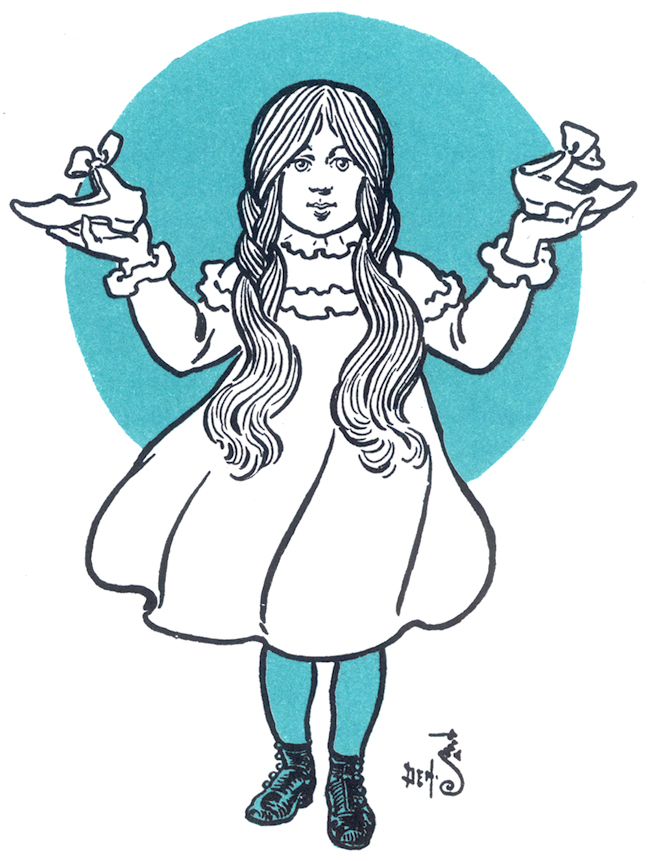
Illustration by W. W. Denslow in The Wonderful Wizard of Oz of Dorothy holding the Shoes
First appearance
Created byL. Frank Baum
GenreChildren's books, fantasy
In-universe information
TypeMagical shoes
FunctionAble to send the wearer wherever they wish to go

The Silver Shoes are magical footwear appearing in L. Frank Baum's 1900 novel The Wonderful Wizard of Oz as heroine Dorothy Gale's transport home. They are originally owned by the Wicked Witch of the East but passed to Dorothy when her house lands on the Witch. At the end of the story, Dorothy uses the shoes to transport herself back to her home in Kansas,[1] but when she arrives at her destination finds the shoes have fallen off en route.

Appearances in books

[edit]

The Wonderful Wizard of Oz

[edit]

The Wonderful Wizard of Oz (1900) is the only book in the original series to feature the Silver Shoes directly. They are the property of the Wicked Witch of the East until Dorothy's house lands on her and kills her. They are then given to Dorothy by the Good Witch of the North, who tells Dorothy that "there is some charm connected with them; but what it is we never knew." When Dorothy is captured by the Wicked Witch of the West, she tries to steal the shoes. She finally gets one by tricking Dorothy into tripping over an invisible iron bar. Dorothy then melts the Witch with a bucket of water and recovers the shoe. In the final chapters of the book, Glinda explains that the shoes can transport the wearer anywhere they wish. If the Silver Shoes have any other powers they are never outlined in the books, however the Witch of the West was obsessed with obtaining them, as they would give her much greater power than any other thing she possessed, suggesting the shoes hold immense magic. After saying goodbye to her friends, Dorothy knocks her heels together three times, and commands the Shoes to carry her home. When Dorothy opens her eyes, she has arrived in Kansas. She finds that the shoes are gone, having fallen off during her flight and landing somewhere in the Deadly Desert. Though they are mentioned several times in sequels, they never appear again in the original series.

The Wizard of the Emerald City

[edit]

In Alexander Melentyevich Volkov's The Wizard of the Emerald City (1939), the Silver shoes or Serebryaniye bashmachki as they are called in the manuscript, are the source of Elly's (his version of Dorothy) protection instead of the good Witch's kiss. She is therefore attacked once by an Ogre when removing them, and afterward wears them even when she sleeps. They are not taken from the Witch's body, but rather brought by Toto from her dwelling (a dark cave). This was possibly done to avert the problem of a person wearing the shoes to be impossible to harm, since in that book the hurricane is created by the Wicked Witch to destroy mankind, and redirected upon her by the Good Witch of the North, who suffers no ill effects for harming her. It is said the Witch only wore the shoes on very special occasions. They are lost just like in Baum's book.

Dorothy of Oz

[edit]

In Roger S. Baum's Dorothy of Oz (1989), Glinda recovers the silver shoes and presents them to Dorothy. They have enough power remaining that Dorothy can travel once more to Oz and back to Kansas.

Wicked: The Life and Times of the Wicked Witch of the West

[edit]

In Wicked: The Life and Times of the Wicked Witch of the West (1995), the silver shoes are a gift to Nessarose (the Wicked Witch of the East) before she and her sister, Elphaba (the Wicked Witch of the West) start college. They are made by her father using special glass beads another man (Turtle Heart, possibly her biological father) taught him to make, which make the shoes shiny and iridescent, not necessarily a true silver. They are later enchanted by Glinda (the Good Witch of the North) to give Nessarose the necessary balance to walk. In the Broadway musical adaption of the book, Elphaba is the one who enchants the shoes.

Appearances in film

[edit]

Wizard of Oz (1925 film)

[edit]

The shoes were absent from the 1925 movie.

The Wizard of Oz (1939 film)

[edit]

In the 1939 movie the shoes served the same purpose as in the book but were changed to red by its screenwriter Noel Langley. He gave a notably different appearance than in Denslow's illustrations. In addition to the silver shoes' powers, the Ruby slippers in the film were magically protected from being removed from the feet of the person wearing them unless said person is dead.

The Wiz

[edit]

In The Wiz (1978), the shoes are silver high heels. This movie gives further insight into the shoes' magical protection: when Evillene (the witch of the west) tries to obtain them magically, her fingers are bent painfully backwards.

The Wizard of Oz (1982 film)

[edit]

In the anime movie, the shoes are once again ruby slippers, though they are never referred to by that name. They are heeled shoes with pointed, slightly curled toes, similar to their appearance in Denslow's illustrations. Unlike the book, the shoes are still on Dorothy's feet when she arrives in Kansas.

Return to Oz

[edit]

In Return to Oz (1985), the Ruby Slippers are used once again. In this movie, the slippers have more power than simply transporting people. They allow the Nome King to conquer Oz and turn every one in the Emerald City to stone. Dorothy later uses the shoes to reverse this process. This extra power is due to the fact the slippers replace the Nome King's Magic Belt. In the original draft of the script, the Nome King had refashioned the slippers into the actual Magic Belt from the novels. Upon his death, they reverted into the form of slippers. This was cut from the final filming of the movie.

The Muppets' Wizard of Oz

[edit]

In The Muppets' Wizard of Oz (2005), the Silver Shoes are portrayed as sparkling, bejeweled, glittery Manolo Blahnik high-heels. The laws of ownership are again displayed in that the Witch of the West tries to cut off Dorothy's feet to obtain the shoes. Once again the shoes remain on Dorothy's feet when she arrives home.

Wicked

[edit]

In the Broadway show Wicked, an adaptation of Gregory McGuire's novel of the same name, and its 2024 and 2025 film counterparts, Wicked (2024) and Wicked: For Good (2025), the Silver Shoes are portrayed as the prized possessions of Nessarose Thropp, the paraplegic younger sister of Elphaba (the Wicked Witch of the West).

In the novel, the shoes are a gift from Nessarose's father, the governor of Munchkinland, upon Nessarose's acceptance to Shiz University. The shoes are described as so dazzlingly bejeweled and constructed that their true color is indeterminable. The shoes initially have no powers, but Glinda later enchants them to grant Nessarose greater mobility while wearing them. Nessarose promises them to Elphaba upon her passing.

In the Broadway and subsequent film adaptations, the shoes likewise have no magical characteristics, and were previously worn by Nessarose and Elphaba's late mother, later gifted to Nessarose by their father. Later, after Nessarose implores Elphaba to help her, Elphaba enchants the shoes, which allow Nessarose to walk. In the film adaptation, they allow Nessarose to fly. Upon Nessarose's death, Glinda gives them to Dorothy, which incenses Elphaba. Throughout her mostly offstage/offscreen interactions with Dorothy, Elphaba demands the shoes be returned to her solely due to their sentimental value, and not for their magical abilities. The shoes in the film were designed by costumer Paul Tazewell.

Appearances in television

[edit]

The Wonderful Wizard of Oz (1986 anime)

[edit]

When first seen on the feet of the Witch of the East in the 1986 anime version, they are brown peasant's shoes. When the Witch of the North then magically transfers them to Dorothy's feet, they take on the appearance of white slip-on shoes. When Dorothy is forced to give one of the shoes to the Witch of the West, it reverts to the peasant form. After the Witch is melted and Dorothy is shown wearing it again, it has returned to its white form.

The shoes are used twice after they initially send Dorothy home. The first time, she is holding them in her hands when she clicks the heels and drops them. Consequently, Dorothy is transported to Oz and the shoes are left in Kansas (Glinda sends her home). The second time occurs while Dorothy is sleeping. Tik-Tok is emitting a distress signal and the shoes activate, transporting Dorothy to the Land of Ev in a beam of light. Her clothes are changed in mid flight.

The Wizard of Oz (TV series)

[edit]

In the 1990 The Wizard of Oz television series, the Ruby Slippers are used to transport Dorothy back to Oz. They are depicted to possess other powerful magical capabilities that Dorothy did not fully understand, and as such, often served as a form of deus ex machina against hopeless situations. They are no longer depicted as high heels.

A unique concept proposed by this series is that the Ruby Slippers' magic is linked to the glow of their red coloration. Their powers only function while a dim glow of red light emanates from them, initiated by Dorothy clicking her heels; and the effects of their magic immediately cease after the shoes cease to glow. Also, the Wicked Witch was once able to annul their abilities entirely, by capturing a red Luminary (teardrop-shaped creatures who control all color in Oz) and forcing him to drain the red color from the slippers themselves. However the slippers regained their powers after the Luminary escaped.

This series also proposes that the slippers do not necessarily have to be on the user's feet for their powers to work, as Dorothy once used them by tapping the heels together when she held the shoes in her hands (since the ground's sandy surface prevented her from clicking the heels together).

Also worth noting in a single episode, is that Truckle, the series' lead Flying Monkey, was once able to wear the Ruby Slippers and thus utilize their powerful magic for his own whims. Even with his generally dim wits and reckless disregard, the slippers gave him sufficient power to overwhelm the Wicked Witch of the West's magical attacks, and temporarily reduce her to his servant. This once again demonstrates that the shoes' users need not be a skilled/knowledgeable spellcaster, in order to gain great power. The Cowardly Lion also gets to wear them briefly.

Charmed In the season five episode where the Halliwell sisters are jovially interfered with by fairy tale creatures due to the Wicked Queen of Snow White. Once Piper vanquishes the Queen, she is sent home from purgatory with Dorothy's slippers. They are depicted as ruby slippers, like the 1939 Film

Once Upon a Time (TV series)

[edit]

In the Once Upon a Time television series, the Silver Slippers are first alluded to in "The Doctor", when Rumpelstiltskin sends the Mad Hatter to the Land of Oz in order to locate and retrieve the shoes so that he could travel to the Land without Magic in order to locate his lost son Balefire.

In "It's Not Easy Being Green", shortly before "The Doctor", Zelena, the woman who would eventually become the Wicked Witch of the West, goes to the Wizard in order to seek out her family. Upon discovering that she was abandoned by her mother, Cora, and that her half-sister, Regina became Queen and was being trained by Rumpelstiltskin, the Wizard gives Zelena the shoes so that she can travel to the Enchanted Forest to try and replace Regina as Rumpelstiltskin's student. Upon being rejected by him, Zelena turns green with envy. She mocks Rumpelstiltskin with the power of the Silver Slippers, thus causing his later desire to obtain them. Using the Silver Slippers again she returns to Oz and dethrones the Wizard.

In "Kansas" the Slippers appear again, as Zelena, posing as the Wizard of Oz, gives Dorothy the Silver Slippers in order to send her back to Kansas, in the hopes that it would keep Dorothy from becoming a powerful witch herself, and from defeating and replacing Zelena as the Witch of the West.

In "Our Decay", an adult Dorothy has returned to Oz via the Slippers to face down Zelena and rescue the Scarecrow from her.

In "Ruby Slippers", the Silver Slippers appear one last time, enabling travel between the Underworld and Oz so that Ruby (Red Riding Hood) can rescue Dorothy from a sleeping curse Zelena has placed her under. Zelena, who is trying to change her ways gives the Slippers over to the heroes so Ruby and Snow White can make their way back to Oz.

Appearances in other media

[edit]

Dorothy of Oz

[edit]

The Dorothy of Oz series completely revamps the Silver Shoes. They are instead depicted as red boots created by Selluriah, the Witch of the East. When Mara (codename Dorothy) stomps the heels of said boots, she takes on the form and powers of a witch. This power is channeled (rather inexpertly) through the staff Thrysos. The transformation is rather embarrassing, as it involves Mara being momentarily nude and various men are always apt to spot her. It is yet to be revealed if these boots will help Mara return home.

Fables

[edit]

The shoes are shown in the DC comics Vertigo series Fables. Dorothy, who's portrayed as a cold, merciless assassin, found that she enjoyed killing after being hired by the Wizard to kill the Witch of the West. However, she loses them on the way back to Kansas over the Deadly Desert, and goes to great lengths to get them back. She has several encounters with Fabletown spy Cinderella, which climaxes with them facing off in the mini-series Cinderella: Fables Are Forever. After deducing that they are actually too big to fit Dorothy, Cinderella takes them and pushes her out of an airship over the Deadly Desert to her apparent death, though her body is not seen. Cinderella then looks over the shoes and decides they're just the right size to fit her.

References

[edit]
Revisions and contributorsEdit on WikipediaRead on Wikipedia
from Grokipedia
The Silver Shoes are a pair of magical silver central to L. Frank Baum's 1900 novel , originally belonging to the and acquired by protagonist after her house crushes the witch upon landing in the . In the story, the shoes possess the enchantment to transport their wearer to any desired location—most notably, back to —simply by knocking the heels together three times while concentrating on the destination, a power revealed to Dorothy by the Good Witch of the toward the novel's climax. Dorothy, unaware of their full capabilities earlier, wears the pointed-toe silver shoes throughout her journey along the to the , where they become coveted by the , who steals one during an ambush but ultimately loses both after being melted by water. Upon using them to return home, Dorothy loses the shoes in a during the instantaneous transport, emphasizing their one-time utility for her escape from Oz. In popular culture, the shoes inspired the iconic in the 1939 MGM film adaptation , a change made to exploit the vibrancy of , where silver appeared dull compared to iridescent red. Recent adaptations, including the 2024 film Wicked, revert to silver to align with Baum's original text, featuring jeweled designs with over 1,000 crystals for visual effect while honoring the novel's lore.

Overview and Origins

Description and Powers

The Silver Shoes are depicted as a pair of silver-colored leather shoes with pointed toes, discovered on the feet of the after Dorothy's house crushes her. These shoes, remnants of the deceased witch, are presented to Dorothy by the Witch of the North, who shakes the dust from them before handing them over. Upon trying them on, Dorothy finds that the Silver Shoes fit her perfectly, as if custom-made, prompting her to wear them for her journey along the . The primary magical power of the Silver Shoes is their ability to transport the wearer instantaneously to any desired location in the world, achieved through three short steps, each completed in the blink of an eye. This enchantment, a "powerful charm" inherent to the shoes, remains unknown to Dorothy for much of her adventure, allowing the to covet them without immediate threat. , the Good Witch of the South, later reveals that the shoes could have enabled Dorothy's return to from the very first day of her arrival in Oz. To activate the transportation power, the wearer must knock the heels of the Silver Shoes together exactly three times while mentally or verbally commanding the destination. For instance, Dorothy invokes the command "Take me home to !" upon tapping her heels, successfully returning to her farm alongside Toto. During her journey, the shoes prove indispensable for overcoming vast distances, such as crossing the deadly desert surrounding Oz. The Silver Shoes exhibit a limitation in that they adhere closely to the wearer, resisting removal by others without consent, as evidenced by the Wicked Witch of the West's repeated failed attempts to steal them despite her cunning tricks and use of the . The witch places an invisible iron bar in the kitchen to trip Dorothy, causing one shoe to come off, which she snatches and wears on her foot—but cannot secure the second, as her nighttime theft attempt is interrupted by Toto's barking, prompting Dorothy to throw a bucket of water on her and melt her. Once used for their full purpose, the shoes are lost forever, falling off during Dorothy's rapid transport and vanishing into the desert sands.

Introduction in L. Frank Baum's Works

In L. Frank Baum's (1900), the Silver Shoes make their debut as powerful magical artifacts owned by the , who rules over Munchkin Country. When Dorothy Gale's house is carried by a to the and crushes the witch upon landing, the Silver Shoes—adorned with pointed toes—are revealed protruding from beneath the house. of the North arrives to celebrate the witch's demise and confirms the transfer of ownership, declaring to Dorothy, "The silver shoes are yours, and you shall have them to wear," before presenting them to her as a protective charm. Dorothy, finding they fit perfectly, wears them throughout her adventures in Oz, unaware of their full potential until later revelations. The Silver Shoes play a pivotal role in resolving the central plot of , serving primarily as Dorothy's means of returning home to . As Dorothy and her companions journey southward to the Quadling Country seeking aid from the Good, they reach her castle after overcoming various obstacles, including hostile hammer-headed men. There, Glinda discloses the shoes' enchantment: "All you have to do is to knock the heels together three times and command the shoes to carry you wherever you wish to go." This method, which enables instantaneous transportation across vast distances, underscores the shoes' function as a device to conclude Dorothy's quest. In the story's climax, Dorothy taps the heels three times while saying, "Take me home to ," and is whisked back to her farm in a mere three great leaps, leaving the shoes behind in the desert. Baum conceived the Silver Shoes as a magical transport mechanism to efficiently wrap up the narrative, drawing inspiration from traditions of enchanted footwear, such as the in tales like "" by , which allow the wearer to traverse leagues in a single step. In subsequent Oz sequels, the shoes receive only brief allusions; (1904) does not reference them, as the story focuses on new characters without Dorothy's involvement. However, in (1907), Dorothy reflects on their loss during her prior visit, noting in conversation that they were left behind after carrying her home, preventing their reuse in later adventures. These passing nods affirm their canonical status while shifting emphasis to other Ozian magics under Ozma's rule.

Symbolism and Interpretations

Literary and Thematic Significance

The Silver Shoes in L. Frank Baum's symbolize untapped personal power and the profound journey toward home, encapsulating Dorothy Gale's latent agency that manifests only at the narrative's climax. Throughout her , Dorothy wears the shoes without grasping their full potential to transport her instantly back to , a revelation delivered by the Good Witch that underscores the theme of and the realization that solutions lie within oneself. This motif of deferred empowerment mirrors the broader arc of self-discovery for Dorothy and her companions, who learn that their desired attributes—, intellect, and heart—were present all along, much like the shoes' magic on Dorothy's feet. The shoes also drive Dorothy's character development, positioning her as an unwitting protector whose possession of them thwarts the Wicked Witch of the West's ambitions. The witch's covetous attempts to seize the artifacts—first by commanding the Winkies and later by guile—fail spectacularly, as the shoes scorch her hand upon contact, affirming Dorothy's inadvertent guardianship over profound magic. In this way, the seemingly ordinary silver footwear highlights Baum's theme of overlooked enchantment in everyday objects, transforming a simple pair of slippers into emblems of resilience and hidden potential that elevate the protagonist from bewildered child to empowered heroine. Within the broader Oz universe, the Silver Shoes inaugurate a motif of magical artifacts intrinsically linked to witches, a pattern that permeates Baum's subsequent novels and often signifies protection or the fragility of . Their origin as the Wicked Witch of the East's property, transferred to Dorothy after the witch's demise, sets a precedent for witch-bound relics like the , which summons the and embodies coercive power in the original tale. This recurring element reinforces the series' exploration of magic as both a boon and a peril, tied to the witches' legacies. Baum himself framed the shoes as a straightforward narrative tool in his introductory note to the 1900 edition, portraying the book as a "modernized fairy tale" crafted purely for children's delight, where such devices foster wonder and tidy resolution without the grimness of older folklore.

Political and Cultural Allegories

The silver shoes in L. Frank Baum's The Wonderful Wizard of Oz have been widely interpreted as a political allegory for the free silver movement during the 1890s U.S. Populism, contrasting with the gold standard represented by the yellow brick road. In this reading, the shoes symbolize the potential of unlimited silver coinage to alleviate economic hardships faced by farmers and workers, enabling Dorothy's journey and ultimate return to her rural Kansas home, which stands for traditional agrarian values, over the illusory prosperity of the Emerald City, emblematic of Eastern banking elites and monopolies. Scholarly analyses, beginning with Henry Littlefield's influential 1964 essay "The Wizard of Oz: Parable on ," explicitly link the Oz narrative to late-19th-century monetary debates, portraying the silver shoes as tools of for the against deflationary policies and corporate dominance. Littlefield argues that the shoes' magical transportive power reflects Populist for at a 16:1 silver-to-gold ratio, a policy championed by to inflate the money supply and combat unemployment. Subsequent economists like Hugh Rockoff have reinforced this view, noting how the shoes' acquisition after defeating the parallels the repeal of the in 1893 and the hope for silver's revival post-1896 election. However, this interpretation has faced criticism from scholars who contend that Baum lacked explicit political intent and that many allegorical correspondences are coincidental or inconsistent with historical details. In broader cultural readings, the silver shoes have evolved into symbols of female agency within feminist critiques, representing Dorothy's journey toward and reclamation of in a male-dominated world. Feminist scholars highlight how Dorothy's use of the shoes to click her heels and return home embodies a blend of domestic return and assertive power, transforming her from a passive girl into an empowered figure who asserts control over her destiny. Modern extensions of these allegories in the often tie the silver shoes to ongoing , portraying silver as an undervalued asset overlooked by dominant financial systems, much like marginalized voices in contemporary debates over wealth distribution and . Analyses draw parallels to post-2008 financial crises, where the shoes' role in bypassing elite illusions evokes calls for equitable economic reforms to empower the disenfranchised.

Adaptations in Literature

Expansions in Oz Series Books

In the sequels to L. Frank Baum's The Wonderful Wizard of Oz, the Silver Shoes are frequently referenced in dialogue as a key element of Dorothy Gale's initial journey to and from the Land of Oz, underscoring their role as a powerful but one-time artifact in her possession. These mentions serve to connect new adventures to the original tale without reintroducing the shoes as active plot devices, instead portraying them as lost or historical items that highlight Dorothy's growth and familiarity with Oz's magic. For instance, in Ozma of Oz (1907), Dorothy recounts to Billina the yellow hen how she once owned a pair of silver shoes that allowed her to travel through the air, but laments that she lost them during her return to Kansas. Baum's later works continue this pattern of retrospective allusions, emphasizing the shoes' transportation powers while integrating them into broader narratives of exploration and conflict resolution. In Dorothy and the Wizard in Oz (1908), Dorothy explains to the Wizard how she used the magical silver shoes to escape Oz after their first encounter, reinforcing their function as a means of instantaneous travel. Similarly, The Road to Oz (1909) features Princess Ozma reminding Dorothy of her prior use of the Silver Shoes alongside the Magic Belt to journey between Oz and Kansas in mere moments, framing the artifact as a symbol of Dorothy's unique connection to both worlds. By The Tin Woodman of Oz (1918), the shoes are invoked in backstory, describing how the Wicked Witch of the East wore them before they passed to Dorothy, tying them to the series' foundational lore of enchantment and loss. Ruth Plumly Thompson, who continued the Oz series after Baum's death, further expands on the Silver Shoes in her contributions, maintaining their status as cherished but absent relics while occasionally alluding to their potential in rescue scenarios. In The Wishing Horse of Oz (1935), Dorothy recalls an incident where the attempted to steal the silver shoes from her, prompting Dorothy to defend herself with a bucket of —an event that echoes the original novel's climax and illustrates the shoes' enduring allure as objects of desire among Oz's antagonists. Thompson's narratives generally diminish the shoes' centrality, treating them as artifacts of Dorothy's early exploits rather than tools for ongoing plots, which aligns with the series' shift toward ensemble adventures involving new characters and lands. Illustrator John R. Neill, who provided artwork for both Baum's and Thompson's books from The Wonderful Wizard of Oz onward, depicts the Silver Shoes in select illustrations to evoke their iconic shimmer and form, often in flashback or descriptive scenes that preserve their visual legacy without propelling the action. Later authorized authors in the Oz canon, such as Jack Snow and Eloise Jarvis McGraw, reference the shoes sparingly in minor roles, consistently portraying them as preserved elements of Oz's magical heritage within the Emerald City, where they symbolize the realm's safeguarded wonders. Throughout the official Oz series by Baum and his successors, the Silver Shoes retain their canonical description as gleaming silver artifacts, never altered to the ruby hue seen in film adaptations, ensuring fidelity to the original novel's depiction of their enchanting properties.

Modern Retellings and Prequels

In Alexander Volkov's 1939 children's novel The Wizard of the Emerald City, a loose of Baum's original set in a parallel "Magic Land," the protagonist (a renamed Dorothy) acquires the silver shoes from the defeated Ginger Witch of the Blue Country. These shoes preserve their enchanting ability to transport the wearer instantaneously over great distances, and ultimately clicks their heels together three times to return home to after aiding the , , and against the Iron Woodman. Roger S. Baum, grandson of L. Frank Baum, continued the legacy in his 1989 sequel Dorothy of Oz, where the silver shoes magically reappear in Dorothy's possession after being lost in the original tale. Sent by Glinda with a prophetic note, the shoes possess just enough residual magic for a final round trip: Dorothy uses them to journey back to Oz, where she confronts the villainous Jester—who wields the Wicked Witch of the West's wand to transform inhabitants into porcelain dolls—and then returns home once more, emphasizing themes of heroism and closure. Gregory Maguire's 1995 novel Wicked: The Life and Times of the provides a origin for the silver shoes, portraying them as iridescent artifacts initially crafted by the Munchkinlander Frexspar (Frex) using techniques learned from the Quadling Turtle Heart. Gifted to his younger daughter Nessarose as a of paternal love and mobility aid, the shoes are later enchanted by to grant Nessarose the power to walk unaided, enabling her tyrannical rule over Munchkinland as its Eminent Thropp. After Nessarose's death—caused by her sister Elphaba's accidental spell—the shoes become a coveted emblem of power and resentment, eventually passing to Dorothy and evolving into the transport devices central to Oz's conflicts, underscoring motifs of , control, and familial rivalry. Modern graphic novel retellings often faithfully recreate the silver shoes' canonical attributes while expanding visual interpretations. For instance, Eric Shanower and Skottie Young's Eisner Award-nominated adaptation The Wonderful Wizard of Oz (2009) depicts the shoes as shimmering, protective talismans that Dorothy employs for her homeward journey, highlighting their narrative role in empowerment and escape. Similarly, the comic prequel to Legends of Oz: Dorothy's Return (2013) retains the silver shoes' appearance and limited magic post-original events, integrating them into broader Oz lore without altering their core function.

Adaptations in Film

Early and Classic Films

The 1925 silent film The Wizard of Oz, directed by Larry Semon, is a loose adaptation of Baum's novel, positioning Dorothy as a farm girl heir to Oz's throne, with the overall plot straying far from the original story. A pivotal shift occurred in the iconic 1939 MGM musical The Wizard of Oz, directed by Victor Fleming, which transformed the Silver Shoes into ruby slippers to capitalize on the vivid reds of Technicolor filming. Costume designer Gilbert Adrian crafted the slippers as high-heeled, sequined pumps made from white silk pumps dyed red and covered in over 2,300 sequins, creating a sparkling effect that popped against the film's yellow brick road and green Emerald City. This visual choice prioritized cinematic spectacle over fidelity to the novel's silver design, with the heel-clicking mechanism—requiring three taps while repeating "there's no place like home"—becoming a globally popularized gesture for invoking the slippers' homeward transport power. Additionally, the film endowed the slippers with a protective quality absent in the book: when the Wicked Witch of the West attempts to seize them, bursts of fire emanate from the shoes, preventing removal and underscoring their enchanted resilience. The 1978 urban musical adaptation , directed by and starring as Dorothy, reverted to silver footwear but reimagined them as high-heeled to suit the story's New York City-inspired setting and emphasis on dance sequences. These silver , bestowed upon Dorothy by Addapearle (the Good Witch of the South), facilitate mobility across fantastical urban landscapes like a graffiti-covered subway and a of terror, aligning their transport magic with rhythmic, streetwise movement rather than formal heel-clicking. The design choice highlights the film's African American reinterpretation, blending the shoes' original silver hue with practical, high-heeled footwear that supports and narrative themes of self-discovery in a modern context.

Modern and Musical Films

In the 1985 film , directed by , the from the adaptation are central to the plot, with Dorothy discovering that they were lost during her previous journey home and subsequently acquired by the , who uses their power to petrify the inhabitants of Oz and adorn his mountain with ornaments. Dorothy retrieves the slippers to restore the and return home, incorporating elements from L. Frank Baum's later Oz books such as for nods to the original canon, including the 's affinity for precious metals like silver in his lair decorations. The production's were handmade with plastic rubies that often lost adhesion due to stage lights melting the glue, requiring enhancements for their magical glow. The 1982 Japanese film , produced by , depicts Dorothy wearing red magic shoes inspired by the film rather than the book's silver pair, with the transportation scenes featuring dynamic to emphasize the shoes' power in clicking heels to return home. These sequences highlight the shoes' role in the climax, where Dorothy bids farewell to her companions and uses them to escape Oz, blending traditional anime visuals with the story's magical elements. The 2024 musical film Wicked, directed by , returns to the silver shoe design from Baum's novel for fidelity to the source material, avoiding the copyrighted from the version. Costume designer Paul Tazewell created the bejeweled silver shoes with a 3D-printed base and spiral heel details evoking tornadoes, gifted by Governor Frex to his daughter Nessarose (the future ). enchants the shoes to enable Nessarose to walk, symbolizing the sisters' fraught relationship and 's protective yet conflicted bond, as the shoes later become a point of contention when Nessarose demands them from . This portrayal underscores themes of empowerment and family tension in 's backstory. In the 2013 prequel Oz the Great and Powerful, directed by Sam Raimi, the silver shoes are not directly depicted, as the story occurs before Dorothy's arrival in Oz, but the film's adherence to Baum's book canon over the 1939 movie implies their original silver origins rather than ruby, sidestepping MGM's copyright on the latter while setting up the magical artifacts of the Oz universe.

Adaptations in Television

Animated Series and Anime

In the 1986 Japanese anime series , produced by and spanning 52 episodes, the Silver Shoes serve as a pivotal magical element central to Dorothy's journey. The adaptation portrays the shoes with exaggerated , including a prominent glow during activation, which underscores their enchanting properties and differentiates them from more subdued depictions in other media. These shoes enable Dorothy's return to , allowing for dynamic episodic adventures across Oz and beyond. The 1990 animated series , a 13-episode production by DIC Enterprises that aired internationally including in , uses inspired by the 1939 film rather than the silver shoes from the . Here, the slippers facilitate episodic quests and problem-solving, often invoking their transport function to whisk characters between locations in Oz for self-contained stories involving the , Tin Man, and . The series emphasizes the slippers' role in ongoing narratives, where clicking the heels triggers swift, magical resolutions to threats from figures like the . A notable stylistic feature across these animated adaptations is the use of fluid to highlight the heel-tapping , rendering the motion with smooth, emphatic sequences that amplify the shoes' mystical allure and make the activation visually striking. This approach allows for creative expansions on the shoes' powers while maintaining to their core transport capabilities in Baum's work.

Live-Action Episodes and Specials

The Muppets' Wizard of Oz, a 2005 made-for-TV miniseries, faithfully adapts the silver shoes from L. Frank Baum's original novel, presenting them as sparkling magical footwear bestowed upon Dorothy Gale, played by singer Ashanti. In the production, the shoes are designed by fashion icon Manolo Blahnik and feature prominently in humorous scenes involving Muppet characters, such as Miss Piggy portraying both the Good Witch of the North and the Wicked Witch of the East, who covets the shoes for their power to transport Dorothy home. The miniseries emphasizes the shoes' role in Dorothy's journey, culminating in her clicking the heels together to return to Kansas, infused with the Muppets' signature comedic flair, including Pepe the King Prawn as the Tin Man and Kermit the Frog as the Scarecrow. In the fantasy series (2011–2018), the silver slippers serve as a pivotal artifact in the Oz-related story arcs, particularly those involving the Wicked Witch Zelena and the Enchanted Forest's connections to other realms. Discovered by Zelena after her arrival in Oz via a , the slippers enable instantaneous travel between lands when clicked together three times, a power she learns from Rumplestiltskin and later exploits for time manipulation and revenge plots against her half-sister Regina. The slippers gain added complexity in season 5's "" episode, where they facilitate Dorothy's entrapment in Oz and Ruby (Red Riding Hood)'s quest to rescue her, blending the artifact's classic function with the series' multiverse narrative and Zelena's redemption arc. The 2017 NBC series Emerald City reimagines elements of the silver shoes as "The Elements," a set of magical gauntlets worn by Dorothy Gale (Adria Arjona) that draw inspiration from Baum's original footwear while incorporating dark magic elements tied to Oz's elemental forces. These ruby-studded golden artifacts grant the wearer control over aspects of nature, such as wind and stone, but come with perilous consequences, including amplifying the user's inner darkness and enabling ritualistic spells that fuel the series' grim prophecy of "The Beast Forever." Unlike traditional slippers, the gauntlets are acquired after the Wicked Witch of the East's death and play a central role in Dorothy's battles against tyrannical forces in the fractured land of Oz, emphasizing themes of power's corrupting influence over whimsical transport.

Adaptations in Other Media

Comics and Graphic Novels

In the Vertigo Comics series Fables (2002–2015), the Silver Shoes play a key role in crossover storylines involving Dorothy Gale, who is reimagined as a ruthless assassin operating in a modern world of exiled fairy tale characters. Dorothy utilizes the shoes' teleportation abilities to shift between locations and even alter her human forms, amplifying their original magical properties for espionage and combat scenarios within the series' expansive narrative. This visual reinterpretation emphasizes the shoes' gleaming silver design as a symbol of hidden power and deception, contrasting with Dorothy's deceptive innocence. The 2012 Korean Dorothy of Oz by Son Hee-joon offers a fresh where the Silver Shoes are depicted as elegant silver boots, serving as a conduit for emotional as well as physical transportation. In this format, the shoes facilitate Dorothy's psychological growth and connections in a fantastical Oz, with their shiny, metallic aesthetic underscoring themes of longing and self-discovery amid adventurous panels. The design highlights their book-accurate silver hue to evoke mystery and allure in the 's dynamic illustrations. Various Marvel and DC Oz-inspired comics from the 1970s to 2000s occasionally retain the Silver Shoes' original coloration for fidelity to Baum's novel, integrating them into superhero-style narratives with enhanced abilities such as rapid relocation or protective auras. These depictions often feature bold, illustrated panels that accentuate the shoes' silvery sheen against vibrant Oz landscapes, blending classic lore with action tropes in crossover events.

Video Games and Merchandise

The Silver Shoes have appeared in several video games inspired by L. Frank Baum's Oz series, often as book-accurate magical artifacts granting transportation or other powers to the player character. In the Japanese role-playing game series Yellow Brick Road (1995) and its sequel Yellow Brick Road II: Glinda and the Crystal of Light (1998), the Wizard presents the silver shoes to Dorothy, enabling her to traverse the Land of Oz and access key locations. These titles emphasize the shoes' original literary role as a versatile charm, distinct from the ruby variants in film adaptations. Merchandise featuring the Silver Shoes caters primarily to book purists seeking fidelity to Baum's 1900 novel The Wonderful Wizard of Oz, where the footwear is described as gleaming silver rather than the ruby color popularized by the 1939 film. These contrast sharply with the abundance of ruby slipper replicas, like the licensed prop versions from Paragon FX Group, which replicate Judy Garland's iconic sequined pair and dominate commercial markets due to their cinematic fame. The 2024 release of the film Wicked spurred a surge in silver shoe collectibles, aligning with the musical's book-inspired depiction of Nessarose's footwear. The Noble Collection introduced a limited-edition Nessarose Silver Slippers Set, featuring silver-plated shoes adorned with over 2,000 European crystals in a swirling pattern, priced at $1,500 and designed for display in an acrylic case. This high-end replica draws from the film's while nodding to the original novel's silver aesthetic, appealing to collectors who value the shoes' literary variations over film alterations. Commercially, the Silver Shoes have influenced theme park attractions recreating Oz environments, particularly through Universal Studios' integrations. The Wicked: The Experience at (opened 2024) showcases replicas of Nessarose's silver sparkly shoes alongside her dress in immersive displays, allowing visitors to engage with the prequel's narrative and the shoes' empowering symbolism from Baum's works.

Cultural Legacy

Iconic Status and Variations

The Silver Shoes from L. Frank Baum's attained enduring iconic status through their transformation into the in the 1939 film adaptation, becoming one of Hollywood's most recognizable props and symbols of innocence, hope, and magical return. These slippers draw annual crowds at institutions like the Smithsonian's , where a pair worn by underscores their cultural permanence. In 2005, one pair was stolen from the museum and recovered in 2018 after a decade-long FBI investigation, highlighting their status as cultural treasures requiring enhanced security. A pivotal element of their fame is the heel-clicking incantation introduced in the film, where , played by Garland, taps the heels three times while chanting "There's no place like home" to transport back to —an addition not present in Baum's novel, which simply requires tapping the heels without a verbal formula. This ritual has permeated global consciousness, evoking themes of homesickness and self-empowerment. Central to fan discourse is the silver-versus-ruby debate, rooted in the original novel's of understated silver footwear symbolizing subtle transformation and possibly alluding to 19th-century economic debates over the . The 1939 film's shift to ruby was driven by the need to exploit Technicolor's vibrancy, creating a glittering contrast against the that enhanced visual spectacle. This alteration sparked ongoing discussions about fidelity to Baum's vision versus cinematic innovation, with silver representing quiet magic and ruby embodying bold, eye-catching allure. Variations in adaptations highlight this tension: book-faithful works, such as certain stage productions and the original text, preserve the silver hue to honor Baum's public-domain description. Color-emphasizing versions, starting with the MGM film, favor ruby for dramatic effect, while modern hybrids like the 2024 film Wicked employ metallic silver encrusted with over 1,000 Preciosa crystals in a tornado-inspired swirl, blending book accuracy with contemporary shimmer to sidestep trademark issues tied to the ruby design. The shoes' legacy extends to pop culture parodies and fashion influences, with appearances in The Simpsons—such as ruby slippers displayed in a Smithsonian couch gag—satirizing their museum-worthy status. Similarly, a 2024 Family Guy episode parodies the trope when Meg Griffin receives comically undersized ruby slippers in an Oz-inspired fantasy, poking fun at the magic's everyday absurdities. In fashion, the 1939 film's sparkle inspired post-release trends in embellished heels, while recent silver shoe revivals, as seen in summer 2024 collections, nod to the book's original design for versatile, light-reflecting styles.

Real-World Inspirations and Impact

The concept of the Silver Shoes in L. Frank Baum's draws inspiration from the longstanding European tradition of enchanted footwear that bestows extraordinary powers on its wearer, as seen in tales like Charles Perrault's "," where magical boots enable vast leaps across distances, or the Brothers Grimm's "," featuring glass slippers that uniquely identify and elevate the protagonist's status. Baum, who sought to craft a distinctly American , was influenced by these European sources, including the works of and the , adapting the motif to symbolize transportation and agency within a Midwestern American context. His exposure to Midwestern and traditions during his time in rural further shaped the narrative, infusing it with elements of regional tall tales and populist imagery that grounded the fantastical shoes in everyday rural life. The Silver Shoes have had a notable societal impact, particularly in promoting themes in , where they exemplify a young girl's innate power and resourcefulness, influencing subsequent stories of female self-discovery and independence. In the early , the book's immense —selling over three million copies by —elevated silver as a cultural symbol of value and magic amid the era's broader economic debates on . More recently, the 2024 release of the film Wicked, which faithfully depicts silver shoes adorned with over 1,000 crystals, has reignited interest in silver accessories, driving trends in jewelry collaborations featuring emerald-hued charms, metallic flats, and crystal-embellished pieces inspired by the Oz universe. Analytically, the Silver Shoes are frequently examined in American literature courses for their role in the novel's political , representing the movement of the that sought to expand the money supply through silver coinage to aid farmers and workers. This interpretation highlights Baum's Midwestern roots and the shoes' function as a for untapped economic potential, often contrasted with the gold standard symbolized by the Yellow Brick Road. Educational exhibits reinforce this legacy; for instance, the Oz Museum in , displays replica alongside original book artifacts to illustrate their allegorical depth and cultural resonance.

References

Add your contribution
Related Hubs
User Avatar
No comments yet.