Hubbry Logo
Silver acetylideSilver acetylideMain
Open search
Silver acetylide
Community hub
Silver acetylide
logo
8 pages, 0 posts
0 subscribers
Be the first to start a discussion here.
Silver acetylide
Silver acetylide
from Wikipedia
Silver acetylide
Wireframe model of silver acetylide
Names
Preferred IUPAC name
Silver acetylide
Systematic IUPAC name
Silver(I) ethynediide
Other names
  • Silver percarbide
  • Silver carbide
  • Silver dicarbide
  • Argentous acetylide
  • Argentous ethynediide
  • Argentous percarbide
  • Argentous carbide
  • Argentous dicarbide
Identifiers
3D model (JSmol)
ChemSpider
  • InChI=1S/C2.2Ag/c1-2;;/q-2;2*+1
    Key: FIDGMLJJLFFOEI-UHFFFAOYSA-N
  • ethynide: InChI=1S/C2H.Ag/c1-2;/h1H;/q-1;+1
    Key: SLERPCVQDVNSAK-UHFFFAOYSA-N
  • [Ag+].[Ag+].[C-]#[C-]
  • ethynide: [Ag+].[C-]#C
Properties
Ag2C2
Molar mass 239.758 g·mol−1
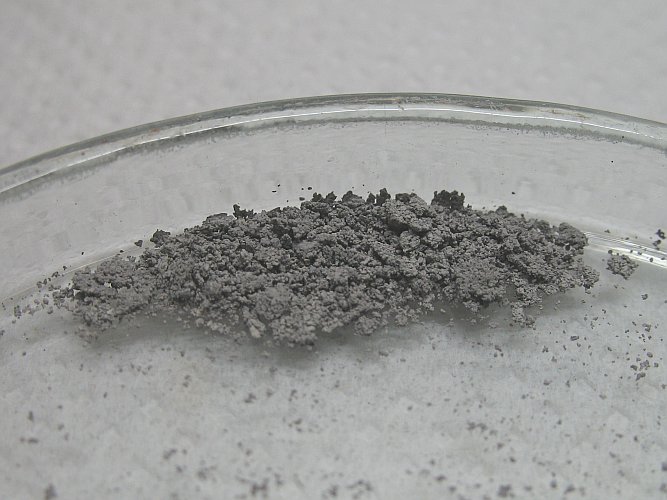
Appearance gray or white solid
Density 4.47 g/cm3[1]
Melting point 120 °C (248 °F; 393 K)
Boiling point decomposes
insoluble
Hazards
Occupational safety and health (OHS/OSH):
Main hazards
highly sensitive primary explosive
NFPA 704 (fire diamond)
NFPA 704 four-colored diamondHealth 3: Short exposure could cause serious temporary or residual injury. E.g. chlorine gasFlammability 3: Liquids and solids that can be ignited under almost all ambient temperature conditions. Flash point between 23 and 38 °C (73 and 100 °F). E.g. gasolineInstability 4: Readily capable of detonation or explosive decomposition at normal temperatures and pressures. E.g. nitroglycerinSpecial hazards (white): no code
3
3
4
Flash point 77 °C (171 °F; 350 K)
Thermochemistry
357.6±5.0 kJ/mol[2]
Except where otherwise noted, data are given for materials in their standard state (at 25 °C [77 °F], 100 kPa).
checkY verify (what is checkY☒N ?)

Silver acetylide is an inorganic chemical compound with the formula Ag2C2, a metal acetylide. The compound can be regarded as a silver salt of the weak acid, acetylene. The salt's anion consists of two carbon atoms linked by a triple bond, thus, its structure is [Ag+]2[C≡C]. The alternate name "silver carbide" is rarely used, although the analogous calcium compound CaC2 is called calcium carbide. Silver acetylide is a primary explosive.

Synthesis

[edit]

Silver acetylide can be produced by passing acetylene gas through a solution of silver nitrate:[3]

2 AgNO3(aq) + C2H2(g) → Ag2C2(s) + 2 HNO3(aq)

The reaction product is a greyish to white precipitate. This is the same synthesis from Berthelot in which he first found silver acetylide in 1866.[4]

The double salt is formed in acidic or neutral silver nitrate solutions. Performing the synthesis in basic ammonia solution does not allow the double salt to form, producing pure silver acetylide. To properly form the double salt, acetylene gas is passed through dilute silver nitrate and nitric acid solution. Instead of the conventional synthesis of passing acetylene gas through silver nitrate solution, a purer and whiter precipitate can be formed by passing acetylene gas through acetone and adding the acetylene solution drop-wise to a dilute silver nitrate and nitric acid solution. The reaction was performed at ambient room temperature.

Silver acetylide can be formed on the surface of silver or high-silver alloys, e.g. in pipes used for transport of acetylene, if silver brazing was used in their joints.

Explosive character

[edit]

Pure silver acetylide is a heat- and shock-sensitive primary explosive. Silver acetylide decomposes through the reaction:

Ag2C2(s) → 2 Ag(s) + 2 C(s)

The detonation velocity of the silver acetylide-silver nitrate double salt is 1980 m/s, while that of pure silver acetylide is 1200 m/s.[5]

Solubility

[edit]

Silver acetylide is not soluble in water and is not appreciably soluble in any other solvent.

References

[edit]
Revisions and contributorsEdit on WikipediaRead on Wikipedia
from Grokipedia
Silver acetylide, chemically denoted as Ag₂C₂, is an inorganic metal acetylide compound recognized as a highly sensitive primary material. It manifests as a white, unstable powder that is insoluble in and decomposes violently when dry, making it a potent component. The compound is typically synthesized through the reaction of gas with solutions of silver salts, such as ammoniacal (Tollens' reagent), yielding a precipitated solid that must be handled wet to mitigate risks. Structurally, silver acetylide adopts a coordination polymeric form, characterized by π-bonding interactions between silver cations and the acetylide dianion (C₂²⁻), resulting in nanoscale crystalline particles and characteristic C≡C stretching frequencies around 1880–1930 cm⁻¹ in the IR or Raman . This architecture contributes to its energetic properties, with a around 357.6 ± 5.0 kJ/mol, and it forms various double salts (e.g., with or ) that enhance stability or tunability for specific applications. Physically, it is non-hygroscopic and light-sensitive, decomposing to silver metal and carbon upon heating or mechanical disturbance, often producing acrid smoke and irritating fumes. Beyond its explosive utility in detonators—where it outperforms analogs like copper acetylide in power—silver acetylide serves as a mild, low-basicity in . It facilitates reactions such as couplings with acid chlorides to form ketones (yields up to 72% for substituted variants) and diazonium salts to yield azoethynyl compounds, enabling the construction of complex molecules in fields like pharmaceuticals and . Advancements as of 2024 include continuous flow synthesis methods for high-purity variants, improving safety and scalability for specialized uses like initiating light-sensitive explosives in structural testing. Due to its extreme sensitivity, silver acetylide demands stringent handling protocols: it should be stored wet in amber containers in dark, cool environments and avoided in dry form indoors to prevent spontaneous from , shock, or temperatures exceeding 120–140 °C. While metallic silver itself is relatively inert, prolonged exposure to silver compounds may pose general toxicity risks, underscoring the need for protective measures in laboratory settings.

Properties

Physical properties

Silver acetylide appears as a white to gray solid precipitate. Its is 239.758 g/mol. The compound has a of approximately 4.47 g/cm³. The compound is non-hygroscopic and light-sensitive. Silver acetylide exhibits a around 120 °C, at which it undergoes rather than or . It is insoluble in and common organic solvents.

Molecular structure

Silver acetylide has the Ag₂C₂, consisting of two Ag⁺ ions and one acetylide dianion [C₂]²⁻. The acetylide anion [−C≡C−] is linear, with the two carbon atoms sp-hybridized and connected by a of approximately 1.20 length, enabling strong σ-donation to metal centers. In the solid state, silver acetylide adopts a coordination polymeric featuring infinite linear chains of alternating −Ag–C≡C–Ag− units, where each silver atom forms σ-bonds to two carbon atoms and may engage in additional π-interactions with the triple bond, resulting in a one-dimensional network rather than discrete monomeric units. Powder diffraction studies indicate that the pure compound is crystalline, reflecting its polymeric architecture.

Synthesis

Laboratory preparation

Silver acetylide is typically synthesized in the laboratory by bubbling gas through an of . The primary reaction is represented by the equation: 2AgNO3(aq)+C2H2(g)Ag2C2(s)+2HNO3(aq)2 \mathrm{AgNO_3 (aq) + C_2H_2 (g) \rightarrow Ag_2C_2 (s) + 2 HNO_3 (aq)} This occurs at and under neutral or slightly acidic to basic conditions, yielding a white to gray solid precipitate depending on the purity of the reagents. A common variation involves using ammoniacal (Tollens' reagent), prepared by adding to until forms, followed by dissolution in ammonium hydroxide. , often generated in situ from and water, is then passed through this solution to form the precipitate. This method ensures controlled conditions and is suitable for educational demonstrations. Other silver salts, such as or (in suspension), can also react with gas under similar aqueous conditions to produce silver acetylide, though remains the most commonly used due to its solubility. Alternatively, suspended in water can be employed with , promoting the formation of the acetylide through direct interaction. Recent advancements include continuous flow synthesis methods, such as a 2024 approach using a 3D-printed bubble generator and coiled tubular reactor with solution. This technique employs vibration and Dean vortices for enhanced mixing, preventing clogging and achieving high-purity silver acetylide- variants with particle sizes of 150–300 nm, improving safety and scalability. Following , the product is isolated by while still damp to minimize risks. Purification involves repeated washing with to remove residual nitrates and other soluble impurities, followed by storage under water. Yields are generally high, provided pure is used.

Accidental formation

Silver acetylide can form unintentionally when metallic silver or silver-containing alloys come into contact with gas in industrial environments, such as operations or gas pipelines. This occurs through a direct reaction between the acetylene and silver surface, where the terminal of acetylene is displaced, leading to the deposition of a thin acetylide layer. In and applications, silver or components exposed to flames or leaks can accumulate explosive deposits of silver acetylide over time. Similarly, silver parts in acetylene storage tanks or transport pipelines may promote buildup if not properly isolated, particularly under conditions of or elevated that facilitate the reaction. These thin films are highly sensitive to shock, friction, or heat, posing significant explosion risks in gas handling systems and potentially initiating catastrophic failures in pipelines or equipment. To prevent such formations, industrial guidelines strictly prohibit the use of unalloyed , , or mercury in piping, fittings, or torches, recommending instead materials like or . Regular inspections and exclusion of silver from acetylene processing plants are essential mitigation strategies.

Reactivity

Solubility

Silver acetylide exhibits general insolubility in , alcohols, and common organic solvents such as and acetone, owing to its ionic polymeric structure featuring strong silver-carbon bonds and high . This low is further evidenced by its behavior in dilute solutions, where only trace amounts dissolve, while higher concentrations of silver salts can promote formation of soluble complexes. The compound shows slight solubility in ammonia solutions, where it reacts to form soluble silver ammine complexes like [Ag(NH₃)₂]⁺ and releases acetylene gas. Similarly, in cyanide solutions, silver acetylide dissolves sparingly through complexation, such as with [Ag(CN)₂]⁻, again liberating acetylene. Factors influencing solubility include pH, with higher pH values enhancing dissolution due to stabilization of the acetylide ion, whereas acidic conditions promote protonation to form acetylene (HC≡CH), potentially increasing apparent solubility. The polymeric nature contributes to the overall insolubility by limiting dissociation in neutral or non-complexing media, as detailed in the molecular structure.

Explosive decomposition

Silver acetylide is classified as a primary due to its high sensitivity to initiation by , shock, and , especially in the dry state, where it can detonate violently upon minimal provocation. Its sensitivity to exceeds that of mercury , while impact sensitivity is comparable, and it can also be initiated by or hot wires in composite forms. When wet, the compound is significantly less sensitive, but drying increases its explosiveness, with prolonged storage further heightening this risk. The explosive decomposition proceeds via the highly : Ag2C2(s)2Ag(s)+2C(s)\mathrm{Ag_2C_2 (s) \rightarrow 2 Ag (s) + 2 C (s)} with a reported change of ΔH = –357.6 ± 5.0 kJ mol⁻¹. This reaction produces no gaseous products in principle, distinguishing it from typical explosives; instead, the rapid formation of metallic silver and carbon deposits causes significant volume expansion and localized heating, driving the . Ignition typically occurs at temperatures of 140–200 °C, though practical demonstrations show upon heating with a as the material dries. Detonation velocities provide insight into its performance: approximately 1200 m/s for the pure , reflecting its lower energy output compared to conventional primaries, and up to 1980 m/s for the with (Ag₂C₂·AgNO₃), which incorporates gaseous decomposition products for enhanced . The mechanism involves cleavage of the Ag–C≡C bonds, leading to instantaneous carbon deposition and silver coalescence, which amplifies the through solid-phase expansion rather than gas dynamics. Due to these properties, handling silver acetylide requires stringent precautions focused on risks: it should always be maintained wet during and use, with dry storage strictly avoided to prevent accidental initiation. Production quantities are limited (e.g., ≤0.5 g per batch under relevant regulations), and operations must employ face shields, safety screens, and remote disposal methods, such as controlled ignition, to mitigate hazards from fragments or residues.

History and applications

Discovery

Silver acetylide was first synthesized in 1866 by French chemist Marcellin Berthelot through the reaction of acetylene gas with ammoniacal silver nitrate solution. Berthelot prepared the compound as part of his broader investigations into the synthesis of organic compounds from inorganic precursors, demonstrating the formation of a white, insoluble precipitate upon bubbling acetylene through the solution. Berthelot's early observations highlighted the compound's striking properties, noting the immediate and its extreme sensitivity to heat and shock, which caused violent explosions producing loud reports, flashes, and upon drying and ignition. He documented these behaviors in his seminal , "Sur la préparation de l'acétylure d'argent," where he described the precipitate's composition as Ag₂C₂ and its decomposition to silver and carbon without gas evolution, underscoring its uniqueness among explosives. Subsequent 19th-century studies expanded on Berthelot's work, focusing on the chemistry of metal acetylides, including direct comparisons between silver acetylide and the earlier-discovered copper acetylide, which shared similar synthetic routes but differed in stability and reactivity. Researchers and others published analyses confirming the and exploring formation conditions, with key contributions appearing in journals such as the Proceedings of the Chemical Society and the American Chemical Journal, emphasizing the acetylides' role in chemistry. By the early , silver acetylide's explosive nature shifted from scientific curiosity to recognized industrial hazard, particularly in production where trace silver could lead to dangerous deposits capable of detonating under or impact. protocols in chemical plants began explicitly prohibiting silver-containing materials to prevent accidental formation, marking its evolution into a well-documented in high-pressure gas handling.

Uses

Silver acetylide has found limited practical applications primarily due to its extreme sensitivity to shock, heat, and light, which poses significant safety challenges. Since its identification as an material in the late , it has been explored as a primary explosive in niche roles, such as initiators for specialized systems. In modern contexts, double salts like silver acetylide-silver nitrate (SASN) are utilized as high-purity primary explosives in light-initiated high explosives (LIHE) for research applications, including impulse loading experiments on structural elements and simulation of blowoff effects. These variants enable precise, flash-initiated , offering advantages in controlled environments like and compositions where rapid ignition is required. For instance, SASN-based formulations have been optimized for detonation velocities exceeding 5000 m/s, providing reliable performance in such initiators. Beyond explosives, silver acetylides serve as valuable reagents in , acting as sources of acetylide ions for carbon-carbon bond formation in coupling reactions with alkyl and aryl halides. They facilitate the preparation of acetylenic ketones and other conjugated systems, with soluble variants enabling structural modifications in polymers through regioselective additions. In , silver acetylide contributes to the development of silver-carbon composites, such as SASN integrated with MXene or (g-C3N4), which exhibit enhanced shielding effectiveness due to their high density and conductivity. These composites leverage the material's unique decomposition properties to achieve absorption, with shielding efficiencies up to 60 dB in the X-band. Despite these specialized uses, silver acetylide's applications remain rare in contemporary practice, as safer, less sensitive alternatives like lead azide or PETN are preferred for most explosive and synthetic needs to mitigate handling risks.

References

Add your contribution
Related Hubs
User Avatar
No comments yet.