Hubbry Logo
SkimmiaSkimmiaMain
Open search
Skimmia
Community hub
Skimmia
logo
8 pages, 0 posts
0 subscribers
Be the first to start a discussion here.
Contribute something
Skimmia
Skimmia
from Wikipedia

Skimmia
Skimmia japonica subsp. reevesiana
Scientific classification Edit this classification
Kingdom: Plantae
Clade: Tracheophytes
Clade: Angiosperms
Clade: Eudicots
Clade: Rosids
Order: Sapindales
Family: Rutaceae
Subfamily: Zanthoxyloideae
Genus: Skimmia
Thunb.
Species

See text.

Skimmia with berries
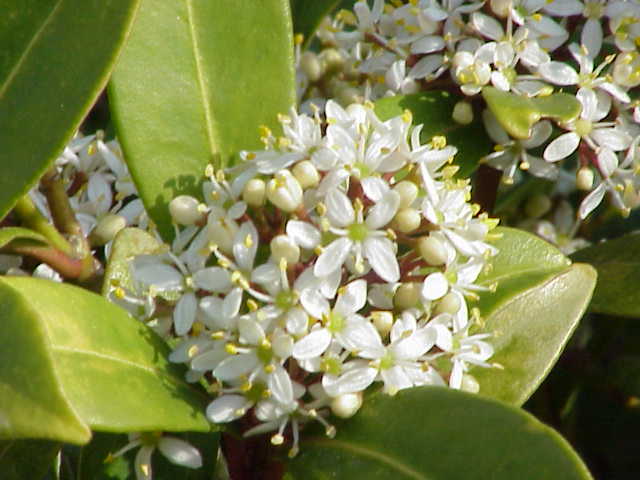
Skimmia japonica in blossom
Skimmia japonica Inflorescence.

Skimmia is a genus of four species of evergreen dioecious shrubs and small trees in the rue family Rutaceae, all native to warm temperate regions of Asia. The leaves are clustered at the ends of the shoots, simple, lanceolate, 6–21 cm long and 2–5 cm broad, with a smooth margin. The flowers are in dense panicle clusters, each flower small, 6–15 mm diameter, with 4-7 petals. The fruit is red to black, 6–12 mm diameter, a fleshy drupe containing a single seed. All parts of the plant have a pungent aroma when crushed.[1] The botanical name Skimmia is a Latinization of shikimi (シキミ, 樒), which is the Japanese name for Illicium religiosum as well as an element in miyama shikimi (ミヤマシキミ, 深山樒), the Japanese name for Skimmia japonica.

Species and subspecies[2]
  • Skimmia anquetilia N.P.Taylor & Airy Shaw. Western Himalaya to Afghanistan. Shrub to 2 m.
  • Skimmia arborescens T.Anderson ex Gamble. Eastern Himalaya to southeast Asia. Shrub or small tree to 15 m.
  • Skimmia japonica Thunb. Japan, China. Shrub to 7 m.
    • Skimmia japonica subsp. distincte-venulosa (Hayata) T.C.Ho
    • Skimmia japonica var. lutchuensis (Nakai) T.Yamaz.
    • Skimmia japonica subsp. reevesiana (Fortune) N.P.Taylor & Airy Shaw
  • Skimmia laureola (DC.) Decne. Nepal to Vietnam and China. Shrub or small tree to 13 m.
    • Skimmia laureola subsp. lancasteri N.P.Taylor
    • Skimmia laureola subsp. multinervia (C.C.Huang) N.P.Taylor & Airy Shaw

Skimmias are fed on by aphids, Horse Chestnut Scale, Garden Leafhopper, and Southern Red Mite.

Cultivation

[edit]

Skimmias are grown as garden plants for their foliage, flowers, and showy red fruits. They are grown in shade, with moist, well-drained, humus-rich soils. They are tolerant of both drought and air pollution. A large number of cultivars have been selected for garden use:[1]

  • Skimmia japonica 'Emerald King'
  • Skimmia japonica 'Fragrans'
  • Skimmia japonica 'Godrie's Dwarf'
  • Skimmia japonica 'Keessen'
  • Skimmia japonica 'Kew White'
  • Skimmia japonica 'Nymans'
  • Skimmia japonica 'Rubella'
  • Skimmia japonica 'Rubinetta'
  • Skimmia japonica 'Ruby Dome'
  • Skimmia japonica 'Wanto'
  • Skimmia japonica 'White Gerpa'
  • Skimmia japonica 'Veitchii'
  • Skimmia japonica subsp. reevesiana 'Ruby King'
  • Skimmia × confusa 'Kew Green' (S. anquetilia × S. japonica)

References

[edit]
Revisions and contributorsEdit on WikipediaRead on Wikipedia
from Grokipedia
Skimmia is a comprising four accepted of shrubs and small trees in the family , native to warm temperate regions of ranging from through the and to , the , and . These are characterized by their compact, densely branched growth habit, aromatic leathery leaves, and terminal panicles of small white or yellowish flowers that appear in spring, often followed by bright red berries on fertilized female plants. The genus is dioecious, with male and female flowers typically on separate plants, though some cultivars are self-fertile. Widely cultivated for their ornamental value in shaded gardens, Skimmia species thrive in moist, acidic soils and provide multi-season interest through their foliage, fragrant blooms, and persistent fruits. The most commonly grown species, S. japonica, originates from , the , and (including ), growing to heights of 0.5 to 1.5 meters in cultivation, while others like S. arborescens from the can reach up to 8 meters in the wild. Additionally, certain species have traditional uses in folk for treating ailments such as fever and due to their content.

Taxonomy

Etymology and history

The genus name Skimmia derives from the Japanese term "shikimi" (or "miyama shikimi" for the wild variant), originally denoting Illicium religiosum (a toxic used in Buddhist rituals), but repurposed by Swedish botanist for S. japonica in his 1784 work Flora japonica, based on specimens collected during his travels in . Thunberg's description established the as comprising shrubs with aromatic foliage, marking the initial European recognition of these East Asian plants. Subsequent taxonomic revisions affirmed Skimmia's placement within the family, initially under varying subfamilies such as Rutoideae or Toddalioideae in early classifications like those of Engler (1896), before positioned it firmly in Zanthoxyloideae based on analyses of nuclear and markers. This subfamily assignment reflects shared traits like simple leaves and drupaceous fruits with other zanthoxylean genera, within the broader order . Key contributions to the 's history include British botanist Joseph Dalton Hooker's explorations of the , documented in his Himalayan Journals (1854), which expanded knowledge of the genus's diversity beyond to the Indo-Himalayan region. The species S. anquetilia was formally described by N.P. Taylor & Airy Shaw in 1979 based on specimens from these areas. Later revisions, such as Nigel P. Taylor's 1987 monograph in The Kew Magazine, refined species delimitations and synonymy, solidifying Skimmia as a small genus of about four to six species.

Accepted species

The genus Skimmia includes four accepted species, all dioecious shrubs or small trees native to temperate and subtropical regions of . These species are recognized based on morphological distinctions in venation, color, and growth , as detailed in taxonomic revisions. Skimmia anquetilia N.P.Taylor & Airy Shaw, the Himalayan skimmia, is a compact growing to 2 m tall with an open and highly aromatic, leathery green leaves clustered at stem tips. Native to the from through and , it produces small yellowish flowers and red ; no synonyms are currently accepted. Skimmia arborescens T.Anderson ex Gamble is a rare, tree-like reaching up to 8 m in height, with elliptic to obovate papery leaves 5–18 cm long and clusters of yellowish flowers followed by bluish-black fruits. It occurs in scattered populations from eastward to southern , , and northern Indo-China, where it inhabits forested slopes; it includes the accepted subspecies S. arborescens subsp. nitida N.P.Taylor & Airy Shaw ( to Indo-China), and no other synonyms are widely recognized. Skimmia japonica Thunb., the most widespread and commonly cultivated species, forms shrubs or small trees up to 7 m tall with glossy, elliptic leaves 6–13 cm long, fragrant white flowers, and bright red fruits on female plants. Native to , the , , and southern , it encompasses accepted infraspecific taxa including S. japonica subsp. japonica (central and southern , ) and S. japonica subsp. reevesiana (southern to , self-fertile with smaller stature); varieties such as var. japonica and var. veitchii (with bronze-tinged young leaves) are also noted. Synonyms include S. fortunei Mast. for subsp. reevesiana. Skimmia laureola (DC.) Decne. is a low shrub to 1.5 m tall featuring aromatic, oblanceolate leaves 6–9 cm long that emit a spicy scent when crushed, along with yellowish flowers and red fruits. Distributed across southern from the through , , , and , it includes subspecies S. laureola subsp. laureola (wider Himalayan range) and subsp. multinervia (with more prominent leaf venation, to northern Indo-China); the is Limonia laureola DC.

Description

Vegetative characteristics

Skimmia species are shrubs or small trees, typically growing to heights of 1 to 7 meters, although some, like S. arborescens, can reach up to 12 meters in native conditions. They exhibit a slow-growing, compact with dense, woody branching that often results in dome-shaped or rounded forms, making them suitable for low-maintenance . This growth pattern contributes to their neat, tidy appearance in cultivation, where they rarely exceed 2 meters. The leaves of Skimmia are simple and alternate, frequently clustered toward the ends of shoots to create a pseudo-whorled arrangement. They are generally lanceolate to elliptic or obovate in shape, leathery in texture, and measure 6 to 13 cm in length and 2 to 4 cm in width, with entire margins that may occasionally appear slightly crenate. The upper surface is glossy dark green, while the underside is paler yellow-green, and the leaves contain numerous glandular dots. When crushed, they emit a pungent, citrus-like aroma attributable to volatile essential oils, such as linalyl anthranilate in some species. Stems are sturdy and woody, supporting the dense branching typical of the genus, with young shoots often bearing the leaf clusters prominently. The overall vegetative structure is unarmed and glabrous, enhancing the plant's resilience in shaded, humid environments. Skimmia plants are dioecious, with male and female individuals displaying similar vegetative traits.

Flowers, fruits, and reproduction

Skimmia are dioecious, with unisexual flowers borne on separate and , necessitating cross- between them for successful production. Typically, one supports for up to six to ensure adequate set. The flowers are small, measuring 6-8 mm in diameter, and feature 4-5 petals arranged in a star-shaped corolla; they appear in dense, terminal panicles that range from 5-8 cm long. These blooms are creamy white, occasionally tinged pink, and mildly fragrant, with flowers being slightly larger and more aromatic than those on ; they emerge in mid-spring, adding ornamental value during the flowering period. Following , female develop fruits that are fleshy , typically but can be in some , and spherical, with a of 6-10 mm. Each contains 1–5 seeds, each encased in a hard endocarp (), and the fruits ripen in autumn, persisting on the plant through winter to provide extended visual interest. In some variants, fruits may appear rather than , but the red form is more common across the . Reproduction in Skimmia primarily occurs via extracted from mature drupes, though vegetative propagation by cuttings is more commonly practiced due to the variability of seedlings. Seedlings may display hybrid traits if from multiple male plants is involved, leading to inconsistent morphology.

Distribution and habitat

Geographic range

Skimmia species are native exclusively to warm temperate regions of , spanning from the western Himalayas eastward to and southern , with distributions concentrated in mountainous and forested areas across the continent. The genus encompasses several accepted species, each exhibiting distinct regional patterns that reflect adaptations to varied topographic and climatic zones within this range. No Skimmia species occur naturally outside Asia, though they have been widely introduced elsewhere for ornamental purposes. Skimmia japonica, the most widespread species, is distributed across eastern Asia, including (including the Nansei-shoto islands), the southern (Primorye, , and ), , and southeastern . It thrives in lowland to mid-elevation forests, often below 1,000 meters. In contrast, S. laureola occupies the eastern Himalayan region, from central through and northeastern (Assam, , Arunachal Pradesh, Nagaland, and ) to , southeastern , and southwestern . This species favors higher elevations, typically between 2,125 and 3,950 meters in temperate forests. The remaining species highlight further Himalayan specialization: S. anquetilia is confined to the western Himalayas, ranging from eastern through and northern (Jammu & , , and ) to western , at altitudes of 1,830 to 3,030 meters in coniferous undergrowth. S. arborescens, meanwhile, bridges the eastern Himalayas with southeastern Asia, occurring from and northeastern () southward to , , , , and southern ( and provinces), often as a small in mid-elevation subtropical to temperate zones. Additional species include S. reevesiana, native to southern and southeastern (including ), , , , and the , typically in montane forests. S. multinervia is found in the and adjacent areas, from and northeastern () through to southwestern (, ) and northern Indo-China (, ), at elevations above 2,000 meters. These distributions underscore the genus's concentration in the Himalayan arc and adjacent eastern Asian highlands, with elevational gradients from near sea level in S. japonica's range to over 3,000 meters in the Himalayan endemics.

Natural habitat preferences

Skimmia species thrive in cool to mild temperate climates characteristic of montane regions in eastern and southeastern , where they experience moderate temperatures, distinct seasonal changes, and protection from extreme winds in sheltered positions. These environments typically provide consistent moisture without prolonged waterlogging. The genus favors moist, well-drained soils rich in , often derived from decaying leaf litter in forest floors, with acidic to neutral . These conditions prevail in shaded, humid microclimates where accumulates, promoting root health and preventing nutrient leaching. Species such as Skimmia reevesiana (sometimes treated as a subspecies of S. japonica) are commonly found in montane forests at elevations of 1200-2600 m, while S. arborescens occupies shady, moist montane areas between 1000-2800 m. In their natural settings, Skimmia plants associate with mixed woodlands and shrublands dominated by other evergreens, such as rhododendrons and ferns, forming dense layers that enhance humidity and provide partial shade. For instance, S. multinervia grows in montane forests above 2000 m alongside conifers and broad-leaved trees, contributing to the of these ecosystems. S. laureola similarly inhabits shady forest undergrowth at altitudes of 2100-3000 m in the . These associations underscore the genus's adaptation to competitive, resource-limited environments with filtered light and stable moisture.

Cultivation and uses

Growing requirements

Skimmia require partial to full shade for optimal growth, as direct sunlight can cause leaf scorch on the foliage. They perform best in locations with dappled light or deeper shade, such as under the canopy of taller trees, where they receive less than two hours of direct sun daily. These shrubs prefer humus-rich, moist but well-drained soils that are slightly acidic, with a ideally below 6.0, though they can tolerate neutral conditions up to pH 7.0. Consistent moisture is essential, especially during establishment, but once mature, Skimmia exhibits good provided the soil does not become waterlogged. These preferences parallel the shady, moist environments of their native East Asian habitats. Skimmia is hardy in USDA zones 7 to 9, where winter temperatures rarely drop below 0°F (-18°C), but it benefits from protection against harsh winds and extreme cold, such as mulching roots or sheltering in exposed sites. In colder areas within zone 7, additional winter protection like burlap wrapping may prevent damage. Fertilization needs are minimal; in fertile soils, no additional feeding is required, but for plants in poor conditions, apply a low-nitrogen, slow-release in spring to support steady growth without encouraging excessive foliage that could attract pests. Over-fertilization, particularly with high-nitrogen products, should be avoided to maintain plant health.

Propagation and maintenance

Skimmia plants can be propagated through several methods, though success rates vary due to their slow growth and specific requirements. Seed propagation involves fresh, clean seeds after a period of cold stratification to mimic winter conditions, which typically takes 4-6 weeks at 34-41°F (1-5°C); is slow and may take several months, making this method less practical for home gardeners. Semi-hardwood or half-ripe cuttings, taken in mid- to late summer from non-flowering shoots, are more reliable for vegetative ; these 3-4 inch cuttings should be rooted under with bottom heat around 70°F (21°C) in a well-draining medium like a peat-sand mix, often taking 4-6 weeks to establish roots before potting on. Layering offers another option, particularly for simple layering in spring, where a low branch is wounded and buried in moist until rooted, typically over one ; this method preserves the parent plant's characteristics and is suitable for dioecious to ensure matching. Ongoing maintenance of Skimmia focuses on supporting their compact, habit while promoting health and fruit production where desired. is minimal and best performed immediately after spring flowering to maintain shape, removing any dead, damaged, or overly vigorous shoots that disrupt the natural form; avoid heavy cuts, as the plants recover slowly. Apply a 2-3 inch layer of organic mulch, such as leaf mold or bark chips, annually in late winter or early spring around the base to retain and suppress weeds, ensuring it is kept 2 inches away from stems to prevent rot. For fruit production on female plants, pair with a nearby , as Skimmia is dioecious; a of one to every six females ensures adequate for reliable berry set without cross-pollination issues. Common care challenges include overwatering, which can lead to from pathogens like , manifesting as , yellowing leaves, and mushy ; prevent this by allowing the top inch of to dry between waterings and ensuring excellent drainage, especially in containers. is most successful in early spring before new growth, when the plant is dormant; disturb minimally and thoroughly afterward to reduce shock, avoiding autumn moves in cooler climates to prevent winter heaving. Skimmia japonica is the primary species from which numerous popular cultivars have been developed, selected for their ornamental qualities such as fragrant flowers, persistent , or distinctive foliage, often originating from 19th- and 20th-century selections in nurseries like those of the Veitch family. These cultivars are typically dioecious, requiring male and female plants for berry production, though some hermaphroditic forms exist. One widely grown male cultivar is 'Rubella', noted for its compact, bushy habit reaching about 1 tall and wide, with dark elliptic leaves and prominent winter buds that open to fragrant flowers in spring. Originating from early 20th-century selections, it is valued for its reliable bud display and , earning the Royal Horticultural Society's . The female cultivar 'Veitchii', raised by the Veitch Nurseries in the late , forms an upright, dense to 1.5 m, featuring rich green broadly oval leaves and dense clusters of white spring flowers followed by abundant red berries if pollinated. It is prized for heavy fruiting and structural interest in shaded borders. 'Kew White', a slow-growing female selection from the Royal Botanic Gardens, Kew, in the early 20th century, grows to 1.5 m with aromatic leathery green elliptic leaves, producing panicles of white flowers and heavy clusters of bright red berries. 'Finchy', a compact modern male introduced in the late , reaches 0.6-0.8 m with dark green leaves and creamy buds opening to scented white flowers, making it suitable for small gardens or containers. 'Emerald King', a male with dense, leathery dark green foliage, forms a compact shrub to 1 m, featuring red buds that develop into fragrant white flowers, selected for its robust growth and foliage interest. 'Fragrans', a male originating from nurseries in the early , forms a low-domed bushy to 1 m, with aromatic dark obovate leaves and fragrant white flowers. These can be propagated via semi-hardwood cuttings to maintain their traits.

Other uses

Certain Skimmia species, particularly S. laureola and S. anquetilia, have traditional uses in folk in their native Himalayan regions for treating ailments such as fever, , and digestive issues, attributed to phytochemicals like coumarins and alkaloids. Extracts have been studied for potential and properties, though modern clinical use is limited.

Ecology

Pollination and seed dispersal

Skimmia species exhibit dioecious breeding systems, with separate male and female plants necessary for successful reproduction, as pollen from male flowers must reach female flowers on nearby plants. The small, fragrant, creamy-white flowers, which bloom in spring, primarily attract insect pollinators such as bees (including honeybees, bumblebees, and solitary bees) and hoverflies, drawn to the nectar and pollen. While wind pollination may occur secondarily due to the exposed anthers, entomophily remains the dominant mechanism in their natural woodland habitats. Following fertilization, female plants produce vibrant red berries that persist through winter, serving as a key food source for birds in lean seasons. These frugivorous birds, upon consuming the berries, excrete viable , enabling long-distance dispersal and colonization of new areas within Skimmia's native Asian forests. In humid, environments, additional dispersal occurs via gravity, as fallen berries release onto the , and potentially by water in streamside or rainy conditions, though avian vectors predominate for .

Pests and diseases

Skimmia plants are generally resistant to many pests but can be affected by aphids (Aphididae family), which suck sap from tender shoots and leaves, leading to distorted growth, curled foliage, and sticky honeydew that promotes sooty mold. Scale insects, such as armored or soft scales, attach to stems and leaves, extracting plant juices and causing yellowing, wilting, and premature leaf drop if infestations are severe. Spider mites, including species like the twospotted spider mite, thrive in hot, dry conditions and feed on leaf undersides, resulting in stippled or speckled yellow dots on foliage, bronzing, and fine webbing in heavy infestations. Among diseases, root and crown rot pose significant threats, primarily caused by soilborne pathogens such as Phytophthora spp. (e.g., P. cactorum, P. cryptogea), Pythium spp., and spp., which are exacerbated by poor drainage and overwatering. Symptoms include brown, rotted s, water-soaked crowns, of otherwise green leaves, and eventual stem dieback due to compromised root systems. Leaf spot diseases, attributed to fungi like Ascochyta sp. and Pleospora sp., manifest as irregular spots on leaves, favored by prolonged wetness in shaded, crowded plantings. Powdery mildew can also occur, appearing as a white, powdery coating on leaves under humid conditions. Effective management emphasizes cultural practices to prevent issues, such as ensuring well-drained soil to avoid root rot and spacing plants adequately for airflow to reduce fungal leaf spots and mite proliferation. For pests, non-chemical controls like strong water sprays to dislodge aphids, scales, and mites, or introducing natural predators such as ladybird beetles, are recommended first; chemical options like neem oil or targeted insecticides should be used sparingly on leaf undersides due to potential toxicity to beneficial insects and the plant's ornamental value. Infected leaves or severely affected plants should be promptly removed and disposed of to limit spread. No specific fungicides are registered for Skimmia diseases, underscoring the importance of preventive hygiene in propagation and cultivation.

References

Add your contribution
Related Hubs
Contribute something
User Avatar
No comments yet.