Hubbry Logo
search
logo
1989234

Slapton, Devon

logo
Community Hub0 Subscribers
Read side by side
from Wikipedia

Slapton is a village and civil parish in the South Hams district of Devon, England. It is located near the A379 road between Kingsbridge and Dartmouth, and lies within the South Devon Area of Outstanding Natural Beauty (AONB). The nearby beach is Slapton Sands; despite its name, it is not a sandy beach but a shingle one.

Key Information

In 1901 the population of the civil parish was 527,[1] decreasing to 473 in 2001,[2] and decreasing further to 434 at the 2011 census.[3] The parish is surrounded clockwise from the north by the parishes of Blackawton, Strete, Stokenham and East Allington.[4]

History

[edit]

Slapton was recorded in the Domesday Book of 1086 as Sladone.[5] The Collegiate Chantry of St Mary was founded in 1372 or 1373 by Sir Guy de Brian.[6] The Tower Inn and West tower remain and the tower has been designated by English Heritage as a grade I listed building.[7] The Church of St James dates from the late 13th or early 14th century, and is also grade I listed.[8]

The nearby beach is a coastal bar (see below), known as Slapton Sands. After Lalla Rookh, a tea clipper, was wrecked at Prawle Point in March 1873, some of her cargo of tea and tobacco,[9] heaped up to 11 feet (3.4 m) high in places, as well as pieces of wreckage, were washed up on Slapton Sands.[10] The beach itself is not sand, but consists of small smooth pebbles ranging in size from ¼ inch to several inches.

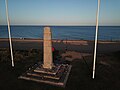
In 1944, during World War II, it was part of the site of Exercise Tiger, a rehearsal for the Invasion of Normandy which was attacked by German E-Boats and also saw a large number of friendly fire deaths. An M4A1 Sherman tank that was sunk in this action has been recovered and now stands on the road behind the beach at nearby Torcross.[11] A stone memorial presented by the United States Army to the residents of South Hams also commemorates those who participated in the practice area for the Invasion of Normandy.[12] The monument is accompanied by two flag poles either side.[13] Part of Exercise Fabius took place a week after Exercise Tiger on Slapton Sands.

Geography and environmental importance

[edit]

Behind Slapton Sands is Slapton Ley, a nature reserve and example of serial or ecological succession — the process whereby open water becomes reed bed and eventually, as silt and leaf litter builds up, woodland. The beach itself is a bar: the material that makes up the beach was pushed up by the rising sea levels during the Flandrian transgression after the last glacial period (from 10,000 to 5,000 years ago). A similar process formed Chesil Beach.[14]

Beaches formed like this are reworked by coastal processes now but are not supplied by enough material to recreate them, should material be removed. This had terrible consequences nearby at Hallsands where most of the beach was removed as building material for Devonport dockyards, leaving the village exposed to storms. It was struck by a storm in 1917 and most of the village was washed away, although no villagers were killed.[14]

Further north, the beach is known as Strete Gate and at the northernmost end is Pilchard Cove. The southern end of the beach is known as Torcross Sands. A length of beach about 100 metres (110 yd) south of Pilchard Cove is regularly used by naturists.[15][a]

Climate

[edit]
Climate data for Slapton (1991–2020)
Month Jan Feb Mar Apr May Jun Jul Aug Sep Oct Nov Dec Year
Record high °C (°F) 14.6
(58.3)
16.2
(61.2)
19.5
(67.1)
22.2
(72.0)
24.1
(75.4)
30.5
(86.9)
28.2
(82.8)
28.8
(83.8)
25.0
(77.0)
23.4
(74.1)
17.7
(63.9)
15.7
(60.3)
30.5
(86.9)
Mean daily maximum °C (°F) 9.5
(49.1)
9.6
(49.3)
11.0
(51.8)
13.2
(55.8)
15.9
(60.6)
18.8
(65.8)
20.8
(69.4)
20.8
(69.4)
18.6
(65.5)
15.5
(59.9)
12.3
(54.1)
10.2
(50.4)
14.7
(58.5)
Daily mean °C (°F) 6.8
(44.2)
6.7
(44.1)
8.0
(46.4)
9.6
(49.3)
12.2
(54.0)
14.9
(58.8)
16.8
(62.2)
16.9
(62.4)
15.1
(59.2)
12.5
(54.5)
9.4
(48.9)
7.4
(45.3)
11.4
(52.5)
Mean daily minimum °C (°F) 4.0
(39.2)
3.7
(38.7)
4.8
(40.6)
5.8
(42.4)
8.4
(47.1)
10.9
(51.6)
12.7
(54.9)
13.0
(55.4)
11.5
(52.7)
9.4
(48.9)
6.4
(43.5)
4.6
(40.3)
8.0
(46.4)
Record low °C (°F) −8.0
(17.6)
−6.8
(19.8)
−6.5
(20.3)
−2.5
(27.5)
−0.1
(31.8)
2.5
(36.5)
6.2
(43.2)
6.0
(42.8)
3.9
(39.0)
−0.3
(31.5)
−2.7
(27.1)
−6.4
(20.5)
−8.0
(17.6)
Average precipitation mm (inches) 129.6
(5.10)
97.6
(3.84)
85.1
(3.35)
73.5
(2.89)
59.7
(2.35)
67.4
(2.65)
64.6
(2.54)
78.2
(3.08)
70.1
(2.76)
120.2
(4.73)
129.6
(5.10)
141.1
(5.56)
1,117.2
(43.98)
Average precipitation days (≥ 1.0 mm) 15.0 12.4 11.9 10.4 9.1 9.0 8.7 9.8 9.7 13.8 15.3 15.6 141.1
Mean monthly sunshine hours 56.3 88.0 122.5 178.9 211.9 215.5 209.1 191.8 151.2 103.5 71.9 48.5 1,649.7
Source 1: Met Office[16]
Source 2: Starlings Roost Weather[17]
[edit]

See also

[edit]

Notes and references

[edit]
[edit]
Revisions and contributorsEdit on WikipediaRead on Wikipedia
from Grokipedia
Slapton is a small village and civil parish in the South Hams district of Devon, England, located approximately a quarter-mile inland from Start Bay along the A379 road between Kingsbridge and Dartmouth.[1][2] Perched on a hill above the 3-mile shingle beach of Slapton Sands, the parish encompasses the village itself, the hamlets of Start and Hansel, and surrounding rural farms, with a population of 434 (2011 census), though local estimates suggest around 600 permanent residents as of the 2020s.[1][2] It forms part of the South Devon Area of Outstanding Natural Beauty, characterized by gently rolling hills, deep valleys, and the coastal lagoon of Slapton Ley—the largest natural freshwater lake in southwest England.[2][3][4] The area's history dates back to prehistoric times, with evidence of Neolithic settlement from flint scatters and Bronze Age activity including burial mounds and field systems, followed by an Iron Age hilltop enclosure.[4] By the Anglo-Saxon period, Slapton was part of a royal estate granted in 846 AD and owned by the Bishop of Exeter by 1086, as recorded in the Domesday Book under the name Sladone, with 53 households.[4] Medieval development included the founding of St James the Great Church in the 13th century and a chantry college in 1373, of which a 14th-century tower survives despite the Dissolution of the Monasteries under Henry VIII.[1][3][4] The parish's geology features Devonian slates and Permian breccia, contributing to its shingle barrier that has enclosed Slapton Ley since around 900 BC.[4] Slapton gained international notoriety during World War II as the site of Operation Tiger, a rehearsal for the D-Day landings on April 28, 1944, when German E-boats attacked Allied convoys off Slapton Sands, resulting in the deaths of 749 American servicemen.[2][3][5] The village was evacuated for military training, and the tragedy was kept secret until the 1980s; memorials, including a Sherman tank at nearby Torcross, commemorate the event today.[2] Today, Slapton is a conservation area with thatched cottages, narrow leys (lanes), two pubs, a community shop, and amenities like a playground and nature field, attracting visitors for its beaches, walking trails, birdwatching at Slapton Ley Nature Reserve, and watersports.[1][2] The Slapton Ley Field Centre supports ecological studies in the reserve, highlighting the area's biodiversity and role in environmental education.[3]

Overview and Administration

Location and Governance

Slapton is a village and civil parish located in the South Hams district of Devon, England.[1] It lies along the South Devon coastline, approximately 6 miles southwest of Dartmouth and 7 miles east of Kingsbridge, positioned near the A379 road that connects these towns.[6] The parish's central coordinates are approximately 50°18′00″N 3°39′00″W.[7] Administratively, Slapton is governed as a civil parish within the South Hams District Council and falls under the oversight of Devon County Council.[1] The area is part of the South Devon National Landscape, formerly known as the South Devon Area of Outstanding Natural Beauty (AONB), which encompasses its scenic coastal and rural features.[8] Historically, the manor of Slapton was recorded in the Domesday Book of 1086 as "Sladone," noting a population of 53 households at that time.[9] Access to Slapton is primarily via the A379 coastal road, which runs along the shingle barrier known as the Slapton Line.[10] The parish is situated adjacent to Start Bay, a section of the English Channel coastline, providing direct proximity to the sea.[11]

Demographics

According to the 2001 census, Slapton parish had 473 residents, which decreased to 434 by the 2011 census. The 2021 census recorded a slight rebound to 506 residents.[12] Historically, the population reached a peak of 527 in 1901.[13] This reflects a gradual decline from the early 20th century due to rural depopulation, a common trend in remote English parishes, though recent data indicates stabilization or modest growth amid broader regional shifts. The population density remains low at approximately 37 persons per square kilometre, underscoring Slapton's sparse, rural setting within South Hams.[14] The community features an aging demographic profile typical of South Devon, with 31.8% of residents aged 65 and over as of the 2021 census, higher than the England average of 18.4%, driven by retirement migration.[12] In terms of social composition, the 2011 census showed 96.8% of residents identifying as White British, with minimal representation from other ethnic groups, consistent with patterns in rural Devon.[15] Household structures are diverse but lean toward smaller units, including family homes and a notable share of retiree-occupied properties, often single-person or couple-only.

Geography

Topography and Coastline

Slapton is situated within the South Hams district of Devon, characterized by the rolling hills typical of the region's undulating landscape, where elevated slopes and valleys create a varied topography rising from sea level along the coast to approximately 100 meters inland. This terrain forms part of Start Bay, a southeast-facing embayment on the English Channel coast, bounded by headlands such as Strete Gate to the north and Torcross to the south.[16] The coastline is dominated by Slapton Sands, a prominent approximately 4.5-kilometer shingle barrier beach that stretches between Strete Gate and Torcross, functioning as a tombolo-like bar separating the sea from the inland freshwater lagoon of Slapton Ley. This barrier, with a crest elevation of around 6 to 8 meters above ordnance datum, formed between 10,000 and 3,000 years ago during the Holocene, when post-glacial sea-level rise of approximately 21 meters over 9,000 years pushed shingle sediments inland from offshore sources, eventually damming a post-glacial estuary to isolate the Ley.[16][17] The beach's shingle composition, primarily flint, chert, and quartz pebbles with median sizes ranging from 2 to 9 millimeters, accumulates through ongoing longshore drift, predominantly northward under the influence of southerly Atlantic waves, though seasonal reversals occur from easterly Channel storms.[16][18] Geologically, the area underlies Devonian bedrock, consisting of sandstones, shales, and mudstones such as the Meadfoot Beds, deposited in deep marine environments during the Devonian period around 400 million years ago.[19][18] These rocks, often folded and faulted due to Variscan orogeny, form the stable headlands flanking Start Bay and contribute to the coastal sediment supply via cliff erosion, while the overlying Quaternary shingle ridge reflects the dynamic interplay of marine processes in shaping the modern landform.[20][21]

Climate

Slapton, located on the coast of South Devon, features a temperate oceanic climate classified as Cfb under the Köppen-Geiger system, marked by mild winters, cool summers, and no distinct dry season.[22] This classification reflects the region's maritime influences, including prevailing westerly winds and the moderating effect of the Atlantic Ocean. The Gulf Stream plays a key role in tempering extremes, keeping sea surface temperatures around 11–12°C year-round and preventing severe frosts or heatwaves typical of more continental areas at similar latitudes.[23][24] Based on Met Office data for the 1991–2020 period, Slapton's annual mean temperature averages 11.4°C, derived from a mean daily maximum of 14.8°C and minimum of 8.0°C.[25] July is the warmest month, with a mean maximum of 20.9°C, while January sees the lowest temperatures at a mean minimum of 4.0°C. Precipitation totals 1,117 mm annually, concentrated in winter months like January (130 mm), supporting lush vegetation but contributing to occasional flooding risks. Sunshine hours average 1,650 per year, with July providing the most at 209 hours.[25] In recent decades, climate change has introduced subtle shifts, including gradual warming and more frequent extreme events. The UK, including South Devon, has warmed by about 1.2°C since the 1880s, with the 2015–2024 decade being 0.4°C warmer than the previous one.[26] Summers in the 2020s have shown elevated highs, such as multiple days above 25°C in June 2023 across the region. Additionally, human-induced climate change has increased the intensity and frequency of storm rainfall, exacerbating wet winters.[27][28]

History

Prehistoric and Medieval History

Evidence of early human activity in the Slapton area dates back to the Neolithic period, with flint tools and scatters discovered in fields surrounding Slapton Ley, indicating settlement along the coastal landscape.[4] These finds suggest exploitation of the region's resources, including marine and woodland environments, during the period around 4500–2300 BCE. Bronze Age occupation is evidenced by barrows on the hills above the village, reflecting funerary practices and territorial markers in the South Hams landscape.[4] Nearby Iron Age hillforts, including Blackdown Rings approximately 12 km north of Slapton, feature defensive earthworks with ramparts dating to around 800–500 BCE, highlighting defensive settlement patterns in the vicinity during the late Bronze Age to early Iron Age transition.[29] Slapton is recorded in the Domesday Book of 1086 as "Sladone," a manor in the hundred of Chillington held by Juhel of Totnes, with a total of 53 households comprising 20 villagers, 8 smallholders, and 25 slaves, placing it among the larger settlements in Devon.[9] The estate supported an agricultural economy focused on arable farming with 16 ploughlands, meadow for livestock, and common pasture, alongside woodland for pigs, underscoring its role as a productive rural holding in the post-Conquest landscape.[9] Medieval development centered on manorial and ecclesiastical institutions, with the manor remaining under the de Brian family from at least the reign of Henry II (1154–1189) until the early 15th century.[30] In 1373, Sir Guy de Brian, a prominent courtier and standard-bearer to Edward III, founded the Collegiate Chantry of St Mary within the manor, establishing a college for priests to perform daily services for his family's souls.[31] The Church of St James, the parish church, originated in the late 13th to early 14th century, featuring a Perpendicular Gothic style with a 15th-century tower and chancel additions, and is designated as a Grade I listed building for its architectural and historical significance.[32]

World War II and Exercise Tiger

During World War II, the Slapton area played a critical role in Allied preparations for the D-Day invasion of Normandy. In November 1943, the British War Cabinet notified Devon County Council of the need to clear a 30,000-acre coastal zone around Slapton Sands, leading to the compulsory evacuation of approximately 750 families—totaling around 3,000 residents—between December 20, 1943, and early 1944.[33][34] This evacuation transformed the region into a secure training ground for the United States Army, particularly the 4th Infantry Division and the 1st Engineer Special Brigade, who used the site's shingle beach and surrounding terrain as a near-replica of Utah Beach in Normandy.[35][36] The pivotal event was Exercise Tiger, a large-scale amphibious rehearsal conducted from April 22 to 30, 1944, involving up to 30,000 American troops, 300 ships, and live-fire simulations to mimic the full D-Day operation.[37] On the night of April 27–28, a convoy of eight Landing Ship Tanks (LSTs) carrying about 7,500 troops from the 4th and 29th Infantry Divisions sailed from Plymouth toward Slapton Sands, escorted by just one British corvette due to a communications failure that left heavier naval support behind.[38] German E-boats, operating from Cherbourg, exploited this vulnerability and torpedoed LST-507 and LST-531, while damaging LST-289; LST-507 sank rapidly, claiming the lives of 202 men, including a 10-man crew aboard a Duplex Drive (DD) amphibious Sherman tank.[35][5] The official U.S. Department of Defense tally records 749 fatalities from the attack—551 soldiers and 198 sailors—many due to drowning, hypothermia, or wounds in the cold waters off Start Bay.[5] Compounding the tragedy, an earlier friendly fire incident on April 27 occurred when a timing error in radio frequencies caused naval gunfire and strafing from Allied aircraft to hit disembarking troops on Slapton Sands, killing at least 100–300 men.[39] To prevent morale damage and intelligence leaks to the Axis powers, the U.S. and British commands classified Exercise Tiger details, listing many victims as missing in action rather than disclosing the rehearsal's failure; this secrecy persisted until the 1980s, when declassified documents and books like Edwin P. Hoyt's The Invasion Before Normandy (1985) brought the full scope to public attention.[40][41] The exercise's lessons, including improved convoy escorts and radio encryption, directly informed D-Day successes, though at a cost exceeding Utah Beach's invasion casualties.[37] Today, Slapton's wartime legacy endures through artifacts and memorials. In May 1984, local historian Ken Small recovered an M4A1 Sherman DD tank from the wreck of LST-507 off Torcross beach, where it now stands unrestored as a poignant memorial to the lost crews, positioned in a car park overlooking the sea.[42][43] Additional tributes include a granite sign at Slapton Sands detailing the evacuation and tragedy, and a monument at Utah Beach in Normandy inscribed in memory of the 749 victims, erected to honor their sacrifice during the rehearsal that paved the way for liberation.[44][45]

Post-War Developments

Following the conclusion of World War II, residents of Slapton and nearby villages in the South Hams area began repopulating the region in late 1944, after the military released the 30,000-acre training zone that had been evacuated since December 1943.[46] Returnees encountered significant challenges, including the clearance of unexploded ordnance by bomb disposal units, which detonated devices discovered during ploughing and other activities, though no human fatalities were recorded. Looting of homes and farms had occurred during the absence, with items such as door fittings and livestock feed stolen, while unharvested crops were ravaged by seagulls, rats, and other scavengers.[46] Agricultural recovery was prioritized to restore food production, with farmers encouraged to resume operations in time for autumn sowing despite these hazards. Repairs to essential infrastructure, including roads along the A379 route through Slapton, were carried out by Devon County Council workers, Italian prisoners of war, and local labor to reconnect communities and support farm access. Returning households received aid from the American and Canadian Red Cross, including household goods like quilts and teapots, aiding the transition back to civilian life. By the mid-1950s, the area had largely stabilized, though agricultural practices continued to evolve amid broader post-war mechanization trends in Devon.[46] Throughout the 20th century, traditional farming in Slapton declined due to economic shifts, land consolidation, and intensification, reducing the number of small family holdings and altering rural employment patterns. This coincided with a rise in second homes and holiday properties, driven by the area's scenic appeal; by 2003, more than 11% of dwellings in the encompassing South Hams district were holiday homes, contributing to seasonal population fluctuations and housing pressures.[47] The designation of the South Devon Area of Outstanding Natural Beauty in 1960 encompassed Slapton, promoting landscape conservation while fostering tourism as an alternative economic pillar. A major disruption occurred in January 2001, when storms eroded the shingle ridge at Slapton Sands, breaching the barrier and temporarily closing the A379 road, which underscored the need for adaptive coastal infrastructure.[8][48] Slapton's integration into South Hams District Council planning was reinforced by the 2011 Census, which recorded a parish population of 434. In the 2020s, community resilience initiatives have gained prominence amid climate challenges, with the Slapton Line Partnership leading efforts through its 2022 Adaptation Plan and a revised strategy in November 2023 to address accelerating coastal erosion, fostering collective actions for coastal access, infrastructure realignment, and long-term viability without over-reliance on the vulnerable A379 Slapton Line.[49] These projects emphasize public engagement, coast path maintenance, and proactive erosion response to build adaptive capacity.[50]

Environment and Conservation

Slapton Ley Nature Reserve

Slapton Ley is the largest natural freshwater lake in southwest England, with the Lower Ley covering approximately 77 hectares of open water and the total lake extending about 2.4 kilometers in length.[51] It formed in the post-glacial period through the Flandrian Transgression, around 3,000 years ago, when rising sea levels pushed a shingle ridge across the mouths of two river valleys, creating a lagoon that evolved into the current lake.[51] The reserve encompasses diverse habitats, including open water, extensive reed beds, freshwater marshes, and surrounding woodlands, which illustrate ecological succession from the initial open-water state to a potential climax community of oak-ash forest driven by sedimentation and natural processes.[52] The biodiversity of Slapton Ley is exceptionally rich, supporting over 490 vascular plant species, including rare ones such as strapwort (Corrigiola litoralis), the only known UK population of which occurs here.[51] Animal life thrives across the habitats, with the lake and its fringing vegetation providing key refuges for otters (Lutra lutra), water voles (Arvicola terrestris), and wintering bitterns (Botaurus stellaris), alongside breeding populations of Cetti's warblers (Cettia cetti) numbering 35-45 pairs.[52] Migratory birds, such as great crested grebes (Podiceps cristatus) and large flocks of starlings (Sturnus vulgaris) forming murmurations of up to 100,000 individuals, utilize the reed beds and open water seasonally.[52] The reserve also hosts hazel dormice (Muscardinus avellanarius), 14 bat species including soprano pipistrelles (Pipistrellus pygmaeus), and 18 dragonfly species, contributing to its status as a vital wetland ecosystem.[52] Since the 1960s, the Field Studies Council has managed the site on behalf of owners including the Wild Planet Trust and in partnership with Natural England.[53] Conservation efforts at Slapton Ley emphasize protecting its ecological integrity, with the area designated as a National Nature Reserve in 1993 to safeguard its unique freshwater habitats and biodiversity.[51] It also holds Site of Special Scientific Interest (SSSI) status, first notified in 1952, highlighting its national importance for wildlife.[51] Ongoing research, spanning over 50 years, focuses on ecological processes such as water quality monitoring, habitat dynamics, and species interactions to inform adaptive management strategies.[52] Invasive species control is a priority, with annual treatments targeting Himalayan balsam (Impatiens glandulifera) and Japanese knotweed (Fallopia japonica) to prevent their spread into sensitive reed beds and marshes.[51] Additional measures include habitat maintenance through coppicing and scrub control to support rare plants like strapwort via translocation programs initiated in 1996.[52]

Coastal Management and Erosion

The coastal management of Slapton has been shaped by significant erosion events in Start Bay, including the destruction of the nearby village of Hallsands during a severe storm on January 26, 1917, which exposed the shoreline after extensive shingle dredging for Plymouth harbor works had removed protective beach material.[54] This event highlighted the vulnerability of the region's shingle barriers to human intervention and extreme weather, with the storm lowering beach levels by nearly 2 meters and leading to the village's abandonment.[55] More recently, in the winter of 2000–2001, a series of easterly storms coinciding with spring tides breached the Slapton Sands shingle ridge, eroding up to 5 meters of beach over a 1,000-meter stretch and temporarily severing the A379 road between Torcross and Strete Gate by undermining its foundations.[56] This incident isolated communities and underscored ongoing risks to infrastructure from wave overtopping and sediment loss.[57] Current strategies emphasize sustainable approaches over hard engineering, as outlined in the South Devon and Dorset Shoreline Management Plan II (SMP2) adopted in 2010, which designates a Managed Realignment policy for the Slapton Ley barrier beach across short, medium, and long terms to allow natural processes while supporting localized interventions.[58] Short-term measures include shingle recycling, where sediment is redistributed along the beach—for instance, in 2015, over 17,000 cubic meters of material was moved from the northern end to bolster vulnerable sections—and periodic beach nourishment to counteract losses from longshore drift.[10] In the 2020s, adaptation efforts by the Slapton Line Partnership have focused on monitoring and contingency planning for sea-level rise, projected to reach up to 1 meter by 2100 under high-emission scenarios, including enhanced sediment budgeting and community resilience initiatives to mitigate risks to the A379.[16] Community attitudes toward erosion management in Slapton have evolved from initial resistance to more adaptive perspectives, as evidenced by research in 2009 showing a shift toward acceptance of natural processes following the 2001 breach, with residents increasingly viewing hard defenses as unsustainable.[59] This resilience is reflected in the 2023 economic impact report on the Slapton Line, which quantifies erosion threats to the A379—potentially closing the road and disrupting access for over 30,000 residents and £100 million in annual regional economic activity—while advocating for proactive, nature-based solutions to balance protection and environmental health.[60] In March 2024, Devon County Council received £6.63 million in funding to enhance Slapton Line resilience. Additionally, in November 2024, the Save Our Shoreline charity was formed to promote nature-based solutions for coastal protection in Start Bay.[61][62]

Economy and Society

Tourism and Local Economy

Slapton's local economy is overwhelmingly dominated by tourism, which forms the backbone of employment and business activity in the area. According to the 2023 Slapton Line Final Report, the Accommodation and Food Services sector accounts for more than 40% of the 860 jobs in the primary area including Slapton, employing around 350 people.[60] While remnants of traditional agriculture and small-scale fishing continue in the surrounding South Hams district, these sectors have diminished significantly, with tourism now supporting the majority of local livelihoods.[63] The primary attractions fueling this tourism are Slapton Sands beach, renowned for walking and swimming along its shingle and sandy shores, and the Exercise Tiger memorials, including a preserved Sherman tank, which draw history enthusiasts to the site's World War II heritage.[64][44] These sites contribute to an estimated 288,000 adult day visitors annually to the Slapton Line area, based on 2014 car journey data adjusted for tourism patterns.[63] The resulting visitor expenditure totals approximately £9.28 million per year, generating £4.11 million in gross value added (GVA) and underscoring tourism's critical role in sustaining local businesses.[63] Despite these benefits, the economy faces notable challenges, including pronounced seasonality that concentrates visitor activity in summer months while straining off-season viability for hospitality operations.[60] Additionally, the influx of second homes and retirees—comprising 42% of residents over 16—has driven up housing costs, exacerbating affordability issues for year-round locals amid the tourism-driven property market.[60]

Community and Culture

The Slapton Parish Council plays a central role in fostering community life, managing local services such as a community support group, cafe, and cinema, while promoting the well-being of approximately 500 residents in this rural coastal parish.[1] Annual events strengthen social bonds, including the Slapton Ley Festival of Nature, a free community gathering featuring environmental activities, music, stories, and sustainable stalls organized by local charities and the Field Studies Council.[65] Remembrance services for Exercise Tiger, the tragic World War II D-Day rehearsal that claimed 749 American lives off Slapton Sands, are held annually at the Sherman Tank Memorial, drawing locals and visitors to honor the event through ceremonies and bootprint tributes.[44][5] Volunteer groups contribute to community efforts, notably through organized beach cleans at Slapton Sands as part of the Marine Conservation Society's Great British Beach Clean, where participants remove litter and record data to support ocean protection initiatives.[66] Slapton's cultural heritage centers on St James the Great Church, a 14th-century structure that serves as a focal point for weddings, funerals, and community festivals, including occasional flower displays that celebrate local traditions.[67] Local folklore reflects the area's maritime past, particularly its association with 18th- and 19th-century smuggling along Devon's coast, immortalized in traditional folk songs like "The Smuggler," which references Slapton as a hub for illicit tub-running operations.[68] The arts scene is enriched by programs at the Field Studies Council Slapton Ley, offering courses in painting, drawing, creative writing, and botanical illustration inspired by the surrounding landscape and nature reserve.[69] In modern society, Slapton demonstrates resilience through community-led initiatives, such as the Slapton Line Partnership's 2019 revised strategy, which addresses coastal change and sea-level rise by coordinating adaptation policies among residents, landowners, and authorities to sustain the parish's character.[70] Heritage preservation is a priority for the community, with the Parish Council committed to maintaining the rural charm and historical sites within the designated Slapton Conservation Area, established in 1973 and extended in 1992 to protect thatched cottages and medieval features.[71][72] While no notable famous residents are associated with Slapton, these efforts underscore a collective dedication to intangible social and cultural elements, occasionally amplified by tourism during public events.

References

User Avatar
No comments yet.