Hubbry Logo
Smoking gunSmoking gunMain
Open search
Smoking gun
Community hub
Smoking gun
logo
8 pages, 0 posts
0 subscribers
Be the first to start a discussion here.
Smoking gun
Smoking gun
from Wikipedia

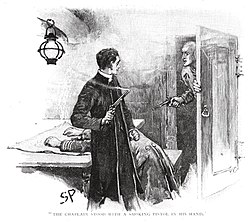
Illustration by Sidney Paget (1893).

The term "smoking gun" is a reference to an object or fact that serves as conclusive evidence of a crime or similar act, just short of being caught in flagrante delicto. "Smoking gun" refers to the strongest kind of circumstantial evidence, as opposed to direct evidence. Direct evidence would be eyewitness testimony of someone who saw an actus reus (the actual alleged act), while connected events (the preceding chase, etc.) are considered circumstantial.[1]

Phrase origin

[edit]

The phrase originally came from the idea that finding a very recently fired (hence smoking) gun on the person of a suspect wanted for shooting someone would in that situation be nearly unshakable proof of having committed the crime. A variant of the phrase (as "smoking pistol") is used in the Sherlock Holmes story, "The Adventure of the Gloria Scott" (1893).[2]

Extended meaning

[edit]

In addition to this, its meaning has evolved in uses completely unrelated to criminal activity: for example, scientific evidence that is highly suggestive in favor of a particular hypothesis is sometimes called "smoking gun evidence".[3]

See also

[edit]

References

[edit]
Revisions and contributorsEdit on WikipediaRead on Wikipedia
from Grokipedia
A is an object, document, or fact that provides conclusive proof of guilt, , or the validity of a , evoking the image of a recently discharged and still emitting smoke, which would irrefutably link it to a . The term draws from this literal scenario to denote so direct and incriminating that it leaves little room for alternative explanations or denials. Its figurative application emerged in the within literary contexts, including early stories, before solidifying as a common in legal, journalistic, and scientific during the . While often invoked in investigations to describe pivotal revelations, genuine smoking guns remain exceptional, as most evidentiary chains rely on cumulative rather than singular, unambiguous artifacts.

Etymology and Origins

Literal and Early Uses

A literal denotes a recently discharged, with visible issuing from the barrel or muzzle, signifying its immediate prior use and serving as direct in forensic investigations. This residue, typically from , distinguishes the weapon as having been fired within seconds or minutes of discovery, often incriminating a found in possession. The phrase's earliest documented literal appearance occurs in the 1843 English serialization of Russian author Alexander Marlinsky's novel Ammalát Bek in Blackwood's Edinburgh Magazine, Volume 53: "Ammalát leaped from his horse, and, resting his arms on his yet , looked for several moments steadfastly in the face of the murdered man." In this context, the underscores the protagonist's recent , linking the weapon temporally to the . Throughout the early 19th century, descriptions of warm or smoking firearms appeared in crime reports and nascent detective literature as compelling indicators of guilt, predating the phrase's idiomatic evolution. Such elements featured prominently in narratives, where the heat or smoke from a provided forensic clues to identify perpetrators caught shortly after firing. These literal references emphasized the gun's evidentiary value based on observable physical properties rather than abstract proof.

Transition to Metaphorical Phrase

The transition from a literal firearm emitting smoke to a metaphorical emblem of irrefutable evidence began in late 19th-century literature, particularly through Arthur Conan Doyle's 1893 short story "The Adventure of the Gloria Scott," where a chaplain is discovered holding a "smoking pistol" immediately after a shooting, directly implicating him in the recent act due to the visible residue of discharge. This depiction emphasized the causal connection: the smoke's presence served as temporal proof of firing moments earlier, bridging detection of the artifact to inference of guilt without requiring eyewitness observation of the trigger pull. By the early , the phrase evolved into an idiomatic expression in English-language and journalistic accounts, denoting physical or documentary artifacts that provided conclusive, near-contemporaneous akin to catching a perpetrator in the act. Such uses solidified its figurative status, extending beyond literal weaponry to any indicator of where the "smoke" metaphorically signaled recency and , often in contexts demanding proof short of direct . The phrase's evidentiary power derives empirically from the rapid dissipation of visible gun smoke post-firing, typically dispersing within seconds to minutes in open air due to and settling of particulate matter, thereby establishing a narrow window that causally ties the residue to an immediate prior event. This first-principles reliability—rooted in the physics of byproducts—underpins the metaphor's intuitive logic, distinguishing it from less temporally precise indicators.

Definition and Usage

Core Definition

A smoking gun denotes a piece of tangible evidence, such as an object, document, or verifiable fact, that furnishes irrefutable proof of wrongdoing, culpability, or a specific claim by establishing an immediate and direct causal connection to the act in question. This evidence typically manifests as empirical traces—recent, unaltered, and resistant to fabrication—that preclude plausible deniability, akin to a firearm emitting smoke from having been fired moments prior, thereby linking the holder inextricably to the discharge. In evidentiary terms, it transcends ambiguity, demanding scrutiny under standards where alternative interpretations fail due to the artifact's inherent specificity and temporal proximity to the event. Distinct from , which builds inference through correlated patterns potentially susceptible to confounding factors, a prioritizes causal immediacy: it forges an unbroken chain from perpetrator to prohibited action via hard-to-replicate markers, such as forensic residues or authenticated records, rendering guilt evident beyond without reliance on probabilistic narratives. While not formally defined in legal codes, its utility lies in verifiability; for instance, unaltered digital logs or physical imprints defy retroactive alteration, compelling acceptance through their objective resilience to counterclaims. This demarcation underscores a commitment to empirical rigor, where the evidence's self-evident linkage obviates extended interpretive chains.

Variations and Extensions

In scientific inquiry, the "smoking gun" metaphor extends to evidence that conclusively supports or falsifies a hypothesis through direct causal linkage, such as empirical data establishing predicted phenomena. For example, the detection of the cosmic microwave background radiation in 1965 by Arno Penzias and Robert Wilson provided a smoking gun for the Big Bang theory, as its blackbody spectrum matched theoretical predictions of relic radiation from an expanding universe. Similarly, in astrobiology, organic molecules detected by NASA's Curiosity rover on Mars in 2024, combined with sulfur isotopes indicating abiotic origins, served as a smoking gun ruling out certain biotic interpretations while confirming geological processes. These applications demand more than correlation, requiring verifiable mechanisms like spectral analysis or isotopic ratios to demonstrate agency and temporality. In corporate and financial investigations, the term applies to documents or communications proving deliberate misconduct, often via establishing sequence and intent. During the 2001 Enron scandal, shredded records and internal memos recovered by investigators acted as smoking guns revealing accounting manipulations, with SEC officials describing related audit failures as definitive proof of complicity. In the 2019 Merrill Lynch spoofing case, chat room transcripts with timestamps demonstrated traders' coordinated deception, leading to a $25 million CFTC penalty and exemplifying how electronic trails provide causal evidence of fraud. Such extensions preserve the metaphor's rigor, insisting on chain-of-custody proofs like metadata to exclude . Linguistically, variants like "smoking pistol" trace to Arthur Conan Doyle's 1893 Sherlock Holmes story "The Adventure of the Empty House," where a chaplain holds a recently fired pistol, but "smoking gun" supplanted it by the mid-20th century for its evocation of fleeting gunpowder residue implying recency and irrevocability. While synonyms such as "irrefutable proof" exist, the original phrasing underscores irreversible implication, distinguishing it from mere indicia by requiring evidence of proximate causation.

Historical Milestones

Literary and Early 20th-Century References

In late 19th- and early 20th-century detective fiction, depictions of a "smoking revolver"—a firearm recently discharged, with visible smoke or heat indicating immediate use—served as a recurring motif for direct physical evidence resolving mysteries. The term "smoking revolver" emerged in print around 1875, often in narratives where the weapon's state proved culpability beyond doubt, predating widespread forensic science but aligning with emerging emphasis on material clues. This imagery permeated Arthur Conan Doyle's Sherlock Holmes canon, where recently fired weapons frequently provided pivotal proof, as in "The Adventure of the Sussex Vampire" (1924), wherein a suspect hurls a smoking revolver after discharge, corroborating the timeline of events through its residual heat and odor. Imitators and pulp writers extended this convention into the 1920s and 1930s, embedding "smoking gun" or revolver variants in hardboiled tales of swift justice. Carroll John Daly, a pioneer of the genre in Black Mask magazine from 1922, employed such elements in stories culminating in confrontations where the warm barrel clinched guilt, as reflected in his 1936 novel The Mystery of the Smoking Gun, which literalized the device as a plot pivot. These narratives, numbering dozens in pulp output, prioritized tangible artifacts over confessions, fostering a literary shift toward forensic realism in detection. Early 20th-century crime journalism in the U.S. and UK mirrored this, with reporters invoking "smoking guns" literally in accounts of seized weapons from Prohibition-era raids (1920–1933), where residue or warmth linked arms to recent felonies like bootlegging hits. In cases such as Al Capone's 1931 tax evasion trial precursors, federal agents highlighted recovered firearms as probative, though ledgers ultimately proved decisive; the phrasing in period dispatches reinforced weapons as empirical anchors against alibi-dependent defenses. This usage, spanning 1900–1940, cultivated public trust in object-based adjudication, distinct from later metaphorical extensions.

Popularization in the Watergate Era

The Watergate scandal, originating from a break-in at the Democratic National Committee headquarters on June 17, 1972, involved operatives linked to President Richard Nixon's reelection campaign, prompting investigations into a subsequent cover-up. White House recordings, secretly made since 1971, captured discussions revealing Nixon's role in obstructing the FBI probe; the pivotal "smoking gun" tape documented a June 23, 1972, conversation between Nixon and chief of staff H.R. Haldeman, in which Nixon directed the CIA to falsely claim national security concerns to halt the FBI's Watergate inquiry. This audio evidence directly contradicted Nixon's public denials of involvement, establishing an irrefutable causal link to obstruction of justice. The unanimously ruled on July 24, 1974, in that did not shield the tapes from , compelling their release. On August 5, 1974, the disclosed the June 23 transcript, prompting bipartisan condemnation and eroding Nixon's support; he announced his the next day, August 8, marking the first U.S. presidential . Prior to disclosure, Nixon allies had demanded a "" to justify , framing it as conclusive proof; the tape's emergence fulfilled that criterion, transforming the metaphor from niche legal rhetoric to a staple of public discourse on definitive evidence. Media coverage amplified the phrase's visibility, with outlets invoking "" to describe the tape's unambiguous incrimination, embedding it in . This usage surge during 1972–1974 coverage demonstrated audio's power to circumvent verbal deniability, elevating standards for investigative reporting by prioritizing verifiable recordings over . The scandal's resolution via such evidence reinforced the term's connotation of incontrovertible causality in accountability narratives.

Notable Examples

In criminal investigations, a "smoking gun" refers to direct physical or documentary evidence that conclusively links a suspect to the crime, such as forensic traces or recordings that withstand rigorous scrutiny. Gunshot residue (GSR) analysis, developed in the mid-20th century, exemplifies this by detecting characteristic particles from firearm discharge on a suspect's hands or clothing, often confirming shooter identity in close-range murders when corroborated by timelines and alibis. For instance, in post-1970s cases, GSR tests have identified perpetrators by matching residue composition—lead, barium, and antimony—to ammunition primers, with studies showing detection reliability within hours of firing, though secondary transfer risks necessitate exclusion of non-shooters nearby. Video recordings have served as smoking guns in abuse prosecutions, as seen in the federal case against . Tapes recovered in 2002, depicting sexual acts with underage victims, were authenticated through witness testimony and metadata, contributing to his September 2022 conviction on six counts of producing and enticement of minors, with sentences totaling 30 years upheld on appeal. Prosecutors emphasized the videos' unaltered nature and victims' corroboration, distinguishing them from by direct visual proof of exploitation spanning 1991–2010. Physical artifacts like bloodied items can constitute potential smoking guns but require unchallenged . In the 1995 O.J. Simpson murder trial, matching Aris gloves—one at the stained with victims' and Simpson's blood, the other at his estate—were presented as linking him to the stabbings, with DNA mixtures confirming intermingled fluids from , , and Simpson himself. However, defense challenges to handling and the infamous courtroom demonstration where shrunken, latex-lined gloves failed to fit Simpson's hands raised doubts about tampering or fit, ultimately contributing to despite initial prosecutorial reliance on them as dispositive. For such evidence to hold, courts apply standards like Daubert v. Merrell Dow Pharmaceuticals (1993), mandating that forensic methods demonstrate testability, , error rates, and general acceptance to ensure reliability over . Chain-of-custody documentation—from collection to analysis—further safeguards integrity, as breaks can invalidate admissibility by permitting substitution or contamination, as scrutinized in GSR and protocols.

In Political and Journalistic Investigations

In the Iran-Contra affair of 1986, the "Diversion Memo" authored by Lieutenant Colonel served as a key piece of documentary evidence linking proceeds from secret arms sales to to the funding of Nicaraguan Contra rebels, in violation of congressional prohibitions like the . This memo, uncovered during investigations, provided direct provenance through its internal origins and detailed financial diversions totaling approximately $3.8 million, though congressional probes found no conclusive "" implicating President Reagan personally in the diversion. Independent counsel Lawrence Walsh's 1993 report emphasized the memo's role in proving operational illegality among mid-level officials, verified via declassified records and witness corroboration. Edward Snowden's 2013 leaks furnished empirical proof of expansive NSA surveillance programs, including PRISM, which compelled tech firms like Google and Apple to share user data with the agency, affecting millions of Americans without individualized warrants. These documents, authenticated through journalistic verification by outlets like The Guardian and corroborated by subsequent congressional inquiries, demonstrated bulk metadata collection under Section 215 of the Patriot Act, sparking reforms like the USA Freedom Act of 2015. The leaks' provenance—internal NSA slides and orders—established causal overreach beyond prior suspicions, with FISA court rulings later confirming unconstitutional aspects of the programs. In journalistic practice, website, operational since 1997, has specialized in publishing verbatim such as court filings and indictments to expose wrongdoing, including political figures' involvement in and cases. For instance, it disseminated documents revealing schemes tied to public officials, prioritizing raw evidentiary files over narrative interpretation to enable independent verification. This approach underscores a commitment to , as seen in its archival of authenticated leaks and FOIA releases, contrasting with speculative reporting. A recent invocation occurred in October 2025 legal filings by former FBI Director James Comey's defense team, which cited a September 2025 social media post by President Trump as "smoking-gun evidence" of prosecutorial vindictiveness in Comey's indictment for alleged leaks. The post explicitly called for Comey's prosecution, argued to demonstrate motive rooted in personal animus from prior investigations, with filings urging dismissal on grounds of selective enforcement. This claim relies on the post's public verifiability and temporal proximity to charging decisions, though its legal weight awaits judicial determination, highlighting social media's emerging role in evidentiary chains for political retribution allegations.

In Scientific and Empirical Debates

In debates over Darwinian evolution, transitional fossils have served as pivotal empirical refutations of creationist claims positing an absence of intermediate forms. Archaeopteryx, discovered in 1861 and featuring a mosaic of reptilian and avian traits such as feathered wings alongside a long bony tail and teeth, provides direct fossil evidence linking theropod dinosaurs to modern birds, undermining assertions of irreducible gaps in the record. Similarly, the molecular clock, which calibrates genetic divergence rates against fossil timelines, corroborates evolutionary branching patterns, with endogenous retroviruses (ERVs) and shared pseudogenes acting as genomic markers inherited from common ancestors, falsifying independent origins hypotheses through precise sequence alignments across species. Recent causal analyses have employed "smoking gun" evidence to counter minimization of tobacco's vascular risks. Mendelian randomization studies using genetic variants as instrumental variables demonstrate a direct causal pathway from smoking initiation and intensity to thoracic aortic aneurysm formation, with odds ratios exceeding 2.0 independent of confounders like age and hypertension. Experimental models further substantiate this by inducing aneurysm-like pathology via intra-aortic nicotine infusion in mice, isolating nicotine's role in vascular wall degradation and refuting dose-response denial in public health narratives. Cannabis policy discussions highlight spikes in use disorders as data-driven counters to harm-minimization arguments post-legalization. A 2023 systematic review of cohort studies reported a post-legalization rise in adult cannabis use disorder prevalence from baseline rates of approximately 2-3% to higher proportions, with difference-in-differences estimates attributing increases to accessibility gains. Among psychiatric patients, legalization amplified cannabis use disorder odds by factors linked to daily consumption surges, privileging longitudinal prevalence data over correlative claims of benignity.00165-6/fulltext) In gun policy empirics, per-capita analyses of ownership reveal low homicide perpetration among lawful holders, challenging blanket causal attributions of firearms to violence escalation. Switzerland's high civilian gun density—over 27 firearms per 100 residents—coexists with a homicide rate under 0.6 per 100,000, orders of magnitude below U.S. urban averages, underscoring cultural and regulatory confounders over mere availability in causal models. U.S. concealed carry permittee data similarly show arrest rates for violent crimes below 0.02% annually, far under general population baselines, providing quantitative refutation to narratives equating ownership with inherent risk amplification.

Criticisms and Limitations

Media Overuse and Sensationalism

The term "smoking gun," elevated to prominence in journalistic discourse following the release of incriminating White House tapes during the Watergate scandal in June 1974, has since the 1980s been increasingly applied by media outlets to forms of evidence far short of irrefutable proof, such as ambiguous documents or circumstantial correlations. This pattern reflects a post-Watergate inflation, where reporters and headlines routinely designate suggestive materials—like emails implying intent without explicit confirmation or data points showing mere proximity to an event—as conclusive, thereby conflating correlation with causation and bypassing rigorous scrutiny of alternative explanations. Such overuse manifests in sensational headlines that prioritize narrative closure over evidentiary weight, as evidenced by the phrase's recognition as an overextended analogy in media criticism by the early 2000s, when it was flagged for banishment from common parlance due to its indiscriminate application across unrelated contexts. In reporting, this dilutes the standard for causal inference, where weak indicia (e.g., temporal associations or incomplete records) are framed as definitive links, fostering public expectations of dramatic revelations that rarely materialize as advertised and encouraging fallacious leaps without testing competing causal mechanisms. Mainstream outlets, often incentivized by competitive pressures to amplify stories, contribute to this erosion, as their systemic tendencies toward amplification can prioritize speed and impact over precision, a critique echoed in analyses of journalistic distortions. The consequences include diminished public discernment of genuine proof, as repeated of lesser conditions audiences to toward even strong cases, while undermining institutional trust in verifiable investigations that demand methodical elimination of confounders. This not only trivializes the metaphor's original of unambiguous guilt but also hampers causal realism in , where media consumers are left ill-equipped to distinguish robust demonstration from mere suggestion without habitual recourse to evaluating plausibly rival accounts.

Instances of Misidentified "Smoking Guns"

In the O.J. Simpson murder trial of 1995, prosecutors initially hailed a pair of bloodstained Aris Light gloves as a pivotal link between the crime scene at Nicole Brown Simpson's Bundy Drive residence and O.J. Simpson's Rockingham estate, with DNA testing indicating the presence of victims' blood alongside Simpson's on both gloves. This evidence was positioned as irrefutable forensic proof of Simpson's involvement, given the rarity of the glove model and the matching blood mixtures recovered on June 13, 1994. However, defense challenges revealed chronic contamination issues at the Los Angeles Police Department crime lab, including improper handling of blood samples that could introduce extraneous DNA, as testified by DNA expert Dr. Kevin Malone on August 3, 1995. Further doubts arose from allegations of evidence planting by detective Mark Fuhrman, who discovered the Rockingham glove, and courtroom demonstrations where the gloves appeared not to fit Simpson's hands, attributed by the defense to shrinkage from blood exposure or deliberate tampering rather than exoneration. These factors, combined with tests detecting EDTA preservative in blood drops at the scene—suggesting possible frame-up from reference vials—undermined the gloves' status as conclusive proof, contributing to Simpson's acquittal on October 3, 1995, despite the prosecution's initial confidence. The 2009 Climategate controversy involved the unauthorized release of over 1,000 emails from the University of East Anglia's Climatic Research Unit on November 17, 2009, which climate skeptics touted as a "smoking gun" exposing systematic data manipulation and suppression of dissenting research to fabricate evidence of anthropogenic global warming. Phrases like "hide the decline" in correspondence from scientist Phil Jones were interpreted as admissions of concealing post-1960 proxy data discrepancies in temperature reconstructions, fueling claims of a hoax perpetuated by the IPCC consensus. Independent investigations, including the UK House of Commons Science and Technology Committee's March 2010 review and the University of East Anglia's own inquiry led by Sir Muir Russell, concluded that while some emails reflected poor transparency in communication, there was no evidence of falsified data or deliberate distortion of the scientific consensus on warming trends, as validated by subsequent empirical temperature records from satellites and stations showing continued rises aligned with greenhouse gas forcings. The Penn State investigation into Michael Mann's "hockey stick" graph similarly cleared researchers of misconduct in July 2010, affirming that the emails did not undermine the robustness of climate models or observational data supporting a 0.6–0.8°C global temperature increase since the late 19th century. These cases highlight the infrequency of incontrovertible smoking guns in complex investigations, where initial interpretations often falter under scrutiny requiring cross-verification from multiple independent datasets and methods, such as re-testing forensic samples or replicating climate models with withheld raw data. Media amplification of singular artifacts, as seen in both instances, tends to foster premature certainty, overlooking causal chains like lab protocols or statistical adjustments that demand empirical triangulation rather than isolated reliance, a pattern evident in post-hoc analyses revealing that purported definitive evidence rarely suffices without accounting for contamination risks or contextual qualifiers.

Cultural and Linguistic Impact

Representations in Media and Fiction

In , the "smoking gun" trope manifests as a literal or metaphorical piece of irrefutable evidence unveiled at the climax, decisively proving guilt and overriding prior ambiguity. Early examples draw from Arthur Conan Doyle's stories, where physical traces like fresh or a warm barrel serve as conclusive indicators of recent criminal action, embedding the motif of tangible, immediate proof in the genre's deductive framework. This device, while rooted in realistic —such as visible smoke from black powder firearms prevalent in the —often amplifies forensic simplicity for narrative payoff, as seen in Dorothy L. Sayers' Clouds of Witness (1926), where a suicide letter functions as the metaphorical smoking gun resolving a accusation. Modern television adaptations, particularly forensic procedurals like CSI: Crime Scene Investigation (2000–2015), dramatize the trope through high-tech residue analysis, portraying gunpowder particulates or ballistic matches as instantaneous "smoking guns" that single-handedly crack cases. Episodes frequently depict investigators using luminol or atomic absorption spectroscopy to detect trace evidence on suspects' hands or clothing, yielding verdicts within hours, whereas real-world protocols involve days of lab validation to distinguish transferred residue from environmental contamination. Such portrayals, echoed in tie-in media like the CSI: Miami novel Smoking Gun (2004), prioritize visual spectacle—glowing screens and dramatic zooms—over the probabilistic nature of forensic matching, where error rates can exceed 1% for integrated bullet identification systems. These representations reinforce a cultural heuristic for "smoking gun" evidence as self-evident and causal, yet they risk romanticizing isolated artifacts at the expense of holistic analysis, as genuine cases demand contextual corroboration to rule out fabrication or coincidence. In film, biopics like All the President's Men (1976) extend the trope metaphorically to journalistic uncovers, visualizing incremental leads culminating in tape-recorded admissions as analogous to a fired weapon, though the actual Watergate "smoking gun" tapes postdate the depicted events and were absent from the screenplay. This stylistic choice, while heightening tension, underscores fiction's tendency to conflate evidentiary drama with empirical rigor, potentially misleading audiences on the rarity of truly standalone proofs in complex inquiries.

Evolution in Contemporary Discourse

In the digital era following 2000, the "smoking gun" metaphor has adapted to encompass electronic artifacts such as emails and metadata, which function as presumptive irrefutable proof in investigations but necessitate forensic authentication to counter risks of alteration or fabrication. For instance, courts have evaluated emails as potential "smoking gun" indicators of intent in discrimination claims, yet admissibility hinges on chain-of-custody verification to exclude tampering. Metadata, including timestamps and geolocation data, similarly serves as contextual analogs, revealing patterns in negligence or fraud cases, though its volatility underscores the imperative for specialized extraction protocols. Advancements in artificial intelligence have introduced tools for sifting vast datasets to isolate such evidence, as noted by Bank of England Governor Andrew Bailey in discussions on regulatory oversight, where AI aids in pinpointing decisive anomalies amid financial records. However, experts caution that AI outputs, while efficient for hypothesis generation, cannot substitute layered empirical validation, as isolated "aha" moments risk overlooking contextual fraud indicators or introducing algorithmic biases. This evolution demands heightened scrutiny, given digital media's susceptibility to forgery, including AI-generated deepfakes that mimic incriminating documents. The metaphor's global dissemination has permeated non-English policy arenas, particularly in debates over transnational threats like drug cartels, where 2025 analyses highlight the frequent absence of a singular "" despite cumulative indicators of state-cartel entanglements in . U.S. policy discourse on militarized counternarcotics echoes this, invoking the term to justify preemptive action absent conclusive artifacts, prioritizing probabilistic threat assessment over deferred proof. Looking forward, integration with forensic technologies like mobile device analytics promises refined detection—positioning smartphones as contemporary "smoking guns" via call logs and app data—but overhyping unverified viral claims erodes evidentiary rigor, reinforcing the need for causal chains grounded in reproducible data rather than ephemeral digital traces. This trajectory preserves the idiom's core demand for unambiguous causation, adapting to technological flux without diluting standards of verifiability.

References

Add your contribution
Related Hubs
User Avatar
No comments yet.