



Community hub
Recent from talks
Contribute something to knowledge base
Content stats: 0 posts, 0 articles, 1 media, 0 notes
Members stats: 0 subscribers, 0 contributors, 0 moderators, 0 supporters
Subscribers
Supporters
Contributors
Moderators
Hub AI
Solar phenomena AI simulator
(@Solar phenomena_simulator)
Hub AI
Solar phenomena AI simulator
(@Solar phenomena_simulator)
Solar phenomena
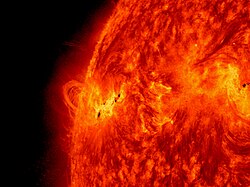
Solar phenomena are natural phenomena which occur within the atmosphere of the Sun. They take many forms, including solar wind, radio wave flux, solar flares, coronal mass ejections, coronal heating and sunspots.
These phenomena are believed to be generated by a helical dynamo, located near the center of the Sun's mass, which generates strong magnetic fields, as well as a chaotic dynamo, located near the surface, which generates smaller magnetic field fluctuations. All solar fluctuations together are referred to as solar variation, producing space weather within the Sun's gravitational field.
Solar activity and related events have been recorded since the eighth century BCE. Throughout history, observation technology and methodology advanced, and in the 20th century, interest in astrophysics surged and many solar telescopes were constructed. The 1931 invention of the coronagraph allowed the corona to be studied in full daylight.
The Sun is a star located at the center of the Solar System. It is almost perfectly spherical and consists of hot plasma and magnetic fields. It has a diameter of about 1,392,684 kilometres (865,374 mi), around 109 times that of Earth, and its mass (1.989×1030 kilograms, approximately 330,000 times that of Earth) accounts for some 99.86% of the total mass of the Solar System. Chemically, about three quarters of the Sun's mass consists of hydrogen, while the rest is mostly helium. The remaining 1.69% (equal to 5,600 times the mass of Earth) consists of heavier elements, including oxygen, carbon, neon and iron.
The Sun formed about 4.567 billion years ago from the gravitational collapse of a region within a large molecular cloud. Most of the matter gathered in the center, while the rest flattened into an orbiting disk that became the balance of the Solar System. The central mass became increasingly hot and dense, eventually initiating thermonuclear fusion in its core.
The Sun is a G-type main-sequence star (G2V) based on spectral class, and it is informally designated as a yellow dwarf because its visible radiation is most intense in the yellow-green portion of the spectrum. It is actually white, but from the Earth's surface, it appears yellow because of atmospheric scattering of blue light. In the spectral class label, G2 indicates its surface temperature, of approximately 5770 K [3] ( the UAI will accept in 2014 5772 K ) and V indicates that the Sun, like most stars, is a main-sequence star, and thus generates its energy via fusing hydrogen into helium. In its core, the Sun fuses about 620 million metric tons of hydrogen each second.
The Earth's mean distance from the Sun is approximately 1 astronomical unit (about 150,000,000 km; 93,000,000 mi), though the distance varies as the Earth moves from perihelion in January to aphelion in July. At this average distance, light travels from the Sun to Earth in about 8 minutes, 19 seconds. The energy of this sunlight supports almost all life on Earth by photosynthesis, and drives Earth's climate and weather. As recent as the 19th century, scientists had little knowledge of the Sun's physical composition and source of energy. This understanding is still developing; a number of present-day anomalies in the Sun's behavior remain unexplained.
Many solar phenomena change periodically over an average interval of about 11 years. This solar cycle affects solar irradiation and influences space weather, terrestrial weather, and climate.
Solar phenomena
Solar phenomena are natural phenomena which occur within the atmosphere of the Sun. They take many forms, including solar wind, radio wave flux, solar flares, coronal mass ejections, coronal heating and sunspots.
These phenomena are believed to be generated by a helical dynamo, located near the center of the Sun's mass, which generates strong magnetic fields, as well as a chaotic dynamo, located near the surface, which generates smaller magnetic field fluctuations. All solar fluctuations together are referred to as solar variation, producing space weather within the Sun's gravitational field.
Solar activity and related events have been recorded since the eighth century BCE. Throughout history, observation technology and methodology advanced, and in the 20th century, interest in astrophysics surged and many solar telescopes were constructed. The 1931 invention of the coronagraph allowed the corona to be studied in full daylight.
The Sun is a star located at the center of the Solar System. It is almost perfectly spherical and consists of hot plasma and magnetic fields. It has a diameter of about 1,392,684 kilometres (865,374 mi), around 109 times that of Earth, and its mass (1.989×1030 kilograms, approximately 330,000 times that of Earth) accounts for some 99.86% of the total mass of the Solar System. Chemically, about three quarters of the Sun's mass consists of hydrogen, while the rest is mostly helium. The remaining 1.69% (equal to 5,600 times the mass of Earth) consists of heavier elements, including oxygen, carbon, neon and iron.
The Sun formed about 4.567 billion years ago from the gravitational collapse of a region within a large molecular cloud. Most of the matter gathered in the center, while the rest flattened into an orbiting disk that became the balance of the Solar System. The central mass became increasingly hot and dense, eventually initiating thermonuclear fusion in its core.
The Sun is a G-type main-sequence star (G2V) based on spectral class, and it is informally designated as a yellow dwarf because its visible radiation is most intense in the yellow-green portion of the spectrum. It is actually white, but from the Earth's surface, it appears yellow because of atmospheric scattering of blue light. In the spectral class label, G2 indicates its surface temperature, of approximately 5770 K [3] ( the UAI will accept in 2014 5772 K ) and V indicates that the Sun, like most stars, is a main-sequence star, and thus generates its energy via fusing hydrogen into helium. In its core, the Sun fuses about 620 million metric tons of hydrogen each second.
The Earth's mean distance from the Sun is approximately 1 astronomical unit (about 150,000,000 km; 93,000,000 mi), though the distance varies as the Earth moves from perihelion in January to aphelion in July. At this average distance, light travels from the Sun to Earth in about 8 minutes, 19 seconds. The energy of this sunlight supports almost all life on Earth by photosynthesis, and drives Earth's climate and weather. As recent as the 19th century, scientists had little knowledge of the Sun's physical composition and source of energy. This understanding is still developing; a number of present-day anomalies in the Sun's behavior remain unexplained.
Many solar phenomena change periodically over an average interval of about 11 years. This solar cycle affects solar irradiation and influences space weather, terrestrial weather, and climate.
Recent media
Recent media