Hubbry Logo
logo
Solar gain
Community hub

Solar gain

logo
0 subscribers
Read side by side
from Wikipedia
Solar gain through windows includes energy transmitted directly through the glass and energy absorbed by the glass and frame and then re-radiated into the space.
Solar gain is illustrated by the snow on the roof of this house: sunlight has melted all of the snow, except for the area that is shaded by the chimney to the right.

Solar gain (also known as solar heat gain or passive solar gain) is the increase in thermal energy of a space, object or structure as it absorbs incident solar radiation. The amount of solar gain a space experiences is a function of the total incident solar irradiance and of the ability of any intervening material to transmit or resist the radiation.

Objects struck by sunlight absorb its visible and short-wave infrared components, increase in temperature, and then re-radiate that heat at longer infrared wavelengths. Though transparent building materials such as glass allow visible light to pass through almost unimpeded, once that light is converted to long-wave infrared radiation by materials indoors, it is unable to escape back through the window since glass is opaque to those longer wavelengths. The trapped heat thus causes solar gain via a phenomenon known as the greenhouse effect. In buildings, excessive solar gain can lead to overheating within a space, but it can also be used as a passive heating strategy when heat is desired.[1]

Window solar gain properties

[edit]

Solar gain is most frequently addressed in the design and selection of windows and doors. Because of this, the most common metrics for quantifying solar gain are used as a standard way of reporting the thermal properties of window assemblies. In the United States, The American Society of Heating, Refrigerating, and Air-Conditioning Engineers (ASHRAE),[2] and The National Fenestration Rating Council (NFRC)[3] maintain standards for the calculation and measurement of these values.

Shading coefficient

[edit]

The shading coefficient (SC) is a measure of the radiative thermal performance of a glass unit (panel or window) in a building. It is defined as the ratio of solar radiation at a given wavelength and angle of incidence passing through a glass unit to the radiation that would pass through a reference window of frameless 3 millimetres (0.12 in) Clear Float Glass.[3] Since the quantities compared are functions of both wavelength and angle of incidence, the shading coefficient for a window assembly is typically reported for a single wavelength typical of solar radiation entering normal to the plane of glass. This quantity includes both energy that is transmitted directly through the glass as well as energy that is absorbed by the glass and frame and re-radiated into the space, and is given by the following equation:[4]

Here, λ is the wavelength of radiation and θ is the angle of incidence. "T" is the transmissivity of the glass, "A" is its absorptivity, and "N" is the fraction of absorbed energy that is re-emitted into the space. The overall shading coefficient is thus given by the ratio:

The shading coefficient depends on the radiation properties of the window assembly. These properties are the transmissivity "T" , absorptivity "A", emissivity (which is equal to the absorptivity for any given wavelength), and reflectivity all of which are dimensionless quantities that together sum to 1.[4] Factors such as color, tint, and reflective coatings affect these properties, which is what prompted the development of the shading coefficient as a correction factor to account for this. ASHRAE's table of solar heat gain factors[2] provides the expected solar heat gain for 18 in (3.2 mm) clear float glass at different latitudes, orientations, and times, which can be multiplied by the shading coefficient to correct for differences in radiation properties. The value of the shading coefficient ranges from 0 to 1. The lower the rating, the less solar heat is transmitted through the glass, and the greater its shading ability.

In addition to glass properties, shading devices integrated into the window assembly are also included in the SC calculation. Such devices can reduce the shading coefficient by blocking portions of the glazing with opaque or translucent material, thus reducing the overall transmissivity.[5]

Window design methods have moved away from the Shading Coefficient and towards the Solar Heat Gain Coefficient (SHGC), which is defined as the fraction of incident solar radiation that actually enters a building through the entire window assembly as heat gain (not just the glass portion). The standard method for calculating the SHGC also uses a more realistic wavelength-by-wavelength method, rather than just providing a coefficient for a single wavelength like the shading coefficient does.[4] Though the shading coefficient is still mentioned in manufacturer product literature and some industry computer software,[6] it is no longer mentioned as an option in industry-specific texts[2] or model building codes.[7] Aside from its inherent inaccuracies, another shortcoming of the SC is its counter-intuitive name, which suggests that high values equal high shading when in reality the opposite is true. Industry technical experts recognized the limitations of SC and pushed towards SHGC in the United States (and the analogous g-value in Europe) before the early 1990s.[8]

A conversion from SC to SHGC is not necessarily straightforward, as they each take into account different heat transfer mechanisms and paths (window assembly vs. glass-only). To perform an approximate conversion from SC to SHGC, multiply the SC value by 0.87.[3]

g-value

[edit]

The g-value (sometimes also called a Solar Factor or Total Solar Energy Transmittance) is the coefficient commonly used in Europe to measure the solar energy transmittance of windows. Despite having minor differences in modeling standards compared to the SHGC, the two values are effectively the same. A g-value of 1.0 represents full transmittance of all solar radiation while 0.0 represents a window with no solar energy transmittance. In practice though, most g-values will range between 0.2 and 0.7, with solar control glazing having a g-value of less than 0.5.[9]

Solar heat gain coefficient (SHGC)

[edit]

SHGC is the successor to the shading coefficient used in the United States and it is the ratio of transmitted solar radiation to incident solar radiation of an entire window assembly. It ranges from 0 to 1 and refers to the solar energy transmittance of a window or door as a whole, factoring in the glass, frame material, sash (if present), divided lite bars (if present) and screens (if present).[3] The transmittance of each component is calculated in a similar manner to the shading coefficient. However, in contrast to the shading coefficient, the total solar gain is calculated on a wavelength-by-wavelength basis where the directly transmitted portion of the solar heat gain coefficient is given by:[4]
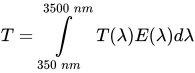
Here is the spectral transmittance at a given wavelength in nanometers and is the incident solar spectral irradiance. When integrated over the wavelengths of solar short-wave radiation, it yields the total fraction of transmitted solar energy across all solar wavelengths. The product is thus the portion of absorbed and re-emitted energy across all assembly components beyond just the glass. It is important to note that the standard SHGC is calculated only for an angle of incidence normal to the window. However this tends to provide a good estimate over a wide range of angles, up to 30 degrees from normal in most cases.[3]

SHGC can either be estimated through simulation models or measured by recording the total heat flow through a window with a calorimeter chamber. In both cases, NFRC standards outline the procedure for the test procedure and calculation of the SHGC.[10] For dynamic fenestration or operable shading, each possible state can be described by a different SHGC.

Though the SHGC is more realistic than the SC, both are only rough approximations when they include complex elements such as shading devices, which offer more precise control over when fenestration is shaded from solar gain than glass treatments.[5]

Solar gain in opaque building components

[edit]

Apart from windows, walls and roofs also serve as pathways for solar gain. In these components heat transfer is entirely due to absorptance, conduction, and re-radiation since all transmittance is blocked in opaque materials. The primary metric in opaque components is the Solar Reflectance Index which accounts for both solar reflectance (albedo) and emittance of a surface.[11] Materials with high SRI will reflect and emit a majority of heat energy, keeping them cooler than other exterior finishes. This is quite significant in the design of roofs since dark roofing materials can often be as much as 50 °C hotter than the surrounding air temperature, leading to large thermal stresses as well as heat transfer to interior space.[5]

Solar gain and building design

[edit]

Solar gain can have either positive or negative effects depending on the climate. In the context of passive solar building design, the aim of the designer is normally to maximize solar gain within the building in the winter (to reduce space heating demand), and to control it in summer (to minimize cooling requirements). Thermal mass may be used to even out the fluctuations during the day, and to some extent between days.

Control of solar gain

[edit]

Uncontrolled solar gain is undesirable in hot climates due to its potential for overheating a space. To minimize this and reduce cooling loads, several technologies exist for solar gain reduction. SHGC is influenced by the color or tint of glass and its degree of reflectivity. Reflectivity can be modified through the application of reflective metal oxides to the surface of the glass. Low-emissivity coating is another more recently developed option that offers greater specificity in the wavelengths reflected and re-emitted. This allows glass to block mainly short-wave infrared radiation without greatly reducing visible transmittance.[3]

In climate-responsive design for cold and mixed climates, windows are typically sized and positioned in order to provide solar heat gains during the heating season. To that end, glazing with a relatively high solar heat gain coefficient is often used so as not to block solar heat gains, especially in the sunny side of the house. SHGC also decreases with the number of glass panes used in a window. For example, in triple glazed windows, SHGC tends to be in the range of 0.33 - 0.47. For double glazed windows SHGC is more often in the range of 0.42 - 0.55.

Different types of glass can be used to increase or to decrease solar heat gain through fenestration, but can also be more finely tuned by the proper orientation of windows and by the addition of shading devices such as overhangs, louvers, fins, porches, and other architectural shading elements.

Passive solar heating

[edit]

Passive solar heating is a design strategy that attempts to maximize the amount of solar gain in a building when additional heating is desired. It differs from active solar heating which uses exterior water tanks with pumps to absorb solar energy because passive solar systems do not require energy for pumping and store heat directly in structures and finishes of occupied space.[12]

In direct solar gain systems, the composition and coating of the building glazing can also be manipulated to increase the greenhouse effect by optimizing their radiation properties, while their size, position, and shading can be used to optimize solar gain. Solar gain can also be transferred to the building by indirect or isolated solar gain systems.

Passive solar designs typically employ large equator facing windows with a high SHGC and overhangs that block sunlight in summer months and permit it to enter the window in the winter. When placed in the path of admitted sunlight, high thermal mass features such as concrete slabs or trombe walls store large amounts of solar radiation during the day and release it slowly into the space throughout the night.[13] When designed properly, this can modulate temperature fluctuations. Some of the current research into this subject area is addressing the tradeoff between opaque thermal mass for storage and transparent glazing for collection through the use of transparent phase change materials that both admit light and store energy without the need for excessive weight.[14]

See also

[edit]

References

[edit]
Revisions and contributorsEdit on WikipediaRead on Wikipedia
from Grokipedia
Solar gain refers to the increase in thermal energy within a building or structure due to the absorption of solar radiation, primarily through windows, walls, and roofs, where shortwave sunlight passes through glazing and is converted to longwave infrared heat by interior surfaces.[1] This process, akin to the greenhouse effect, traps heat inside by allowing visible and near-infrared radiation to enter while restricting the escape of longer-wavelength infrared emissions from warmed materials.[2] In building design, solar gain is a fundamental aspect of passive solar architecture, enabling natural heating in colder climates without mechanical systems, though it requires careful control to prevent excessive warming in summer.[3] The physics of solar gain involves the transmission of solar spectrum radiation—peaking in the visible range at approximately 520 W/m² under clear conditions—through transparent materials like glass, which typically absorbs or reflects only a portion while allowing the rest to heat interior absorbers such as floors or walls.[2] Key metrics include the solar heat gain coefficient (SHGC), which quantifies the fraction of incident solar radiation admitted as heat (ranging from 0 to 1, with lower values indicating better blocking), and the U-factor, measuring conductive heat loss. Effective designs orient apertures (e.g., south-facing windows within 30° of true south) to maximize winter gain while using overhangs, shading, or low-emissivity coatings to minimize summer overheating.[1] Passive solar strategies leveraging solar gain incorporate five essential elements: aperture for collection, absorber surfaces (often dark-colored), thermal mass (e.g., concrete or masonry) for storage, distribution via natural convection or fans, and adjustable controls like vents or blinds.[4] Notable techniques include direct gain, where sunlight heats living spaces directly (utilizing 60-75% of incident radiation); indirect gain, such as Trombe walls (8-16 inch thick masonry behind glazing, with heat lagging 8-12 hours); and isolated gain via sunspaces.[3] These approaches can reduce heating energy needs by up to 50% in appropriate climates, promoting energy efficiency and sustainability, but demand site-specific analysis considering latitude, orientation, and local weather patterns.[1]

Fundamentals of Solar Gain

Definition and Principles

Solar gain refers to the increase in thermal energy within a building's interior due to the absorption or transmission of solar radiation through its envelope, including elements such as windows, walls, and roofs. This process contributes to heating the indoor space either directly or indirectly, influencing overall thermal performance and energy consumption.[5] The basic principles of solar gain distinguish between direct and indirect mechanisms. Direct solar gain occurs when shortwave solar radiation passes through transparent materials like glazing and is absorbed by interior surfaces, converting to heat within the space. In contrast, indirect solar gain involves solar radiation being absorbed by opaque building elements, such as walls, which then transfer heat to the interior via conduction or re-emit it as longwave radiation.[6][1] The concept of solar gain emerged in building science during the mid-20th century, particularly in the post-World War II era, as researchers addressed energy efficiency amid fuel shortages and the rise of modern architecture. This period saw increased focus on passive solar techniques to optimize heat retention in homes, laying foundational studies for quantifying solar contributions to building loads.[7] Solar gain is quantified using solar irradiance, typically measured in watts per square meter (W/m²), which represents the power of incoming solar radiation on a surface and serves as a key metric for calculating heat transfer into buildings. The solar heat gain coefficient provides a related measure for specific components like windows.[8]

Physics of Solar Radiation Absorption

Solar radiation reaching Earth's surface consists of electromagnetic waves spanning a broad spectrum, primarily divided into ultraviolet (UV), visible, and infrared (IR) components. The UV portion occupies wavelengths from approximately 100 to 400 nm, carrying about 5% of the total energy and contributing to photochemical reactions but limited heat due to atmospheric absorption. Visible light spans 400 to 700 nm, accounting for roughly 43% of the energy, and is responsible for illumination while also adding to thermal effects through absorption by materials. The IR component, from 700 nm to 1 mm, dominates with about 52% of the energy and is the primary contributor to heating, as it directly excites molecular vibrations in surfaces, converting radiant energy to thermal energy.[9] The absorption of solar radiation by building materials follows fundamental principles of thermal radiation, governed by Kirchhoff's law, which states that for a body in thermal equilibrium, the emissivity ε at a given wavelength equals the absorptivity α, or ε(λ) = α(λ). This implies that materials which efficiently absorb radiation at certain wavelengths also emit strongly at those wavelengths when heated. For any incident radiation, the fraction absorbed (α), transmitted (τ), and reflected (ρ) sum to unity: α + τ + ρ = 1. In opaque building materials like walls or roofs, transmissivity τ is zero, simplifying to α + ρ = 1, meaning absorbed energy directly heats the surface while the rest is reflected away. These properties vary by wavelength; for instance, many construction materials have high absorptivity in the IR range, enhancing solar heating.[10] Once absorbed, the radiant energy converts to thermal energy and transfers through the building via three primary modes: conduction, convection, and radiation. Conduction occurs within solids, described by Fourier's law, where the heat flux q is proportional to the negative temperature gradient:
q=kT \mathbf{q} = -k \nabla T
here, k is the thermal conductivity of the material, and ∇T is the temperature gradient; this mode dominates in transferring heat from the sun-warmed outer surface inward through walls or roofs. Convection involves heat exchange between the surface and surrounding air, driven by buoyancy or forced flow, and is significant near windows or vents where warmed air rises and circulates. Radiation, meanwhile, includes both the incoming solar absorption and the subsequent long-wave emission from heated surfaces, following the Stefan-Boltzmann law, where net radiative heat loss depends on surface temperature and emissivity; in solar gain, this mode recirculates heat within enclosed spaces. These processes collectively determine how absorbed solar energy raises indoor temperatures.[11][12] The total solar heat gain Q_solar through a building element can be quantified as the product of the surface area A, incident solar irradiance I, and the effective optical properties:
Qsolar=A×I×(τ+α×f) Q_{\text{solar}} = A \times I \times (\tau + \alpha \times f)
where τ is the transmissivity (direct passage of radiation), α is the absorptivity, and f is the inward-flow fraction of absorbed energy that enters the space (typically 0.5 to 0.84 depending on material thickness and convection, as absorbed heat partitions between indoor and outdoor sides). This equation captures both transmitted and absorbed contributions to internal heating, excluding conductive losses from temperature differences. The intensity of solar radiation on a surface is further modulated by the angle of incidence θ, the angle between the incoming rays and the surface normal. According to the cosine law, the effective irradiance is reduced as I_effective = I × cos θ, where I is the direct normal irradiance; at θ = 0° (perpendicular incidence), cos θ = 1 for maximum energy capture, but oblique angles (e.g., θ = 60°) yield only 50% intensity, significantly lowering absorption on vertical walls during low-sun periods. This angular dependence is critical for understanding diurnal and seasonal variations in solar gain.[13]

Solar Gain Through Building Elements

Properties in Glazing and Windows

The properties of glazing and windows play a critical role in determining solar gain through fenestration, primarily via optical transmittance and thermal re-radiation effects. Key metrics include the shading coefficient, g-value, and solar heat gain coefficient, each quantifying aspects of how incident solar radiation interacts with transparent building elements.[14] The shading coefficient (SC) is defined as the ratio of solar heat gain through a glazing system under standard conditions to the solar heat gain through a reference 1/8-inch (3 mm) clear glass pane.[15] Typical SC values range from 0.5 to 1.0, with clear single glazing around 0.83–0.87 and reductions achieved through tinting or reflective coatings that lower solar transmittance and absorptance.[15] For instance, tinted glazings can decrease SC by absorbing more short-wave radiation, thereby limiting the heat entering the interior.[15] Although SC was historically used in building standards, it has largely been supplanted by more precise metrics like the solar heat gain coefficient in modern codes such as the International Energy Conservation Code (IECC).[16][17] The g-value, also known as the solar factor or total solar energy transmittance, represents the fraction of incident solar radiation that is admitted through the glazing on a scale from 0 to 1, encompassing both directly transmitted radiation and that absorbed and re-emitted inward.[18] A g-value of 1.0 indicates full transmittance, as with ideal clear glass, while values near 0 denote complete blockage.[18] It directly relates to overall solar energy transmittance and is equivalent to the shading coefficient divided by 0.87 for reference clear glass.[18] The solar heat gain coefficient (SHGC) provides a comprehensive measure of solar gain, defined as the ratio of total solar heat gain entering the interior through the fenestration—via direct transmission, absorption, and inward re-radiation—to the incident solar radiation.[19] It is calculated according to standards like ANSI/NFRC 200, which involve heat balance modeling for the entire product (including frame and glazing) under specified conditions such as 75°F (24°C) interior and 90°F (32°C) exterior temperatures.[19][20] NFRC ratings ensure comparability, with SHGC values typically ranging from 0.2 to 0.8 depending on glazing configuration.[14] Low-emissivity (low-e) coatings on glazing surfaces selectively reduce infrared (IR) transmission while allowing visible light, thereby lowering SHGC by minimizing the re-radiation of absorbed heat.[21] Double glazing, consisting of two panes with an air or gas-filled space, typically yields an SHGC of around 0.70 for clear configurations, which can drop to 0.25–0.30 with low-e coatings and argon gas fill due to suppressed convection and enhanced reflection of long-wave radiation.[21][22] Triple glazing further reduces SHGC compared to double, often to 0.20–0.40 in low-solar-gain setups with multiple low-e layers and argon or krypton fills, providing better control in cooling-dominated climates.[23] A key distinction exists between SHGC and U-value: the former quantifies solar-driven heat gain through transmittance and absorption, while the U-value measures non-solar conductive and convective heat loss, with lower U-values indicating better insulation independent of solar input.[14] In contemporary building codes like the IECC, SHGC is the primary metric for solar gain compliance, with allowable values varying by climate zone (e.g., ≤0.40 in hot regions), whereas SC may serve only as an alternative calculation basis in limited cases.[17]

Solar Gain in Opaque Components

Solar gain in opaque building components occurs when solar radiation is absorbed by non-transparent surfaces such as walls and roofs, leading to heat transfer into the building interior via conduction. The extent of absorption depends on the material's solar absorptance (α_s), which represents the fraction of incident solar radiation absorbed by the surface. For common building materials, α_s values typically range from 0.4 to 0.6 for light-colored brick and 0.25 to 0.4 for white paint, with darker surfaces exhibiting higher absorptance due to lower reflectivity.[24] This absorbed heat raises the surface temperature, creating a temperature gradient that drives conductive heat flow through the material, influenced by its thermal properties. The transfer of this absorbed heat into the building is delayed by the thermal mass of the opaque component, which stores energy and reduces the immediacy of internal temperature fluctuations. High thermal mass materials, such as concrete, exhibit significant time lags—often several hours—between peak solar exposure and peak indoor heat gain, thereby attenuating diurnal temperature swings.[25] Transient heat gain through opaque elements can be modeled using dynamic simulation methods, such as finite difference solutions to the heat conduction equation, which account for thermal mass effects and time lags.[26] Insulation plays a critical role in modulating this heat gain by increasing the overall thermal resistance (R-value), which not only reduces the steady-state conductive flow but also extends the time lag when paired with internal thermal mass, shifting peak gains to off-peak periods. For instance, concrete walls with high R-value insulation (e.g., R-20 or higher) can significantly dampen internal temperature variations compared to low-mass assemblies. In terms of orientation, south-facing walls in the northern hemisphere experience 20-30% higher annual solar exposure than east- or west-facing equivalents due to optimal alignment with the sun's path, amplifying potential heat gains; roofs, being horizontal, receive more diffuse but intense midday radiation. Ventilation behind exterior cladding, such as in rainscreen systems, mitigates this by promoting convective cooling of the absorbed heat before it conducts inward, potentially reducing surface temperatures by several degrees Celsius, depending on wind speed and cavity design.[27][28][29] Modern advancements include the incorporation of phase-change materials (PCMs) into opaque components, which absorb solar heat via latent heat storage during phase transitions (e.g., melting), thereby reducing peak internal loads. PCM-enhanced walls can decrease heat gain by 20-50% in various climates by storing excess energy during the day and releasing it nocturnally, offering a dynamic alternative to traditional mass.[30]

Impacts of Solar Gain on Buildings

Thermal Comfort and Energy Use

Solar gain serves as a free heat source in cold climates, where it can contribute significantly to meeting winter heating needs through passive solar design. In northern U.S. regions, south-facing glazing can provide net positive heat gains that offset 50-75% of seasonal heat losses in many cases, effectively reducing reliance on mechanical heating systems.[28] The integration of solar gain with heating, ventilation, and air-conditioning (HVAC) systems enhances overall energy savings by balancing gains against losses. The net energy gain from solar input is calculated as ΔE = Q_solar - Q_loss, where Q_solar represents the absorbed solar radiation and Q_loss encompasses conduction, convection, and infiltration losses through the building envelope.[31] This approach allows for optimized HVAC operation, as excess solar heat reduces the demand for auxiliary heating, potentially lowering total building energy use in heating-dominated climates when paired with thermal mass storage.[32] Solar gain influences thermal comfort primarily through its effect on mean radiant temperature (MRT), a key parameter in the Predicted Mean Vote (PMV) model, which predicts occupant thermal sensation on a scale from -3 (cold) to +3 (hot). Elevated MRT due to solar radiation increases the operative temperature, potentially leading to discomfort in overheated conditions.[33] In office buildings within temperate zones, unmanaged solar gain can elevate cooling energy demands, as demonstrated in simulations where unshaded glazing amplifies peak loads during transitional seasons.[34] Adaptive comfort models, such as those in ASHRAE Standard 55, accommodate variations in naturally ventilated spaces by permitting wider indoor temperature ranges based on outdoor conditions—without compromising occupant satisfaction, provided running mean outdoor temperatures remain moderate. This supports energy-efficient design by expanding the acceptable comfort band in buildings relying on passive ventilation, reducing mechanical cooling needs while maintaining PMV within neutral ranges.[35]

Overheating and Cooling Loads

Excessive solar gain can lead to overheating in buildings when peak solar radiation causes internal temperatures to rise above acceptable comfort levels, typically exceeding 28–32°C during occupied hours. This occurs as shortwave radiation passes through transparent elements or is absorbed and re-radiated as longwave heat by opaque surfaces, overwhelming natural ventilation or thermal mass capacity. In such scenarios, the combined effects of direct solar transmission, absorbed heat, and limited heat dissipation elevate indoor air and surface temperatures, particularly in spaces with high glazing ratios or low insulation.[36] A key concept in assessing overheating from solar gain on external surfaces is the sol-air temperature, which represents the equivalent outdoor temperature accounting for both air temperature and solar radiation effects. The formula is $ T_{\text{sol-air}} = T_{\text{air}} + \frac{\alpha_s I}{h_o} $, where $ T_{\text{air}} $ is the ambient air temperature, $ \alpha_s $ is the solar absorptance of the surface, $ I $ is the incident solar radiation intensity, and $ h_o $ is the external surface heat transfer coefficient (typically 20–30 W/m²K). This metric helps quantify how solar radiation amplifies heat transfer into the building envelope, simulating the thermal stress as if it were solely due to higher air temperatures.[37] Cooling loads attributable to solar gain are calculated differently for fenestration and opaque elements. For windows and glazing, the solar cooling load is approximated as $ Q_{\text{solar}} = \text{SHGC} \times A \times I_{\text{peak}} $, where SHGC is the solar heat gain coefficient (ranging from 0 to 1, indicating the fraction of incident solar radiation admitted), $ A $ is the fenestration area, and $ I_{\text{peak}} $ is the peak incident solar intensity (often 800–1000 W/m² at midday). This method captures both transmitted and absorbed-re-radiated heat entering the space. For opaque components like walls and roofs, the Cooling Load Temperature Difference (CLTD) method is used: $ Q = U \times A \times \text{CLTD} $, where $ U $ is the overall heat transfer coefficient, $ A $ is the surface area, and CLTD is a tabulated value (from standards like ASHRAE) adjusted for sol-air temperature, time of day, orientation, and thermal lag, typically ranging from 10–40°C under peak conditions. These calculations inform HVAC sizing and reveal how solar gain can contribute significantly to total cooling loads in sunny climates.[38][39] Several risk factors exacerbate overheating from solar gain. Building orientation plays a critical role, with east-facing facades experiencing intense morning solar peaks that heat interiors rapidly after overnight cooling, and west-facing ones suffering afternoon peaks when ambient temperatures are already high, leading to prolonged discomfort. Urban heat island (UHI) effects further amplify solar impacts by elevating local air temperatures 2–5°C above rural areas—equivalent to a 10–20% intensification of solar-driven heat gain due to reduced albedo, trapped heat, and higher effective sol-air temperatures in dense cityscapes.[40][41] Historical events underscore the consequences of unmanaged solar gain in overheating scenarios. During the 1970s energy crises, triggered by oil embargoes, pre-air-conditioned buildings in the U.S. and Europe revealed vulnerabilities to solar overheating, as high glazing and poor shading in mid-century designs drove excessive heat buildup, prompting early adoption of passive solar controls and energy codes to mitigate cooling demands without mechanical systems. More recently, the 2003 European heatwave, with temperatures 20–30% above average, significantly increased cooling needs across the continent, with electricity demand for air conditioning surging in affected regions like France, exacerbating blackouts and highlighting solar gain's role in amplifying thermal stress during extremes.[42][43] Recent events, such as the record-warm 2024 in Europe and the 2025 heatwave, have similarly driven electricity demand increases of up to 14% due to heightened cooling needs, further emphasizing the growing risks from solar gain in warming climates.[44][45] Climate change projections indicate worsening overheating risks from solar gain, particularly in mid-latitude regions like Europe. By 2050, under moderate emissions scenarios, mid-latitude cities could see 20–50% more annual overheating hours (defined as >28°C indoors) due to intensified solar radiation patterns, longer heat exposure periods, and UHI synergies, potentially doubling cooling energy demands in non-retrofitted buildings. This underscores the need for adaptive design to counter rising sol-air equivalents and peak intensities in warming climates.[46]

Strategies for Managing Solar Gain

Shading and Control Techniques

External shading devices, such as overhangs, vertical fins, and louvers, are fixed or adjustable structures positioned outside building envelopes to intercept solar radiation before it reaches glazing surfaces, thereby reducing solar heat gain coefficient (SHGC) values. Overhangs are particularly effective for south-facing windows in the northern hemisphere, blocking high-angle summer sun while allowing lower-angle winter sun to penetrate for passive heating. Vertical fins provide shading for east- and west-facing windows, mitigating low-angle morning and afternoon radiation, while louvers offer directional control through slatted designs that can be fixed or pivoted. A common design approach for overhang depth on south-facing windows to achieve summer control involves calculations based on latitude and sun angles to approximate shading during peak summer months.[47] Internal shading devices, including blinds, curtains, and solar control films, are installed inside buildings to absorb or reflect solar radiation that has already passed through glazing, though they are generally less effective than external options because heat transfer occurs after the radiation enters the space. Horizontal or vertical blinds with reflective slats can redirect light and reduce direct beam penetration, while curtains and drapes with light-colored, insulating backings block up to 33% of summer heat gain on sunlit windows. Roller shades, especially those with low-emissivity or cellular designs, can reduce SHGC depending on fabric openness and color, with cellular variants achieving up to 60% reduction in solar heat gain when tightly fitted. Solar control films applied to interior glass surfaces reflect infrared radiation, further lowering effective SHGC without significantly altering visible transmittance.[48] Dynamic shading systems enhance control by automating adjustments to solar exposure, using sensors to track solar angles, irradiance, and indoor conditions for real-time optimization. Automated louvers or motorized external shades pivot or retract based on photocell or pyranometer inputs, maintaining consistent shading while maximizing daylight. Electrochromic glass represents an advanced integration, where low-voltage application modulates ion flow in thin films to vary solar transmittance (τ) from approximately 0.1 (tinted state) to 0.6 (clear state), reducing SHGC from 0.41-0.46 to 0.09-0.12 and cutting cooling loads by 25-58% compared to static low-e glazing. These systems often incorporate building management software for predictive control, aligning with occupancy and weather data to minimize energy use.[49] Vegetative shading, such as deciduous trees planted strategically to the south, east, or west of buildings, offers seasonal control by providing dense foliage cover in summer to block solar gain—reducing it by approximately 30% through direct shading of walls and windows—while leafless branches in winter permit passive solar heating. This natural approach not only lowers cooling energy demands but also enhances biodiversity and urban microclimates, with studies confirming average 30% air-conditioning savings in shaded residences.[50]

Integration in Passive Solar Design

Passive solar design harnesses solar gain to provide heating and daylighting in buildings without mechanical systems, relying on architectural elements to capture, store, and distribute solar energy. Direct gain systems allow sunlight to enter living spaces through large south-facing windows, where it is absorbed by thermal mass materials such as concrete floors or masonry walls, which store the heat and release it gradually over time. Indirect gain approaches, like Trombe walls, position a thermal mass wall behind glazing to absorb solar radiation without direct exposure to the interior, with vents facilitating convective heat transfer to adjacent rooms. Isolated gain configurations, such as attached sunspaces, collect solar energy in a separate enclosure connected to the main building, enabling controlled heat distribution while providing additional usable space.[1] Optimizing solar gain in passive designs involves balancing window-to-wall ratios (WWR) to maximize winter heat collection while minimizing losses, with optimal ratios of 10-20% recommended for cold climates to achieve net energy benefits from glazing. Thermal mass plays a critical role in stabilizing indoor temperatures, governed by the equation ΔT=Qsolarmc\Delta T = \frac{Q_{\text{solar}}}{m c}, where ΔT\Delta T is the temperature change, QsolarQ_{\text{solar}} is the solar heat input, mm is the mass of the material, and cc is its specific heat capacity; this relationship ensures that sufficient mass moderates diurnal temperature swings by absorbing excess daytime heat and releasing it at night. Shading techniques, integrated into the overall envelope, further refine this balance by preventing unwanted summer gains.[51][25] In Germany, Passive House standards exemplify effective solar gain integration, requiring space heating energy demand not to exceed 15 kWh/m²/year, a target achieved through optimized glazing with high solar heat gain coefficients (around 50%) and airtight envelopes that leverage winter solar contributions to minimize auxiliary heating needs. Design tools like EnergyPlus enable precise modeling of these systems by simulating solar radiation, thermal mass interactions, and overall building performance under varying climates. Guidelines from the National Fenestration Rating Council (NFRC) inform window selections by rating solar heat gain coefficients (SHGC), promoting high values (closer to 1) for passive heating in cold regions, while the Passive House Institute provides certification criteria emphasizing solar-optimized envelopes with U-values ≤0.80 W/(m²K).[52][53][54] Bioclimatic design extends passive solar principles to hot climates by prioritizing daylighting from solar gain while minimizing thermal loads, using elements like light shelves on south-facing facades to reflect sunlight onto ceilings for deeper interior penetration without direct heat entry. External light shelves, often with reflective surfaces and seasonal adjustability, reduce solar heat gain factors to as low as 0.1 compared to 0.4 for internal versions, enhancing occupant comfort and cutting cooling demands in regions like southern Europe.[55]

References

User Avatar
No comments yet.