



Community hub
0 subscribers7 pages, 0 posts
Recent from talks
All channels
Be the first to start a discussion here.
Be the first to start a discussion here.
Be the first to start a discussion here.
Be the first to start a discussion here.
Contribute something
Welcome to the community hub built to collect knowledge and have discussions related to Absorptance.
Nothing was collected or created yet.
Absorptance
View on Wikipediafrom Wikipedia
In the study of heat transfer, absorptance of the surface of a material is its effectiveness in absorbing radiant energy. It is the ratio of the absorbed to the incident radiant power.[1]
Mathematical definitions
[edit]Hemispherical absorptance
[edit]Hemispherical absorptance of a surface, denoted A is defined as[2]

where
- is the radiant flux absorbed by that surface;
- is the radiant flux received by that surface.


Spectral hemispherical absorptance
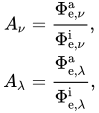
[edit]Spectral hemispherical absorptance in frequency and spectral hemispherical absorptance in wavelength of a surface, denoted Aν and Aλ respectively, are defined as[2]
where
- is the spectral radiant flux in frequency absorbed by that surface;
- is the spectral radiant flux in frequency received by that surface;
- is the spectral radiant flux in wavelength absorbed by that surface;
- is the spectral radiant flux in wavelength received by that surface.


Directional absorptance
[edit]Directional absorptance of a surface, denoted AΩ, is defined as[2]

where
- is the radiance absorbed by that surface;
- is the radiance received by that surface.


Spectral directional absorptance
[edit]Spectral directional absorptance in frequency and spectral directional absorptance in wavelength of a surface, denoted Aν,Ω and Aλ,Ω respectively, are defined as[2]
![{\displaystyle {\begin{aligned}A_{\nu ,\Omega }&={\frac {L\mathrm {_{e,\Omega ,\nu }^{a}} }{L\mathrm {_{e,\Omega ,\nu }^{i}} }},\\[4pt]A_{\lambda ,\Omega }&={\frac {L\mathrm {_{e,\Omega ,\lambda }^{a}} }{L\mathrm {_{e,\Omega ,\lambda }^{i}} }},\end{aligned}}}](https://wikimedia.org/api/rest_v1/media/math/render/svg/fe80669bec46628645300a32529b8b7c45e62047)
where
- is the spectral radiance in frequency absorbed by that surface;
- is the spectral radiance received by that surface;
- is the spectral radiance in wavelength absorbed by that surface;
- is the spectral radiance in wavelength received by that surface.


Other radiometric coefficients
[edit]| Quantity | SI units | Notes | |
|---|---|---|---|
| Name | Sym. | ||
| Hemispherical emissivity | ε | — | Radiant exitance of a surface, divided by that of a black body at the same temperature as that surface. |
| Spectral hemispherical emissivity | εν ελ |
— | Spectral exitance of a surface, divided by that of a black body at the same temperature as that surface. |
| Directional emissivity | εΩ | — | Radiance emitted by a surface, divided by that emitted by a black body at the same temperature as that surface. |
| Spectral directional emissivity | εΩ,ν εΩ,λ |
— | Spectral radiance emitted by a surface, divided by that of a black body at the same temperature as that surface. |
| Hemispherical absorptance | A | — | Radiant flux absorbed by a surface, divided by that received by that surface. This should not be confused with "absorbance". |
| Spectral hemispherical absorptance | Aν Aλ |
— | Spectral flux absorbed by a surface, divided by that received by that surface. This should not be confused with "spectral absorbance". |
| Directional absorptance | AΩ | — | Radiance absorbed by a surface, divided by the radiance incident onto that surface. This should not be confused with "absorbance". |
| Spectral directional absorptance | AΩ,ν AΩ,λ |
— | Spectral radiance absorbed by a surface, divided by the spectral radiance incident onto that surface. This should not be confused with "spectral absorbance". |
| Hemispherical reflectance | R | — | Radiant flux reflected by a surface, divided by that received by that surface. |
| Spectral hemispherical reflectance | Rν Rλ |
— | Spectral flux reflected by a surface, divided by that received by that surface. |
| Directional reflectance | RΩ | — | Radiance reflected by a surface, divided by that received by that surface. |
| Spectral directional reflectance | RΩ,ν RΩ,λ |
— | Spectral radiance reflected by a surface, divided by that received by that surface. |
| Hemispherical transmittance | T | — | Radiant flux transmitted by a surface, divided by that received by that surface. |
| Spectral hemispherical transmittance | Tν Tλ |
— | Spectral flux transmitted by a surface, divided by that received by that surface. |
| Directional transmittance | TΩ | — | Radiance transmitted by a surface, divided by that received by that surface. |
| Spectral directional transmittance | TΩ,ν TΩ,λ |
— | Spectral radiance transmitted by a surface, divided by that received by that surface. |
| Hemispherical attenuation coefficient | μ | m−1 | Radiant flux absorbed and scattered by a volume per unit length, divided by that received by that volume. |
| Spectral hemispherical attenuation coefficient | μν μλ |
m−1 | Spectral radiant flux absorbed and scattered by a volume per unit length, divided by that received by that volume. |
| Directional attenuation coefficient | μΩ | m−1 | Radiance absorbed and scattered by a volume per unit length, divided by that received by that volume. |
| Spectral directional attenuation coefficient | μΩ,ν μΩ,λ |
m−1 | Spectral radiance absorbed and scattered by a volume per unit length, divided by that received by that volume. |
References
[edit]- ^ IUPAC, Compendium of Chemical Terminology, 5th ed. (the "Gold Book") (2025). Online version: (2006–) "Absorptance". doi:10.1351/goldbook.A00035
- ^ a b c d "Thermal insulation — Heat transfer by radiation — Physical quantities and definitions". ISO 9288:1989. ISO catalogue. 1989. Retrieved 2015-03-15.
Absorptance
View on Grokipediafrom Grokipedia
Absorptance is the fraction of incident radiant or luminous flux that is absorbed by a body or material, denoted by the symbol α and ranging from 0 (no absorption) to 1 (complete absorption, as in a blackbody).[1][2] It represents the efficiency with which a surface or volume retains electromagnetic radiation, such as visible light, infrared, or ultraviolet, converting it into thermal energy or other forms.[3] This property is fundamental in fields like optics, radiative heat transfer, and photovoltaics, where it determines how materials interact with light and heat.[4]
In radiative transfer, absorptance is interrelated with reflectance (ρ, the fraction reflected) and transmittance (τ, the fraction transmitted), governed by energy conservation such that α + ρ + τ = 1 for non-scattering, non-fluorescent materials.[4][5] Absorptance can be spectral (α_λ, varying with wavelength λ due to material composition) or total (integrated over a spectrum, relevant for broadband sources like solar radiation).[6] It depends on intrinsic material properties, including the refractive index (n), extinction coefficient (k), and thickness (d), as well as external factors like angle of incidence and polarization.[4] For example, in thin films or coatings, increasing thickness enhances absorptance until saturation, while higher extinction coefficients promote deeper penetration and greater absorption.[7]
A key principle linking absorptance to emission is Kirchhoff's law of thermal radiation, which states that, for a body in thermal equilibrium, the spectral absorptance equals the spectral emissivity (ε_λ = α_λ) at the same wavelength and temperature, explaining why good absorbers are also efficient emitters.[8][6] This law underpins applications in solar absorbers (high α in visible, low ε in infrared for selective surfaces) and spacecraft thermal control (tailored α/ε ratios to balance heat gain and loss).[7] Measurements of absorptance often use spectrophotometry or calorimetric methods, ensuring accuracy across wavelengths for practical engineering designs.[9]