Hubbry Logo
Southwick HouseSouthwick HouseMain
Open search
Southwick House
Community hub
Southwick House
logo
8 pages, 0 posts
0 subscribers
Be the first to start a discussion here.
Southwick House
Southwick House
from Wikipedia

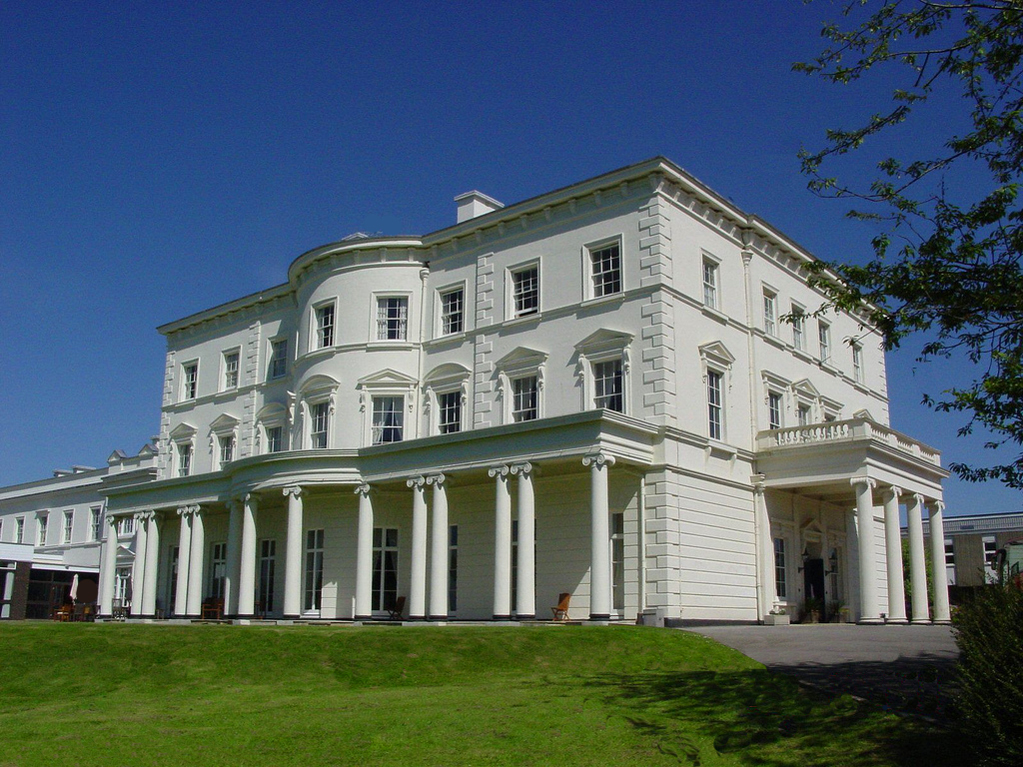
Southwick House is a Grade II listed 19th-century manor house of the Southwick Estate in Hampshire, England, about 5 miles (8 km) north of Portsmouth. It is home to the Defence School of Policing and Guarding and related military police capabilities.

Key Information

History

[edit]

Early history

[edit]

The house was built in 1800 in the late Georgian style to replace Southwick Park house. The three-storey house is distinct for its two-storey foyer lit from a cupola and a series of elliptical rooms. A semi-circular portico is centred on the house's colonnade of paired Ionic columns.[1]

World War II

[edit]

The house became important during World War II. In 1940 the estate owners allowed the Royal Navy to use the house to accommodate overnight pupils of the Royal Navy School of Navigation, HMS Dryad, which was based in Portsmouth Naval Dockyard. In 1941, after heavy bombing of the dockyard, the house was requisitioned and became the new home of HMS Dryad.[2]

In 1943, with the planning for D-Day already underway, the house was chosen to be the location of the advance or forward command post (Sharpener Camp) of the Supreme Headquarters Allied Expeditionary Force. Because of this, HMS Dryad was moved out of the house onto further land requisitioned from the estate.[2]

D-day preparation

[edit]
D-Day map in map room, 2019, with markers for positions of forces at the 6 June 1944 landings
Drawing showing map room in operation, 1944

In 1944, in the months leading up to D-Day, the house became the headquarters of the main allied commanders, including Allied Supreme Commander General Eisenhower, Naval Commander-in-Chief Admiral Ramsay and Army Commander-in-Chief General Montgomery.[3]

The large wall maps that were used on D-Day are still in place in the house in the main map room.[4]

Area of the map showing D-day departure routes from the south coast of England; Isle of Wight in centre
Area of the map showing arrival routes at the Normandy beaches around Arromanches
Former US president Eisenhower (right) revisited the map room in 1963 and was interviewed by Walter Cronkite

After HMS Dryad

[edit]

In 2004, the functions of HMS Dryad were transferred to HMS Collingwood in Fareham and the site reverted to its original name of Southwick Park.[5]

Since 2005, it has been home to the tri-Service Defence School of Policing and Guarding (formerly the Defence College of Policing and Guarding).[6]

Listings

[edit]

In 1987, the house was recorded as Grade II listed on the National Heritage List for England.[7] The following year the detached clock tower – a three-stage Italianate structure with a slate roof – was also Grade II listed.[1]

References

[edit]

Bibliography

[edit]
[edit]
Revisions and contributorsEdit on WikipediaRead on Wikipedia
from Grokipedia
Southwick House is a Grade II listed 19th-century located in the Southwick Estate, , , approximately 5 miles (8 km) north of , renowned for serving as the advance headquarters of the (SHAEF) during the planning and launch of the D-Day invasion in . Originally constructed in 1800, the house was destroyed by fire in 1840 and rebuilt in a similar Georgian style in 1843 by architect S. Howell for the Whyte family, who had owned the estate since its acquisition from in 1539 following the dissolution of Southwick Priory. The estate itself traces its origins to the Augustinian priory founded around 1133, but the current house stands as a key architectural remnant of the family's long tenure. During , Southwick House was requisitioned by the Royal Navy in 1940, becoming the headquarters for HMS Dryad, the navigation school, before being repurposed in April 1944 as the primary command post for , the Allied invasion of . Here, General , alongside Naval Commander Admiral Sir and Ground Forces Commander General , coordinated the massive amphibious assault, including the pivotal decision on June 5, 1944, to proceed with the invasion the following day despite adverse weather—a choice made in the house's library. A large plywood wall map, constructed by Chad Valley Toys and spanning from to Brest, remains on the ground floor, marking the room where final briefings occurred and underscoring the site's enduring historical value. Today, the property is owned by the and serves as the headquarters for the Defence School of Policing and Guarding, with public access available by appointment; it was officially listed as Grade II on September 24, 1987, recognizing its architectural and military heritage. The house continues to host commemorative events, such as the annual Southwick Revival, preserving its legacy as a "small place with " central to one of the 20th century's defining military operations.

Architecture

Design and Construction

Southwick House was constructed in the early as a replacement for the earlier Jacobean mansion on the Southwick Estate, initiated by Thomas Thistlethwayte MP after he inherited the property in the first decade of that century. The new house adopted a Regency style, characteristic of late , and was completed around 1813. The site was deliberately selected on higher ground within the estate to capitalize on panoramic views toward and the sea, enhancing the estate's aesthetic and strategic appeal near . The original structure was largely destroyed by in , prompting a prompt rebuild that closely replicated the Regency design while incorporating a third storey for added grandeur. Designed by architect S. Howell, the reconstructed house features a symmetrical south front with a central , three storeys over a , and stucco-clad walls topped by a concealing the roof. The east elevation includes a prominent supported by four Ionic columns, complemented by rusticated , a continuous verandah on Ionic columns, and pedimented architraves, emphasizing classical proportions and elegance. While specific builders remain undocumented, the project reflected anonymous Regency influences prevalent in manor houses of the period, with possible consultation from landscape designer on the surrounding grounds. Materials were primarily for the exterior, providing a smooth, durable finish suited to the damp local climate, though internal elements may have incorporated timber and typical of the style. The Thistlethwayte family retained ownership during this phase, underscoring their commitment to modernizing the estate.

Key Features

Southwick House exemplifies Georgian architectural principles through its symmetrical stuccoed facade and balanced proportions. The south front features a central bow spanning all three storeys, flanked by slight projections and arranged in a 2.1.3.1.2 window configuration, with a rusticated ground floor, quoins, and first-floor architraves topped by segmental or triangular pediments, culminating in an eaves cornice supported on console brackets. A continuous stone verandah encircles the ground floor of the bow, supported by Ionic columns arranged singly or in pairs, enhancing the classical elegance. The east elevation presents five bays with a central three-bay projection housing the main entrance under a porte-cochere framed by four Ionic columns, while the west side includes a two-storey service wing. The estate's , dating to the early 1800s in Italianate style, adds a distinctive vertical element, comprising a tall square structure in three stages with a pyramidal roof topped by a and weathervane. Its lower stage features rusticated with round-headed entrances and a moulded ; the middle stage has tall round-headed arches framing clock faces; and the upper stage includes an imitation balustrade, louvred openings, and pseudo-machicolations. The house is approached via landscaped parkland that includes formal gardens west of the building, such as a walled potager with beds and a large glasshouse, alongside an ornamental area planted with shrubs like camellias and rhododendrons, exotic s including and monkey puzzle, and a near remnants of an . Further afield, Regency-influenced parkland extends southward to a 400-meter artificial lake, screened by tree clumps and linked by a tree-lined avenue. Inside, the house maintains a Georgian layout with a distinctive two-storey foyer illuminated by a , providing natural light to the and emphasizing verticality in the . A series of elliptical rooms contributes to the aesthetic flow, offering curved spaces that enhance both visual harmony and acoustic qualities within the principal areas. The map room, originally configured as a in the Georgian tradition, preserves its period setup with panelled walls and wide windows suited to communal gatherings. Functional spaces reflect the house's original domestic planning, including panelled drawing rooms designed for reception and leisure, a for scholarly pursuits, and upper bedrooms accessed via interconnecting corridors. These rooms, adapted from symmetrical Georgian plans, feature proportions that prioritize light and proportion, such as the drawing rooms' broad windows overlooking the parkland. The layout of the principal rooms includes the map room.

History

Early History

The origins of the Southwick Estate trace back to the medieval period, when the area was dominated by Southwick Priory, an Augustinian house founded around 1133 by Henry I initially at and relocated to Southwick by approximately 1150 due to the site's more suitable location for expansion. The priory quickly grew into a significant religious and economic center, holding extensive manors including Southwick, Dean, and Colemore, with lands dedicated primarily to , such as arable farming and for production—reflected in the name "Southwick," meaning "south dairy farm" in . It also attracted pilgrims to its shrine of the Virgin Mary, completed in the church by 1182, underscoring its spiritual role within Hampshire's monastic network. The priory was dissolved in April 1538 as part of Henry VIII's , with Prior surrendering the site; its assets, including the manor and remaining buildings, were promptly sold to John (also spelled Whyte), a local gentleman and servant to Thomas Wriothesley, 1st Earl of Southampton. acquired the freehold in 1539 and converted the prior's lodging into a Tudor mansion, marking the transition from ecclesiastical to secular use while retaining much of the estate's agricultural lands for farming and local sustenance. The estate passed through 's descendants, including his great-granddaughter Honora , who in 1607 married Daniel Norton, bringing the property into the Norton family; they expanded it as a country seat for the local , emphasizing in the surrounding parklands and oversight of tenant farms that supported Hampshire's rural economy. In the early 17th century, Daniel Norton constructed a new Jacobean-style mansion known as Southwick Park on or near the site, replacing or augmenting the earlier Tudor residence to better suit the era's architectural preferences and the family's status as prominent landowners. This house served as the core of the estate, which functioned as a typical country retreat: a hub for agricultural management, with woods and fields yielding timber, crops, and livestock, and expansive grounds ideal for —activities central to life and social networks in the region during the 17th and 18th centuries. The estate's role in local society reinforced the Thistlethwayte family's eventual inheritance through Norton descent, maintaining continuity in until the late 18th century.

Ownership and Pre-WWII Developments

In 1802, Thomas Thistlethwayte inherited the Southwick estate from his father, Robert Thistlethwayte, and promptly demolished the existing Jacobean mansion to make way for a new residence. As a for and a prominent local figure, Thomas commissioned the construction of a Regency-style house on a higher site, featuring a two-storey design with a sweeping supported by classical columns; the building was completed c. 1800. This project reflected the family's long-standing stewardship of the estate, which had been in their possession since the through descent from earlier owners like the Nortons. The house underwent significant modifications in the mid-19th century following a devastating fire in 1840 that gutted the structure. Under Thomas Thistlethwayte's oversight, reconstruction began promptly, with architect S. Howell overseeing the work to create a near-replica of the original design by , including the addition of a third floor and alterations to the fenestration for enhanced stability and light. Further expansions during this period included a service wing to support the growing estate operations, solidifying the house as the family's primary seat until Thomas's death in 1850. The estate then passed through subsequent generations of Thistlethwaytes, maintaining its role as a central hub for family inheritance and local influence. Throughout the , the Thistlethwayte family managed the Southwick estate as a model of traditional English , overseeing agricultural activities across its extensive holdings. As , they enforced covenants that shaped village life, such as mandating red front doors on estate properties to foster a unified community aesthetic and reinforce familial authority. Their social role in the pre-1914 era involved of local institutions and tenant relations, positioning the family as key benefactors in the rural community near the naval hub of . By the early 20th century, Southwick House remained a private family residence under the Thistlethwaytes, with Evelyn Thistlethwayte acquiring full ownership in approximately 1931 by purchasing the estate from his nephew, Donald Claude Thistlethwayte. This period saw the estate's continued operation amid the expanding military presence in the area, though it stayed primarily as a civilian home until the onset of .

World War II Requisition

In early 1941, amid intensifying Luftwaffe bombing raids on the Portsmouth Naval Dockyard—beginning with major attacks on 11 and 24 July 1940—Colonel Evelyn Thistlethwayte, the owner of Southwick House and squire of the Southwick Estate, was persuaded by Admiral Sir William James, Commander-in-Chief at Portsmouth, to permit the Royal Navy to utilize the property as overnight accommodations for officer cadets from HMS Dryad, the Royal Naval School of Navigation. The arrangement stemmed from prior social ties, including shooting outings hosted by Thistlethwayte for naval officers, though he later expressed regret over the decision due to the site's strategic location. By mid-1941, following further damage to the dockyard facilities on 10 March, the house was formally requisitioned by the Royal Navy at Thistlethwayte's acquiescence, relocating HMS Dryad entirely from its vulnerable Portsmouth base to Southwick House as a secure navigation training school. The conversion of Southwick House into a naval establishment involved adapting its Georgian interiors and outbuildings for military purposes, with principal rooms repurposed as dormitories to house up to several dozen officer trainees overnight and ancillary structures fitted out as classrooms for theoretical instruction. The estate's cellars were reinforced and designated as air raid shelters to mitigate the persistent threat of aerial attacks, allowing uninterrupted training despite fatigue from frequent disruptions. Outbuildings and surrounding parkland accommodated practical exercises, while basic security protocols, including perimeter patrols, were introduced to safeguard personnel and equipment from or . From its relocation, HMS Dryad at Southwick House focused on training naval navigators, plotters, and specialists in tactics, equipping personnel for convoy protection and U-boat interdiction operations critical to the . Courses emphasized chart work, , and radar-assisted plotting, drawing on the school's pre-war curriculum but adapted to wartime urgencies such as evasive maneuvers against wolfpack attacks. Daily operations under the command of A. G. L. Wilson proceeded with a regimen of lectures, simulator drills, and field exercises, sustaining the flow of qualified officers to front-line vessels despite air raid interruptions. By 1943, the facility had expanded its capacity through additional billets in local cottages and temporary structures, supporting broader naval demands ahead of major Allied offensives. This foundational role as a hub persisted until early , when the site was repurposed as the advance headquarters for .

D-Day Operations

In early June 1944, the (SHAEF) under General relocated its advance command post to Southwick House near , , transforming the estate into the nerve center for , the Normandy invasion. This move positioned SHAEF close to the embarkation ports, facilitating real-time coordination amid heightened secrecy and security measures. The house, previously requisitioned by the Royal Navy as HMS Dryad, now hosted Eisenhower's team in its adapted rooms, including a dedicated operations center. Key Allied commanders convened at Southwick House to oversee the invasion's multifaceted elements, with Admiral Sir Bertram Ramsay directing naval forces, General Bernard Montgomery commanding ground operations, and managing air support. These leaders, alongside Eisenhower, relied on the estate's facilities for daily briefings and strategic deliberations, drawing on intelligence from across the Allied network. The operations room featured a massive wall map, constructed by Chad Valley Toys and depicting and the French coast from to the beaches, marked with ship positions and beach sectors for precise tracking. Adjacent spaces housed large-scale relief models of the beaches, enabling commanders to visualize assault routes, obstacles, and landing zones during planning sessions. As the invasion date approached, Southwick House became the focal point for critical decisions amid uncertain weather. On June 4, 1944, severe storms forced a 24-hour postponement of the original June 5 launch, with high winds and rain battering the estate and disrupting preparations across . The following evening, , SHAEF's chief meteorologist, briefed Eisenhower in the house's library, forecasting a narrow window of improved conditions on June 6 despite lingering risks of clouds and swells. Despite reservations from Leigh-Mallory about potential airborne losses, Eisenhower made the final "go" decision around 9:15 p.m. on June 5, declaring, ", we'll go," which set in motion the largest amphibious assault in history. From Southwick House's operations room, Allied forces coordinated the deployment of approximately 156,000 troops, over 7,000 ships and , and 11,000 for the initial assault on five beaches. Ramsay's naval team used the map room to direct the armada's assembly in , while Montgomery and Leigh-Mallory synchronized ground and air elements, ensuring drops and naval bombardments aligned with the H-hour landings. This orchestration from the estate underscored Southwick House's pivotal role in synchronizing the invasion's scale and timing.

Post-War Military Use

Following the D-Day landings on June 6, 1944, Southwick House continued to function as a temporary headquarters for the (SHAEF) until mid-July 1944, when Allied operations shifted forward to as the progressed. With the departure of SHAEF, the site reverted fully to Royal Navy control as part of HMS , the service's primary shore establishment for navigation and maritime warfare training, resuming operations for officer and rating instruction in core skills such as piloting, chart work, and plotting. This return to peacetime naval use marked the beginning of Southwick House's long-term role in sustaining the 's navigational expertise through the post-war era and into the . During the 1950s and 1960s, HMS Dryad expanded its curriculum to incorporate advanced hydrographic training, including tactical hydrography and meteorology courses essential for survey operations and fleet navigation in contested waters. The establishment integrated with NATO frameworks by providing specialized instruction for allied personnel, such as above-water warfare tactics, supporting multinational exercises that enhanced collective maritime defense capabilities. Facility upgrades accelerated in the 1970s, with the construction of a £3 million complex introducing state-of-the-art navigation and direction simulators, followed by the 1974 opening of the Cook Building as a multi-platform Combined Tactical Trainer for warship operations. Further enhancements in the 1980s and 1990s included radar and command system simulators, enabling realistic scenario-based training for radar plotting and force-level tactics amid evolving Cold War threats. In 2004, HMS Dryad was decommissioned after 63 years of service, with its navigation and maritime warfare functions consolidated at HMS Collingwood in to streamline training. The Southwick site experienced a brief period of vacancy following the closure, during which preservation efforts focused on D-Day artifacts like the original operations map. By , the estate was handed over to the for broader military applications beyond naval use, transitioning to a tri-service facility while retaining its historical structures. In , it became the home of the Defence College of Policing and Guarding (now the Defence School of Policing and Guarding), providing tri-service training in policing and security, a role it continues to fulfill as of 2025.

Heritage and Legacy

Listings and Preservation

Southwick House was designated a Grade II listed building on 24 September 1987 ( reference 1096247) due to its special architectural and historic interest, including its role as the Allied headquarters under General during the planning of in 1943–1944, with surviving features such as a large period map room. The associated received separate Grade II listing on 19 May 1988 (reference 1096185), recognized for its mid-19th-century Italianate design, including a tall square tower with rusticated base, clock face by Westwoods of , and pyramidal roof with spire. As a (MoD) property, Southwick House falls under the protections of the Planning (Listed Buildings and Conservation Areas) Act 1990, mandating consent for any works of , alteration, or extension that could affect its special character. The MoD oversees ongoing maintenance and conservation, incorporating periodic condition surveys as part of its heritage management obligations. Following the 2004 closure of HMS Dryad and a subsequent period of partial vacancy, a 2007–2009 survey by identified associated structures, such as the , as overgrown and decaying, prompting enhanced monitoring. As of November 2025, reports highlighted ongoing maintenance issues, including a at the site. Preservation challenges arise from integrating military operations—currently as the headquarters of the Defence School of Policing and Guarding (DSPG)—with heritage requirements, necessitating coordinated repairs and restrictions on modifications to avoid impacting historical fabric. MoD heritage reports from the 2010s document such efforts, including maintenance programs for curtilage structures like the orangery to address deterioration while supporting active use.

Cultural Significance

Southwick House holds an iconic status as the "birthplace of D-Day," serving as the advance headquarters where and his key subordinates finalized plans and issued the order to launch on June 6, 1944. This role has cemented its place in popular culture, notably featured in Cornelius Ryan's seminal 1959 book The Longest Day, which vividly describes the tense deliberations in the house's operations center amid stormy weather delays. The site has also appeared in numerous documentaries, including the BBC's D-Day 70: The Heroes Remember series, which explores the planning sessions, and PBS's The Eyes of the World: From D-Day to VE Day, highlighting the command gatherings. A in the library, where Eisenhower made his final decision, further underscores its symbolic importance in memorials worldwide. The house's educational value lies in its facilitation of guided site visits for history students and scholars, offering rare access to the preserved D-Day map room by prior appointment through the . These tours emphasize Southwick House's pivotal role in historiography, particularly in illustrating Allied cooperation among American, British, and other forces during the multinational planning meetings led by Eisenhower, General , and Admiral Sir . This focus has contributed to broader narratives on unified command structures, as seen in analyses of the invasion's success through inter-Allied coordination at the site. On a local level, Southwick House's legacy has transformed the surrounding village into a recognized "D-Day village," with wartime artifacts like the original wall map—still mounted in the operations room and depicting tidal flows for the —preserved as tangible links to 1944. The estate's requisition and the influx of personnel during preparations left an indelible mark, fostering community pride through annual commemorations and maintained historical features that evoke the era's intensity. Globally, the house's significance is amplified by personal accounts from its key figures, such as Eisenhower's reflections in his materials, where he recounted the high-stakes atmosphere of the June 5, 1944, library meeting amid gale-force winds, underscoring the weight of his "OK, we'll go" decision. Similarly, Ramsay's entries from Southwick House capture the eve-of-invasion tension, noting the assembled fleet's readiness and the profound responsibility felt by commanders on June 5, 1944. These firsthand narratives have shaped international understanding of the site's role as a nerve center for one of history's largest amphibious operations.

Recent Developments

In 2005, Southwick House and the surrounding Southwick Park estate were reassigned to serve as the home of the tri-service Defence School of Policing and Guarding (DSPG), which provides specialized training for military police and security personnel from the Royal Navy, British Army, and Royal Air Force. This consolidation centralized policing education previously dispersed across various locations, enhancing efficiency in delivering standardized instruction on law enforcement, investigations, and guarding duties within a military context. The site has been modernized to support contemporary training needs, incorporating advanced facilities for practical exercises while maintaining the integrity of key historical elements, such as the preserved D-Day operations room and wall map used by Allied commanders in 1944. As an active establishment, access to Southwick House remains strictly controlled, requiring prior and appointments for visitors, including those interested in its wartime heritage. This balance ensures operational security for ongoing DSPG activities, which include simulations and courses for hundreds of service personnel annually. In June 2025, Southwick hosted the Southwick Revival event on June 7 and 8, a major commemoration marking the 81st anniversary of D-Day and the 80th of VE Day, featuring public tours of the estate, historical reenactments, interactive displays on wartime operations, and participation from veterans and military charities. The event drew thousands, offering guided visits to the iconic map room and surrounding grounds, with proceeds supporting local and armed forces support organizations, underscoring the site's continued role in fostering public appreciation of its WWII legacy.

References

Add your contribution
Related Hubs
User Avatar
No comments yet.