Hubbry Logo
Spacetime topologySpacetime topologyMain
Open search
Spacetime topology
Community hub
Spacetime topology
logo
8 pages, 0 posts
0 subscribers
Be the first to start a discussion here.
Spacetime topology
Spacetime topology
from Wikipedia

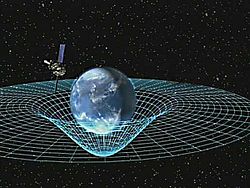
Spacetime topology is the topological structure of spacetime, a topic studied primarily in general relativity. This physical theory models gravitation as the curvature of a four dimensional Lorentzian manifold (a spacetime) and the concepts of topology thus become important in analysing local as well as global aspects of spacetime. The study of spacetime topology is especially important in physical cosmology.

Types of topology

[edit]

There are two main types of topology for a spacetime M.

Manifold topology

[edit]

As with any manifold, a spacetime possesses a natural manifold topology. Here the open sets are the image of open sets in .

Path or Zeeman topology

[edit]

Definition:[1] The topology in which a subset is open if for every timelike curve there is a set in the manifold topology such that .

It is the finest topology which induces the same topology as does on timelike curves.[2]

Properties

[edit]

Strictly finer than the manifold topology. It is therefore Hausdorff, separable but not locally compact.

A base for the topology is sets of the form for some point and some convex normal neighbourhood .

( denote the chronological past and future).

Alexandrov topology

[edit]

The Alexandrov topology on spacetime, is the coarsest topology such that both and are open for all subsets .

Here the base of open sets for the topology are sets of the form for some points .

This topology coincides with the manifold topology if and only if the manifold is strongly causal but it is coarser in general.[3]

Note that in mathematics, an Alexandrov topology on a partial order is usually taken to be the coarsest topology in which only the upper sets are required to be open. This topology goes back to Pavel Alexandrov.

Nowadays, the correct mathematical term for the Alexandrov topology on spacetime (which goes back to Alexandr D. Alexandrov) would be the interval topology, but when Kronheimer and Penrose introduced the term this difference in nomenclature was not as clear[citation needed], and in physics the term Alexandrov topology remains in use.

Planar spacetime

[edit]

Events connected by light have zero separation. The plenum of spacetime in the plane is split into four quadrants, each of which has the topology of R2. The dividing lines are the trajectory of inbound and outbound photons at (0,0). The planar-cosmology topological segmentation is the future F, the past P, space left L, and space right D. The homeomorphism of F with R2 amounts to polar decomposition of split-complex numbers:

so that
is the split-complex logarithm and the required homeomorphism F → R2, Note that b is the rapidity parameter for relative motion in F.

F is in bijective correspondence with each of P, L, and D under the mappings z → –z, z → jz, and z → – j z, so each acquires the same topology. The union U = F ∪ P ∪ L ∪ D then has a topology nearly covering the plane, leaving out only the null cone on (0,0). Hyperbolic rotation of the plane does not mingle the quadrants, in fact, each one is an invariant set under the unit hyperbola group.

See also

[edit]

Notes

[edit]

References

[edit]
Revisions and contributorsEdit on WikipediaRead on Wikipedia
from Grokipedia
Spacetime topology refers to the global topological structure of in , where is modeled as a connected, time-oriented Lorentzian manifold (Mn+1,g)(M^{n+1}, g) with a metric of (,+,,+)(-, +, \dots, +), determining properties such as causal relations between events and the overall " independent of local geometry. This structure is inherited from the manifold MM, and its study involves topological invariants like the and , which impose restrictions on possible spacetimes—for instance, compact even-dimensional Lorentzian manifolds without boundary must have zero . In four dimensions, such manifolds are not simply connected, highlighting how constrains the connectivity of . A key aspect of spacetime topology is its interplay with causality, which classifies curves as timelike (g(X,X)<0g(X,X) < 0), null (g(X,X)=0g(X,X) = 0), or spacelike (g(X,X)>0g(X,X) > 0), defining futures I+(p)I^+(p) and pasts I(p)I^-(p) for points pMp \in M. Distinct topologies arise from : the Zeeman (or path) topology, the finest compatible with timelike curves and homeomorphic to the manifold topology in under the extended by dilatations; and the Alexandrov (or interval) topology, the coarsest where causal intervals are open sets, coinciding with the manifold topology under strong causality conditions. Globally hyperbolic spacetimes, satisfying strong causality plus the compactness of J+(p)J(q)J^+(p) \cap J^-(q) for all p,qp, q, are homeomorphic to R×Σ\mathbb{R} \times \Sigma for some Σ\Sigma, ensuring well-posed initial value problems and precluding certain pathologies like closed timelike curves in chronological spacetimes. Notable implications include the potential for "holes" in —regions where fails under embeddings—and changes, which global hyperbolicity forbids but may occur in more general models via mechanisms like cut-and-paste constructions, affecting extendibility and singularity formation. Theorems such as Hawking's theorem assert that cross-sections are 2-spheres in 3+1 dimensions, while Penrose's singularity theorem links trapped surfaces in globally hyperbolic to geodesic incompleteness under the . These features underscore 's role in probing foundational questions, from the absence of naked singularities to the stability of cosmological models.

Overview

Definition and Basic Concepts

In general relativity, spacetime is modeled as a four-dimensional Lorentzian manifold, consisting of a smooth, connected, Hausdorff, and paracompact topological space equipped with a pseudo-Riemannian metric of Lorentzian signature, typically denoted as (1,3) or (3,1), which distinguishes timelike, spacelike, and null separations between events. This structure captures the fusion of three spatial dimensions and one temporal dimension into a unified continuum, where the metric determines the geometry and causal relations among points representing physical events. The smoothness ensures that differentiable functions and tensor fields can be defined consistently, while the Hausdorff and paracompact properties guarantee that the space is well-behaved for partitioning into open covers and separating distinct points with disjoint neighborhoods. A fundamental distinction in spacetime topology arises between local and global aspects: local topology concerns the structure of neighborhoods around individual points, where the manifold resembles the flat Minkowski spacetime of , allowing for well-defined tangent spaces and local coordinate charts; in contrast, global topology addresses the overall connectivity and large-scale arrangement of the entire , which may include non-trivial features like closed timelike curves or asymptotic regions. This separation is crucial because local flatness does not dictate global properties, which can vary significantly depending on the distribution of matter and energy via Einstein's field equations. The study of spacetime topology builds on foundational concepts from , adapted to the pseudo-Riemannian setting. A is defined by a collection of open sets satisfying axioms of union, intersection, and inclusion, which enable the notion of continuity for maps between spaces—essential for describing how worldlines (timelike curves traced by observers) and light cones evolve without abrupt discontinuities. Homeomorphisms, which are continuous bijections with continuous inverses, preserve these topological features, ensuring that deformations of spacetime coordinates do not alter intrinsic properties like the separation of events along causal paths. Spacetime topology specifically examines properties that remain invariant under continuous deformations, such as the number of connected components (reflecting overall integrity), (indicating whether the space is finite or unbounded), and the presence of "holes" (quantified by or homology groups, which detect non-contractible loops in spatial or temporal directions). These invariants provide insights into the and potential pathologies, like singularities or wormholes, without relying on the specific metric details.

Significance in General Relativity

The study of spacetime topology gained prominence in general relativity during the 1960s and 1970s, driven by foundational contributions from Robert Geroch, , and , who developed theorems on the global structure of spacetimes and their topological properties. Geroch's 1967 work established key results on the topology of spacelike sections in Lorentzian manifolds, showing that topological changes in these sections occur if and only if the spacetime is acausal under certain conditions. Hawking and Penrose's singularity theorems further integrated topology with , demonstrating how topological and causal constraints predict the formation of singularities in physically realistic spacetimes. In terms of , spacetime topology imposes fundamental constraints on possible causal structures, as certain non-trivial topologies permit closed timelike curves (CTCs), which would allow causal paradoxes such as information traveling backward in time. For instance, topologies that are not simply connected can support CTCs, but general relativity's conditions, like global hyperbolicity, exclude such features to maintain a consistent causal order, ensuring that light cones do not allow loops. These topological restrictions are essential for resolving potential inconsistencies in relativistic models, as violations would undermine the predictability of physical laws. In cosmology, the global of profoundly influences models of the , distinguishing between finite and infinite spatial extents and affecting observable phenomena. Multiply connected topologies, such as those with compact spatial sections, imply a finite where light paths can wrap around, leading to repeating patterns or "circles in the sky" in the (CMB) radiation. Observations from missions like Planck have constrained these possibilities, favoring simply connected topologies but leaving room for subtle multiply connected structures that could explain CMB anomalies without altering the overall flat geometry. Topological invariants play a crucial role in classifying singularities and horizons, providing tools to characterize the structure of spacetimes and cosmological singularities like the . Hawking's theorem asserts that, under the dominant , cross-sections of the event horizon in asymptotically flat spacetimes must be topologically equivalent to spheres, ensuring a stable spherical for isolated s. Similarly, topological and causal conditions in the Penrose-Hawking singularity theorems classify singularities as unavoidable in expanding universes with sufficient matter density, highlighting how delineates regions of breakdown in . A key concept is the theorem on topology change in classical , which prohibits smooth transitions between topologically distinct spacetimes without violating or energy conditions. This underscores the rigidity of spacetime topology in , where alterations require non-classical physics.

Types of Spacetime Topology

Manifold Topology

In , spacetime is modeled as a smooth, four-dimensional Lorentzian manifold (M,g)(M, g), where the manifold TM\mathcal{T}_M is the standard inherited from the differentiable of MM. This provides the foundational framework for defining continuity and openness in , essential for the mathematical description of gravitational phenomena. The open sets in TM\mathcal{T}_M are precisely the unions of images of open subsets of R4\mathbb{R}^4 under the coordinate charts ϕα:UαR4\phi_\alpha: U_\alpha \to \mathbb{R}^4 that form a maximal atlas covering MM, with transition maps between overlapping charts being smooth diffeomorphisms. This construction ensures that the is compatible with the , allowing for the consistent definition of differentiable functions and tensors across the manifold. Key properties of TM\mathcal{T}_M include being Hausdorff, which guarantees that distinct points can be separated by disjoint open neighborhoods, and second-countable, meaning it has a countable basis for its open sets, rendering the space separable and metrizable. Additionally, TM\mathcal{T}_M is locally Euclidean: around every point pMp \in M, there exists a chart such that the neighborhood is homeomorphic to an open ball in R4\mathbb{R}^4. These attributes support the imposition of a smooth Lorentzian metric gg of signature (,+,+,+)(-, +, +, +), enabling the local Minkowski-like structure required for . The manifold topology underpins on by facilitating coordinate charts that localize tensor fields, such as the metric gg and the , for computational purposes. Globally, TM\mathcal{T}_M allows the study of 's overall structure through topological invariants, including the χ(M)\chi(M) and the π1(M)\pi_1(M). For example, any compact, even-dimensional Lorentzian manifold without boundary must satisfy χ(M)=0\chi(M) = 0, implying it cannot be simply connected in four dimensions. A notable instance occurs in flat Minkowski spacetime, where TM\mathcal{T}_M coincides exactly with the standard Euclidean topology on R4\mathbb{R}^4. In this case, coordinate transformations, such as Lorentz boosts, preserve the topology while adapting the metric to maintain the indefinite inner product.

Zeeman Topology

The Zeeman topology, also referred to as the path topology, is defined as the finest topology on a spacetime manifold such that all timelike curves are continuous when equipped with the standard manifold topology. In this topology, a set is open if its intersection with every timelike curve is relatively open in the manifold topology. This construction refines the manifold topology by incorporating causal continuity along worldlines, ensuring that openness criteria align with the paths of freely falling particles. The basis for the Zeeman topology is generated by sets of the form Y+(p,U)Y(p,U){p}Y^+(p, U) \cup Y^-(p, U) \cup \{p\}, where UU is an open neighborhood of pp in the manifold topology, Y+(p,U)={qUY^+(p, U) = \{ q \in U \mid there exists a timelike curve from pp to qq entirely in U}U \}, and Y(p,U)Y^-(p, U) is defined analogously for the chronological past. The full basis includes arbitrary unions of such sets intersected with small open neighborhoods to maintain local fineness while preserving the causal structure. This topology is strictly finer than the manifold topology, Hausdorff, and separable, but lacks local compactness due to the emphasis on extended causal paths over bounded regions. It preserves sequential compactness along timelike paths, which supports the analysis of limits and convergence in causal settings without coordinate dependence. Introduced by E. C. Zeeman in his 1967 paper to investigate causality in independently of coordinate systems, the topology underscores the role of structures in defining trajectories. Zeeman's work emphasized fine topologies tailored to the paths of massive particles, providing a foundation for subsequent extensions to curved spacetimes in .

Alexandrov Topology

The on a is defined as the coarsest in which the chronological future I+(E)I^+(E) and chronological past I(E)I^-(E) of any subset EE are open sets. It is generated as the with subbasis consisting of all such I+(E)I^+(E) and I(E)I^-(E), or equivalently, with basis given by the causal intervals I+(x)I(y)I^+(x) \cap I^-(y) for points x,yx, y in the . Here, the chronological future of a point pp is the set I+(p)={qI^+(p) = \{ q \mid there exists a future-directed timelike curve from pp to q}q \}, and the chronological past I(p)I^-(p) is defined analogously. These basis elements, known as Alexandrov intervals, capture the causal openness inherent in the 's chronological order relation. A key property of the is that its open sets correspond precisely to arbitrary unions of these causal intervals, ensuring that the topology reflects the without additional metric assumptions. The topology coincides with the underlying manifold topology if and only if the spacetime is strongly causal, meaning that every point admits arbitrarily small neighborhoods intersected by no inextendible causal curve more than once. In strongly causal spacetimes, this equivalence preserves the Hausdorff separation of points based solely on causal distinguishability. Originally developed by A. D. Alexandrov in the context of order topologies on partially ordered sets during the mid-20th century, the was adapted to to define topological openness purely through causal relations, independent of differentiability or coordinate charts. In the GR setting, it is weaker (coarser) than the Zeeman topology, which is generated by neighborhoods of timelike curves and thus finer in distinguishing causal paths. The fails to be Hausdorff in spacetimes that violate strong causality, as causally indistinguishable points cannot be separated by disjoint open sets in this causal framework.

Examples and Applications

Planar Spacetime

Planar spacetime refers to the two-dimensional version of Minkowski spacetime, a flat Lorentzian manifold equipped with the metric ds2=dt2+dx2ds^2 = -dt^2 + dx^2, where light rays follow null geodesics with ds=0ds = 0. This metric distinguishes timelike (ds2<0ds^2 < 0), spacelike (ds2>0ds^2 > 0), and lightlike (ds2=0ds^2 = 0) separations, providing a foundational model for causal relations in . The topological structure of planar spacetime divides the (t,x)(t, x)-plane into four disjoint quadrants based on the at the origin: the future quadrant F+F^+ where t>xt > |x|, the past quadrant FF^- where t<xt < -|x|, the right space quadrant RR where x>tx > |t|, and the left space quadrant LL where x<tx < -|t|. These boundaries are formed by null geodesics, the worldlines of light signals propagating at 4545^\circ angles to the axes. The entire plane is to R2\mathbb{R}^2, establishing its simple topological type, with this homeomorphism realized through the split-complex plane where points are represented as z=t+jxz = t + j x and j2=1j^2 = 1. The split-complex structure preserves the Minkowski inner product as the norm z2=t2+x2|z|^2 = -t^2 + x^2, highlighting the underlying the causal divisions. In this framework, the causal topology employs an on the quadrants induced by the partial order of causal precedence, where one event precedes another if connected by a future-directed timelike or null . The standard planar admits no closed timelike curves, ensuring chronological protection and global hyperbolicity. Planar serves as a simplified model for causal diagrams in more complex scenarios, such as the that uniformly cover the RR and LL quadrants to describe accelerated observers. It also underpins applications in two-dimensional models, like the Callan-Giddings-Harvey-Strominger (CGHS) framework, where conformal invariance allows exact solvability and reveals horizon structures analogous to higher-dimensional cases.

Global Topological Structures

Global topological structures in refer to the overall connectivity and invariant properties of the four-dimensional Lorentzian manifold that encodes the causal relations dictated by . These structures capture features that persist under continuous deformations, distinguishing simply connected spacetimes like from more complex ones with non-trivial holes or identifications. Key invariants include the , homology groups, and covering spaces, which provide algebraic tools to classify the global geometry without relying on the metric. The π1(M)\pi_1(M) of a manifold MM is generated by classes of closed loops based at a point, serving as a detector of "holes" in the ; for instance, non-trivial π1(M)\pi_1(M) indicates multiply connected regions where paths cannot be continuously shrunk to a point. Homology groups Hk(M)H_k(M), which generalize cycles across dimensions, classify voids and connectivity; the first homology group H1(M)H_1(M) relates to one-dimensional cycles and is often isomorphic to the abelianization of π1(M)\pi_1(M), aiding in the study of causal paths in curved spacetimes. spaces, derived from π1(M)\pi_1(M), represent universal covers that "unwrap" the manifold, revealing its simply connected core; for example, the universal cover of a multiply connected lifts closed timelike curves to open paths. Exotic global structures arise in spacetimes with non-trivial , such as multiply connected examples like the four-torus T4=S1×S1×S1×S1T^4 = S^1 \times S^1 \times S^1 \times S^1, where spatial slices form a three-torus and the temporal direction adds periodicity, leading to identifications that compactify the universe without boundaries. Wormholes manifest as bridges with topology S2×RS^2 \times \mathbb{R}, connecting distant regions via a throat of spherical cross-sections extending infinitely, as seen in Einstein-Rosen bridges that alter global connectivity while preserving local Lorentzian signature. The Gödel universe exemplifies closed timelike curves (CTCs), where the cylindrical topology permits worldlines that loop back in time, violating chronological protection yet satisfying Einstein's equations with rotation. Causality constraints interplay with in globally hyperbolic spacetimes, defined as strongly causal manifolds where J+(p)J(q)J^+(p) \cap J^-(q) is compact for all p,qMp, q \in M, equivalently admitting a Cauchy Σ\Sigma such that every inextendible causal intersects Σ\Sigma exactly once, ensuring unique foliations by constant-time hypersurfaces for well-posed initial value problems. Such spacetimes are non-compact and / distinguishing, as established by theorems showing that global hyperbolicity implies the absence of CTCs and compact J+(p)J(q)J^+(p) \cap J^-(q) for points p,qp, q. The Hawking-King-McCarthy , constructed from path relations, recovers the manifold's differential and causal structures while highlighting non-compactness in globally hyperbolic cases, prohibiting certain topological defects. In cosmology, finite spacetime topologies predict repeating patterns in the cosmic microwave background (CMB), such as matched circles in the sky—pairs of antipodal points with identical temperature profiles due to geodesic closures. Observational searches using CMB data from missions like WMAP and Planck have constrained such topologies, finding no evidence for matched circles with angular radii greater than 25° (as of WMAP 2004), implying that the distance to any topological identification exceeds 0.91 times the radius of the last scattering surface; more recent Planck 2018 analyses tighten this to no detection for certain topologies with scales corresponding to angular radii larger than ~10°, and 2025 studies on lens spaces continue to find no evidence. Classical prohibits topology change via continuous metrics, as diffeomorphisms preserve the manifold; however, introduces possibilities like Wheeler's foam, where Planck-scale fluctuations could nucleate handles or wormholes, altering connectivity through tunneling amplitudes. These quantum effects remain speculative, with semiclassical prohibitions like the topological censorship theorem arguing against traversable changes in asymptotically flat spacetimes.

References

Add your contribution
Related Hubs
User Avatar
No comments yet.
