Hubbry Logo
Spahn RanchSpahn RanchMain
Open search
Spahn Ranch
Community hub
Spahn Ranch
logo
8 pages, 0 posts
0 subscribers
Be the first to start a discussion here.
Spahn Ranch
Spahn Ranch
from Wikipedia

Spahn Ranch, also known as the Spahn Movie Ranch, was a 55-acre (22.26 hectare) movie ranch in Los Angeles, California. For a period it was used as a ranch, dairy farm and later movie set during the era of westerns. After a decline in use for filming by the 1950s, its owner George Spahn established a stable for renting horses for riding on the varied acres. It became known in the late 20th century as the primary headquarters of Charles Manson and his cult followers, the "Manson Family", for much of 1967 and 1968. They were notorious for the Tate–LaBianca murders of August 1969.

Key Information

The entrance to the historic ranch was originally at 12000 Santa Susana Pass Road (street numbers have since been changed) of the Simi Hills and Santa Susana Mountains above Chatsworth, California. It is no longer in use. After Spahn's death and a wildfire that destroyed the main ranch house and outbuildings, the land was incorporated into Santa Susana Pass State Historic Park.[1]

History

[edit]

1880s–1968: Initial ownership and movie ranch

[edit]

Beginning in the 1880s, a piece of land, including what would later become the Spahn Ranch, became the homestead of Mexican immigrant Dionisio Sánchez and Hoosier James R. Williams, along with their families.[2][3]

The property was purchased in 1928 by Sharon M. Atkins and in 1947 by couple Lee and Ruth McReynolds. Lee built some movie sets next to his trading post on the property to catch some overflow from the Iverson Movie Ranch. With mountainous terrain, boulder-strewn scenery and an "old Western town" set, Spahn Ranch was a suitable filming site for westerns and had been used mostly for B movies and TV series.[4][5]

In 1953, McReynolds sold the site to dairy farmer George Spahn, and it became known as the Spahn Ranch. He continued to allow some filming there. Much of the information reported about specific productions filmed there is unreliable. The rumor that the location was used for the film Duel in the Sun (1946) is now known to be false. Among the productions said to have been filmed at Spahn Ranch are The Lone Ranger with Clayton Moore,[6] and several episodes of the Bonanza television series.[7] Spahn Ranch is also often cited as the filming location for the B-movie The Creeping Terror (1964).[8]

After the decline of filming and his dairy business, Spahn added more sets and rental horses. The ranch became popular among locals as a place to go horseback riding.[9] By the late 1960s, however, the ranch became almost deserted.[10]

1968–1969: Manson Family headquarters

[edit]

Spahn was 80 years old, going blind and living at his ranch when he allowed the Manson Family to move in, rent-free, in exchange for labor.[11] The family did daily chores and helped run the horse-rental business, which had become Spahn's main source of income.[12] Manson Family member Lynette Fromme later wrote, "I was impressed with George Spahn's hardiness. He was eighty years old and, although his blindness had for five or six years kept him in a world apart, he was mentally still present, living alone and working through all the frustrations of having lost authority in the running of his own business."[13]

In the 1970 murder trial, Prosecutor Vincent Bugliosi later claimed that Manson would occasionally send one of his girls to Spahn for sexual relations.[14] A Spahn employee, ranch hand Donald "Shorty" Shea, had known Manson in the past and had a physical confrontation with Manson.[15]

On August 16, 1969, after the Tate–LaBianca murders, more than one hundred officers from the Special Enforcement Detail (the SWAT team of the Los Angeles County Sheriff's Department) were deployed at Spahn Ranch in what authors Tom O'Neill and Dan Piepenbring [de] have alleged was the largest documented police raid in California history in their book CHAOS: Charles Manson, the CIA, and the Secret History of the Sixties, resulting in the arrest of several Manson Family members due to suspicion of their participation in an automobile theft ring (unrelated to the later arrest of those involved in the murders).[16][17]

Ten days later, on August 26, Susan Atkins of the Family lured Shea to a remote spot on the ranch where he was ambushed and killed by Bruce M. Davis and Steve "Clem" Grogan.[18][19] The Family members allegedly believed he had reported them to the police, leading to the August 16 raid.[20] His remains were not found until December 1977, when Grogan agreed to lead investigators to the spot where Shea had been buried.[21] Spahn was unaware of the reason for Shea's disappearance; he was never accused of any role in the 1969 murders for which several Family members were later convicted.[22]

In late 1969, Robert Hendrickson began filming the Manson Family at the ranch for his documentary Manson,[23] including Spahn, Lynette "Squeaky" Fromme, Bruce Davis, Nancy Pitman, Catherine "Gypsy" Share, Sandra Good, Paul Watkins and others.[24]

1970–present: fire, Spahn's death, and incorporation into a state park

[edit]
Original Spahn Ranch wooden sign on display at Graveface Museum in Savannah, Georgia

The Clampitt Fire destroyed all of the Spahn Movie Ranch's film sets and residential structures in September 1970.[25] George Spahn died on September 22, 1974, and is buried in Eternal Valley Memorial Park in nearby Newhall.[26]

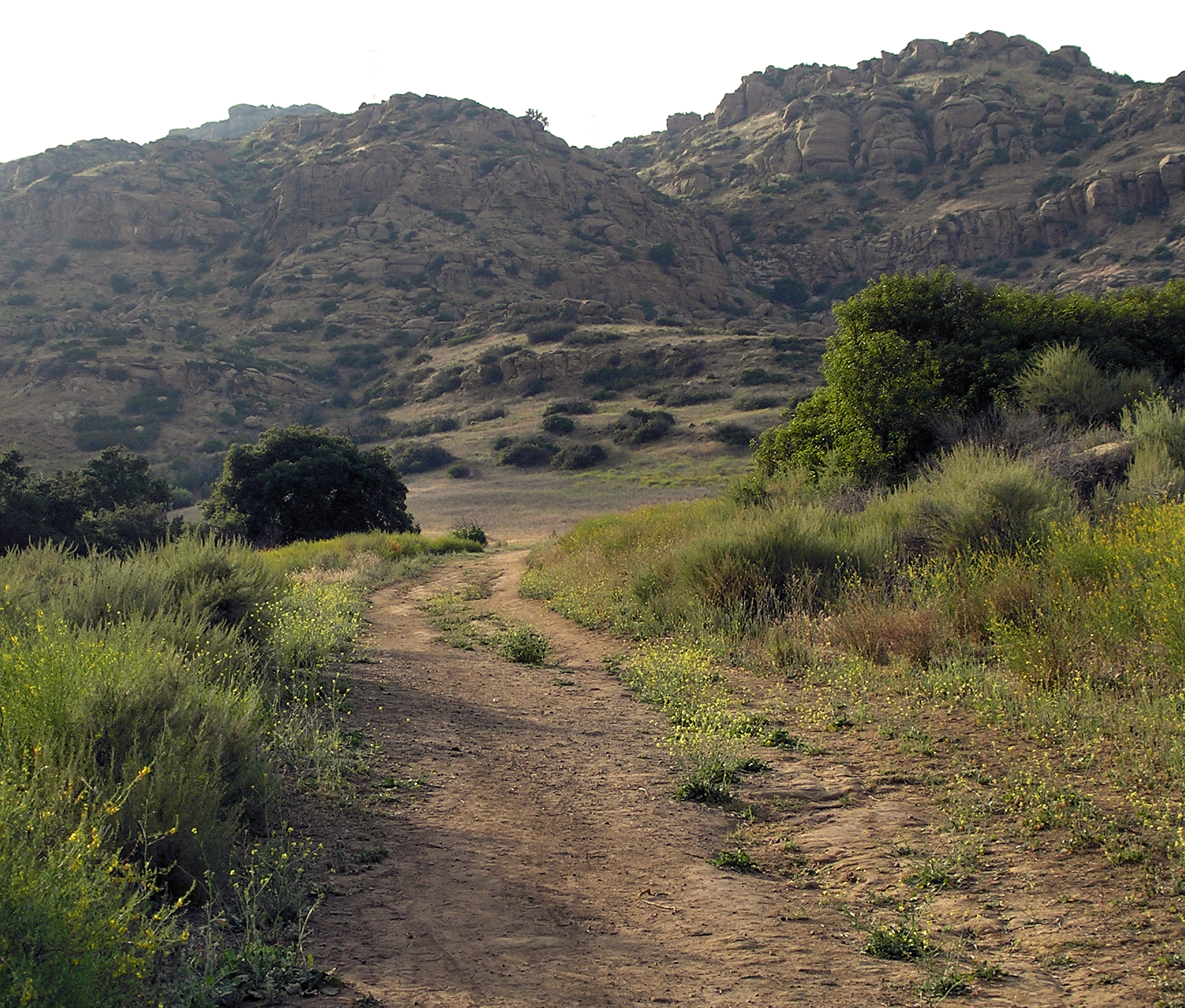
The Spahn Movie Ranch site is now part of California's Santa Susana Pass State Historic Park, the "Devil's Slide" section of the historic Old Santa Susana Stage Road being located on the park's western side.[27] Several hiking trails give access to extensive views of the San Fernando Valley.[28]

[edit]

Spahn Movie Ranch is a setting in Once Upon a Time in Hollywood (2019), a drama film written and directed by Quentin Tarantino and set in 1969 at the time of the Tate–LaBianca murders.[29] The scenes for the movie were filmed at the nearby Corriganville Park in Simi Valley, which was also a movie ranch at one time.[30] George Spahn was played by Bruce Dern.[31]

See also

[edit]

References

[edit]
[edit]
Revisions and contributorsEdit on WikipediaRead on Wikipedia
from Grokipedia
Spahn Ranch, also known as the Spahn Movie Ranch, was a approximately 55-acre property located south of Road in the Chatsworth area of , originally developed as a filming location for Western and shows. Acquired by dairy farmer in 1955 after prior ownership by figures including star and Lee McReynolds, the ranch featured constructed sets such as a saloon and jail used in productions like and , and later served as a stable for horse rentals to visitors. In late 1967, and his followers, later termed the , began inhabiting the decaying ranch, providing labor and care for the elderly, blind Spahn in exchange for residence in shacks and trailers on the isolated site. The group used the ranch as their primary base through 1969, from which several members departed to commit the Tate-LaBianca murders on August 8–10, 1969, killing seven people including actress ; Manson and associates were convicted in 1971 based on accomplice liability for orchestrating the killings amid Manson's apocalyptic ideology. The ranch's structures were largely destroyed by the Clampitt Fire, a massive ignited by downed power lines, on September 25, 1970, erasing physical remnants of its film sets and commune era. The site was later acquired by the State of in 1980 and incorporated into the Santa Susana Pass State Historic Park, preserving the natural landscape but not the original buildings.

Geography and Physical Description

Location and Terrain

Spahn Ranch was located in the area of northwestern , near Chatsworth and the boundary with Ventura County. The site's entrance was at 12000 Santa Susana Pass Road, later renumbered to 22601 Santa Susana Pass Road. Its approximate coordinates are 34.2728° N, 118.6230° W. The property encompassed 55 acres (22 hectares) of land, now largely within the boundaries of Santa Susana Pass State Historic Park. The terrain featured rugged foothills where the Simi Hills meet the Santa Susana Mountains, part of the western . This landscape included steep, rocky slopes, boulder-strewn hills, narrow canyons, and dry washes, with chaparral-dominated vegetation suited to the region's semi-arid conditions. Topographic relief reached approximately 700 feet near the crests, providing dramatic elevations and natural rock formations ideal for sets. The geology primarily consists of sedimentary rocks, including shales and sandstones from formations like the Santa Susana Formation, shaped by tectonic activity along faults such as the Santa Susana thrust.

Infrastructure and Features

Spahn Ranch comprised approximately 55 acres of rugged terrain in the , featuring mountainous landscapes with boulder-strewn scenery and hard rock formations suitable for Western film productions. The property included a constructed "old Western town" movie set with facades depicting a saloon, barbershop, café, jail, , barn, undertaking parlor, and Longhorn Saloon, primarily built to attract filming business from nearby ranches in the . Additional infrastructure encompassed corrals for horses used in ranch operations and rentals, a erected in , George Spahn's small residence near the dirt road entrance, and scattered abandoned cabins along riding trails. Access to the ranch relied on poorly maintained dirt roads branching off Road, supplemented by trails winding through oak groves, dry creek beds, and hillsides that supported both daily activities and for scripts. These elements collectively enabled the ranch's dual role in handling and as a versatile backdrop for B-Western films and television episodes from the 1940s to the 1960s.

Early Ownership and Development

Initial Acquisition in the 1880s

In the mid-1880s, the arid, rugged terrain in the area of what is now County's Chatsworth region—later encompassing the 55-acre Spahn Ranch—was acquired through under the federal Homestead Act of 1862, which allowed settlers to claim up to 160 acres of public land after five years of residency and improvements. James Richard Williams, an immigrant from , filed a homestead claim for 160 acres in this vicinity around 1881, arriving with his wife Caroline and five children to cultivate portions of the land, including about 20 acres initially under tillage amid the chaparral-covered hills. Williams' efforts focused on basic ranching and farming in an era when the region supported sparse cattle grazing and limited agriculture, constrained by poor soil and . Adjacent parcels, totaling approximately 129 acres, were homesteaded by Dionisio Sánchez, a Mexican-born settler who had recently naturalized as a U.S. citizen, along with his wife Maria and six children; Sánchez's claim overlapped the future ranch boundaries and reflected the era's pattern of Hispanic-American families establishing footholds in Southern California's frontier lands through persistent labor on marginal terrain. These early acquisitions involved no monetary purchase but required proof of residency, cultivation, and fencing to secure patents from the federal government, often finalized after years of hardship including isolation, wildfires, and economic pressures from overland stagecoach routes passing nearby. By the late 1880s, such homesteads formed the foundational private holdings that would be subdivided and resold over decades, transitioning from subsistence operations to eventual commercial uses.

Transition to Ranching Operations

Following the initial of the land in the late , the parcels that would form Spahn Ranch were developed for agricultural purposes suited to the region's rocky, semi-arid terrain in the . Dionisio Sánchez, a Mexican immigrant who naturalized as a U.S. citizen, and his wife Maria secured a 129-acre homestead, while James R. Williams, an native, claimed 160 acres under the Homestead Act of 1862, requiring five years of residency and improvements such as fencing and basic structures. These efforts transitioned the undeveloped lots into functional ranching operations, focusing on livestock grazing rather than intensive crop farming due to limited water and soil quality. By the early 1900s, after Sánchez and Williams obtained clear title through homestead patents, the properties supported small-scale ranching typical of frontiers, including sheep, goats, and possibly herding on the natural hillsides and valleys. Ownership records indicate the land passed through subsequent holders, such as in 1909–1912, who maintained its use as pastureland before larger-scale commercialization. This shift from provisional to established ranching involved constructing corrals, trails, and water diversions, enabling sustained pastoral economies amid the area's growing suburban pressures. The ranching phase persisted into the , providing economic viability through local markets for wool, meat, and dairy, until interest redirected land use toward set construction and leasing. This early ranching era laid the infrastructural foundation—such as stables and access roads—that later accommodated both and cinematic props.

Film Industry Era

Rental for Western Productions

The Spahn Ranch served as a rental location for and television productions, capitalizing on its 55-acre expanse in the , which provided rugged, arid terrain suitable for depicting frontier settings. Production companies paid fees to for access to the site, including its constructed Western facades, livestock, and props, which supplemented the ranch's declining agricultural revenues after . This rental model persisted into the 1950s and early 1960s, though demand waned with the shift toward studio-based filmmaking and reducing the appeal of low-budget outdoor shoots. Notable rentals included episodes of the television series (1959–1973), which utilized the ranch's landscapes for outdoor scenes in multiple installments. Similarly, (1949–1957) and Disney's (1957–1959) filmed sequences there, leveraging the property's established sets for action-oriented Western narratives. These productions often involved local stunt performers and horse wranglers affiliated with the ranch, contributing to its role as a hub for B-Western and episodic television content during the genre's postwar popularity. By the late 1960s, however, film rentals had sharply declined, prompting Spahn to seek alternative tenants to maintain the property.

Notable Films and Contributions

Spahn Ranch was a frequent filming location for low-budget western productions from the onward, leveraging its boulder-strewn hills, mountainous backdrop, and George Spahn's constructed replica of an old western town featuring structures like the Longhorn Café and Rock City Saloon. The ranch's isolation in the facilitated authentic outdoor shoots without urban interference, contributing to its appeal for B-movies and television episodes that required rugged, period-appropriate scenery. Among the notable films, ' The Outlaw (1943), starring , utilized the ranch for key sequences, marking one of its early high-profile uses in cinema. Later, (1969), directed by and featuring , was the final major motion picture filmed there before a 1970 brush fire destroyed the sets, with the production capturing the decaying ranch atmosphere amid biker gang violence. Other B-films included The Creeping Terror (1964), a low-budget horror-western hybrid, and The Female Bunch (1971), though the latter postdated primary operations. Television contributed significantly to the ranch's legacy, with episodes of Bonanza (1959–1973) using its trails and facades for Nevada Territory scenes, alongside The Lone Ranger (1949–1957) and Zorro (1957–1959) for action sequences in faux old-west towns. The ranch's owner, George Spahn, supplemented income by supplying livestock, wagons, and props to productions, reducing costs for studios and sustaining the property through rentals that averaged $100 per day in the mid-20th century. This economic model highlighted the ranch's niche role in enabling accessible location shooting for western genres, which dominated American popular media during the era.

Economic Role and Challenges

The primary economic function of Spahn Ranch during its era was as a location rental site for Western motion pictures and television productions, where owners leased the 55-acre property to studios seeking authentic frontier backdrops without the expense of extensive set construction. This generated revenue through per-day or per-project fees, allowing the ranch to transition from subsistence ranching to a semi-commercial enterprise tied to Hollywood's demand for rugged, versatile terrain featuring rock formations, canyons, and built facades mimicking Old West towns. Productions such as episodes of and utilized the site, contributing to its role in supporting low-budget B-Westerns that proliferated in the 1930s through 1940s. Rental income fluctuated with the Western genre's popularity, which provided a lifeline amid declining agricultural viability in the arid area, but required ongoing maintenance of sets and trails to remain competitive. Owners invested in basic infrastructure like false-front buildings and corrals to attract filmmakers, offsetting costs through repeat business from independent producers unable to afford studio lots. However, specific fee structures mirrored industry norms, with comparable ranches charging around $650 per day in the mid-20th century, though exact figures for Spahn remain undocumented in available records. Challenges arose from oversaturation of movie ranches, including larger competitors like Iverson and Corriganville, which offered more expansive sets and drew premium clients, limiting Spahn's bookings to smaller outfits. The post-World War II shift toward urban dramas and international co-productions eroded demand for domestic Western locations, culminating in a noticeable decline in filming activity by the as television Westerns peaked then waned amid genre fatigue and rising production costs. This downturn forced diversification into horse rentals for trail rides, signaling the ranch's vulnerability to broader cinematic trends rather than inherent operational flaws.

George Spahn's Ownership

Acquisition in 1948

, a dairy farmer originally from , acquired the 55-acre in 1948 after relocating to in the late following his separation from his wife. The property, located in the area of County, had already established itself as a site for filming westerns due to its rugged terrain and constructed sets from prior owners, including structures built by Lee McReynolds who had purchased the land in 1947. Spahn, then aged 59, saw potential in continuing the ranch's dual role as a horse-breeding operation and a rental venue for the film industry, which provided steady income amid declining demand for western productions post-World War II. Under Spahn's ownership, the ranch retained its name and features, including a , stables, and faux facades that had hosted shoots for silent films and early series. He invested in additional stock for trail rides and pack trips, catering to tourists and production crews, while residing on-site with family members and ranch hands. This acquisition marked a shift from Spahn's eastern dairy background to western ing, leveraging the property's cinematic history to sustain operations despite the era's economic challenges for such venues. By maintaining low overhead and flexible leasing, Spahn ensured the ranch's viability into the 1950s and beyond, even as his eyesight began to deteriorate from .

Daily Operations and Personal Life

During George Spahn's ownership, which began with his purchase of the 55-acre property in 1953, daily operations increasingly centered on horse rentals and tourist excursions as waned in the . Spahn maintained stables with dozens of available for rent, allowing visitors to ride along established trails through the ranch's rocky hills and mock-Western sets, generating primary revenue from these activities amid declining demand for location shoots. Occasional filming persisted, including episodes of television series like , but ranch hands focused on animal care, trail upkeep, and basic maintenance of aging structures to support public access. Spahn, nearing blindness by the late , delegated much oversight to Ruby Pearl, a former and circus performer who served as his companion and manager for over 15 years. Pearl handled logistics such as coordinating horse rentals, supervising ranch hands—including stuntmen and workers—and ensuring operational continuity, often leaving in the evenings while Spahn remained on-site. The ranch employed a small staff for chores like feeding , repairing fences, and guiding riders, reflecting a shift to low-key recreational enterprise. In his personal life, Spahn resided in the main house on the property, having separated from his wife in the late 1940s after relocating from , where he had operated a . Born on February 11, 1889, he fathered multiple children from his but lived independently at the ranch, dependent on aides for daily needs due to his vision loss. His relationship with Pearl provided both companionship and partnership, though the ranch's isolation and his frailty limited broader social engagements.

Manson Family Occupation (1968–1969)

Arrival and Initial Integration

In the summer of 1968, led his group of approximately 30-40 followers, predominantly young women along with a handful of men, to Spahn Ranch in Chatsworth, , after being evicted from a previous residence in . The move occurred gradually, with the group initially camping at a nearby church before occupying abandoned shacks and cabins scattered along the ranch's riding trails. , recognizing the ranch's isolation and the vulnerability of its owner, —an 80-year-old man who was nearly blind and in declining health—persuaded him to allow the group to settle there rent-free. The agreement hinged on the group's labor contributions to the ranch's operations, which had dwindled due to Spahn's condition and the site's fading use as a . Family members, particularly the women, performed daily chores including cooking, cleaning Spahn's house, tending to horses, and assisting with trail rides for occasional visitors. Women rotated duties staying overnight with Spahn to provide companionship and care, helping to meet his practical needs amid his isolation. Lynette "Squeaky" Fromme emerged as a key figure in this integration, forming a close personal bond with Spahn, who nicknamed her for the sounds she reportedly made when he touched her. She acted as his de facto companion, managing some household tasks and participating in ranch activities, which solidified the group's foothold. This arrangement initially masked the group's unconventional dynamics, presenting them as helpful hippies contributing to the ranch's upkeep rather than an emerging cult.

Daily Activities and Internal Dynamics

The Manson Family's arrangement with allowed them to reside rent-free on in exchange for performing various chores, including cleaning, cooking, minor repairs, and assisting with the horse-rental operation, which had become Spahn's primary income source amid declining film work. members, particularly the women, also provided personal care and companionship to the elderly, nearly blind Spahn, with some accounts indicating sexual relations as part of the dynamic, though the extent of actual labor varied according to trial testimonies—ranch hands handled much of the horse care, and observers noted Manson himself rarely participated in manual work. Daily life revolved around communal routines in the isolated 55-acre property, devoid of clocks, newspapers, or calendars, which reinforced group dependency and temporal disorientation. Activities included scenarios such as cowboys and pirates, group meals prepared collectively, and occasional outings like races or target shooting, interspersed with drug use—primarily and marijuana—that fueled hallucinatory experiences and Manson's philosophical monologues. Internally, the group's structure was hierarchical with Manson as unchallenged leader, enforcing "" through mandatory orgies and partner-sharing to erode individual attachments, while indoctrinating followers via guitar-accompanied sermons blending apocalyptic prophecies from the , lyrics, and racial war visions he termed "Helter Skelter." Tensions escalated in spring 1969 amid paranoia from a failed drug deal and perceived threats from groups like the Black Panthers, prompting stockpiling of weapons, vehicle thefts for parts, and intensified preparations for an anticipated race conflict, though the veracity of Manson's prophetic motivations remains contested beyond prosecutor Vincent Bugliosi's Helter Skelter narrative, which some critiques attribute to trial strategy rather than unassailable evidence. Women held informal roles like "ranch girls" tending to visitors, while men engaged in scavenging or enforcement, fostering a cult-like cohesion through isolation and shared delusions, yet underlying resentments simmered, as evidenced by later defections and trial revelations of coerced loyalty.

Criminal Acts and Escalation

During their occupation of Spahn Ranch, members of the engaged in a range of criminal activities, including vehicle theft, , drug trafficking, and , using the remote property as a base for stripping stolen cars and storing parts. These operations escalated in the summer of amid internal following a failed drug deal involving bad , prompting the acquisition of more weapons and intensified thefts to fund the group. The family's auto theft ring involved stealing dune buggies and using stolen credit cards—obtained after shot drug dealer Bernard Crowe on July 1, 1969, in —to purchase parts, with dismantled vehicles processed at . Assaults also occurred, as family members physically intimidated ranch hands and visitors who objected to their presence, including beatings to silence complaints about the growing commune's disruptive behavior. Law enforcement scrutiny mounted, culminating in a Los Angeles County Sheriff's Department raid on August 16, 1969, targeting suspected grand theft auto; 24 family members, including Manson, were arrested on-site for possessing stolen vehicles and related charges like with a , though most were released days later as the Tate murder investigation took precedence. This raid heightened fears of impending arrests, exacerbating Manson's apocalyptic ideology centered on "Helter Skelter"—a prophesied race war inspired by lyrics—which he sought to trigger through high-profile violence blamed on Black militants. The escalation peaked with the Tate-LaBianca murders on August 8–10, 1969, planned at Spahn Ranch and executed by family members who returned there afterward; five were killed at actress Sharon Tate's home on August 8–9, and Leno and Rosemary LaBianca on August 10, with the acts intended, per trial testimony, to ignite Manson's envisioned societal collapse. Subsequently, ranch hand Donald "Shorty" Shea was targeted as a suspected on the theft probe; on August 26, 1969, he was abducted from the ranch, beaten, stabbed, and shot by Bruce Davis and , with his remains buried nearby in the . Manson, Davis, and Grogan were convicted of Shea's first-degree in a 1972 trial, with the act tied directly to efforts to eliminate perceived threats amid the ranch-based criminal enterprise; Davis and Grogan received life sentences, while Grogan was paroled in 1985 after leading authorities to the body. These events marked the transition from opportunistic crimes to orchestrated killings, driven by Manson's control and the group's isolation at Spahn.

Law Enforcement Oversights and Arrests

Law enforcement interactions with the at Spahn Ranch began in early 1969 amid growing complaints from ranch owner and local residents regarding vehicle thefts, vandalism, and the presence of underage runaways engaged in and drug use. Sheriff's deputies conducted several visits to the property, but these yielded no arrests, as Spahn often minimized the issues—claiming the women were there consensually—and insufficient evidence was found to support charges, despite reports of firearms and suspicious activities. Charles Manson's charismatic persuasion during these encounters further deterred decisive action, allowing the group's operations to persist unchecked. These preliminary oversights culminated in a major raid on August 16, 1969, when over 100 deputies executed search warrants at the 500-acre ranch starting around 6:00 a.m., targeting a suspected auto theft ring involving customized dune buggies and stolen vehicle parts. The operation resulted in the arrest of 26 members, including figures like Lynette "Squeaky" Fromme and Danny DeCarlo, on charges of and possession of stolen property; authorities seized multiple vehicles, weapons, and during the sweep. However, Manson himself was absent, having relocated to in Death Valley days earlier, and most arrestees were released shortly thereafter due to procedural irregularities, such as disputed warrant validity and Miranda rights violations claimed by the suspects. A critical oversight occurred in the raid's aftermath: despite its timing—just one week after the Tate-LaBianca murders on August 8–10, 1969—and the recovery of shell casings later matched to weapons used in those killings, no immediate connection was drawn between the and the homicides. This failure permitted continued criminality, including the August 26 of ranch hand Donald "Shorty" Shea, whom the Family suspected of informing on them to authorities. The auto theft probe indirectly prompted further scrutiny, leading to a separate raid on Barker Ranch on October 12, 1969, where Manson and remaining followers were arrested on similar charges, ultimately facilitating their indictment for the murders.

Post-Manson Decline and Destruction

1970 Fire and Immediate Aftermath

The Clampitt Fire erupted on , 1970, at approximately 8:00 a.m. near Clampitt Road in the , sparked by downed power lines and rapidly intensified by gusting up to 50 miles per hour. The blaze, one of several wildfires that collectively scorched over 500,000 acres across that season, consumed 107,103 acres in the region alone, destroying 80 structures and claiming at least four lives. By early evening of the same day, the fire front advanced into Spahn Ranch, obliterating its aging film sets—including facades mimicking Old West towns used in productions like —along with all residential cabins, barns, and outbuildings. The destruction was total for the ranch's , leaving only , twisted metal debris, and skeletal remains of wooden structures amid the 55-acre property's rugged terrain. Most of George Spahn's horses were evacuated successfully prior to the flames' arrival, averting additional livestock losses. George Spahn, then 81 years old and nearly blind, was rescued from the property during the evacuation and relocated to a care facility in North Hollywood, effectively severing his personal ties to the ranch. No immediate rebuilding occurred, as the inferno's scale—coupled with the site's prior deterioration from neglect and the Manson Family's occupation—rendered economic viability impossible without substantial investment, which Spahn lacked the resources or inclination to pursue. The event, occurring amid ongoing Manson murder trials, drew brief media attention for erasing physical traces of the ranch's infamous recent history, though law enforcement had already cleared the site of Family remnants following their 1969 arrests. In the ensuing weeks, the ranch lay abandoned and exposed to further erosion from winter rains, with opportunistic scavenging of salvageable materials reported but unquantified by authorities. Property taxes and maintenance lapsed under Spahn's absentee oversight, hastening legal and financial entanglements that foreshadowed eventual state intervention, while the fire's regional toll prompted enhanced fire management protocols in County's brushlands.

George Spahn's Death in 1974

George Spahn, the longtime owner of the Spahn Ranch, died on September 22, 1974, at the age of 85. He passed away from natural causes at the Sherwood Convalescent Hospital in , , following a period of declining health after the ranch's destruction by fire in 1970. At the time of his death, Spahn remained married to his wife, Martha Greenholts, though the couple had long lived separately amid his reliance on caregivers due to near-total blindness and advanced age. His admission to the convalescent facility on Sherman Way reflected the ranch's post-Manson obsolescence, as the property had ceased operations as a movie set and riding years earlier. Spahn was buried in Eternal Valley Park in , approximately 20 miles from the former ranch site. No evidence of foul play or unusual circumstances surrounded his , consistent with attributing it solely to age-related natural causes.

Incorporation into Santa Susana Pass State Historic Park

State Acquisition and Preservation Efforts

In 1980, the California Department of acquired the 43-acre Spahn Ranch site south of Road as the second major land purchase for what would become State Historic Park, following initial acquisitions focused on the historic stage road corridor. This purchase incorporated the former into public lands managed for cultural and natural preservation, after the property had lain largely abandoned following George Spahn's death in 1974 and the destruction of its structures by wildfires in 1970 and subsequent years. Preservation efforts emphasized protecting the site's geological features, such as its terrain used in early productions, while integrating it into a network of hiking trails like the Spahn Ranch Trail via Mattingly, Sanchez, and El Camino Nuevo paths, which allow public access to interpretive remnants without reconstruction of lost buildings. Organizations including the Foundation for the Preservation of the advocated for expanded boundaries, facilitating the overall assembly of approximately 670 acres by supporting state and deals to safeguard against urban development pressures in the Simi Hills-Santa Susana Mountains region. The Santa Susana Mountain Park Association further advanced preservation through community-driven initiatives, including the 2008 approval of a general plan by the and Commission that prioritizes cultural resource protection, trail maintenance, and habitat restoration over commercial exploitation, ensuring the Spahn site's historical context as a 20th-century location and base is conveyed via signage and guided access rather than sensationalism. These efforts align with the park's designation to conserve the Old Santa Susana Stage Road, listed on the , while preventing erosion and from degrading the open space that replaced the ranch's former infrastructure.

Current Status as Hiking and Historical Site (as of 2025)

Spahn Ranch, now integrated into the northern boundary of State Historic Park in , serves primarily as a destination for hikers interested in its rugged terrain and historical associations with early Hollywood production and the Manson Family's occupation in the late 1960s. The site features no surviving structures from the original era, as a 1970 destroyed the main buildings and outbuildings, leaving only natural landscapes of badlands and boulder-strewn hills. Access to the location requires , with popular routes such as the 3.2-mile Spahn Ranch via Mattingly, Sanchez, and El Camino Nuevo Trail offering moderate difficulty through rocky paths and providing views of the . The park remains open daily from 8:00 a.m. to sunset as of October 2025, with primary entry points including the 10200 block of Larwin Avenue off the 118 Freeway via Topanga Canyon Boulevard. Hikers must adhere to state park regulations preserving all natural features, including plants, rocks, and any remnant historical elements, as the area holds cultural significance beyond its criminal history, encompassing Chumash Native American heritage and 19th-century stagecoach routes. Interpretive signage is minimal at the Spahn site itself, focusing visitor experience on self-guided exploration rather than structured tours, though the park's broader trails connect to other historic features like the Santa Susana Stage Road, listed on the National Register of Historic Places. No major developments or closures have altered public access in 2025, maintaining the site's role as an open, undeveloped historical landmark amid ongoing preservation efforts by . The terrain poses challenges for inexperienced hikers, with steep inclines and loose rock, but rewards with expansive vistas and opportunities for reflection on the ranch's multifaceted past.

Cultural Depictions and Legacy

Representations in Film, Books, and Media

In Quentin Tarantino's 2019 film Once Upon a Time in Hollywood, Spahn Ranch serves as a pivotal setting for a tense sequence depicting stuntman Cliff Booth's visit to the property on August 8, 1969, where he encounters members of Charles Manson's group amid their squalid living conditions and subtle threats. The portrayal emphasizes the ranch's decayed Western movie set ambiance, with interiors recreated to show cluttered trailers and blind owner George Spahn asleep, heightening suspense without graphic violence, as the narrative diverges into an alternate history averting the Tate murders. The 1973 documentary Manson, directed by Robert Hendrickson and Laurence Merrick, incorporates authentic footage captured at Spahn Ranch during the group's residence, offering glimpses of their daily activities, communal living, and interactions shortly before the murders, which provides a raw, contemporaneous visual record of the site's role as their primary base. Vincent Bugliosi's 1974 book Helter Skelter: The True Story of the Manson Murders describes Spahn Ranch as the remote, rundown headquarters where Manson and his followers resided from late 1968, engaging in vehicle thefts, dune buggy repairs, and apocalyptic planning, with its isolation facilitating evasion of authorities until raids in August and October 1969. Bugliosi, the lead prosecutor, details evidentiary searches at the site yielding weapons and stolen goods, underscoring its centrality to the case against Manson for orchestrating the Tate-LaBianca killings, though the book has faced scrutiny for potential prosecutorial bias in interpreting Manson's motives. News media representations, such as a , 1969, report from the ranch, portrayed it as a commune turned crime scene, with on-site footage highlighting debris-strewn lots and remnants post-arrests, contributing to public perceptions of the location as a symbol of counterculture's dark underbelly. Similarly, LIFE magazine's 1969 photographs captured the ranch's hovels and desert surroundings as the backdrop for Manson's operations, emphasizing its transformation from a film set to a site of communal depravity and murder plotting.

Controversies Surrounding Historical Interpretations

The dominant historical interpretation of events at Spahn Ranch, as presented in prosecutor Vincent Bugliosi's 1974 book Helter Skelter, portrays the site as the central headquarters where orchestrated an apocalyptic race war scenario inspired by ' White Album, directing his followers to commit the Tate-LaBianca murders on August 8–10, 1969, to ignite societal chaos. This narrative relies heavily on testimonies from former members like and , who described Manson's hypnotic control, communal sessions, and explicit instructions issued from the ranch's dilapidated structures. Bugliosi's account, drawn from trial evidence and his direct involvement, emphasizes empirical details such as dune buggy thefts and armed patrols at the ranch to substantiate the premeditated dynamic, but critics note its prosecutorial bias in prioritizing conviction over exhaustive alternative explanations. Challenges to this interpretation emerged prominently in Tom O'Neill's 2019 book Chaos: Charles Manson, the CIA, and the Secret History of the Sixties, which scrutinizes archival records and interviews to argue that Bugliosi selectively emphasized Helter Skelter while downplaying inconsistencies, such as the August 16, 1969, sheriff's raid on Spahn Ranch that arrested dozens but released Manson due to a warrant technicality, potentially influenced by broader intelligence interests in counterculture monitoring. O'Neill cites declassified documents and witness discrepancies to question whether Manson's motives were truly ideological or more prosaic, involving drug trafficking disputes with dealer Bernard Crowe or personal vendettas against record producer Terry Melcher, events loosely tied to ranch activities but not fitting a grand conspiracy. Manson himself, in rare recorded statements from prison interviews featured in a 2024 Peacock docuseries, dismissed Helter Skelter as a "fairy tale" fabricated by authorities, claiming the murders stemmed from impulsive reactions rather than ranch-planned doctrine, though his self-serving testimony lacks corroboration from neutral sources. Further debates center on psychological and environmental causal factors at Spahn Ranch, with a 2025 FBI criminal profiler analysis attributing the escalation not solely to Manson's charisma but to a "" of ranch isolation, unchecked access to firearms and vehicles, and followers' pre-existing vulnerabilities like Lynette Fromme's history of , challenging interpretations that over-rely on narratives without empirical psychiatric evaluations. A 2016 legal review argues Manson's documented , evidenced by prison medical records from the 1950s onward, undermines portrayals of him as a rational strategist directing operations from the ranch, suggesting instead that Family dynamics were amplified by opportunistic rather than deliberate ideology. These critiques highlight source credibility issues, as Bugliosi's firsthand role incentivized a cohesive story, while alternative accounts like O'Neill's draw from 20 years of primary document review but introduce speculative elements lacking direct causation proof. Errol Morris's 2025 documentary Chaos: The Manson Murders reinforces this uncertainty, interviewing surviving figures to underscore how incomplete evidence from the ranch—such as unrecovered audio tapes of Manson's lectures—leaves interpretive gaps unresolved by empirical data alone.

Debates on Counterculture and Criminal Responsibility

The Manson Family's activities at Spahn Ranch, a dilapidated former movie set turned commune in , fueled debates over whether the group's crimes exemplified the perils of or represented an aberration exploited by Charles Manson's personal pathology. Critics argued that elements of the —such as communal living, use, and rejection of —created fertile ground for manipulation, as Manson recruited disaffected youth to the ranch under the guise of and spiritual enlightenment, only to impose coercive control through LSD-fueled rituals and isolation. However, others contended that Manson was not a product of the but a pre-existing criminal who parasitized its ideals; his apocalyptic "Helter Skelter" ideology, blending lyrics with racial war fantasies, diverged sharply from mainstream and ethos, serving instead as a vehicle for his lifelong pattern of and violence predating the scene. This view posits the murders as a backlash against civil rights gains rather than an organic outgrowth of countercultural excess, with Spahn Ranch functioning less as a haven and more as a lawless outpost where Manson's engaged in petty crimes like and auto theft to sustain operations. Post-murder analyses highlighted a divide within countercultural circles: radical groups like the Weathermen grappled with whether to disavow Manson as a fascist infiltrator or critique societal failures that enabled such cults, while mainstream media, amplified by President Nixon's labeling of Manson as emblematic of depravity, accelerated public disillusionment with the era's optimism. Empirical patterns from the time, including increased cult formations amid youth alienation (with over 2,000 communes documented in alone by ), suggest countercultural drift toward authority vacuums heightened vulnerability to charismatic predators like Manson, who at Spahn enforced hierarchical dominance contradicting the movement's egalitarian . Yet causal attribution remains contested, as Manson's followers—many middle-class runaways—exhibited voluntary participation in ranch life, including sex work to fund George Spahn's silence, underscoring individual agency over blanket . On criminal responsibility, Manson's 1971 conviction for first-degree murder and —despite his absence from the Tate-LaBianca killings—hinged on prosecutorial of his verbal directives to followers, including coded instructions issued from Spahn Ranch to ignite a supposed race war. Debates persist over the extent of his psychological sway, with defense claims of via prolonged drug exposure and at the ranch invoking diminished capacity, though courts rejected this, affirming followers' accountability as adults capable of independent action (e.g., ' detailed confession implicating Manson). Recent forensic reassessments describe a "" of Manson's narcissistic traits, follower predispositions to escapism, and ranch isolation fostering , but emphasize legal precedents holding cult leaders liable for foreseeable outcomes of their influence, without excusing participants' direct perpetration. Parole hearings for surviving Family members, such as (released 2023 after serving 53 years), have revisited these dynamics, weighing ranch-era against post-arrest remorse and societal reintegration potential, yet underscoring that prioritizes evidentiary causation over therapeutic narratives of victimhood.

References

Add your contribution
Related Hubs
User Avatar
No comments yet.