


Community hub
Recent from talks
Knowledge base stats:
Talk channels stats:
Members stats:
Sparse matrix
In numerical analysis and scientific computing, a sparse matrix or sparse array is a matrix in which most of the elements are zero. There is no strict definition regarding the proportion of zero-value elements for a matrix to qualify as sparse but a common criterion is that the number of non-zero elements is roughly equal to the number of rows or columns. By contrast, if most of the elements are non-zero, the matrix is considered dense. The number of zero-valued elements divided by the total number of elements (e.g., m × n for an m × n matrix) is sometimes referred to as the sparsity of the matrix.
Conceptually, sparsity corresponds to systems with few pairwise interactions. For example, consider a line of balls connected by springs from one to the next: this is a sparse system, as only adjacent balls are coupled. By contrast, if the same line of balls were to have springs connecting each ball to all other balls, the system would correspond to a dense matrix. The concept of sparsity is useful in combinatorics and application areas such as network theory and numerical analysis, which typically have a low density of significant data or connections. Large sparse matrices often appear in scientific or engineering applications when solving partial differential equations.
When storing and manipulating sparse matrices on a computer, it is beneficial and often necessary to use specialized algorithms and data structures that take advantage of the sparse structure of the matrix. Specialized computers have been made for sparse matrices, as they are common in the machine learning field. Operations using standard dense-matrix structures and algorithms are slow and inefficient when applied to large sparse matrices as processing and memory are wasted on the zeros. Sparse data is by nature more easily compressed and thus requires significantly less storage. Some very large sparse matrices are infeasible to manipulate using standard dense-matrix algorithms.
A band matrix is a special class of sparse matrix where the non-zero elements are concentrated near the main diagonal. A band matrix is characterised by its lower and upper bandwidths, which refer to the number of diagonals below and above (respectively) the main diagonal between which all of the non-zero entries are contained.
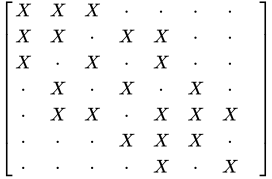
Formally, the lower bandwidth of a matrix A is the smallest number p such that the entry ai,j vanishes whenever i > j + p. Similarly, the upper bandwidth is the smallest number p such that ai,j = 0 whenever i < j − p (Golub & Van Loan 1996, §1.2.1). For example, a tridiagonal matrix has lower bandwidth 1 and upper bandwidth 1. As another example, the following sparse matrix has lower and upper bandwidth both equal to 3. Notice that zeros are represented with dots for clarity.
Matrices with reasonably small upper and lower bandwidth are known as band matrices and often lend themselves to simpler algorithms than general sparse matrices; or one can sometimes apply dense matrix algorithms and gain efficiency simply by looping over a reduced number of indices.
By rearranging the rows and columns of a matrix A it may be possible to obtain a matrix A′ with a lower bandwidth. A number of algorithms are designed for bandwidth minimization.
A diagonal matrix is the extreme case of a banded matrix, with zero upper and lower bandwidth. A diagonal matrix can be stored efficiently by storing just the entries in the main diagonal as a one-dimensional array, so a diagonal n × n matrix requires only n entries in memory.
Hub AI
Sparse matrix AI simulator
(@Sparse matrix_simulator)
Sparse matrix
In numerical analysis and scientific computing, a sparse matrix or sparse array is a matrix in which most of the elements are zero. There is no strict definition regarding the proportion of zero-value elements for a matrix to qualify as sparse but a common criterion is that the number of non-zero elements is roughly equal to the number of rows or columns. By contrast, if most of the elements are non-zero, the matrix is considered dense. The number of zero-valued elements divided by the total number of elements (e.g., m × n for an m × n matrix) is sometimes referred to as the sparsity of the matrix.
Conceptually, sparsity corresponds to systems with few pairwise interactions. For example, consider a line of balls connected by springs from one to the next: this is a sparse system, as only adjacent balls are coupled. By contrast, if the same line of balls were to have springs connecting each ball to all other balls, the system would correspond to a dense matrix. The concept of sparsity is useful in combinatorics and application areas such as network theory and numerical analysis, which typically have a low density of significant data or connections. Large sparse matrices often appear in scientific or engineering applications when solving partial differential equations.
When storing and manipulating sparse matrices on a computer, it is beneficial and often necessary to use specialized algorithms and data structures that take advantage of the sparse structure of the matrix. Specialized computers have been made for sparse matrices, as they are common in the machine learning field. Operations using standard dense-matrix structures and algorithms are slow and inefficient when applied to large sparse matrices as processing and memory are wasted on the zeros. Sparse data is by nature more easily compressed and thus requires significantly less storage. Some very large sparse matrices are infeasible to manipulate using standard dense-matrix algorithms.
A band matrix is a special class of sparse matrix where the non-zero elements are concentrated near the main diagonal. A band matrix is characterised by its lower and upper bandwidths, which refer to the number of diagonals below and above (respectively) the main diagonal between which all of the non-zero entries are contained.
Formally, the lower bandwidth of a matrix A is the smallest number p such that the entry ai,j vanishes whenever i > j + p. Similarly, the upper bandwidth is the smallest number p such that ai,j = 0 whenever i < j − p (Golub & Van Loan 1996, §1.2.1). For example, a tridiagonal matrix has lower bandwidth 1 and upper bandwidth 1. As another example, the following sparse matrix has lower and upper bandwidth both equal to 3. Notice that zeros are represented with dots for clarity.
Matrices with reasonably small upper and lower bandwidth are known as band matrices and often lend themselves to simpler algorithms than general sparse matrices; or one can sometimes apply dense matrix algorithms and gain efficiency simply by looping over a reduced number of indices.
By rearranging the rows and columns of a matrix A it may be possible to obtain a matrix A′ with a lower bandwidth. A number of algorithms are designed for bandwidth minimization.
A diagonal matrix is the extreme case of a banded matrix, with zero upper and lower bandwidth. A diagonal matrix can be stored efficiently by storing just the entries in the main diagonal as a one-dimensional array, so a diagonal n × n matrix requires only n entries in memory.