Hubbry Logo
Spring-tooth harrowSpring-tooth harrowMain
Open search
Spring-tooth harrow
Community hub
Spring-tooth harrow
logo
8 pages, 0 posts
0 subscribers
Be the first to start a discussion here.
Spring-tooth harrow
Spring-tooth harrow
from Wikipedia
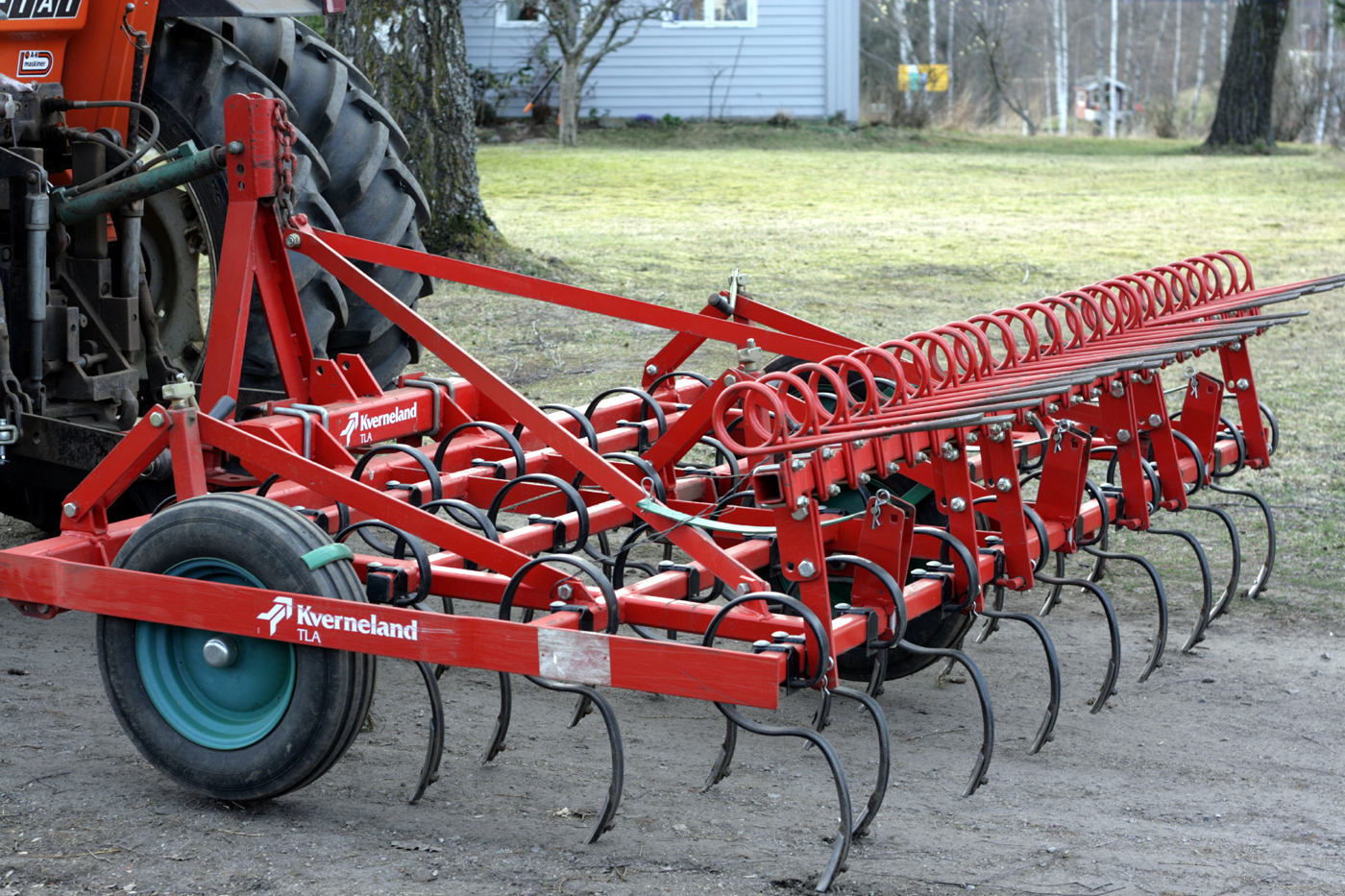
Modern Kverneland spring-tooth harrow
A 12-foot traditional style spring tooth harrow. Note how it is in four foot sections with manual levers to adjust the depth of tillage.

A spring-tooth harrow is a type of harrow, and specifically a type of tine harrow. It uses many flexible iron teeth mounted in rows to loosen the soil before planting.

A drag harrow more specifically refers to a largely outdated type of soil cultivation implement that is used to smooth the ground as well as loosen it after it has been plowed and packed. It uses many flexible iron teeth usually arranged into rows. It is set on the ground and pulled and cannot be backed up. It has no hydraulic functionality and has to be raised/adjusted with one or multiple manual levers. It was originally pulled by draft animals and later adapted to tractors. It is a largely outdated piece of farm equipment, having been replaced by more modern tillage equipment, however, smaller farmers still use them.[1]

Uses

[edit]

A drag harrow is used to loosen and even out soil after it has been plowed and packed. The drag harrow also kills some weeds that may be present, but it is not very efficient in doing so, and it is not one of its primary functions.

In modern times

[edit]

The non-hydraulic drag harrow is not often used in modern farming as other harrows have proven to be more suitable, such as the disc harrow. Another reason they are not often used is because they cannot be controlled hydraulically, meaning that the operator is required to dismount from the tractor to adjust it or unclog it. However it is used as a drag behind several other implements such as a rod weeder. Due to their low cost and simplicity, old fashioned are still widely used by small farmers.[1]

See also

[edit]

Drag harrows can be a name used for several different types of equipment. A spike tooth harrow or flex harrow is often called a drag harrow and is in use extensively throughout the US for seedbed preparation and for grooming grassland pastures. See also:

References

[edit]
[edit]
Revisions and contributorsEdit on WikipediaRead on Wikipedia
from Grokipedia
A spring-tooth harrow is an agricultural implement consisting of a rigid frame equipped with multiple rows of flexible, curved tines made from , designed to loosen, aerate, and level soil while minimizing damage from rocks or roots. These tines, typically mounted on square steel bars and secured with heavy clamps and bolts, allow the harrow to penetrate the soil surface to a controlled depth, breaking up clods and preparing a smooth for planting such as forages or pastures. Primarily used as a secondary tool following plowing or disking, it excels in conventional farming practices on small to medium-sized fields, where it helps incorporate residues, control light weeds, and improve without excessive compaction. Patented in 1869, the spring-tooth harrow marked a significant advancement in farm machinery, enabling more efficient seedbed preparation and replacing earlier rigid-tooth cultivators in many operations by the 1870s. Modern versions, often available in widths from 6 to 26 feet and configured as pull-type, , or cart-mounted units, feature adjustable depth controls, abrasion-resistant skid shoes, and heat-treated components for durability in varied conditions. While horse-drawn models were common historically, contemporary spring-tooth harrows are typically tractor-pulled, offering versatility for tasks like leveling plowed fields or maintaining established crops such as by lightly scratching the surface to manage weeds. Its flexible design reduces operator effort and equipment wear compared to rigid spike-tooth harrows, making it a staple in sustainable systems that balance with productivity.

History

Invention and Early Development

The spring-tooth harrow emerged in the 1860s as an innovative solution to the challenges of tilling rough, stony soils, where traditional rigid wooden or iron tines frequently broke or became obstructed by rocks and roots, necessitating constant repairs and halting fieldwork. This development addressed the limitations of earlier harrows, which were ill-suited for the uneven terrain common in parts of the , allowing farmers to maintain productivity without frequent interruptions. A pivotal advancement came with the patent issued to David L. Garver of , on October 5, 1869, for an improved harrow design featuring flexible spring teeth made from . Garver, a former cabinetmaker who had settled in Michigan's rocky farmlands in 1863, drew from his experiences replacing damaged wooden tines to create this tool, which used resilient iron elements to withstand impacts. The patent emphasized the teeth's ability to flex and rebound upon striking obstacles, preventing breakage and enabling smoother operation across varied ground conditions. Early prototypes of the spring-tooth harrow incorporated curved, springy teeth fashioned from flat strips or adapted leaf springs, approximately 4 feet long, 2 inches wide, and 1/4 inch thick, bent into a to absorb shocks from stones and while loosening effectively. These teeth extended about 5-6 inches below the frame and were positioned to incline forward, promoting self-clearing and re-entry into the after deflection. Initially deployed as animal-drawn implements in rocky regions such as the eastern and , the design proved particularly valuable for preparing fields in areas with abundant obstructions, marking a shift toward more durable and efficient practices.

Adoption and Evolution

Following its patenting in 1869, the spring-tooth harrow experienced rapid adoption across North America during the 1870s and 1880s, particularly for post-plowing soil preparation in rocky and uneven terrains where rigid harrows often failed. Farmers valued its flexible teeth for breaking clods and leveling seedbeds without frequent clogging or damage from stones, making it a staple in regions like the eastern United States. Key innovations drove this expansion, notably from manufacturers like Acme, which patented a refined version in by Frederick Nishwitz of Brooklyn, New York. By the late , harrows were commonly built in multiple sections—such as four 3-foot units forming a 12-foot-wide tool—to enhance maneuverability while maintaining coverage. Refinements in the early focused on and mounting for superior . Increased curvature improved penetration and residue flow, reducing drag in heavy or trashy conditions. By the 1920s, the harrow evolved from draft animal-pulled versions to tractor-mounted configurations, with chain-link attachments linking sections for greater flexibility over contours. This boosted efficiency, enabling larger-scale operations before the widespread shift to disc harrows in the mid-20th century.

Design

Components

The frame of a spring-tooth harrow is constructed from rigid or sectional bars, typically spanning 8 to 20 feet in width to accommodate various field scales and capacities, and includes hitch points for attachment to draft animals or . The primary working elements are the teeth, which consist of curved, flexible tines fabricated from high-carbon for resilience and elasticity. These tines are wide and flat, often oil-tempered to enhance durability, and shaped in a semi-circular or inverted C-form to enable vibration and penetration into the . Tines often feature replaceable points or sweeps for different tasks. The teeth are mounted in multiple staggered rows across the frame, promoting uniform disturbance and coverage without gaps. Attachment mechanisms employ bolts, pins, or clips to secure the tines to the frame bars, facilitating individual tooth replacement as needed. Teeth are angled for optimal entry, with the design allowing flex upon impact with rocks or roots to avoid breakage. Optional weights may be added to the frame to adjust based on conditions.

Types and Variations

Spring-tooth harrows are classified into two main configurations based on mounting and power source: drag and mounted types. Drag harrows are non-powered implements trailed behind or draft animals, relying on manual angle adjustments via levers or quadrants to control working depth and tooth . These designs allow the harrow sections to follow contours flexibly, making them suitable for basic preparation and leveling on varied landscapes. Mounted harrows, in contrast, attach directly to a 's , typically Category II, providing greater control and stability during operation. Later models incorporate hydraulic systems for precise depth adjustment, enabling operators to raise or lower the implement from the cab without stopping. This configuration supports heavier sections and wider coverage, often with lift arms and chains that enhance ground-following capability on uneven fields. Specialized variations adapt the spring-tooth design for specific conditions and tasks. Lightweight pasture harrows feature flexible, open-end sections with gentle tines ideal for and in established grass without disturbing the layer. Heavy-duty versions employ stiffened frames and oil-tempered, heat-treated teeth for deeper in rocky fields, where the flexible tines deflect around obstructions to prevent breakage. Chain-spring hybrids integrate spring tines with chain mats or webbed elements, offering added flexibility for breaking up compacted and distributing residues in hybrid farming systems. Spring-tooth harrows are categorized by size to match operational scale, from small units (4-8 feet wide) suited for gardens and plots, to medium sizes (10-15 feet) for small farms requiring moderate coverage, and large models (20+ feet) for commercial use with wheeled carts or foldable frames. These dimensions typically consist of modular sections with 7-12 teeth each, allowing customization based on power and field requirements.

Uses and Operation

Primary Applications

The spring-tooth harrow serves as a key secondary tillage implement in , primarily employed after primary plowing to loosen and aerate , thereby breaking down clods and enhancing in compacted or rocky conditions. Its flexible spring teeth allow effective penetration into hard and stony soils where rigid tools might shatter or fail, promoting better root penetration and water infiltration without excessive disturbance. This application is particularly valuable in preparing fields for subsequent operations, as the harrow's flexibility handles uneven adeptly. In seedbed preparation, the spring-tooth harrow levels and smooths the surface, creating an optimal environment for planting various crops, including forages, pastures, and row crops, by reducing surface irregularities and incorporating fine . It is commonly used in the final stages of to produce a firm, even that supports uniform and , especially in moderately compacted soils. The tool also facilitates the incorporation of crop residues, such as stubble, or amendments like fertilizers into the layer, achieving shallow mixing without deep inversion that could disrupt . This process aids in residue decomposition and nutrient distribution while maintaining surface cover for . Due to its resilience, the spring-tooth harrow excels in challenging terrains like stony or root-filled fields, where it outperforms inflexible implements by navigating obstacles at typical operating speeds of 4-6 mph.

Techniques

Operating a spring-tooth harrow involves specific adjustment procedures to optimize performance for different soil conditions and tasks. The tooth angle is adjusted to control penetration depth, with a shallower angle suitable for light harrowing to aerate the surface without excessive disturbance, and a steeper angle for deeper tillage to break up compacted layers. Additional weights can be added to the frame to enhance tooth penetration in heavier or drier soils, ensuring effective soil loosening. In the field, operators typically make overlapping passes at 45-degree angles to achieve uniform coverage and avoid missed strips, promoting even soil tilth. For preparing fine seedbeds, multiple light passes are recommended, gradually refining the surface while minimizing soil structure damage. During use, regular maintenance is essential to sustain efficiency, particularly after encountering rocky terrain where teeth may bend or break; operators should inspect and straighten or replace affected teeth promptly. Hitch points and other require periodic lubrication to reduce wear and ensure smooth operation. Speed and depth control are critical for effective results, with an optimal working depth of 1-3 inches to loosen adequately without burying residue too deeply. Operators must avoid harrowing wet soils at excessive speeds or depths, as this can lead to compaction and smearing that harms .

Advantages and Limitations

Benefits

The spring-tooth harrow's flexible teeth, typically made of oil-tempered , allow them to deflect and yield upon encountering obstacles such as rocks or , significantly reducing the risk of breakage and minimizing compared to rigid spike-tooth harrows. This design makes it particularly suitable for operations in rough, stony soils where other tools might fail or require frequent repairs. In terms of cost-effectiveness, used or entry-level spring-tooth harrows can be obtained for under $1,000, making them accessible for small-scale farmers, while their simple construction and shallow operating depth (typically ½–1½ inches) result in minimal consumption and lower operational costs compared to more intensive equipment like flame weeders. For , the harrow's gentle, shallow action preserves overall by pulverizing clods and incorporating crop residues into the without excessive disturbance, which helps enhance and improve water infiltration while reducing risks in fragile ecosystems. Its versatility enables multiple uses across a single season, from initial breakup and weed root uprooting to final finishing and light cultivation, adapting well to various crops like grains and through adjustable tine angles and depths. This adaptability supports efficient field preparation in diverse conditions, including rocky terrains.

Drawbacks

Despite their utility in certain tillage scenarios, spring-tooth harrows, particularly traditional models, present several drawbacks that limit their efficiency and practicality in some agricultural operations. One primary limitation is the associated with their operation and upkeep in basic designs; manual adjustments are required for setup, often necessitating operators to exit the and physically configure the implement, which is physically demanding and time-consuming. Additionally, frequent tooth replacements are necessary in heavy-use conditions due to wear on the spring tines and tips, as these components are prone to breakage on extremely rough or rocky terrains with large rocks, making the harrow less ideal for high-volume farming where must be minimized. Another challenge in older models is the limited precision in tillage depth and uniformity without hydraulic systems; the rigid frame and spring action can result in inconsistent penetration, leading to uneven soil working on sloped or undulating fields. This lack of depth control in basic versions restricts operations to the upper 6 inches (15 cm) of soil on previously plowed land, hindering effective incorporation of residues or amendments. In terms of , spring-tooth harrows are inefficient against deep-rooted perennials, as their action primarily disrupts shallow, herbaceous annuals while struggling with heavy residues or stubble that can clog the tines and reduce contact. Compared to disc harrows, they offer inferior performance in cutting and burying tough, deep-rooted weeds, as the spring teeth rather than slice through dense , limiting their effectiveness in residue-heavy fields. Finally, traditional spring-tooth harrows are susceptible to accelerated wear and require more frequent maintenance than powered alternatives equipped with and . Modern designs as of 2025 often incorporate hydraulic controls and durable components to mitigate these issues. Their higher traction resistance also increases fuel consumption compared to disc harrows, exacerbating operational costs in large-scale operations.

Modern Usage

Current Practices

In contemporary , spring-tooth harrows find niche applications among small organic farms for low-impact secondary , where they loosen and aerate the top 1–3 inches of without significant inversion, preserving and microbial activity essential for organic systems. Their Soil Tillage Intensity Rating of 15.6 indicates minimal disturbance, making them suitable for preparing seedbeds and controlling small weeds in and production on limited acreage. Hobbyists and small-scale operators often employ these harrows in combination with no-till strategies, such as rotational systems that manage residues and weeds while reducing overall frequency to maintain . Modern adaptations have enhanced the practicality of spring-tooth harrows for and field operations, including hydraulic folding mechanisms that allow quick reconfiguration between working and road modes. For instance, Hillco Technologies introduced pull-arm designs in 2022, replacing traditional cables to enable efficient folding and unfolding, thereby reducing labor and improving during movement across larger farms. In developing regions, animal-drawn versions of spring-tooth or similar spike-tooth harrows persist, particularly on small upland farms averaging 3 hectares in parts of such as the and , where they support secondary cultivation. These implements, often locally fabricated from and steel spikes, are pulled by draft animals like to break clods, level seedbeds, and perform light weeding for crops including , , and . In , analogous flexible tooth harrows complement animal traction systems in conservation tillage, aiding smallholders in areas with limited mechanization. Since the 2000s, spring-tooth harrows have been integrated with complementary tools for sustainable farming, such as rod weeders for enhanced weed uprooting up to 8 inches deep and rollers to manage residues in no-till organic systems. This pairing allows for shallow passes that pluck small weeds and incorporate mulch without excessive soil disruption, as seen in vegetable production where harrows follow rolling to organize residues for subsequent cultivation.

Alternatives

In modern agriculture, several tillage implements have largely supplanted the spring-tooth harrow due to their enhanced performance in preparation and integration with advanced farming practices. Disc harrows, featuring rotating concave discs, provide faster and deeper in even soils compared to traditional tine-based tools, enabling more efficient residue incorporation and loosening in a single operation. High-speed disc variants, in particular, support one-pass up to 8 inches deep, significantly reducing the number of field passes needed relative to multi-step spring-tooth operations. Power harrows, powered by PTO-driven rotary tines, excel at creating fine, level seedbeds with uniform crumbling, making them preferable for precise planting in heavier soils where spring-tooth harrows may leave uneven surfaces. These tools offer superior weed incorporation by mixing residues thoroughly into the upper soil layer, and many models include hydraulic depth and angle controls for adaptable operation. Chisel plows and field cultivators provide deeper —often to 12 inches or more—while minimizing surface disruption and preserving cover, aligning with conservation tillage goals that reduce and improve . Unlike spring-tooth harrows, which primarily work the , these implements shatter compacted layers without full inversion, leaving 15-30% residue on the surface for better moisture retention and protection. The shift toward these alternatives accelerated since the , driven by the rise of conservation systems that enhance overall efficiency through fewer equipment passes, lower fuel use, and reduced labor demands compared to conventional methods like spring-tooth harrowing. Additionally, disc harrows, power harrows, and chisel plows integrate seamlessly with precision farming technologies, such as GPS-guided variable-rate applications and automated depth adjustments, allowing site-specific that optimizes inputs based on variability and needs. This compatibility has further diminished reliance on less adaptable tools like the spring-tooth harrow in commercial operations.

References

Add your contribution
Related Hubs
User Avatar
No comments yet.