Hubbry Logo
Harrow (tool)Harrow (tool)Main
Open search
Harrow (tool)
Community hub
Harrow (tool)
logo
8 pages, 0 posts
0 subscribers
Be the first to start a discussion here.
Harrow (tool)
Harrow (tool)
from Wikipedia
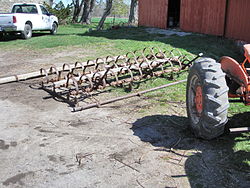
A spring-tooth drag harrow
Disc harrows
Crumbler roller, commonly used to compact soil after it has been loosened by a harrow
Clydesdale horses pulling spike harrows, Murrurundi, New South Wales, Australia

In agriculture, a harrow is a farm implement used for surface tillage. It is used after ploughing for breaking up and smoothing out the surface of the soil. The purpose of harrowing is to break up clods and to provide a soil structure, called tilth, that is suitable for planting seeds. Coarser harrowing may also be used to remove weeds and to cover seed after sowing.

Harrows differ from ploughs, which cut the upper 12 to 25 centimetre (5 to 10 in) layer of soil, and leave furrows, parallel trenches. Harrows differ from cultivators in that they disturb the whole surface of the soil, while a cultivator instead disturbs only narrow tracks between the crop rows to kill weeds.

There are four general types of harrows: disc harrows, tine harrows (including spring-tooth harrows, drag harrows, and spike harrows), chain harrows, and chain-disk harrows. Harrows were originally drawn by draft animals, such as horses, mules, or oxen, or in some times and places by manual labourers. In modern practice they are almost always tractor-mounted implements, either trailed after the tractor by a drawbar or mounted on the three-point hitch.

A modern development of the traditional harrow is the rotary power harrow, often just called a power harrow.[1]

Harrow action

[edit]

In modern mechanized farming, generally a farmer will use two harrows, one after the other. The disk harrow is used first to slice up the large clods left by the mould-board plough, followed by the spring-tooth harrow. To save time and fuel they may be pulled by one tractor; the disk hitched to the tractor, and the spring-tooth hitched to, and directly behind, the disk. The result is a smooth field with powdery dirt at the surface.

Types

[edit]
An ox-drawn harrow in a painting from Yanju's tomb, located in Jiuquan, 5th century AD

In cooler climates, the most common types are the disc harrow, the chain harrow, the tine harrow or spike harrow and the spring tine harrow. Chain harrows are often used for lighter work, such as leveling the tilth or covering the seed, while disc harrows are typically used for heavy work, such as following ploughing to break up the sod. In addition, there are various types of power harrow, in which the cultivators are power-driven from the tractor rather than depending on its forward motion.

Tine harrows are used to refine seed-bed conditions before planting, remove small weeds in growing crops, and loosen the inter-row soils to allow water to soak into the subsoil. The fourth is a chain disk harrow. Disks attached to chains are pulled at an angle over the ground. These harrows move rapidly across the surface. The chain and disk rotate to stay clean while breaking up the top surface to about 1 inch (3 cm) deep. A smooth seedbed is prepared for planting with one pass.

Harrowing with tractor and disk harrow in the 1940s)

Chain harrowing can be used on pasture land to spread dung and break up dead material (thatch) in the sward. Similarly, in sports-ground maintenance, light chain harrowing is often used to level off the ground after heavy use to remove and smooth out boot marks and indentations. Used on tilled land in combination with the other two types, chain harrowing rolls remaining larger soil clumps to the surface, where weather breaks them down and prevents interference with seed germination.

All four harrow types can be used in one pass to prepare soil for seeding. Using any combination of two harrows for various tilling processes is also common. Where harrowing provides a very fine tilth or the soil is very light so that it might easily be wind-blown, a roller is often added as the last of the set.

Harrows may be of several types and weights, depending on their purpose. They almost always consist of a rigid frame that holds discs, teeth, linked chains, or other means of moving soil—but tine and chain harrows are often only supported by a rigid towing bar at the front of the set.

In the southern hemisphere, so-called giant discs are a specialised kind of disc harrows that can stand in for a plough in rough country where a mouldboard plough cannot handle tree stumps and rocks, and a disc-plough is too slow (because of its limited number of discs). Giant scalloped-edged discs operate in a set, or frame, that is often weighted with concrete or steel blocks to improve penetration of the cutting edges. This cultivation is usually followed by broadcast fertilisation and seeding rather than drilled or row seeding.

A drag is a heavy harrow.

19th century spike harrows

Power harrow

[edit]

A rotary power harrow, or simply a power harrow, has multiple sets of vertical tines. Each set of tines is rotated on a vertical axis and tills the soil horizontally. The result is that, unlike a rotary tiller, soil layers are not turned over or inverted, which is useful in preventing dormant weed seeds from being brought to the surface, and there is no horizontal slicing of the subsurface soil that can lead to hardpan formation.[2]

Historical reference

[edit]
Spike harrow depicted on a 16th-century German coat-of-arms

In Europe, harrows were used in antiquity[3] and the Middle Ages.[4]

In China, the rake had appeared by the Han dynasty (202 BC – 220 AD). The rake developed into other implements such as the harrow by the end of the Han dynasty. Two kinds of tined harrows were known during the Han dynasty, the flat harrow known as the pa, which was used throughout China in both wet and dry fields, and the vertical harrow known as the chao, which was only used in wet rice fields in the south. The pa is depicted three times in the murals of Jiayuguan dating to the Wei-Jin period (220–316) while the earliest known representation of the chao is a pottery model from a grave in Guangdong dated between 310 and 312.[5] The harrow was mentioned in the Chinese agricultural text Qimin Yaoshu (Essential Techniques for the Welfare of the People) written by the Northern Wei (386–535) official Jia Sixie. The harrow was used as a farm implement for breaking up soil chunks as well as eradicating weeds, suppressing pests, and diseases. The text describes the harrow as an iron-teeth rake that could take the form of a strip, Y-shape, or square. Most of the Wei and Jin harrows were strip shaped. Another type of harrow replaced the iron teeth with canes and brambles.[6]

See also

[edit]

References

[edit]

Bibliography

[edit]
[edit]
Revisions and contributorsEdit on WikipediaRead on Wikipedia
from Grokipedia
A harrow is an agricultural implement designed to till the surface, breaking up clods and lumps, leveling the field, incorporating residues or amendments, and controlling weeds to prepare a for planting. Typically pulled by a , draft animal, or mounted on machinery, it operates at shallow depths compared to plows, focusing on surface refinement rather than deep inversion of layers. Harrows are essential in production for improving , enhancing water infiltration, and promoting even seed germination. The evolution of the harrow reflects broader advancements in agricultural . In early American farming before 1820, primitive harrows included brush drags made from tree crotches and straight-tooth designs with wooden pegs inserted into frames. By the 1830s, teeth replaced wood for greater durability, marking a shift toward more robust tools. Significant innovations followed with the of the in 1869, which allowed flexible teeth to navigate uneven and rocky s without breaking, and the in the 1870s, which used rotating concave discs for efficient residue incorporation. These developments increased efficiency in soil preparation, supporting the expansion of large-scale farming in the United States. Harrows are classified into several types based on and function, each suited to specific conditions and tasks. Disc harrows feature sets of sharp-edged, concave metal discs mounted on horizontal shafts, ideal for cutting through tough residues, breaking clods, and burying weeds in heavier soils. Tine or tooth harrows, including spike-tooth and spring-tine variants, use rigid or flexible metal teeth to lightly rake the surface, level , and cover seeds without excessive disturbance. Chain harrows employ interconnected chains or links dragged across the field to aerate pastures, spread , and renovate turf with minimal inversion. Additionally, power harrows or rotary harrows, driven by power , mix and residues in the top few inches for fine preparation in organic or conservation systems. Selection of a harrow type depends on factors such as , residue levels, and the desired intensity.

Overview

Definition

A harrow is an agricultural implement designed for secondary , typically consisting of a heavy frame equipped with disks, tines, or chains that mechanically manipulate the surface. It is primarily used to break up clods left after plowing, level the field, and incorporate crop residues or amendments into the , thereby preparing a suitable while managing residue and controlling weeds. Unlike a plow, which performs primary by inverting the layers to bury residues and weeds while bringing deeper to the surface, a harrow operates more shallowly and does not invert the ; instead, it disturbs only the upper layer to refine the without significant burial or turnover. The term "harrow" likely derives from an word *hearwa, referring to a heavy wooden rake used to break up , akin to its function as an agricultural tool.

Primary Functions

The primary function of a harrow in is to aerate the and crumble clods, thereby reducing compaction and creating a fine ideal for preparation. By mechanically disturbing the upper layers, harrows loosen compacted areas that restrict air movement, promoting better oxygenation of the root zone without the need for deep . This process breaks down large aggregates formed after plowing, resulting in a crumbly texture that facilitates and early growth. Harrows also play a key role in and incorporation, uprooting emerging weeds and mixing plant debris into the soil to enhance and prevent . The tines or discs of a harrow slice through shallow-rooted weeds, disrupting their growth cycle, while simultaneously burying residues to stimulate microbial activity and nutrient recycling. This incorporation helps maintain levels, reducing and wind risks in prepared fields. Additionally, harrows level and smooth the surface, achieving uniformity that supports even planting depths and distribution. This smoothing action eliminates ridges and depressions left by primary , ensuring consistent contact between seeds and for optimal establishment. As a secondary benefit, these functions improve water infiltration by increasing porosity and enhance penetration, allowing crops to access and nutrients more effectively in the upper profile.

Design and Components

Basic Structure

A harrow's frame forms the foundational , typically constructed from rigid or flexible metal components such as beams or tubular sections, to endure the mechanical stresses and soil resistance during operation. Rigid frames, often square or rectangular in , provide stability for heavier-duty models, while flexible frames incorporate hinged or articulated sections to conform to uneven . These constructions utilize high-strength to ensure durability against torsional forces and impacts. The working elements of a standard harrow consist of tines, discs, or chains securely attached to the frame, with provisions for adjusting spacing and angles to optimize interaction. Tines are generally spring-loaded or rigid arranged in rows, spaced 5-10 cm apart, allowing for aggressive penetration or gentle leveling. In disc harrows, discs comprise concave blades, typically 40-60 cm in , mounted in with 15-25 cm spacing between blades and adjustable gang angles of 15-25 degrees for varying intensity. Chains form interconnected links in a configuration, offering flexibility without fixed spacing requirements. These elements are bolted or welded to crossbars on the frame for secure assembly. Attachment mechanisms enable integration with power sources, featuring a system compatible with categories I-III for modern trailed or mounted harrows, which includes lift arms, a top link, and hydraulic controls for raising and lowering. For animal-pulled variants, a drawbar connection at the front of the frame facilitates via chains or yokes. These mechanisms ensure stable pulling and maneuverability during field use. Harrow designs scale with operational needs, featuring typical weights ranging from 50 to 500 kg for small to medium units, which balances portability and effectiveness, and working widths of 1 to 10 meters to cover varying field sizes efficiently. Adaptations in these elements appear in specific harrow types, such as tine flexibility in tine models.

Key Variations in Design

Harrows feature both fixed and adjustable designs to accommodate varying conditions, including levels that influence effectiveness. Fixed designs maintain a constant tine depth or disc angle, typically set at 18 to 20 degrees for consistent operation in uniform soils, providing simplicity and lower maintenance for smaller-scale or traditional applications. In contrast, adjustable designs incorporate mechanisms such as hydraulic or manual levers to alter tine penetration or disc inclination, enabling operators to increase depth in drier soils for better clod breakup or reduce it in moist conditions to prevent compaction and enhance selectivity in . These adjustments optimize performance across soil types, with working depth directly manipulating covering and uprooting efficiency based on content. Traction methods significantly influence harrow design, with animal-drawn variants emphasizing lightweight construction for ease of pulling by draft animals. These typically use simple frames made from mild steel, often in a T-shaped configuration weighing under 100 kg to minimize animal strain while covering small fields up to 1-2 hectares. Tractor-mounted or trailed harrows, suited for larger operations, feature heavier, reinforced frames capable of supporting widths over 5 meters and incorporating hydraulic systems for precise control of , angle, and lift. This allows for dynamic adjustments during operation, such as varying to contour uneven , contrasting the static pull of animal systems. Material evolution in harrows has progressed from wooden frames with wrought or teeth in the , which offered basic durability but were prone to breakage on rocky soils, to modern high-strength alloys that enhance and reduce overall weight. Early wooden and iron components, common by the 1850s, transitioned to discs in the for improved cutting efficiency, while contemporary designs employ heat-treated or high-carbon alloys for tines and discs, resisting in abrasive conditions and lowering fuel consumption through lighter frames. Modern harrows integrate features to mitigate risks during field use and , including protective guards around rotating elements like discs or tines to prevent entanglement or debris projection. Foldable sections, often hydraulically operated, allow wings or gangs to collapse for road travel, reducing width from over 10 meters in working mode to under 3 meters for compliance with regulations and safer maneuvering. These adaptations, combined with locks and slow-moving , ensure operator protection and equipment stability across scales.

Types

Tine Harrows

Tine harrows, also known as tooth harrows, utilize protruding tines to penetrate and agitate the surface, making them versatile implements for secondary in . These tools are particularly suited for light to medium work, where they break up clods, level the ground, and incorporate residues without excessive disturbance. Common variants include spike tooth and spring tooth designs, each offering distinct mechanisms for interaction. Spike tooth harrows feature rigid, peg-shaped tines arranged in staggered rows on a frame, typically with spacing of 2-6 between tines and overall widths ranging from 6 to 75 feet. The tines, often 10-20 in length, are slanted rearward to minimize clogging and provide aggressive crumbling action on heavy soils by stirring the surface to a depth of 1-1.5 inches. This design excels at pulverizing soil aggregates and creating a smooth finish, particularly after primary tillage. In contrast, spring tooth harrows employ flexible, semi-circular tines—typically with diameters of 9-13 mm (3/8-1/2 inch)—mounted in rows with 6-12 inch spacing, allowing each tine to move independently under load. These tines flex upon encountering resistance, enabling effective weed pulling by uprooting seedlings and breaking clods through a pulling action, while limiting penetration to 1-6 inches to avoid deep inversion. This flexibility makes them suitable for working around emerging crops without causing significant damage. Tine harrows offer advantages such as cost-effectiveness due to their simple construction and low power requirements—typically 5-6 horsepower per foot of width—and ease of maneuverability in field operations. However, they are less effective on soils, where rigid spike tines may catch or bend, and flexible spring tines risk excessive breakage or uneven performance. Typical use cases for tine harrows include post-plow finishing to refine the surface and seedbed preparation for row crops like corn or soybeans, where they improve seed-to-soil contact and control early emergence. In organic systems, they also support mechanical by dislodging small seedlings at the 2-3 stage.

Disc Harrows

Disc harrows are agricultural implements featuring concave, circular blades mounted on gangs, designed to slice, cut, and mix layers while incorporating residues. These tools excel in heavy-duty tasks such as primary and secondary , where their slicing action effectively breaks up clods and buries more thoroughly than tine-based alternatives. Typically pulled by , disc harrows operate by rotating the discs at an to the direction of travel, allowing them to penetrate and invert for improved and residue management. Disc harrows are classified into single-action and tandem (or double-action) types based on gang configuration. In single-action models, two disc gangs are arranged end-to-end to cut and throw soil in the same direction, suitable for lighter tillage in smaller fields. Tandem disc harrows, by contrast, feature two or more gangs—often offset or staggered in an X-shape—where front gangs throw soil one way and rear gangs throw it oppositely, promoting thorough soil inversion and mixing. Disc diameters commonly range from 40 to 60 cm for tractor-drawn models, with concave shapes enhancing penetration; larger diameters (up to 60 cm) handle heavier soils, while spacing between discs (typically 20-25 cm) influences the fineness of tilth. The core of a is the assembly, consisting of multiple sets of discs mounted on sturdy via hangers and spacers. Each includes sealed or greasable bearings to facilitate smooth rotation under load, and scrapers positioned adjacent to discs to prevent buildup and clogging by clearing from the concave surfaces. is critical: bearings require regular (every 50-100 hours of use) to avoid wobbling or , while scrapers must be adjusted to maintain close contact without excessive wear; neglected components can lead to uneven or damage. Disc harrows are particularly suited to heavy clay soils, where their aggressive cutting action breaks up compacted clods and effectively, preparing fields for planting. They excel at incorporating green manures by chopping and burying plant material to enhance and structure, often outperforming plows in residue-heavy scenarios. In clay-heavy fields, configurations provide better sod breakdown by inverting tough root systems without excessive surface disturbance. Despite their versatility, disc harrows demand higher power—typically 30-60 hp per meter of working width—due to their resistance in dense soils, increasing fuel consumption compared to lighter implements. Overuse, especially on wet soils, can exacerbate by pulverizing aggregates and forming hardpans at depth, reducing water infiltration and root growth; limiting passes to one or two and avoiding moist conditions mitigates this risk.

Chain and Roller Harrows

Chain harrows consist of interlinked metal chains arranged in a flexible , typically forming a rectangular frame that is dragged across the surface. These harrows are primarily used in management to break up and distribute piles, promoting even and reducing parasite concentrations in grazed areas. By dragging the chains over dry manure on hot days, they facilitate faster and prevent buildup in localized spots, enhancing overall health. Additionally, chain harrows level minor surface irregularities, such as molehills, while aerating the to encourage grass growth without deep disruption. In weed management, chain harrows play a supplementary role by disturbing shallow seedlings and incorporating surface residues, though they are less effective against established weeds compared to more aggressive implements. The flexible allows the chains to conform to uneven , making them suitable for maintaining sports fields, arenas, and small-scale pastures where heavy machinery is impractical. Roller harrows feature cylindrical rollers, either smooth for compaction or spiked for additional soil penetration, with diameters commonly ranging from 300 to 600 mm (12 to 24 inches) to suit various field scales. These tools are employed post-harrowing to firm seedbeds, ensuring optimal seed-to-soil contact for improved germination rates in crops like and grasses. Smooth rollers press the evenly, conserving and creating a stable surface that reduces on light, dry soils, while spiked variants crush remaining clods and incorporate residues without excessive compaction. In organic vegetable systems, roller harrows serve as a final pass to refine the seedbed, minimizing air pockets and promoting uniform . Both and roller harrows are valued for their portability, often weighing between 20 and 100 kg, which enables attachment to all-terrain vehicles (ATVs) or small tractors on limited-acreage farms. This lightweight construction facilitates easy transport and maneuverability in confined spaces, such as paddocks or farms, where full-scale equipment is unnecessary. However, their primary limitation lies in shallow working depths—typically under 5 cm—rendering them ineffective for primary tasks like deep soil inversion or heavy clod breaking, for which they must follow more robust implements.

Power Harrows

Power harrows are motorized implements that utilize a rotary mechanism featuring vertical tines or blades to intensively prepare through simultaneous tilling and mixing. These tines, often measuring around 120 x 15 x 300 mm, are mounted on a horizontal rotor shaft driven by the tractor's (PTO) system, typically operating at rotor speeds of 200-500 RPM depending on the gearbox configuration and conditions. This rotation aerates and breaks up clods while incorporating crop residues, making it ideal for high-speed creation without excessive disturbance. Depth control in power harrows is achieved through hydraulic adjustments, allowing working depths of up to 30 cm to accommodate varying types and requirements. A multi-speed gearbox, such as 2-speed or 4-speed options rated for 540 or 1000 PTO RPM, enables variation in rotor speed for optimized performance across different terrains. These features ensure precise mixing while minimizing power demands, with integration to the tractor's facilitating easy attachment and operation. Modern power harrows incorporate advanced features like integrated seeders and crumbler rollers for efficient one-pass operations in conservation tillage systems. For instance, rear hydraulic hitches allow coupling with precision seeders, such as the GIOVE model, while adjustable tube or packer rollers break down larger clods and firm the seedbed in a single traversal. This design promotes reduced tillage passes, preserving soil structure and moisture. In terms of energy efficiency, power harrows typically consume 5-10 L/ha of , influenced by forward speed, depth, and resistance, offering lower rates compared to deeper tools. Their gentle stirring action is particularly suited to wet or sticky s, where they avoid compaction by lifting and mixing without heavy pressure, thus maintaining and drainage.

Operation and Usage

Harrowing Techniques

Harrowing techniques emphasize precise control of operational parameters to achieve effective soil refinement while minimizing compaction and risks. Optimal ground speeds typically range from 4 to 8 km/h, depending on the harrow type and conditions, as higher speeds can increase draft force and fuel consumption without proportional benefits in soil fragmentation. Depth settings should be adjusted based on , with shallower depths of 2-5 cm suitable for light, sandy soils to preserve , and deeper settings of 6-10 cm for heavy clay soils to break up compaction effectively. The number of passes is generally limited to 1-3 to avoid overworking the soil, which can lead to excessive pulverization and reduced aggregate stability, particularly in loamy soils where one or two passes suffice for adequate . Directional patterns play a critical role in sustainable harrowing, especially on sloped . Straight-line harrowing, parallel to crop rows or field boundaries, is standard for flat fields to ensure uniform coverage, but contour harrowing—following contours of the land—is recommended on slopes greater than 2% to slow runoff velocity and reduce by up to 50% compared to up-and-down methods. This technique traps water in shallow depressions formed by the harrow tines, enhancing infiltration and preventing formation during heavy rains. Timing of harrowing is ideally post-plowing, either in spring to prepare seedbeds after winter thaw or in fall to incorporate residues and mitigate weed pressure before freeze. at 50-75% of is optimal for harrowing, as drier conditions (below 50%) risk dust generation and poor clod breakage, while wetter soils (above 75-80%) cause smearing and compaction. Operators should assess moisture by the "ball test," where soil forms a crumbly ball without sticking excessively to tools. Operator safety protocols are essential to mitigate hazards during harrowing. Secure hitching to the using manufacturer-recommended pins and chains prevents detachment, with operators always dismounting the and engaging parking brakes before connecting or disconnecting implements. During operation, avoid sharp turns that could cause the harrow to ride up on the 's rear wheels, maintaining gentle arcs at speeds under 5 km/h for maneuvers; additionally, fixed guards must cover rotating parts like tines or discs to prevent clothing or limb entanglements. Pre-operation inspections for loose components and clear communication with bystanders further reduce accident risks. Specific adjustments, such as tine angles for power harrows, should align with guidelines from the types section to enhance and efficacy.

Applications in Agriculture

Harrows play a crucial role in preparation by serving as seedbed finishers, creating a fine, firm surface that promotes uniform and root development for various . In production, such as corn and , tandem disc harrows are commonly used to incorporate residues and level the after primary , ensuring a smooth seedbed that enhances seed-to-soil contact while managing weeds and clods. For , lightweight tine harrows provide shallow disturbance to produce weed-free, even beds ideal for precise planting, as seen in organic systems where they mix amendments without inverting the . In orchards, harrows facilitate under-tree management by incorporating fertilizers and controlling weeds with minimal compaction, preserving tree roots in established groves. Additionally, harrows integrate into no-till systems by lightly disturbing residues to suppress weeds and prepare planting strips, maintaining cover to support sustainable and rotations. In pasture and livestock management, harrows are essential for renovation, where they level uneven surfaces and distribute nutrients to rejuvenate grazing lands. Chain or spike-tooth harrows effectively spread manure piles during rest periods, recycling nutrients like phosphorus and potassium back into the soil, which reduces selective grazing and parasite loads by exposing eggs to sunlight. For overseeding degraded pastures, flexible tine harrows disturb the sod lightly to incorporate seeds and fertilizers, fostering regrowth of grasses and legumes for improved forage quality in livestock operations. This practice enhances soil fertility naturally, minimizing the need for external inputs in rotational grazing systems. Harrows contribute to through practices that preserve soil structure, particularly in vulnerable hilly or arid landscapes. By retaining 60-90% of crop residues on the surface, tools like flex-tine and spike-tooth harrows reduce raindrop impact and runoff, stabilizing slopes and improving water infiltration in regions prone to . In arid areas, spring disc harrows maintain residue cover to enhance moisture retention and prevent wind , supporting in semi-arid fields. These shallow operations, often combined with contour farming, help sustain productivity on hilly terrains by avoiding deep disruption that could exacerbate gullying. Regional variations in harrow applications reflect differences in mechanization levels, with widespread tractor-pulled models dominating n farms for efficient, large-scale operations in cereal and systems. In developing countries, manual or animal-drawn harrows prevail due to limited access to powered equipment, adapting for smallholder and preparation in resource-constrained settings. This contrast highlights how mechanized harrows in enable precision in no-till , while manual versions in areas like support basic soil leveling for subsistence farming.

History and Development

Ancient and Medieval Origins

The earliest evidence of harrow-like tools dates to the period, when tree branches were used to scratch and level soil surfaces after plowing. By around 3000 BCE in ancient during the Sumerian period, farmers employed simple wooden branch drags to aid in seed incorporation and weed suppression. Linguistic records in Sumerian texts reflect related practices, with terms such as ñiš gán-ùr denoting a harrow combining elements for a wooden implement dragged across fields to break clods and smooth the ground. Roman agricultural advancements elevated the harrow's design and application, introducing iron-tipped versions for enhanced durability and efficiency in breaking up compacted soil. This iron-reinforced harrow, typically a wooden frame fitted with metal points, marked a shift from purely organic drags to more robust implements suited to intensive cultivation in Mediterranean climates. In medieval , harrows achieved widespread adoption by the , evolving into heavy wooden frames—often 4 to 6 feet wide—equipped with teeth of wood, iron, or thorns, drawn by teams of oxen to refine plowed fields on expansive manorial estates. These tools were integral to the prevalent in feudal agriculture, where harrowing after seeding helped cover crops evenly, control weeds, and aerate soil, contributing to the system's overall yield improvements of up to double compared to earlier two-field rotations. Regional adaptations proliferated, including in Britain where designs featuring rows of closely spaced wooden pegs, akin to a , allowed for gentler soil working on lighter soils without excessive disturbance. This integration of harrows into manorial routines not only enhanced productivity but also supported the socioeconomic structure of by enabling surplus production for and .

Industrial and Modern Evolution

The marked a pivotal shift in harrow design, transitioning from wooden, hand-crafted implements to metal-based innovations that enhanced durability and efficiency for larger-scale farming. In the mid-19th century, the emerged as a key advancement, featuring flexible, curved metal teeth that resisted breakage in rocky or root-filled soils, with early patents appearing in the 1860s. Similarly, the was patented in 1872 by Norwegian-American inventor Ole Ringness in , utilizing concave metal discs to cut and turn soil more effectively than traditional spike or chain types, particularly in heavy clay or sod-breaking applications. These inventions, protected under U.S. patents, spurred and were produced by emerging agricultural implement manufacturers, reducing labor demands during the era's expanding crop production. The advent of tractors in the early 20th century further revolutionized harrowing by enabling the use of larger, more robust implements. Following the introduction of the tractor in 1917, farmers integrated harrows with these affordable, mass-produced machines, allowing for wider working widths—often up to 20 feet—and the incorporation of hydraulic adjustments for depth control by the 1930s. This tractor-harrow synergy boosted field coverage rates by several times compared to horse-drawn systems, facilitating the shift to intensive farming in regions like the American Midwest and European plains. In the late 20th and early 21st centuries, technologies integrated GPS guidance into modern harrows, enabling automated steering and variable-rate harrowing to optimize preparation while minimizing overlap and compaction. For instance, tandem disc harrows equipped with GPS systems allow real-time mapping of tilled areas, improving accuracy to within centimeters and supporting data-driven decisions on conditions. Concurrently, eco-friendly designs, such as those for reduced-tillage operations, have gained prominence; these lightweight, low-disturbance harrows can cut consumption by 15-30% compared to conventional deep-tillage methods, thereby lowering and preserving . Global adoption of harrows has accelerated in developing countries, where affordable tine-based models address climate challenges like erratic rainfall and soil degradation by enabling lighter, more frequent soil aeration without excessive erosion. In regions such as and , these simple, low-cost tine harrows—often animal- or small-tractor-drawn—support resilient farming practices amid rising temperatures, with market growth driven by agricultural modernization initiatives.

References

Add your contribution
Related Hubs
User Avatar
No comments yet.