Hubbry Logo
Stagmomantis limbataStagmomantis limbataMain
Open search
Stagmomantis limbata
Community hub
Stagmomantis limbata
logo
8 pages, 0 posts
0 subscribers
Be the first to start a discussion here.
Stagmomantis limbata
from Wikipedia

Stagmomantis limbata
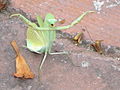
Adult female
Scientific classification Edit this classification
Kingdom: Animalia
Phylum: Arthropoda
Class: Insecta
Order: Mantodea
Family: Mantidae
Genus: Stagmomantis
Species:
S. limbata
Binomial name
Stagmomantis limbata
Hahn, 1835
Synonyms
  • Stagmomantis asteca (Saussure, 1859)
  • Stagmomantis cellularis (Burmeister, 1838)
  • Stagmomantis viridimargo (Burmeister, 1838)

Stagmomantis limbata, common name bordered mantis, bosque mantis, Arizona mantis, or New Mexico praying mantis, is a species of praying mantis native to North America, most prevalent in the south-western United States.[1][2][3][4] This beneficial insect is green or beige in color and grows up to around 3 inches long.[5]

Behavior

[edit]

Stagmomantis limbata are attracted to lights, and males often fly to lights in numbers, but females are unable to fly.[6]

Description

[edit]

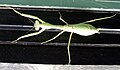
S. limbata is one of the largest mantids native to North America, though it is much smaller than some African and Asian mantids such as species in the genera Sphodromantis and Hierodula. The facial plate (below and between antennae) is about twice as wide as it is long, typical of the genus, though the eyes are not as protruding as the Carolina Mantid's. Females are most often fairly plain green (often with a yellowish abdomen), but sometimes gray, or light brown, with dark spot in middle of the tegmina, which do not completely cover the wide abdomen. Hind wings may be checkered or striped yellow.

Males are slender, long-winged, and variable in color, but most often green and brown with the sides of the folded tegmina green and top brownish (may be solid gray, brown, green, or any combination of these). Abdomen without prominent dark spots on top. The wings are transparent, usually with cloudy brownish spots on outer half.[7]

Habitat

[edit]

Variable, often in open semi-arid areas in tall forbs, shrubs, or trees, but more abundant in lusher, often riparian and wooded areas of streamsides, roadsides, canyons, in towns, etc.[8]

Range

[edit]

Texas to Southern California, north into Colorado and Utah, south into Mexico.[9]

Additional images

[edit]

See also

[edit]

References

[edit]
Revisions and contributorsEdit on WikipediaRead on Wikipedia
from Grokipedia
Stagmomantis limbata, commonly known as the bordered mantis or Arizona mantis, is a of praying mantis in the family , native to the , northern Mexico, and parts of . This univoltine completes one generation per year, with egg cases (oothecae) deposited on woody branches in late summer to fall, nymphs hatching in spring, and adults maturing by fall. As a generalist predator, it feeds on a variety of medium-sized , including flies, moths, and other arthropods, making it a beneficial in natural and agricultural ecosystems where it helps control pest populations. First described as Mantis limbata by Carl Wilhelm Hahn in 1835, the belongs to the genus Stagmomantis, which comprises about 22 recognized distributed primarily in the . Adults exhibit notable : males are slender, long-winged, and typically green with a brown pronotum, enabling greater mobility (averaging 61 cm of daily movement), while females are more robust, with variable green-to-brown coloration and lower mobility (about 34 cm per day). Both sexes measure 4–8 cm in length, with females generally larger (up to 7 cm) and developing plump abdomens for egg production. Nymphs undergo color changes during molts (typically 6–8 instars), shifting from green to brown based on environmental background, which aids in against predators such as birds, spiders, and mammals. Inhabiting diverse low-elevation environments like desert riparian zones, scrublands, and Mediterranean climates, S. limbata prefers habitat edges for oviposition, though this behavior can increase exposure to predation and by wasps like Podagrion species. The ' range includes states such as , , and in the U.S., with records extending into Central . Research highlights its adaptability, including studies on strategies, reproductive behaviors like use and , and interactions with invasive mantids such as Mantis religiosa. Despite its ecological role, edge habitats may act as "ecological traps" due to higher mortality rates for eggs and nymphs.

Taxonomy

Scientific Classification

Stagmomantis limbata belongs to the order Mantodea, a group of renowned for their predatory behavior, which has been documented since ancient times in fossil records dating back over 100 million years. The full taxonomic hierarchy is as follows:
RankClassification
KingdomAnimalia
PhylumArthropoda
ClassInsecta
OrderMantodea
Family
GenusStagmomantis (Saussure, 1869)
SpeciesStagmomantis limbata (Hahn, 1835)
The binomial name is Stagmomantis limbata Hahn, 1835, placing it within the genus Stagmomantis, which includes other North American species such as Stagmomantis carolina. This species is recognized as one of the largest native mantids in North America within the family Mantidae.

Synonyms and Etymology

The binomial name Stagmomantis limbata was first established when the species was described by Carl Wilhelm Hahn in 1835 as Mantis limbata, based on specimens from . The genus Stagmomantis was subsequently erected by de Saussure in 1869 to include this species and others with similar morphology, marking a key taxonomic reorganization within the family. Subsequent revisions, such as those by Morgan Hebard in the early and more recent synoptic reviews, have confirmed the current placement while addressing nomenclatural stability. Several junior synonyms have been recognized for S. limbata over time, primarily due to early descriptions based on limited specimens exhibiting morphological variations such as color differences or subtle structural traits that were later deemed intraspecific. These include Stagmomantis asteca (Saussure, 1859), described from material but synonymized upon comparison of types showing overlap in key characters like pronotal structure; Stagmomantis cellularis (Burmeister, 1838), originally noted for cellular wing patterns now considered variant; and Stagmomantis viridimargo (Burmeister, 1838), which emphasized green margins but was consolidated as a color morph. These synonymies were formalized in mid-20th-century catalogs and persist in current , ensuring nomenclatural consistency.

Description

Morphology

Stagmomantis limbata adults exhibit sexual size dimorphism, with females averaging 57 mm in body length (range 44–69 mm) and males averaging 46 mm (range 39–55 mm). The body is elongate and segmented into head, , and , typical of mantids in the order Mantodea. The head is triangular and highly mobile, featuring large compound eyes positioned laterally for wide-field vision and three ocelli arranged in a triangle for light detection. Antennae arise from between the eyes, serving primarily for chemoreception through sensory setae. The is elongated and flexible, allowing the head to swivel independently, with the pronotum forming a saddle-like dorsal divided into prozone and metazone regions. The forelegs, attached to the , are specialized for prey capture; the femora bear rows of spines including anteroventral, posteroventral, and discoidal sets, while the tibiae feature opposing spines and a terminal spur that interlock with femoral spines to secure prey. The meso- and metathorax support the wings: forewings (tegmina) are leathery and narrow, extending along the sides of the body, while hindwings are membranous, folded fan-like beneath the tegmina when at rest. The is segmented into 11 visible parts, flexible for expansion during oviposition in females.

Color and

_Stagmomantis limbata adults display a spectrum of coloration ranging from and to brown and gray, enabling adaptation to diverse visual environments. Females typically exhibit more uniform coloration within individuals, often appearing as solid or shades of gray to brown across the body. In contrast, males show greater variability, frequently combining bodies with brown pronota or presenting in solid gray, brown, , or mixed hues. This sexual color dimorphism reflects differences in individual homogeneity, with females displaying higher between-individual variation (standard deviation = 0.090) compared to males (standard deviation = 0.037), while males exhibit higher within-individual variation (standard deviation = 0.091 versus 0.045 for females). Sexual dimorphism extends to structural features that complement coloration patterns. Females are larger and more robust, with shorter wings that render them flightless and tegmina often featuring a prominent dark spot in the middle. Males, being slimmer, possess longer, fully developed wings that facilitate flight; their hindwings are transparent and typically bear cloudy brownish spots on the outer half. These traits distinguish the sexes beyond size, aiding in identification. The observed coloration and dimorphism likely serve adaptive roles in within arid landscapes. Males' heterogeneous, generalist coloration supports across varied backgrounds due to their higher mobility, whereas females' more homogeneous, specialist hues match specific substrates given their sedentary nature post-mating. This divergence in strategies aligns with sex-specific behaviors and environmental pressures.

Distribution and Habitat

Geographic Range

Stagmomantis limbata is native to the , with documented occurrences from westward to and northward to and . In this region, the species is particularly abundant in states such as and . Its range extends southward into , where it has been recorded in multiple states including , , , and . The distribution continues through , reaching as far south as and . Some records extend the range to , though these may represent the southern limit of its natural occurrence. As a native species, S. limbata shows no evidence of historical range expansions or contractions in recent studies, maintaining a stable presence within its documented boundaries. Range limits appear influenced by climatic preferences for semi-arid zones, which align with the species' distribution across arid and semi-arid landscapes in its native regions. Within this range, it is occasionally observed in lusher riparian areas along streamsides.

Habitat Preferences

Stagmomantis limbata thrives in open semi-arid environments across its range, favoring areas with abundant vegetation such as tall forbs, shrubs, and scattered trees that provide perching sites for ambush predation. These mantises exhibit a strong preference for lusher microhabitats within otherwise arid landscapes, where they are most commonly observed perching on stems and branches to hunt. Such sites include riparian zones along rivers and streams, which offer higher moisture levels and denser foliage compared to surrounding dry scrub. The species shows particular affinity for habitat edges, such as those between cottonwood-dominated floodplains and mesquite grasslands or desert scrub, where densities of egg cases are significantly higher than in habitat interiors. These transitional zones, often found in canyons, roadsides, and urban peripheries, provide structural complexity that enhances crypsis and prey availability. S. limbata also occurs in modified landscapes like residential gardens, where it exploits diverse plant substrates for concealment. Abiotic conditions play a key role in habitat suitability, with S. limbata tolerating the hot, dry summers and cool, wet winters typical of Mediterranean climates in the . However, survival and abundance are closely tied to moisture-rich spots, such as riparian corridors, which mitigate risks in arid regions and support prey populations. This reliance on localized underscores the species' adaptation to heterogeneous environments where dry expanses are punctuated by vegetated refugia.

Behavior and Ecology

Locomotion and Predation

Stagmomantis limbata exhibits limited locomotion as a solitary , typically remaining stationary on to minimize detection while awaiting prey. females possess reduced wings and are flightless, restricting their mobility to short walks, whereas males have functional wings enabling flight, particularly at night when they are often drawn to artificial lights in search of mates. In field observations, males cover greater daily distances (approximately 61 cm) compared to females (about 34 cm), reflecting their higher mobility. Predation in S. limbata relies on a sit-and-wait , where individuals perch motionless on , leveraging to blend with foliage or bark for surprise attacks. This cryptic posture allows them to passing , followed by a rapid strike using their specialized forelegs, which are adapted with spines to secure captured prey. The ' color variations—ranging from to —enhance this , with females often displaying more uniform tones suited to specific backgrounds. Activity patterns are primarily diurnal, with and occurring during daylight hours, as evidenced by field studies conducted in the morning to afternoon. Males' nocturnal flights contrast with this daytime predation focus, aiding dispersal and mate location without interfering with hunting routines.

Diet and Interactions

Stagmomantis limbata is a carnivorous predator with generalist feeding habits, primarily consuming arthropods such as (Gryllodes sigillatus) and other within an optimal size range of approximately 0.50–1.93 cm. Larger females exhibit a broader diet breadth and preferentially capture longer prey items compared to smaller females, allowing them to exploit a wider variety of available resources in the field. As opportunistic predators, they target any suitably sized moving , including flies, moths, and grasshoppers, demonstrating non-selective predation that contributes to their adaptability across habitats. In ecological contexts, S. limbata serves as a beneficial agent in biological control by reducing populations of agricultural and garden pests, such as caterpillars and other herbivorous insects, through its voracious appetite. However, this non-selective nature also leads to predation on beneficial arthropods, including pollinators like bees and butterflies, potentially limiting its utility in targeted pest management programs. The species' feeding efficiency varies with body size and seasonal prey availability, influencing its overall impact on local arthropod communities. Ecological interactions of S. limbata include and , which structure populations in size-dependent manners and affect dynamics among co-occurring predators. For instance, larger individuals may prey upon smaller conspecifics or other mantid , promoting size-based hierarchies within trophic levels. These behaviors enhance resource competition resolution but can also lead to higher mortality in juvenile stages, underscoring the ' role in complex predator-prey networks.

Reproduction and Life Cycle

Mating Behaviors

Males of Stagmomantis limbata locate receptive females primarily through sex pheromones emitted by the females, who remain largely stationary in their habitats. Field experiments demonstrate that pheromones attract males over long distances, with covered enclosures containing females drawing in significantly more males than those with control items like or empty setups. Male arrivals peak in the hours immediately following sunrise, and well-fed females, characterized by thicker abdomens, attract more suitors than poorly fed ones, suggesting pheromones may honestly signal female condition. Upon detecting a , males approach with extreme caution due to the risk of , often freezing in place and tilting their heads sideways to monitor her movements while inching forward slowly. This "stop-and-go" tactic can take several hours, during which males antennate the to assess receptivity. displays are subtle, relying more on pheromonal cues than visual signals, though males may exhibit abdominal bending similar to calling behaviors observed in related mantids; or prominent wing fanning has not been documented specifically for this species. , with males being smaller and more slender than , facilitates this stealthy navigation around the larger female. Once mounted, copulation in S. limbata is notably prolonged, often lasting several hours—observations record durations exceeding four hours—to maximize transfer and paternity assurance, particularly given males' limited lifetime opportunities (typically only one successful copulation despite encountering multiple females). Males preferentially mount from the rear to minimize exposure to the female's forelegs, a behavioral that reduces cannibalism risk. occurs in approximately 20% of male-female contact encounters, with poorly fed females more prone to consuming the male during or after , though rates vary with female nutritional state and encounter context.

Development Stages

_Stagmomantis limbata exhibits incomplete (hemimetaboly), characteristic of the order Mantodea, progressing through , nymphal, and adult stages without a pupal phase. Females deposit s within protective oothecae, which are foam-like structures attached to and containing dozens to over 100 s per case. In temperate portions of its range, these oothecae overwinter, enduring cold periods before hatching occurs in late spring or early summer. Upon hatching, nymphs emerge en masse, dispersing rapidly to avoid ; they are predatory from the first , feeding on small insects such as and flies. Nymphs undergo 5 to 7 molts to reach maturity, with males typically completing development in 5 (9%) or 6 (91%) instars and females in 6 (64%) or 7 (36%) instars, depending on intra-clutch variation that may serve as a bet-hedging strategy in unpredictable environments. Each molt increases body size and wing development, with final-stage nymphs displaying rudimentary wings. Adult emergence aligns with summer and early autumn, following a total nymphal development period of about 64 days under controlled conditions at moderate temperatures. Development accelerates in warmer conditions, reducing instar durations, while cooler temperatures prolong the process; in natural settings, the full life cycle from egg to adult spans roughly 6 to 12 months. Adults, particularly females, may persist into winter in milder climates before succumbing to senescence.

References

Add your contribution
Related Hubs
User Avatar
No comments yet.