
Hubbry Logo
Stochastic discount factorStochastic discount factorMain
Open search
Stochastic discount factor
Community hub
Stochastic discount factor
logo
7 pages, 0 posts
0 subscribers
Be the first to start a discussion here.
Stochastic discount factor
from Wikipedia

The concept of the stochastic discount factor (SDF) is used in financial economics and mathematical finance. The name derives from the price of an asset being computable by "discounting" the future cash flow by the stochastic factor , and then taking the expectation.[1] This definition is of fundamental importance in asset pricing.

If there are n assets with initial prices at the beginning of a period and payoffs at the end of the period (all xs are random (stochastic) variables), then SDF is any random variable satisfying

The stochastic discount factor is sometimes referred to as the pricing kernel as, if the expectation is written as an integral, then can be interpreted as the kernel function in an integral transform.[2] Other names sometimes used for the SDF are the "marginal rate of substitution" (the ratio of utility of states, when utility is separable and additive, though discounted by the risk-neutral rate), a "change of measure", "state-price deflator" or a "state-price density".[2]

Properties

[edit]

The existence of an SDF is equivalent to the law of one price;[1] similarly, the existence of a strictly positive SDF is equivalent to the absence of arbitrage opportunities (see Fundamental theorem of asset pricing). This being the case, then if is positive, by using to denote the return, we can rewrite the definition as

and this implies

Also, if there is a portfolio made up of the assets, then the SDF satisfies

By a simple standard identity on covariances, we have

Suppose there is a risk-free asset. Then implies . Substituting this into the last expression and rearranging gives the following formula for the risk premium of any asset or portfolio with return :

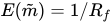
This shows that risk premiums are determined by covariances with any SDF.[1]

See also

[edit]

References

[edit]
Revisions and contributorsEdit on WikipediaRead on Wikipedia
from Grokipedia
The stochastic discount factor (SDF), also known as the pricing kernel, is a positive in that adjusts future asset payoffs for both time value and under , serving as the core mechanism in no-arbitrage models. It is formally defined such that the price ptp_t of any asset at time tt equals the of the product of the SDF mt+1m_{t+1} and the future payoff xt+1x_{t+1}, i.e., pt=Et[mt+1xt+1]p_t = E_t[m_{t+1} x_{t+1}], where the expectation incorporates available at time tt. This framework unifies the of diverse assets, from and bonds to , by linking prices directly to economic fundamentals like consumption and investor preferences. In theory, the SDF extends classical discounting by incorporating elements to account for state-contingent risk, ensuring that the holds and opportunities are absent. It derives from the first-order conditions of investor optimization, representing the intertemporal (IMRS), such as mt+1=βu(ct+1)u(ct)m_{t+1} = \beta \frac{u'(c_{t+1})}{u'(c_t)} in consumption-based models, where β\beta is the subjective discount factor and uu' is . For power utility functions, this simplifies to mt+1=β(ct+1/ct)γm_{t+1} = \beta (c_{t+1}/c_t)^{-\gamma}, with γ\gamma denoting , highlighting how consumption growth influences risk premia. The SDF's positivity is crucial, as it implies the existence of an equivalent martingale measure for risk-neutral valuation. Historically, the SDF concept emerged from no-arbitrage foundations in the 1970s, building on works by Ross (1976) and Harrison and Kreps (1979), and was integrated with risk preferences by Rubinstein (1976) and Lucas (1978). It provides a general representation that encompasses specific models like the (CAPM), where the SDF is linear in the market return, and multifactor models such as Fama-French. Empirically, the SDF framework facilitates testing via the (GMM), though challenges like the underscore the need for volatile yet mean-stable SDFs to match observed Sharpe ratios. Bounds such as the Hansen-Jagannathan inequality, σ(m)/E(m)E(Re)/(1+Rf)\sigma(m)/E(m) \geq |E(R^e)| / (1 + R_f), quantify the required SDF volatility to explain risk premia.

Definition and Interpretation

Formal Definition

In the single-period asset pricing model, consider an economy where assets deliver payoffs XX at time t+1t+1, contingent on the realization of states of the world, with prices pp determined at time tt based on information available up to tt. The stochastic discount factor (SDF), denoted mt+1m_{t+1}, is defined as a positive random variable such that the price of any payoff Xt+1X_{t+1} is given by pt=Et[mt+1Xt+1],p_t = \mathbb{E}_t \left[ m_{t+1} X_{t+1} \right], where Et[]\mathbb{E}_t[\cdot] denotes the conditional expectation under the physical probability measure P\mathbb{P} given the information filtration at time tt. This formulation establishes mt+1m_{t+1} as the state-price density, pricing state-contingent claims directly; for instance, the price of an Arrow-Debreu security that pays one unit in a specific state ss at t+1t+1 and zero otherwise is π(s)=mt+1(s)P(s)\pi(s) = m_{t+1}(s) \mathbb{P}(s), where P(s)\mathbb{P}(s) is the physical probability of state ss. For an asset with price pt=1p_t = 1 at time tt and payoff Xt+1X_{t+1} at t+1t+1, the gross return is Rt+1=Xt+1/pt=Xt+1R_{t+1} = X_{t+1}/p_t = X_{t+1}, yielding the one-period equation Et[mt+1Rt+1]=1.\mathbb{E}_t \left[ m_{t+1} R_{t+1} \right] = 1. This holds for any traded asset return Rt+1R_{t+1}, reflecting the no-arbitrage condition in expectation form. For the risk-free asset, which delivers a payoff of Rt+1fR^f_{t+1} in every state (assuming price 1 at tt), the equation simplifies to Et[mt+1]=1Rt+1f,\mathbb{E}_t \left[ m_{t+1} \right] = \frac{1}{R^f_{t+1}}, providing the pricing of the through the unconditional expectation of the SDF. The SDF mt+1m_{t+1} also serves as the building block for the Q\mathbb{Q}, defined via the Radon-Nikodym derivative dQdP=mt+1Et[mt+1]\frac{d\mathbb{Q}}{d\mathbb{P}} = \frac{m_{t+1}}{\mathbb{E}_t[m_{t+1}]} on the t+1t+1-period sigma-algebra. To derive the under Q\mathbb{Q}, consider any gross return Rt+1R_{t+1} with 1 at tt. Under P\mathbb{P}, Et[mt+1Rt+1]=1\mathbb{E}_t[m_{t+1} R_{t+1}] = 1. Substituting the change of measure, EtQ[Rt+1]=Et[mt+1Et[mt+1]Rt+1]=Et[mt+1Rt+1]Et[mt+1]=1Et[mt+1]=Rt+1f,\mathbb{E}_t^{\mathbb{Q}} \left[ R_{t+1} \right] = \mathbb{E}_t \left[ \frac{m_{t+1}}{\mathbb{E}_t[m_{t+1}]} R_{t+1} \right] = \frac{\mathbb{E}_t[m_{t+1} R_{t+1}]}{\mathbb{E}_t[m_{t+1}]} = \frac{1}{\mathbb{E}_t[m_{t+1}]} = R^f_{t+1}, implying that all gross returns have expectation equal to the gross risk-free rate under Q\mathbb{Q}, or equivalently, discounted asset prices (divided by the cumulative risk-free return) are martingales under this measure. This equivalence highlights the SDF's role in transforming expectations from the physical to the for purposes.

Economic Interpretation

The stochastic discount factor (SDF), often denoted as mm, serves as a pricing kernel that encapsulates both intertemporal discounting and risk adjustment in economic decision-making. It represents the product of a deterministic time discount factor β\beta, which reflects investors' impatience or time preference for consumption today over tomorrow, and a stochastic marginal rate of substitution (MRS) that captures the variability in investor preferences across uncertain future states of the world. This decomposition highlights how the SDF adjusts asset prices not only for the passage of time but also for the economic risks inherent in different outcomes, providing a unified way to value contingent claims. In economic terms, the SDF plays a crucial role in determining , where higher values of mm in adverse states—such as those with low consumption growth or elevated —lead to higher implied prices for assets that deliver payoffs precisely in those states. This mechanism embodies , as investors demand greater compensation for bearing in economically challenging scenarios, effectively making safe assets relatively more expensive and risky ones cheaper in expectation. The SDF thus facilitates intertemporal by linking current pricing decisions to expected future trade-offs, motivating the conceptual form mt+1=βu(ct+1)u(ct)m_{t+1} = \beta \frac{u'(c_{t+1})}{u'(c_t)}, where uu denotes the function and cc consumption, illustrating how ratios drive pricing under . The concept of the SDF emerged as a unifying framework in , with Ross (1976) formalizing its role in deriving linear pricing rules from no-arbitrage conditions via the (APT) to address limitations in traditional models like the CAPM. Hansen and Richard (1987) further introduced the SDF in a dynamic setting, emphasizing its use in deducing testable restrictions from conditioning information, thereby providing a general tool to reconcile diverse implications without relying on specific equilibrium assumptions.

Theoretical Foundations

No-Arbitrage Derivation

The no-arbitrage principle underpins the existence of the (SDF) in financial markets. The first states that a market is free of opportunities if and only if there exists at least one equivalent under which the discounted prices of traded assets are martingales. This measure, known as the risk-neutral or equivalent martingale measure QQ, ensures that the price ptp_t of any traded asset at time tt equals the under QQ of its discounted future payoff Xt+1X_{t+1}, normalized by the risk-free return RfR_f: pt=1RfEQ[Xt+1]p_t = \frac{1}{R_f} E^Q[X_{t+1}]. In this framework, the SDF mt+1m_{t+1} emerges as a positive that represents the Radon-Nikodym derivative linking the physical measure PP to QQ, scaled by the risk-free factor: dQdP=mt+1Rf\frac{dQ}{dP} = m_{t+1} R_f. To derive the SDF explicitly, consider a complete market with a finite discrete state space consisting of SS possible states s=1,,Ss = 1, \dots, S, each occurring with positive physical probability ps>0p_s > 0 under measure PP, where s=1Sps=1\sum_{s=1}^S p_s = 1. In such a setting, no-arbitrage implies the existence of unique ψs>0\psi_s > 0 (also called Arrow-Debreu prices) for each state, such that the pp of any payoff XX with realization XsX_s in state ss is given by p=s=1SψsXsp = \sum_{s=1}^S \psi_s X_s. The SDF is then defined state-by-state as ms=ψs/psm_s = \psi_s / p_s, ensuring positivity since both ψs\psi_s and psp_s are positive. Substituting into the pricing yields the SDF representation: p=s=1SpsmsXs=E[mX],p = \sum_{s=1}^S p_s m_s X_s = E[m X], where the expectation is under the physical measure PP. For the risk-free asset with payoff 1 and 1/Rf1/R_f, this implies 1/Rf=E1/R_f = E, normalizing the SDF to reflect time value and risk adjustment. In , where not all contingent claims can be replicated by traded assets, the SDF is no longer unique. No-arbitrage still guarantees the existence of a positive linear functional on the of traded payoffs, but multiple SDFs may price these assets correctly, each corresponding to different extensions to non-traded payoffs. The set of valid SDFs forms a consisting of all strictly positive random variables m satisfying E[mXj]=pjE[m X_j] = p_j for all traded payoffs XjX_j with prices pjp_j. While the functional is unique for payoffs within the span of traded assets (via the projection of any valid SDF onto that space), for non-traded payoffs outside this span, no-arbitrage imposes bounds on possible prices: the minimum and maximum values of E[mX]E[m X] over all valid SDFs m. The SDF framework is equivalent to risk-neutral pricing, as the change-of-measure directly connects the two. Specifically, the equation under the SDF becomes E[mX]=EQ[XRf],E[m X] = E^Q \left[ \frac{X}{R_f} \right], derived by substituting m=1RfdQdPm = \frac{1}{R_f} \frac{dQ}{dP} into the left-hand side and using the definition of the expectation under QQ. This equivalence holds in both complete and , with the SDF providing a unified representation that embeds the martingale property of discounted prices under QQ.

Consumption-Based Formulation

In representative agent models of , the stochastic discount factor emerges from the agent's under expected maximization and . The representative agent maximizes expected lifetime Ets=0βsu(ct+s)\mathbb{E}_t \sum_{s=0}^\infty \beta^s u(c_{t+s}), where β(0,1)\beta \in (0,1) is the subjective discount factor and u()u(\cdot) is a strictly increasing, strictly concave period utility function. The first-order condition for optimal consumption and portfolio choice yields the Euler equation: for any asset with price ptp_t and payoff xt+1x_{t+1}, u(ct)pt=Et[βu(ct+1)xt+1]u'(c_t) p_t = \mathbb{E}_t [\beta u'(c_{t+1}) x_{t+1}]. Rearranging gives the pricing relation Et[mt+1xt+1]=pt\mathbb{E}_t [m_{t+1} x_{t+1}] = p_t, where the stochastic discount factor is mt+1=βu(ct+1)u(ct)m_{t+1} = \beta \frac{u'(c_{t+1})}{u'(c_t)}, representing the intertemporal in consumption. Specific functional forms of the utility function determine the explicit expression for mt+1m_{t+1}. For constant relative risk aversion (CRRA) or power , u(c)=c1γ1γu(c) = \frac{c^{1-\gamma}}{1-\gamma} with γ>0\gamma > 0, the marginal is u(c)=cγu'(c) = c^{-\gamma}, so mt+1=β(ct+1ct)γm_{t+1} = \beta \left( \frac{c_{t+1}}{c_t} \right)^{-\gamma}. This form links asset prices directly to consumption growth, with higher γ\gamma implying greater sensitivity to consumption risk. For constant absolute risk aversion (CARA) or exponential , u(c)=1γeγcu(c) = -\frac{1}{\gamma} e^{-\gamma c} with γ>0\gamma > 0, the marginal is u(c)=eγcu'(c) = e^{-\gamma c}, yielding mt+1=βeγ(ct+1ct)m_{t+1} = \beta e^{-\gamma (c_{t+1} - c_t)}. This specification is less common in macroeconomic models due to its implications for absolute risk levels but useful in settings with additive separability. To separate risk aversion from the elasticity of intertemporal substitution, Epstein-Zin recursive preferences define via Vt=[(1β)ct1γ11/ψ+βEt[Vt+11γ]11/ψ1γ]11/ψ1γV_t = \left[ (1-\beta) c_t^{\frac{1-\gamma}{1-1/\psi}} + \beta \mathbb{E}_t [V_{t+1}^{1-\gamma}]^{\frac{1-1/\psi}{1-\gamma}} \right]^{\frac{1-1/\psi}{1-\gamma}}, where ψ>0\psi > 0 is the elasticity of substitution and γ>0\gamma > 0 is risk aversion. The resulting SDF is mt+1=β(ct+1ct)1ψ(Rw,t+1)θ1m_{t+1} = \beta \left( \frac{c_{t+1}}{c_t} \right)^{-\frac{1}{\psi}} \left( R_{w,t+1} \right)^{\theta - 1}, with θ=1γ11/ψ\theta = \frac{1-\gamma}{1-1/\psi} and Rw,t+1R_{w,t+1} the return on the agent's wealth portfolio. These consumption-based formulations have significant implications for explaining asset return puzzles. In calibrating a Lucas exchange economy with power utility to U.S. from 1889–1978, Mehra and Prescott found that matching the observed historical equity premium of approximately 6% requires a risk aversion parameter γ\gamma between 10 and 40. However, such high γ\gamma implies a low elasticity of intertemporal substitution, inconsistent with the observed volatility of consumption growth (standard deviation around 1–2% annually), highlighting the . In a general equilibrium setting with complete markets, such as an Arrow-Debreu economy, the SDF serves as the shadow price of consumption goods across states and time. It equals the representative agent's between current and future consumption in each state, ensuring that asset prices clear the market by equating for contingent claims.

Mathematical Properties

Positivity and Normalization

The stochastic discount factor mm, also known as the pricing kernel, must satisfy the positivity condition m>0m > 0 to preclude opportunities and ensure that are positive across all possible states of the world. This requirement stems directly from the , which equates the absence of with the existence of a strictly positive linear functional on the space of contingent claims. If mm were negative with positive probability in some state, an investor could construct an by short-selling assets with payoffs positively correlated with that state while investing in assets that pay off in other states, yielding a nonnegative payoff with a positive and zero cost. Such positivity guarantees that no portfolio delivers a sure positive payoff without risk or cost, aligning the SDF with economically meaningful intertemporal marginal rates of substitution. A key normalization condition for the SDF is that its unconditional expectation equals the inverse of the gross risk-free return, E=1/RfE = 1/R_f, where RfR_f denotes the one-period gross . This arises from applying the general SDF pricing equation to the risk-free asset, which has a price of 1 and a certain payoff of RfR_f, yielding 1=E[mRf]=RfE1 = E[m R_f] = R_f E. The normalization encapsulates the , where 1/Rf1/R_f represents the pure discount for time passage in a risk-free setting, while deviations in mm across states adjust for and economic uncertainty. This condition anchors the SDF to observable , facilitating derivations of the as Rf=1/ER_f = 1/E and ensuring consistency in multi-asset pricing frameworks. The Hansen-Jagannathan bound imposes a fundamental restriction on the second moments of the SDF, stating that σ(m)EsupE[Re]σ(Re),\frac{\sigma(m)}{E} \geq \sup \frac{|E[R^e]|}{\sigma(R^e)}, where the supremum is taken over all excess returns ReR^e (returns in excess of the risk-free rate), and equality holds if and only if the excess return is the mean-variance efficient portfolio achieving the maximum Sharpe ratio. This bound highlights the minimal volatility required for the SDF to price observed asset returns accurately, linking asset risk premia directly to the variability of intertemporal marginal rates of substitution. It serves as a benchmark for evaluating asset pricing models, as any valid SDF must satisfy this volatility bound. In complete markets, where spanning assets replicate any , the SDF is unique and fully determined by no-arbitrage conditions. In contrast, admit a continuum of valid SDFs, all of which price the traded assets correctly but differ in their implications for untraded risks. Among these, the minimal relative SDF—minimized subject to constraints—provides a reference, as it corresponds to the least informative prior consistent with observed prices and has desirable statistical properties for estimation.

Martingale and Projection Properties

In asset pricing theory, the stochastic discount factor (SDF), denoted as mt+1m_{t+1}, plays a central role in establishing the martingale property under the risk-neutral measure QQ. Specifically, under the equivalent martingale measure QQ, the discounted prices of traded assets form martingales, meaning that the expected value of the discounted future price equals the current price. This property ensures no-arbitrage opportunities, as any deviation would allow riskless profits. The SDF serves as the density process, or Radon-Nikodym derivative dQdP\frac{dQ}{dP}, that transforms the physical measure PP into the risk-neutral measure QQ, adjusting for risk preferences and thereby linking observed prices to risk-adjusted expectations. In , where not all risks can be hedged using traded assets, the SDF is not unique, leading to a projection interpretation for . The true SDF can be projected onto the span of payoffs from traded assets, minimizing the mean-squared errors for those assets. This projection yields the unique pricing kernel consistent with observed asset prices, while the orthogonal component captures unhedgeable risks. The Hansen-Jagannathan distance measures the extent of this misspecification by quantifying the minimal distance between a candidate SDF proxy and the space of valid SDFs that price the assets correctly, providing a bound on model inadequacy. The representation connects expected excess returns to the SDF, forming the basis for beta pricing models. For an excess return ReR^e, the expected excess return satisfies E[Re]=RfCov(m,Re)E,E[R^e] = -R_f \frac{\mathrm{Cov}(m, R^e)}{E}, where RfR_f is the . This implies that expected returns compensate for the between the asset return and the SDF, with negative indicating assets that pay off when (reflected in the SDF) is high, thus bearing . In dynamic settings, the time-series properties of the SDF ensure intertemporal consistency. The conditional expectation satisfies Et[mt+1]=1/Rf,tE_t[m_{t+1}] = 1/R_{f,t}, derived from the pricing for the risk-free asset, which guarantees that the one-period risk-free payoff is correctly discounted under the conditional information available at time tt. This normalization links the SDF across periods, maintaining the martingale structure in multi-period models.

Asset Pricing Applications

Single-Period Pricing Equations

In a single-period asset pricing model, the stochastic discount factor (SDF) mt+1m_{t+1} prices any asset with payoff xt+1x_{t+1} at time tt according to the fundamental equation pt=Et[mt+1xt+1],p_t = E_t \left[ m_{t+1} x_{t+1} \right], where ptp_t denotes the time-tt price. This relation derives from no-arbitrage conditions and holds universally for traded claims. For a risk-free bond with payoff xt+1=1x_{t+1} = 1, the price is pt=1/(1+rf,t)p_t = 1 / (1 + r_{f,t}), yielding Et[mt+1]=1/(1+rf,t)E_t [ m_{t+1} ] = 1 / (1 + r_{f,t}). For stocks, the payoff is xt+1=dt+1+pt+1x_{t+1} = d_{t+1} + p_{t+1}, where dt+1d_{t+1} is the dividend and pt+1p_{t+1} the ex-dividend price. For options, such as a European call, the payoff is xt+1=max(St+1K,0)x_{t+1} = \max(S_{t+1} - K, 0), with St+1S_{t+1} the underlying price and KK the strike. Defining gross returns as Ri,t+1=xi,t+1/pi,tR_{i,t+1} = x_{i,t+1} / p_{i,t}, the pricing equation simplifies to Et[mt+1Ri,t+1]=1E_t [ m_{t+1} R_{i,t+1} ] = 1 for any asset ii. Taking expectations and using the risk-free pricing gives Et[Ri,t+1]=(1+rf,t)(1Covt(mt+1,Ri,t+1)Et[mt+1]),E_t [ R_{i,t+1} ] = (1 + r_{f,t}) \left( 1 - \frac{ \operatorname{Cov}_t ( m_{t+1}, R_{i,t+1} ) }{ E_t [ m_{t+1} ] } \right), or equivalently, the risk premium is Et[Ri,t+1](1+rf,t)=(1+rf,t)Covt(mt+1,Ri,t+1)E_t [ R_{i,t+1} ] - (1 + r_{f,t}) = - (1 + r_{f,t}) \operatorname{Cov}_t ( m_{t+1}, R_{i,t+1} ). Assets covarying negatively with the SDF command positive risk premia, as low SDF states (high marginal utility) coincide with high payoffs. The capital asset pricing model (CAPM) arises as a special case when the SDF is linearly affine in the market return Rm,t+1R_{m,t+1}, i.e., mt+1=abRm,t+1m_{t+1} = a - b R_{m,t+1}, reflecting the market portfolio's mean-variance efficiency. Substituting into the risk-free pricing yields abEt[Rm,t+1]=1/(1+rf,t)a - b E_t [ R_{m,t+1} ] = 1 / (1 + r_{f,t}). The general risk premium formula becomes Et[Ri,t+1](1+rf,t)=b(1+rf,t)Covt(Rm,t+1,Ri,t+1)E_t [ R_{i,t+1} ] - (1 + r_{f,t}) = b (1 + r_{f,t}) \operatorname{Cov}_t ( R_{m,t+1}, R_{i,t+1} ). Applying this to the market itself gives Et[Rm,t+1](1+rf,t)=b(1+rf,t)Vart(Rm,t+1)E_t [ R_{m,t+1} ] - (1 + r_{f,t}) = b (1 + r_{f,t}) \operatorname{Var}_t ( R_{m,t+1} ), so b=[Et[Rm,t+1](1+rf,t)]/[(1+rf,t)Vart(Rm,t+1)]b = [ E_t [ R_{m,t+1} ] - (1 + r_{f,t}) ] / [ (1 + r_{f,t}) \operatorname{Var}_t ( R_{m,t+1} ) ]. Thus, Et[Ri,t+1](1+rf,t)=βi,t[Et[Rm,t+1](1+rf,t)]E_t [ R_{i,t+1} ] - (1 + r_{f,t}) = \beta_{i,t} [ E_t [ R_{m,t+1} ] - (1 + r_{f,t}) ], where βi,t=Covt(Rm,t+1,Ri,t+1)/Vart(Rm,t+1)\beta_{i,t} = \operatorname{Cov}_t ( R_{m,t+1}, R_{i,t+1} ) / \operatorname{Var}_t ( R_{m,t+1} ). The (APT) generalizes CAPM to multiple systematic factors by assuming a multifactor linear SDF mt+1=abft+1m_{t+1} = a - \mathbf{b}' \mathbf{f}_{t+1}, where ft+1\mathbf{f}_{t+1} is a vector of factor returns or innovations. The is then Et[Ri,t+1](1+rf,t)=(1+rf,t)bCovt(ft+1,Ri,t+1)E_t [ R_{i,t+1} ] - (1 + r_{f,t}) = (1 + r_{f,t}) \mathbf{b}' \operatorname{Cov}_t ( \mathbf{f}_{t+1}, R_{i,t+1} ). Defining the factor loadings Bi,t=Covt(ft+1,Ri,t+1)Σf,t1\mathbf{B}_{i,t} = \operatorname{Cov}_t ( \mathbf{f}_{t+1}, R_{i,t+1} ) \Sigma_{f,t}^{-1}, where Σf,t=Covt(ft+1,ft+1)\Sigma_{f,t} = \operatorname{Cov}_t ( \mathbf{f}_{t+1}, \mathbf{f}_{t+1} ), and the factor risk premia λt=(1+rf,t)Σf,tb\boldsymbol{\lambda}_t = (1 + r_{f,t}) \Sigma_{f,t} \mathbf{b}, yields Et[Ri,t+1](1+rf,t)=Bi,tλtE_t [ R_{i,t+1} ] - (1 + r_{f,t}) = \mathbf{B}_{i,t}' \boldsymbol{\lambda}_t. Pricing occurs through covariances with the factors, without requiring a . These formulations imply key cross-sectional relations across assets. In CAPM, the (SML) graphs expected returns linearly against betas, with steeper slopes indicating higher market risk premia. The mean-variance frontier consists of portfolios minimizing variance for given expected returns, equivalent to returns most correlated with the SDF's projection onto the space of marketed payoffs. In the multifactor case, the frontier generalizes to hyperplanes in factor-beta space, capturing diversified risks via SDF projections.

Multi-Period and Continuous-Time Extensions

In multi-period settings, the stochastic discount factor (SDF) framework extends to dynamic through iterated conditional expectations, where the price at time tt of a payoff xnx_n at future time nn satisfies pt=Et[mt,nxn]p_t = E_t [m_{t,n} x_n], with mt,nm_{t,n} denoting the cumulative SDF from tt to nn. This cumulative SDF is constructed as the product of successive one-period SDFs, mt,n=k=tn1mt+k,t+k+1m_{t,n} = \prod_{k=t}^{n-1} m_{t+k, t+k+1}, enabling recursive valuation across horizons. Such formulations imply term structure effects, as the multi-period SDF incorporates compounding risk adjustments, leading to horizon-dependent kernels that reflect long-run risk exposures in Markov environments. In continuous-time extensions, the SDF takes the form of an exponential martingale under models, expressed as St=exp(0trsds0tλsdWs120tλs2ds),S_t = \exp\left( -\int_0^t r_s \, ds - \int_0^t \lambda_s \, dW_s - \frac{1}{2} \int_0^t \lambda_s^2 \, ds \right), where rsr_s is the instantaneous , λs\lambda_s represents the market price of risk, and WsW_s is a . This structure arises from differential equations governing state variables, ensuring the SDF remains a and facilitates pricing via change of measure techniques in . The market price of risk λs\lambda_s captures the compensation for risks, linking intertemporal preferences to asset dynamics over intervals. Affine term structure models further specify the SDF in continuous time as exp(at+btyt)\exp(a_t + b_t' y_t), where yty_t is a vector of state variables following an , and ata_t, btb_t are deterministic functions. Bond prices under this SDF admit closed-form solutions of the form exp(A(t)+B(t)yt)\exp(A(t) + B(t)' y_t), with coefficients A(t)A(t) and B(t)B(t) solved via ordinary differential equations known as generalized Riccati equations, such as ddtψY(t,u)=RY(ψY(t,u),eβZtw),\frac{d}{dt} \psi_Y(t, u) = R_Y(\psi_Y(t, u), e^{\beta_Z t w}), with initial conditions tied to maturity uu. Yields are then affine in the states, yt(u)=A(t,u)+B(t,u)ytuy_t(u) = -\frac{A(t,u) + B(t,u)' y_t}{u}, enabling tractable analysis of dynamics and premia in term structure modeling. The long-run risks model of and Yaron integrates predictability into the SDF by incorporating persistent shocks to expected consumption growth and time-varying volatility. The one-period SDF is given by mt+1=θlogδθψgt+1+(θ1)ra,t+1,m_{t+1} = \theta \log \delta - \frac{\theta}{\psi} g_{t+1} + (\theta - 1) r_{a,t+1}, where θ=1γ11/ψ\theta = \frac{1 - \gamma}{1 - 1/\psi} reflects Epstein-Zin preferences with γ\gamma and intertemporal substitution ψ\psi, gt+1g_{t+1} is consumption growth, and ra,t+1r_{a,t+1} is the return on the consumption claim. Consumption growth follows gt+1=μ+xt+σtηt+1g_{t+1} = \mu + x_t + \sigma_t \eta_{t+1}, with xtx_t a persistent predictor (ρ=0.979\rho = 0.979) and σt2\sigma_t^2 fluctuating volatility (ν1=0.987\nu_1 = 0.987), allowing the multi-period SDF to price assets by amplifying compensation for long-horizon uncertainties. This setup explains equity premia and return volatility through correlated shocks to growth and uncertainty.

Empirical Analysis and Testing

Estimation Techniques

One prominent econometric approach to estimating the stochastic discount factor (SDF) involves the (GMM), which exploits moment conditions derived from equations. In this framework, parameters θ of a parameterized SDF m(θ) are estimated by minimizing the sample analogue of the moment conditions E[g(θ)] = 0, where g(θ) incorporates the pricing restrictions E[m(θ) R_t - 1] = 0 for a set of gross asset returns R_t spanning the payoff space. This minimization is achieved via a quadratic form g_N(θ)' W g_N(θ), with weighting matrix W typically chosen as the inverse of the asymptotic of g_N(θ) for ; the resulting is consistent and asymptotically normal under standard regularity conditions. Overidentification tests, such as the J-statistic J = n g_N(\hat{θ})' \hat{S}^{-1} g_N(\hat{θ}) \sim \chi^2(K - L), assess model specification, where n is the sample size, K the number of moment conditions, and L the number of parameters. Nonparametric methods offer flexibility by avoiding parametric assumptions on the SDF form, often relying on the cross-section of returns to infer m directly. Kernel estimation techniques approximate the SDF by smoothing the empirical distribution of returns to satisfy the pricing conditions E[m R] = 1, typically minimizing a distance measure like the conditional Hansen-Jagannathan bound while estimating the joint of returns via kernel estimators. For instance, local polynomial or Nadaraya-Watson kernels can recover the pricing kernel from high-dimensional return data, providing insights into its shape without imposing linearity. Complementing this, projection-based approaches infer the SDF as its minimum-variance projection onto the space spanned by the returns and the constant 1, equivalent to the return on the mean-variance efficient tangency portfolio scaled to satisfy normalization; this yields the unique admissible SDF that prices the observed assets with the lowest second moment. Cross-sectional regression methods, such as the Fama-MacBeth procedure, indirectly estimate the implied SDF by linking observed risk premia to factor exposures. In the first pass, time-series regressions estimate of test assets on common factors, followed by a second-pass cross-sectional regression of excess returns on these to recover factor risk premia λ; the SDF is then inferred as m ≈ 1 - ∑ λ_j β_j, where the linear structure reflects the factor model's implications. This two-step approach accounts for cross-sectional variation in expected returns and provides standard errors via time-series variability of the λ estimates, enabling tests of whether premia align with economic risk measures. Time-series approaches using (VAR) models capture the conditional nature of the SDF by incorporating predictability in returns and higher moments. A VAR system on observables like dividends, consumption, or wealth variables generates conditional expectations and variances, from which the conditional SDF is estimated—often as m_{t+1} = E_t[β u'(C_{t+1}) / u'(C_t)], with parameters fit via GMM on conditional moment conditions derived from the VAR innovations. For example, innovations from a VAR on consumption-wealth ratios can proxy conditional market prices of risk, allowing the SDF to vary with business-cycle predictors like the cay variable. This method highlights time-varying risk compensation but requires careful specification to avoid in the conditioning information. Recent advances as of 2025 incorporate and alternative sources to enhance SDF estimation. For instance, frameworks like NewsNet-SDF use pretrained embeddings from news articles combined with adversarial networks to estimate SDFs, achieving substantial improvements in pricing performance—such as a 471% better than the CAPM and a 74% reduction in pricing errors compared to the Fama-French five-factor model—on U.S. equity from 1980 to 2022. Nonparametric methods leveraging delta-hedged option portfolios recover state-dependent SDF shapes, revealing heterogeneity across volatility regimes in options as of 2025. Production-based approaches derive SDFs from firm-level investment Euler equations, improving out-of-sample pricing for equity portfolios.

Model Evaluation and Bounds

Model evaluation in stochastic discount factor (SDF) frameworks primarily assesses whether a candidate SDF correctly prices a set of test assets, meaning it satisfies the condition E[mR]=1E[m R] = 1 for gross returns RR on those assets. This is typically tested using the (GMM), where the overidentifying restrictions implied by the pricing equation yield a chi-squared under the of correct specification; rejection indicates pricing errors and model misspecification. To quantify the extent of misspecification, the Hansen-Jagannathan distance measures the minimal pricing error as the distance between the mean-variance frontier of admissible SDFs and the projection of the candidate SDF onto that frontier, providing a metric for how far the model deviates from exact . A key tool for evaluating SDF models without full specification is the Hansen-Jagannathan (HJ) bound, which imposes a lower limit on the volatility of any valid SDF capable of pricing observed asset returns. Specifically, the bound requires that σ(m)EmaxE[Re]σ(Re),\frac{\sigma(m)}{E} \geq \max \frac{E[R^e]}{\sigma(R^e)}, where σ(m)\sigma(m) is the standard deviation of the SDF mm, EE is its unconditional mean (often normalized near 1), and the right-hand side is the maximum across excess returns ReR^e; this tests whether a model's implied SDF volatility is sufficient to rationalize empirically observed Sharpe ratios, such as those from equity and bond markets. Extensions of the HJ bound incorporate joint distributional features of returns and the SDF, such as conditioning on information sets or higher moments, to derive tighter restrictions on feasible SDFs that match both means and covariances of asset payoffs. To address potential misspecification robustly, generalized HJ bounds employ moment inequalities rather than equalities, allowing for errors within a tolerance while bounding the SDF's admissible region; this approach, developed in the context of approximate , evaluates models by checking if their SDF lies within inequality-constrained mean-variance sets derived from asset data. These bounds are particularly useful in GMM-based tests of consumption-based models, where exact often fails. Empirical applications of these evaluation techniques have highlighted significant challenges for consumption-based SDF models, such as the consumption capital asset pricing model (CCAPM). In CCAPM, the SDF derived from consumption growth exhibits volatility far below the HJ lower bound required to explain historical equity Sharpe ratios around 0.4-0.5, implying that consumption risk alone cannot account for the observed equity premium of approximately 6% annually over the . This discrepancy, known as the , is compounded by the puzzle, where the model predicts a risk-free rate of 7-10% but data show only about 1%, violating HJ volatility bounds even after adjusting for reasonable and parameters.

References

Add your contribution
Related Hubs
User Avatar
No comments yet.


