
Recent from talks
Status epilepticus
Knowledge base stats:
Talk channels stats:
Members stats:
Status epilepticus
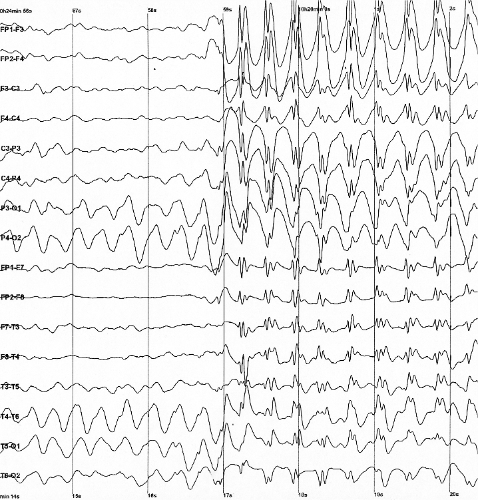
Status epilepticus (SE), or status seizure, is a medical condition with abnormally prolonged seizures. It can have long-term consequences, manifesting as a single seizure lasting more than a defined time (time point 1), or 2 or more seizures over the same period without the person returning to normal between them. The seizures can be of the tonic–clonic type, with a regular pattern of contraction and extension of the arms and legs, also known as convulsive status epilepticus, or of types that do not involve contractions, such as absence seizures or complex partial seizures. Convulsive status epilepticus is a life-threatening medical emergency, particularly if treatment is delayed. For convulsive status epilepticus, the most dangerous type, 5 minutes is the time point at which the seizure or seizures would be considered status epilepticus, so this is defined as a convulsion lasting more than 5 minutes, or two convulsions within 5 minutes without complete recovery. The risk of damage starts to accrue after 30 minutes (time point 2) for convulsive status epilepticus. For other seizure types, the time points may vary. Previous definitions used a 30-minute time limit irrespective of type of seizure.
Risk factors for status epilepticus include a history of epilepsy or other brain problems. These brain problems may include trauma, infections, or strokes, among others. Diagnosis often involves checking the blood sugar, imaging of the head, a number of blood tests, and an electroencephalogram. Psychogenic nonepileptic seizures may present similarly to status epilepticus. Other conditions that can mimic status epilepticus include low blood sugar, movement disorders, meningitis (including tuberculous meningitis), and delirium, among others.
Benzodiazepines are the preferred initial treatment, after which typically phenytoin is given. Possible benzodiazepines include intravenous lorazepam as well as intramuscular injections of midazolam. A number of other medications may be used if these are not effective, such as phenobarbital, propofol, or ketamine. After initial treatment with benzodiazepines, typical antiseizure drugs should be given, including valproic acid (valproate), fosphenytoin, levetiracetam, or a similar substance(s). While empirically based treatments exist, few head-to-head clinical trials exist, so the best approach remains undetermined. This said, "consensus-based" best practices are offered by the Neurocritical Care Society. Intubation may be required to help maintain the person's airway. Between 10% and 30% of people who have status epilepticus die within 30 days. The underlying cause, the person's age, and the length of the seizure are important factors in the outcome. Status epilepticus occurs in up to 40 per 100,000 people per year. Those with status epilepticus make up about 1% of people who visit the emergency department.
Status epilepticus can be divided into two categories: convulsive and nonconvulsive (NCSE).
Convulsive status epilepticus presents an urgent neurological condition, which is characterized by an elongated and uncontrollable onset of seizures in which a regular pattern of contraction and extension of the arms and legs will be observed from the patient. The symptoms can be managed by initially introducing a seizure suppressing medication as the first stage of the treatment, which optimally works only for that stage because any delay will reduce the efficacy of those medications. Convulsive status epilepticus commonly affects the elderly and young children, with a mortality rate of up to 20–30% of elderly patients and 0–3% of young children. Patients who survive initial onset are often left with cognitive and neurological defects.
Epilepsia partialis continua is a variant involving hour-, day-, or even week-long jerking. It is a consequence of vascular disease, tumors, or encephalitis, and is drug-resistant.[citation needed]
Generalized myoclonus is commonly seen in comatose people following cardiopulmonary resuscitation (CPR) and is seen by some as an indication of catastrophic damage to the neocortex; myoclonus status in this situation can usually (but not always) be considered an agonal phenomenon.
Refractory status epilepticus is defined as status epilepticus that continues despite treatment with benzodiazepines and one antiepileptic drug.
Hub AI
Status epilepticus AI simulator
(@Status epilepticus_simulator)
Status epilepticus
Status epilepticus (SE), or status seizure, is a medical condition with abnormally prolonged seizures. It can have long-term consequences, manifesting as a single seizure lasting more than a defined time (time point 1), or 2 or more seizures over the same period without the person returning to normal between them. The seizures can be of the tonic–clonic type, with a regular pattern of contraction and extension of the arms and legs, also known as convulsive status epilepticus, or of types that do not involve contractions, such as absence seizures or complex partial seizures. Convulsive status epilepticus is a life-threatening medical emergency, particularly if treatment is delayed. For convulsive status epilepticus, the most dangerous type, 5 minutes is the time point at which the seizure or seizures would be considered status epilepticus, so this is defined as a convulsion lasting more than 5 minutes, or two convulsions within 5 minutes without complete recovery. The risk of damage starts to accrue after 30 minutes (time point 2) for convulsive status epilepticus. For other seizure types, the time points may vary. Previous definitions used a 30-minute time limit irrespective of type of seizure.
Risk factors for status epilepticus include a history of epilepsy or other brain problems. These brain problems may include trauma, infections, or strokes, among others. Diagnosis often involves checking the blood sugar, imaging of the head, a number of blood tests, and an electroencephalogram. Psychogenic nonepileptic seizures may present similarly to status epilepticus. Other conditions that can mimic status epilepticus include low blood sugar, movement disorders, meningitis (including tuberculous meningitis), and delirium, among others.
Benzodiazepines are the preferred initial treatment, after which typically phenytoin is given. Possible benzodiazepines include intravenous lorazepam as well as intramuscular injections of midazolam. A number of other medications may be used if these are not effective, such as phenobarbital, propofol, or ketamine. After initial treatment with benzodiazepines, typical antiseizure drugs should be given, including valproic acid (valproate), fosphenytoin, levetiracetam, or a similar substance(s). While empirically based treatments exist, few head-to-head clinical trials exist, so the best approach remains undetermined. This said, "consensus-based" best practices are offered by the Neurocritical Care Society. Intubation may be required to help maintain the person's airway. Between 10% and 30% of people who have status epilepticus die within 30 days. The underlying cause, the person's age, and the length of the seizure are important factors in the outcome. Status epilepticus occurs in up to 40 per 100,000 people per year. Those with status epilepticus make up about 1% of people who visit the emergency department.
Status epilepticus can be divided into two categories: convulsive and nonconvulsive (NCSE).
Convulsive status epilepticus presents an urgent neurological condition, which is characterized by an elongated and uncontrollable onset of seizures in which a regular pattern of contraction and extension of the arms and legs will be observed from the patient. The symptoms can be managed by initially introducing a seizure suppressing medication as the first stage of the treatment, which optimally works only for that stage because any delay will reduce the efficacy of those medications. Convulsive status epilepticus commonly affects the elderly and young children, with a mortality rate of up to 20–30% of elderly patients and 0–3% of young children. Patients who survive initial onset are often left with cognitive and neurological defects.
Epilepsia partialis continua is a variant involving hour-, day-, or even week-long jerking. It is a consequence of vascular disease, tumors, or encephalitis, and is drug-resistant.[citation needed]
Generalized myoclonus is commonly seen in comatose people following cardiopulmonary resuscitation (CPR) and is seen by some as an indication of catastrophic damage to the neocortex; myoclonus status in this situation can usually (but not always) be considered an agonal phenomenon.
Refractory status epilepticus is defined as status epilepticus that continues despite treatment with benzodiazepines and one antiepileptic drug.
Recent media