Hubbry Logo
StemonitisStemonitisMain
Open search
Stemonitis
Community hub
Stemonitis
logo
8 pages, 0 posts
0 subscribers
Be the first to start a discussion here.
Stemonitis
Stemonitis
from Wikipedia

Stemonitis
Temporal range: Cenomanian–Present
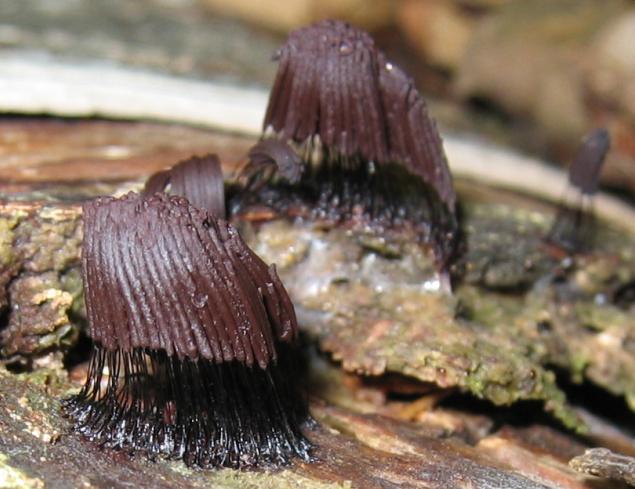
Stemonitis fusca or similar species in the White Mountain National Forest
Scientific classification Edit this classification
Domain: Eukaryota
Phylum: Amoebozoa
Class: Myxogastria
Order: Stemonitidales
Family: Stemonitidaceae
Genus: Stemonitis
Gled. [1]
Type species
Stemonitis fusca
Roth in Roemer & Usteri (1787) [1]

Stemonitis is a distinctive genus of slime moulds found throughout the world (except Antarctica). They are characterised by the tall brown sporangia, supported on slender stalks, which grow in clusters on rotting wood.[2] The genus was first described by German botanist Johann Gottlieb Gleditsch in 1753. A 2014 estimate suggests that there are 18 species in the genus.[3] Identification within the genus is difficult, and can only be performed with confidence using a microscope or by DNA sequencing. A fossil specimen (in Burmese amber) is known from the mid-Cretaceous (99 ma).[4]

Species

[edit]

The following species are accepted by Species Fungorum:[5]

  • Stemonitis axifera (Bull.) T.Macbr. (1889)
  • Stemonitis farrensis T. N. Lakh. & Mukerji (1977)
  • Stemonitis ferruginea Ehrenb. (1818)
  • Stemonitis flavogenita E. Jahn (1904)
  • Stemonitis foliicola Ing (1967)
  • Stemonitis fusca Roth (1787)
  • Stemonitis graciliformis Nann.-Bremek., Mukerji & Pasricha (1984)
  • Stemonitis herbatica Peck (1874)
  • Stemonitis inconspicua Nann.-Bremek. (1966)
  • Stemonitis laxifila Nann.-Bremek. & Y. Yamam. (1988)
  • Stemonitis lignicola Nann.-Bremek. (1973)
  • Stemonitis marjana Y. Yamam. (2000)
  • Stemonitis mediterraneensis H.H. Doğan & Eroğlu (2014)[3]
  • Stemonitis mussooriensis G. W. Martin, K. S. Thind & Sohi (1957)
  • Stemonitis nigrescens Rex (1891)
  • Stemonitis pallida Wingate (1899)
  • Stemonitis rhizoideipes Nann.-Bremek., R. Sharma & K. S. Thind (1984)
  • Stemonitis smithii T.Macbr. (1893)
  • Stemonitis splendens Rostaf. (1875)
  • Stemonitis virginiensis Rex (1891)

References

[edit]
[edit]
Revisions and contributorsEdit on WikipediaRead on Wikipedia
from Grokipedia
Stemonitis is a of myxomycete slime molds in the order Stemonitidales, characterized by stalked sporocarps bearing cylindrical sporothecae, a persistent , and a branching capillitium that forms a surface net for dispersal. These organisms exhibit a complex life cycle typical of acellular slime molds, featuring a multinucleate that engages in and feeds on , fungi, and other microorganisms in moist environments. Under conditions of nutrient scarcity or , the migrates to form fruiting bodies (sporangia) that release dark brown, reticulate (5–7 µm in diameter) through , facilitating wind- and invertebrate-aided dispersal. The comprises approximately 20 accepted , many of which display morphological plasticity but share defining traits such as reddish-brown to black stalks up to several millimeters long and evanescent peridia on the sporothecae. Stemonitis are cosmopolitan, thriving in humid tropical and habitats worldwide, where they commonly colonize decaying wood, fallen leaves, and bryophytes like mosses in the genus Thuidium. Notable examples include S. axifera and S. fusca, which frequently associate with moss-covered logs, and S. splendens, known for its chocolate-tube-like fruiting bodies that appear seasonally from June to August in temperate regions. Evolutionarily, Stemonitis exhibits remarkable morphological stasis, with fossilized fruiting bodies from mid-Cretaceous Burmese amber (approximately 100 million years old) indistinguishable from modern forms, suggesting adaptations like cryptobiosis— a dormant state enabling survival through desiccation—have preserved its structure since the Mesozoic era. This genus plays ecological roles in nutrient cycling by decomposing organic matter and serves as a food source for invertebrates, such as beetles, while its spores' reticulate surfaces enhance flotation and dispersal efficiency. Recent phylogenetic studies indicate potential polyphyly within _Stemonitis*, with spore morphology distinguishing major clades, highlighting ongoing taxonomic refinements.

Taxonomy

Etymology and history

The genus name Stemonitis is derived from stēmōn, meaning "warp" or "thread," alluding to the thread-like stalks and capillitium structures characteristic of its species, combined with the -itis, a common botanical ending denoting a group or . The genus was first formally described by German botanist Johann Gottlieb Gleditsch in 1753, in his publication Methodus fungorum exhibens genera, species et varietates cum charactere, differentia specifica, synonymis, solo, loco et observationibus. The type species for the genus, Stemonitis fusca Roth, was established in 1787. A significant taxonomic advancement came in 1940, when American mycologist G. W. Martin incorporated Stemonitis into the newly proposed order Stemonitales in his review of myxomycetes.

Classification and phylogeny

Stemonitis belongs to the domain Eukaryota, phylum , class , order Stemonitidales, family Stemonitidaceae. Within , molecular phylogenetic studies position Stemonitis in the dark-spored Fuscisporidia clade, closely related to other stemonitoid genera such as Stemonitopsis and Stemonaria, based on analyses of small-subunit gene sequences. These data indicate that Stemonitis is polyphyletic, separating into distinct groups primarily distinguished by ornamentation, such as reticulate versus warted spores, which challenges traditional morphological boundaries. Fossil evidence supports the ancient origins of the genus, with well-preserved sporocarps of Stemonitis discovered in mid-Cretaceous dating to approximately 99 million years ago, demonstrating remarkable morphological stasis relative to modern . Taxonomy of Stemonitis is complicated by morphological convergence and plasticity among , leading to difficulties in delimitation; as of 2019, approximately 20 are accepted based on integrated evidence from morphology and .

Description

Morphology

Stemonitis species produce erect, stipitate fruiting bodies known as sporocarps, which are typically aggregated in dense clusters that can resemble pipe cleaners due to their slender, upright form. These sporocarps range from 0.5 to 2 cm in total height, with individual stalks (sporangiophores) that are rigid, shining black, and often comprise about one-third to half of the total length, expanding slightly at the base for attachment. The sporangia, or spore-bearing capsules, are cylindrical to in shape, measuring 1–3 mm in length and 0.2–0.8 mm in diameter, and arise erect from the stalks in crowded groups. Mature sporangia are dark brown to blackish, with a powdery mass of spores visible through the thin, fugacious peridium that often ruptures irregularly upon dehiscence. Unlike many other myxomycetes, Stemonitis lacks lime deposits on its structures, contributing to their uniform dark coloration. Internally, a persistent, thread-like forms the central axis, extending from the stalk into the and often tapering toward the apex, where it branches to support the capillitium. The capillitium consists of a delicate, dichotomously branched network of slender, dark threads arising from the , forming irregular meshes (10–100 µm in diameter) that extend to the surface and facilitate dispersal by creating a lightweight structure. Microscopically, Stemonitis spores are globose, 6–10 µm in diameter, and exhibit warted, spiny, or reticulate surface ornamentation, appearing dark brown en masse but pale brown under transmitted light. These features, combined with the absence of lime, are diagnostic for identification.

Reproductive structures

The reproductive structures of Stemonitis develop from the diploid , a multinucleate, streaming mass that forms under favorable moist conditions after migrating to suitable substrates. When environmental cues such as or trigger sporulation, the plasmodium differentiates into stalked sporangia clustered in a palisade-like arrangement, typically maturing over 11–48 hours. These erect, cylindrical to elongated sporangia, supported by slender stalks arising from a hypothallus, elevate the reproductive units for aerial dispersal, with the process beginning as protuberances that elongate and darken from white or yellowish to black or brown. Spore production occurs within the sporangia, where in the plasmodium-derived tissue yields haploid s measuring 5–12 μm, often with reticulate surfaces for enhanced . Liberation happens through dehiscence or of the thin peridial wall, which either flakes apart or simply disappears without a distinct lid-like —a key trait distinguishing Stemonitis from some related myxomycetes like Physarum that possess a . The capillitium, a network of thread-like, hygroscopic tubules arising from a central , expands upon drying, breaking the apart and aiding wind-mediated release, often in combination with or raindrop vectors. Sexual reproduction in Stemonitis follows a in most , involving the fusion (syngamy or ) of compatible haploid myxamoebae or biflagellate swarm cells of different to form a diploid , which grows into the characteristic . This one-locus, multiple-allelic mating ensures , with confined to sporogenesis in the fruiting bodies. Some isolates exhibit non-heterothallic or apomictic variants, producing diploid spores without , though heterothallism predominates. Asexual reproduction supplements this cycle through plasmodial fragmentation, where portions of the plasmodium break off and regenerate new plasmodia under moist conditions, and via sclerotia formation during . Sclerotia are hardened, dormant masses of walled that withstand dry periods, later reactivating into plasmodia upon rehydration, as observed in like S. fusca. These mechanisms enhance survival without spore involvement.

Habitat and ecology

Distribution

Stemonitis species display a , with records spanning , , , , , and , but absent from . The genus is documented in temperate, tropical, and subtropical regions globally, thriving in environments with sufficient moisture and . Diversity is highest in and , where more than 10 species—such as Stemonitis axifera, S. fusca, S. splendens, and S. smithii—have been reported across various habitats. These regions host the majority of the genus's approximately 20 recognized species, reflecting extensive surveys and favorable climatic conditions. The genus is absent from polar regions, where extreme cold inhibits plasmodial development, and occurs only rarely in arid deserts due to limited availability. While primarily native, some range expansions may occur through human-mediated transport of infested , though such instances remain incidental to natural dispersal.

Substrates and interactions

Stemonitis species primarily inhabit decaying hardwood logs, stumps, and bark, commonly on wood such as from (Fagus spp.), (Quercus spp.), and like (Pinus spp.) in advanced stages of decay. These substrates provide the moist, nutrient-rich environment essential for the plasmodial stage, often covered by epiphytic mosses, including bryophytes in the genus Thuidium, that retain humidity and facilitate germination. As saprophytes, Stemonitis species contribute to wood decomposition through a bacterio- and fungivorous lifestyle, where the ingests microbial decomposers and organic within lignocellulosic substrates. The secretes extracellular enzymes, including carboxymethyl cellulases, enabling partial breakdown of components in lignocellulose, though primary degradation relies on associated and fungi. This process aids in recycling carbon and nutrients from dead wood back into forest ecosystems. Ecological interactions of Stemonitis involve competition and predation dynamics on shared wood substrates, where plasmodia prey upon bacteria and fungal hyphae, potentially limiting microbial competitors while grazing on spore-producing fungi. Conversely, Stemonitis fruiting bodies face occasional predation by arthropods, such as mites and springtails, which consume spores or young sporangia, influencing local population dynamics. Through spore release, which disperses organic-rich propagules via wind or invertebrates, Stemonitis enhances nutrient cycling by redistributing microbial biomass and facilitating microbial colonization of new decay sites. Fruiting in Stemonitis is triggered by specific abiotic conditions, including high relative (often above 80%) and moderate temperatures (typically 18–28°C), commonly occurring after rainfall in forested microhabitats. These cues prompt the to migrate to the substrate surface, form stalked sporangia, and release spores under conditions. Habitat loss due to poses a significant to Stemonitis populations by reducing the availability of suitable decaying wood substrates, disrupting the supply of advanced decay stages critical for their life cycle. Intensive and land conversion diminish retention, leading to decreased abundance and diversity of these slime molds in affected forests.

Species

Diversity and enumeration

The genus Stemonitis encompasses approximately 20 accepted , as estimated in phylogenetic studies as of 2020 that incorporated both morphological and molecular evidence to refine boundaries. delimitation within the primarily relies on morphological variations, including differences in sporangial shape (such as cylindrical versus forms), spore ornamentation (e.g., warted or reticulate patterns), and capillitium structure (e.g., thread thickness and branching patterns). To address the limitations of morphology, particularly in morphologically plastic taxa, using the (ITS) region and small subunit (SSU rRNA) genes has become essential for accurate identification and phylogenetic placement. Synonymy has complicated historical taxonomy, with several older names reduced to synonyms based on re-examination of type specimens and molecular data. Despite these advances, undescribed diversity persists, particularly in the form of potential cryptic species in tropical regions, where limited sequencing efforts have revealed hidden within apparent morphospecies. This underscores the ongoing need for integrated approaches, building on phylogenetic analyses that highlight the polyphyletic nature of the .

Notable species

Stemonitis fusca Roth ex Wettst., the of the , is characterized by erect, clustered sporangia measuring 6–20 mm in height, with slender black stalks comprising about one-quarter to one-half of the total length and dark violet-brown, warted-reticulate spores 7–9 µm in . It commonly occurs on decaying logs and wood, often in association with mosses, and is widespread across the temperate regions. This species has been extensively studied in laboratory settings for its plasmodial behavior, including observations of its fan-shaped, non-granular that enables and culture on glass substrates. Stemonitis splendens (Rostaf.) Douglas, known as the chocolate tube slime mold, features short, tufted sporangia that are bright reddish-brown when mature, reaching 10–20 mm tall and 1–2 mm wide, supported by short black stalks 3–5 mm long, with warted spores forming a small-meshed network. It frequently fruits on decaying hardwoods in intermediate stages of in and , contributing to the ecological breakdown of wood by feeding on associated and fungal spores. Research highlights its preference for less-decayed wood substrates, underscoring its role in early decomposition processes with potential applications in understanding natural of forest litter. Stemonitis axifera (Bull.) T. Macbr. exhibits cylindrical, acuminate sporangia that are bright rusty-brown, becoming pale brown upon spore dispersal, with a diameter of 0.2–0.3 mm and nearly smooth brown spores 5–7 µm in diameter; the stalks are slender, cylindrical, and smooth. This species ranges from tropical to temperate zones and is often found on bark and lignicolous bryophytes of dead . Ecologically, S. fusca serves as a for investigating plasmodial locomotion and development in controlled experiments, while S. splendens plays a key role in decay dynamics, aiding nutrient cycling in forest ecosystems. No Stemonitis are currently listed as endangered on major conservation assessments, though habitat specialists warrant ongoing monitoring due to reliance on undisturbed decaying environments.

References

Add your contribution
Related Hubs
User Avatar
No comments yet.