Hubbry Logo
Step-index profileStep-index profileMain
Open search
Step-index profile
Community hub
Step-index profile
logo
8 pages, 0 posts
0 subscribers
Be the first to start a discussion here.
Step-index profile
Step-index profile
from Wikipedia
Refractive HRS index distribution in core and cladding with a step-index profile

For an optical fiber, a step-index profile is a refractive index profile characterized by a uniform refractive index within the core and a sharp decrease in refractive index at the core-cladding interface so that the cladding is of a lower refractive index. The step-index profile corresponds to a power-law index profile with the profile parameter approaching infinity. The step-index profile is used in most single-mode fibers[1] and some multimode fibers.[2]

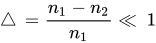
A step-index fiber is characterized by the core and cladding refractive indices n1 and n2 and the core and cladding radii a and b. Examples of standard core and cladding diameters 2a/2b are 8/125, 50/125, 62.5/125, 85/125, or 100/140 (units of μm). The fractional refractive-index change . The value of n1 is typically between 1.44 and 1.46, and is typically between 0.001 and 0.02.
Step-index optical fiber is generally made by doping high-purity fused silica glass (SiO2) with different concentrations of materials like titanium, germanium, or boron.


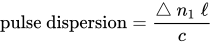
Modal dispersion in a step index optical fiber is given by
where

is the fractional index of refraction
is the refractive index of core
is the length of the optical fiber under observation
is the speed of light.

See also

[edit]

References

[edit]
Revisions and contributorsEdit on WikipediaRead on Wikipedia
from Grokipedia
A step-index profile is a refractive index distribution in optical waveguides, particularly optical fibers, characterized by a uniform, higher refractive index throughout the core and an abrupt transition to a lower, constant refractive index in the surrounding cladding. This "top-hat" structure enables efficient light guidance via at the core-cladding boundary, serving as the foundational design for both multimode and single-mode fibers used in data transmission and sensing applications. The development of the step-index profile traces back to the mid-1960s, when and George A. Hockham proposed using low-loss glass fibers with a cladding of lower to confine , predicting below 20 dB/km for practical . This breakthrough, for which Kao received the 2009 , shifted early experiments from high-loss unclad fibers to structured designs, with initial step-index multimode fibers emerging in the early 1970s as the first viable prototypes for commercial use. By the late 1970s, manufacturing advances like the modified chemical vapor deposition process enabled production of low-loss step-index fibers, revolutionizing long-haul communication by replacing copper cables. Step-index profiles are classified into multimode and single-mode variants based on core size and . Multimode step-index fibers feature core diameters from 50 μm to 1 mm, supporting multiple light paths (modes) that propagate at different speeds, leading to but allowing simpler for short-haul under 2 km, such as in area networks, video , and plastic optical fibers for . Single-mode step-index fibers, with core diameters of 8–10 μm and numerical apertures around 0.1–0.14, propagate only the fundamental mode, exhibiting near-zero intermodal dispersion and enabling bandwidths exceeding 100 Gbps over hundreds of kilometers in submarine cables, metropolitan , and high-speed backbones. Their simplicity facilitates cost-effective fabrication via methods like outside vapor deposition, though they suffer from chromatic dispersion that requires compensation in systems. Beyond telecommunications, step-index profiles find applications in fiber-optic sensors for temperature, pressure, and strain measurement, leveraging total internal reflection for reliable signal integrity in harsh environments like oil wells and aerospace. They also enable medical endoscopes and laser delivery in surgery due to high power-handling capacity, and industrial uses in illumination and power transmission where graded-index alternatives may introduce unwanted complexity. Despite competition from graded-index profiles that reduce dispersion in multimode scenarios, step-index designs remain dominant for single-mode applications owing to their predictable ray optics and mature production ecosystem.

Definition and Structure

Refractive Index Profile

The step-index profile in optical fibers is characterized by a uniform within that abruptly decreases at the core-cladding interface. Specifically, maintains a constant n1n_1 up to the core radius aa, beyond which the refractive index sharply drops to n2n_2 in the cladding, with n1>n2n_1 > n_2. This discontinuous change enables at the boundary, confining light propagation within . Mathematically, the refractive index profile n(r)n(r) as a function of radial distance rr from the axis is expressed as: n(r)={n1for ran2for r>an(r) = \begin{cases} n_1 & \text{for } r \leq a \\ n_2 & \text{for } r > a \end{cases} This piecewise function represents the "step" nature of the profile, distinguishing it from graded-index designs where the index varies continuously. Graphically, the step-index profile appears as a rectangular plot when refractive index is graphed against radial distance: a flat plateau at n1n_1 from r=0r = 0 to r=ar = a, followed by an immediate vertical drop to n2n_2 that remains constant thereafter. This top-hat shape illustrates the abrupt transition, often depicted in fiber optics literature to highlight the simplicity of the design. The step-index profile originated in early designs during the 1960s, pioneered by and George A. Hockham in their seminal 1966 paper, which proposed low-loss waveguides with a higher-index core surrounded by lower-index cladding to enable practical light transmission over long distances.

Core and Cladding Composition

The core of a step-index is the central cylindrical region with a uniform higher that serves as the primary conduit for light propagation. This region confines optical signals through at its boundary with the surrounding cladding. Typical core diameters are approximately 8–10 μm in single-mode step-index fibers, allowing for efficient single-path transmission over long distances, while multimode variants feature larger cores of 50 to 1000 μm to support multiple simultaneous light paths for shorter-range applications. The cladding forms the outer layer encasing the core, possessing a lower refractive index to facilitate light confinement and provide mechanical stability to the fiber structure. With a standard thickness resulting in a 125 μm diameter for most silica-based fibers, the cladding not only protects the delicate core but also ensures compatibility with industry-standard connectors and handling procedures. Structurally, the step-index fiber exhibits a cylindrical geometry, where the core radius aa precisely delineates the abrupt refractive index transition to the cladding, defining the step boundary essential for waveguiding. at this core-cladding interface is enabled by the index contrast, with the boundary conditions dictated by , ensuring rays exceeding the critical angle remain trapped within the core.

Types of Step-Index Fibers

Multimode Step-Index Fibers

Multimode step-index fibers are optical fibers characterized by a core diameter sufficiently large, typically greater than 50 μm (such as 50 μm or 100 μm), to support the simultaneous propagation of multiple transverse guided modes at a given and polarization. This design contrasts with single-mode fibers by enabling a higher light-gathering capacity, though it introduces complexities in signal transmission due to mode interactions. The (NA) plays a key role in determining the range of angles for acceptance into the core, influencing the diversity of modes excited. The number of guided modes in these fibers is governed by the V-number, defined as V=2πaλNAV = \frac{2\pi a}{\lambda} \cdot NA, where aa is the core radius, λ\lambda is the wavelength, and NA is the numerical aperture. For multimode operation, V>2.405V > 2.405, the cutoff value for the fundamental mode, resulting in hundreds to thousands of modes; for example, a step-index fiber with a 100 μm core diameter and NA of 0.2 supports approximately 994 modes. The approximate total number of modes MM for large VV (typically V>20V > 20) follows MV22M \approx \frac{V^2}{2}. In multimode step-index fibers, light rays propagate along either meridional paths, which repeatedly cross the fiber axis in a plane containing the axis, or skew paths, which zigzag helically around the axis without crossing it. These differing path lengths cause intermodal dispersion, where modes travel at varying group velocities, leading to broadening and signal distortion over distance. This effect is most pronounced in step-index profiles compared to graded-index alternatives. Due to intermodal dispersion, multimode step-index fibers exhibit bandwidth limitations, with typical bandwidth-distance products ranging from 20 to 30 MHz·km, restricting their use to shorter distances and lower data rates. For instance, uncompensated step-index designs often achieve only 20 to 30 MHz·km.

Single-Mode Step-Index Fibers

Single-mode step-index fibers are optical waveguides engineered to support only a single propagating mode, achieved through a precise core diameter of approximately 8-10 μm and a normalized VV less than 2.405, which restricts light to the fundamental linearly polarized LP01_{01} mode. The abrupt change at the core-cladding interface in the step-index profile facilitates tight confinement of this mode, minimizing leakage into the cladding. The transition to single-mode operation is governed by the , defined as the longest at which higher-order modes can propagate; for wavelengths longer than λc\lambda_c, only the LP01_{01} mode is supported. This is calculated using the formula: λc=2πaVcn12n22\lambda_c = \frac{2\pi a}{V_c} \sqrt{n_1^2 - n_2^2}
Add your contribution
Related Hubs
User Avatar
No comments yet.