


Community hub
0 subscribers8 pages, 0 posts
Recent from talks
All channels
Be the first to start a discussion here.
Be the first to start a discussion here.
Be the first to start a discussion here.
Be the first to start a discussion here.
Contribute something
Welcome to the community hub built to collect knowledge and have discussions related to Stone ship.
Nothing was collected or created yet.
Stone ship
View on Wikipediafrom Wikipedia
Not found
Stone ship
View on Grokipediafrom Grokipedia
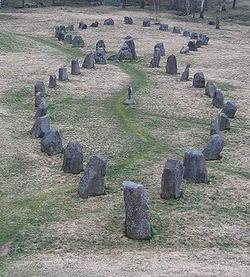
A stone ship, also known as a ship setting or skeppssättning, is a type of prehistoric burial monument consisting of stones arranged in the outline of a ship or boat, typically used to demarcate graves or cremation sites in Scandinavia.[1] These structures symbolize the journey of the deceased to the afterlife, reflecting the maritime culture of the region, and vary in size from small outlines a few meters long to large settings exceeding 80 meters.[2] Constructed by placing slabs or boulders in parallel rows to form the hull, with occasional transverse stones for crossbeams, they often enclose central burial areas but sometimes lack actual interments, suggesting ritual or commemorative functions beyond mere graves.[1]
The tradition of stone ships spans from the late Bronze Age around 1700 BC to the early medieval period up to AD 1000, encompassing the Iron Age and Viking Age, with regional variations in adoption and style.[1] They are distributed across southern Scandinavia, including Sweden, Denmark, and Norway, as well as parts of the Baltic region and Iceland, though the highest concentrations occur in Sweden's Gotland and Öland islands and Denmark's Jutland peninsula.[1] In south-western Scandinavia, the practice began earlier and was associated with elite burials, while on Gotland it emerged around 200 years later and became more widespread, possibly indicating shifts in social hierarchies and symbolic meanings over time.[1]
Archaeological interpretations suggest stone ships served multifaceted roles in funerary rituals, including marking social status, facilitating ancestral veneration, and embodying cosmological beliefs tied to seafaring and navigation.[1] Influenced by real boat and ship burials, such as those at Oseberg and Gokstad in Norway, the stone versions democratized the ship motif for broader use, though elite monopolization occurred in some periods, leading to devaluation or rejection in others as societal structures evolved.[1] Finds within these settings often include cremated remains, grave goods like pottery and tools, and occasionally unburnt bones, underscoring their primary function as memorials for the dead.
Notable examples include the large ship settings at Lindholm Høje near Aalborg, Denmark, a major Viking Age cemetery with over 150 stone ships dating from the 5th to 11th centuries AD, where the outlines range from 3 to 23 meters and illustrate varying social statuses through size and complexity. In Sweden, the Gettlinge grave field on Öland features multiple Bronze and Iron Age stone ships,[3] while the Anundshög site in Västmanland boasts one of the largest at 53 meters long, surrounded by a burial mound from the 1st millennium AD.[4] At Gammel Lejre in Denmark, six ship settings from the 6th century AD, including one 83 meters in length, highlight the site's role as a power center linked to early Danish kings.[5] In 2024, archaeologists uncovered a Viking Age cemetery near Varberg in Halland, Sweden, containing more than 139 graves and several stone ships.[6] These monuments continue to provide insights into prehistoric Scandinavian society, cosmology, and technological prowess in stoneworking.[1]