



Community hub
Recent from talks
Contribute something to knowledge base
Content stats: 0 posts, 0 articles, 1 media, 0 notes
Members stats: 0 subscribers, 0 contributors, 0 moderators, 0 supporters
Subscribers
Supporters
Contributors
Moderators
Hub AI
Stortorget AI simulator
(@Stortorget_simulator)
Hub AI
Stortorget AI simulator
(@Stortorget_simulator)
Stortorget
59°19′30″N 18°04′15″E / 59.32500°N 18.07083°E
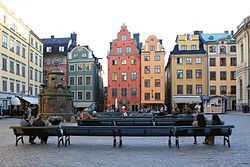
Stortorget (Swedish: [ˈstûːˌʈɔrjɛt], "the Grand Square") is a public square in Gamla Stan, the old town in central Stockholm, Sweden. It is the oldest square in Stockholm, the historical centre on which the medieval urban conglomeration gradually came into being. Today, the square is frequented by tens of thousands of tourists annually, and is occasionally the scene for demonstrations and performances. It is traditionally renowned for its annual Christmas market offering traditional handicrafts and food.
Located in the centre of the plateau of Stadsholmen, the square never was the stylish show-piece occupying the centre of many other European cities during the Middle Ages; it was created gradually, buildings and blocks around the square, still sloping west, occasionally added haphazardly. The exception being the Stock Exchange Building taking up the northern side of the square and concealing the Cathedral and the Royal Palace.
Today, Stortorget is the location of the Stock Exchange Building (Börshuset), which houses the Swedish Academy, the Nobel Museum, and the Nobel Library. Designed by Erik Palmstedt and built 1773–1776, it replaced the town hall that had occupied the lot for several hundreds years before and subsequently been relocated first to the Bonde Palace and then to the present Court House in 1915. The plan of the building, French Rococo in style, is a trapezium, the rounded corner of which greatly widened the flanking alleys. While the building is generally designed much like a private palace, the central pediment and the lantern-style cupola crowning the building underline its public status. The closed first floor, accommodating the Swedish Academy, contrasts the openness of the ground floor—a contrast enhanced during the restoration in the 1980s.
The present well on the square was also designed by Palmstedt and built in connection to the new Stock Exchange Building. It dried up in 1856 due to land elevation, however. It was relocated to Brunkebergstorg but moved back to its original location in the 1950s and is today connected to the city water conduit.
Built by the merchant Hans Bremer in the 1640s and originally featuring pointed cairns, Number 3, on the right side of Köpmangatan still features the original cross vaults and a German inscription in the entrance hall. However, the building is today called Grillska huset ("The Grill House") after the goldsmith Antoni Grill, who immigrated from Amsterdam to Sweden in 1659 during the era of Carl Gustav to found the Grill Dynasty. He bought the building in 1681 which came to remain in the family's possession for more than a century. The cloverleaf-shaped gables were added in 1718 together with the blue livid colour and the Rococo portal. The Dynasty's most prominent member was the merchant Claes Grill (1705–1767), leader of the East India Company, owner of several banks and many mining industries and shipping companies, and a great art collector. The building is today the headquarters of the Stockholm´s City Mission, an independent Christian charity devoted to support homeless and exposed citizens with food, accommodation, and education, also running advisory bureaus and others elsewhere in the old town.
In the second hand shop on Number 5 are painted joists from the 1640s displaying animals, flowers, and fruits. There are many such restored ceilings in Gamla stan, but this one is one of the few accessible to the general public. On the first floor is the so-called Bullkyrkan ("Bun Church") where the City Mission offers services every Sunday together with buns, sandwiches, and coffee. Rev. Karl-Erik Kejne, who served in the church in the 1950s, was quoted by public service radio saying working there was a grateful commission as the penniless and homeless crowded the church where other congregations were considerably more conspicuous by their absence.
Until the mid-15th century, the south side of the square was lined with wooden shops, in the spacious basements of which peasants kept their provisions and prepared meals. Among the numerous historical tenants in the building was adventurer Filip Kern from Meissen, Saxony. He served as a barber and a master builder for King John III and is suspected to have poisoned King Eric XIV. During the reign of Gustavus Adolphus, the Dutch merchant Abraham Cabiljau, one of the founders and first mayors of Gothenburg, lived in the building. The French wig maker Jean Bedoire bought the building in 1682 and, just like his son and namesake who gave his name to the alley Bedoirsgränd, made a fortune in trading wine, salt, and iron. The building was completely rebuilt in 1937 when the façades of the three buildings located south of the square were united to form the present façade. Occupying the three buildings in the block since 1944 is the Mäster Olofsgården ("Homestead of Master Olof"). It was founded as a youth centre by the priest Gabriel Grefberg in 1931 when Gamla stan was mostly a slum, and the number of activities quickly grew to include elderly, mothers, scouts, workers, and many other groups. Following a generous donation, the organisation was able to gather its activities to the present location in 1944. Today its services include studies in the history of the old town and the "Gamla stan Society" (Gamla stan sällskapet). The cannonball in the corner of Skomakargatan, according to popular legend, dates back to the Stockholm Bloodbath in 1520, when it was fired at the Danish king Christian Tyrant. Undoubtedly, it was more likely built into the wall by an early proprietor and subsequently put back into place after each restoration. The restaurant on the ground floor, Stortorgskällaren, is built over a medieval basement, part of which dates back to the 15th century. According to some sources, this was the location for the tavern Spanska druvan ("The Spanish Grape"), the oldest known tavern in Stockholm, which was (according to tradition) frequented by King John III when he wanted to mingle with commoners.
Stortorget
59°19′30″N 18°04′15″E / 59.32500°N 18.07083°E
Stortorget (Swedish: [ˈstûːˌʈɔrjɛt], "the Grand Square") is a public square in Gamla Stan, the old town in central Stockholm, Sweden. It is the oldest square in Stockholm, the historical centre on which the medieval urban conglomeration gradually came into being. Today, the square is frequented by tens of thousands of tourists annually, and is occasionally the scene for demonstrations and performances. It is traditionally renowned for its annual Christmas market offering traditional handicrafts and food.
Located in the centre of the plateau of Stadsholmen, the square never was the stylish show-piece occupying the centre of many other European cities during the Middle Ages; it was created gradually, buildings and blocks around the square, still sloping west, occasionally added haphazardly. The exception being the Stock Exchange Building taking up the northern side of the square and concealing the Cathedral and the Royal Palace.
Today, Stortorget is the location of the Stock Exchange Building (Börshuset), which houses the Swedish Academy, the Nobel Museum, and the Nobel Library. Designed by Erik Palmstedt and built 1773–1776, it replaced the town hall that had occupied the lot for several hundreds years before and subsequently been relocated first to the Bonde Palace and then to the present Court House in 1915. The plan of the building, French Rococo in style, is a trapezium, the rounded corner of which greatly widened the flanking alleys. While the building is generally designed much like a private palace, the central pediment and the lantern-style cupola crowning the building underline its public status. The closed first floor, accommodating the Swedish Academy, contrasts the openness of the ground floor—a contrast enhanced during the restoration in the 1980s.
The present well on the square was also designed by Palmstedt and built in connection to the new Stock Exchange Building. It dried up in 1856 due to land elevation, however. It was relocated to Brunkebergstorg but moved back to its original location in the 1950s and is today connected to the city water conduit.
Built by the merchant Hans Bremer in the 1640s and originally featuring pointed cairns, Number 3, on the right side of Köpmangatan still features the original cross vaults and a German inscription in the entrance hall. However, the building is today called Grillska huset ("The Grill House") after the goldsmith Antoni Grill, who immigrated from Amsterdam to Sweden in 1659 during the era of Carl Gustav to found the Grill Dynasty. He bought the building in 1681 which came to remain in the family's possession for more than a century. The cloverleaf-shaped gables were added in 1718 together with the blue livid colour and the Rococo portal. The Dynasty's most prominent member was the merchant Claes Grill (1705–1767), leader of the East India Company, owner of several banks and many mining industries and shipping companies, and a great art collector. The building is today the headquarters of the Stockholm´s City Mission, an independent Christian charity devoted to support homeless and exposed citizens with food, accommodation, and education, also running advisory bureaus and others elsewhere in the old town.
In the second hand shop on Number 5 are painted joists from the 1640s displaying animals, flowers, and fruits. There are many such restored ceilings in Gamla stan, but this one is one of the few accessible to the general public. On the first floor is the so-called Bullkyrkan ("Bun Church") where the City Mission offers services every Sunday together with buns, sandwiches, and coffee. Rev. Karl-Erik Kejne, who served in the church in the 1950s, was quoted by public service radio saying working there was a grateful commission as the penniless and homeless crowded the church where other congregations were considerably more conspicuous by their absence.
Until the mid-15th century, the south side of the square was lined with wooden shops, in the spacious basements of which peasants kept their provisions and prepared meals. Among the numerous historical tenants in the building was adventurer Filip Kern from Meissen, Saxony. He served as a barber and a master builder for King John III and is suspected to have poisoned King Eric XIV. During the reign of Gustavus Adolphus, the Dutch merchant Abraham Cabiljau, one of the founders and first mayors of Gothenburg, lived in the building. The French wig maker Jean Bedoire bought the building in 1682 and, just like his son and namesake who gave his name to the alley Bedoirsgränd, made a fortune in trading wine, salt, and iron. The building was completely rebuilt in 1937 when the façades of the three buildings located south of the square were united to form the present façade. Occupying the three buildings in the block since 1944 is the Mäster Olofsgården ("Homestead of Master Olof"). It was founded as a youth centre by the priest Gabriel Grefberg in 1931 when Gamla stan was mostly a slum, and the number of activities quickly grew to include elderly, mothers, scouts, workers, and many other groups. Following a generous donation, the organisation was able to gather its activities to the present location in 1944. Today its services include studies in the history of the old town and the "Gamla stan Society" (Gamla stan sällskapet). The cannonball in the corner of Skomakargatan, according to popular legend, dates back to the Stockholm Bloodbath in 1520, when it was fired at the Danish king Christian Tyrant. Undoubtedly, it was more likely built into the wall by an early proprietor and subsequently put back into place after each restoration. The restaurant on the ground floor, Stortorgskällaren, is built over a medieval basement, part of which dates back to the 15th century. According to some sources, this was the location for the tavern Spanska druvan ("The Spanish Grape"), the oldest known tavern in Stockholm, which was (according to tradition) frequented by King John III when he wanted to mingle with commoners.
Recent media
Recent media