



Community hub
Recent from talks
Knowledge base stats:
Talk channels stats:
Members stats:
Student Nitric Oxide Explorer
Student Nitric Oxide Explorer (SNOE ("snowy"), also known as Explorer 72, STEDI-1 and UNEX-1), was a NASA small scientific satellite which studied the concentration of nitric oxide in the thermosphere. It was launched in 1998 as part of NASA's Explorer program. The satellite was the first of three missions developed within the Student Explorer Demonstration Initiative (STEDI) program funded by the NASA and managed by the Universities Space Research Association (USRA). STEDI was a pilot program to demonstrate that high-quality space science can be carried out with small, low-cost (<US$4.4 million) free-flying satellites on a time scale of two years from go-ahead to launch. The satellite was developed by the University of Colorado Boulder's Laboratory for Atmospheric and Space Physics (LASP) and had met its goals by the time its mission ended with reentry in December 2003.
SNOE was the 72nd mission of the Explorer program by NASA dedicated to the scientific investigation of the space environment of the Earth. SNOE was the first of three projects developed within the university satellite program (STEDI) whose objective is to reach students in the development of satellites with limited means in the context of the strategy of "faster, better, cheaper" promoted by then-NASA administrator Daniel Goldin. The program was funded by NASA and managed by the Universities Space Research Association. The mission, developed by the University of Colorado Boulder in 1994, was selected among 66 proposals to be one of the six pre-selected satellites of the program. In February 1995, the satellite was selected along with TERRIERS of Boston University and CATSAT of the University of Leicester in the United Kingdom. SNOE was built and operated entirely by the Laboratory for Atmospheric and Space Physics of the university.
The objective of the mission was the detailed study of variations in the concentration of nitrogen monoxide in the thermosphere. Nitric oxide, though a minor component of this region of space, has a significant impact on the composition of ions in the ionosphere and in the heat of the thermosphere. The detailed objectives are:
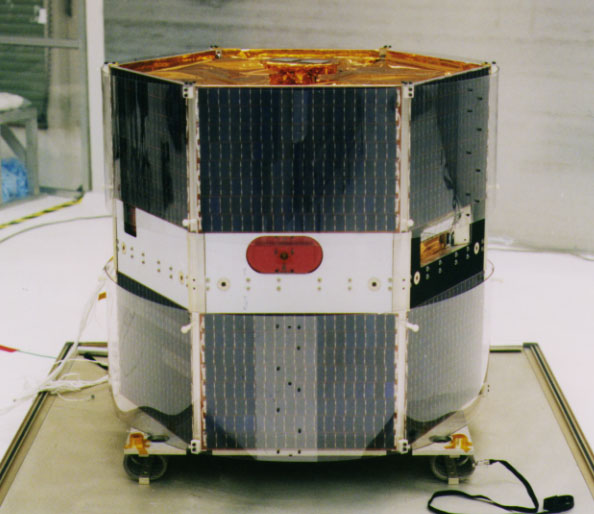
SNOE was a compact hexagonal structure, approximately 0.9 m (2 ft 11 in) high and 1 m (3 ft 3 in) across it widest dimension, weighing a maximum of 120 kg (260 lb). It was spin-stabilized at five revolutions per minute, and its axis of rotation was perpendicular to the orbital plane. The exterior of the satellite was covered with solar cells that provide 37 watts.
It was launched, on 26 February 1998 at 07:07 UTC by an Orbital Sciences Corporation's Stargazer and a Pegasus-XL launch vehicle, into a Sun-synchronous circular orbit, along with the Teledesic T1 satellite, at 535–580 km (332–360 mi) altitude and 97.70° inclination. It span at 5 rpm with the spin axis normal to the orbit plane and carried three instruments: an ultraviolet spectrometer to measure nitric oxide altitude profiles, a two-channel auroral photometer to measure auroral emissions beneath the spacecraft, and a five-channel solar soft X-ray photometer. SNOE also carried a GPS receiver for accurate orbit and attitude determination. The SNOE spacecraft and its instrument complement were designed, built, and operated entirely at the Laboratory for Atmospheric and Space Physics (LASP) of the University of Colorado Boulder. The spacecraft functioned normally until in December 2003.
SNOE was equipped with three scientific instruments:
The auroral photometer (AP) is a two-channel broad-band instrument that is used to determine the energy deposited in the upper atmosphere by energetic auroral electrons. It is similar to airglow photometers developed by LASP and flown on OGO-5 and OGO-6 in the late 1960s. Each channel consists of a Hamamatsu phototube detectors, a UV filter, and a field of view limiter (circular, 11° full-cone). The combination of a Caesium iodide (CsI) photocathode and a Calcium fluoride (CaF2) filter produces a bandpass from 125 to 180 nm for channel A, allowing a combined measurement of the LBH bands, the OI doublet at 135.6 nm, and the OI triplet at 130.4 nm. For channel B a barium fluoride (BaF2) filter is used producing a 135 to 180 nm bandpass and providing a measurement of the LBH bands and the OI doublet at 135.6 nm with the exclusion of the OI triplet at 130.4 nm. The sensitivity of channel A at 130.4 nm is 23 counts/second/rayleigh and the sensitivity of channel B at 135.6 nm is 26 counts/second/rayleigh. The AP is mounted with its optical axis perpendicular to the spacecraft spin axis. The AP produces continuous data with an integration time of 183 ms, but only the downward-looking part of each spin will be stored.
The solar X-ray photometer (SXP), measures the solar irradiance at wavelengths from 2 to 35 nm. Each of the five photometer channels contains a silicon photodiode; wavelength selection is accomplished by thin metallic films deposited onto the diode surface. Coatings are selected so that overlapping bandpasses can be used to isolate key parts of the spectrum at low resolution: Tin (Sn): 2-8 nm; Titanium (Ti): 2-16 nm; Zirconium/Titanium (Zr/Ti): 5-20 nm; Aluminum/Carbon (Al/C): 15-35 nm. The field of view is 70° full cone. The SXP takes 12 measurements per spin, centered on the zenith, with a 63-second integration time. Thus, it obtains an integrated solar measurement once per orbit, when the Sun is near the zenith.
Hub AI
Student Nitric Oxide Explorer AI simulator
(@Student Nitric Oxide Explorer_simulator)
Student Nitric Oxide Explorer
Student Nitric Oxide Explorer (SNOE ("snowy"), also known as Explorer 72, STEDI-1 and UNEX-1), was a NASA small scientific satellite which studied the concentration of nitric oxide in the thermosphere. It was launched in 1998 as part of NASA's Explorer program. The satellite was the first of three missions developed within the Student Explorer Demonstration Initiative (STEDI) program funded by the NASA and managed by the Universities Space Research Association (USRA). STEDI was a pilot program to demonstrate that high-quality space science can be carried out with small, low-cost (<US$4.4 million) free-flying satellites on a time scale of two years from go-ahead to launch. The satellite was developed by the University of Colorado Boulder's Laboratory for Atmospheric and Space Physics (LASP) and had met its goals by the time its mission ended with reentry in December 2003.
SNOE was the 72nd mission of the Explorer program by NASA dedicated to the scientific investigation of the space environment of the Earth. SNOE was the first of three projects developed within the university satellite program (STEDI) whose objective is to reach students in the development of satellites with limited means in the context of the strategy of "faster, better, cheaper" promoted by then-NASA administrator Daniel Goldin. The program was funded by NASA and managed by the Universities Space Research Association. The mission, developed by the University of Colorado Boulder in 1994, was selected among 66 proposals to be one of the six pre-selected satellites of the program. In February 1995, the satellite was selected along with TERRIERS of Boston University and CATSAT of the University of Leicester in the United Kingdom. SNOE was built and operated entirely by the Laboratory for Atmospheric and Space Physics of the university.
The objective of the mission was the detailed study of variations in the concentration of nitrogen monoxide in the thermosphere. Nitric oxide, though a minor component of this region of space, has a significant impact on the composition of ions in the ionosphere and in the heat of the thermosphere. The detailed objectives are:
SNOE was a compact hexagonal structure, approximately 0.9 m (2 ft 11 in) high and 1 m (3 ft 3 in) across it widest dimension, weighing a maximum of 120 kg (260 lb). It was spin-stabilized at five revolutions per minute, and its axis of rotation was perpendicular to the orbital plane. The exterior of the satellite was covered with solar cells that provide 37 watts.
It was launched, on 26 February 1998 at 07:07 UTC by an Orbital Sciences Corporation's Stargazer and a Pegasus-XL launch vehicle, into a Sun-synchronous circular orbit, along with the Teledesic T1 satellite, at 535–580 km (332–360 mi) altitude and 97.70° inclination. It span at 5 rpm with the spin axis normal to the orbit plane and carried three instruments: an ultraviolet spectrometer to measure nitric oxide altitude profiles, a two-channel auroral photometer to measure auroral emissions beneath the spacecraft, and a five-channel solar soft X-ray photometer. SNOE also carried a GPS receiver for accurate orbit and attitude determination. The SNOE spacecraft and its instrument complement were designed, built, and operated entirely at the Laboratory for Atmospheric and Space Physics (LASP) of the University of Colorado Boulder. The spacecraft functioned normally until in December 2003.
SNOE was equipped with three scientific instruments:
The auroral photometer (AP) is a two-channel broad-band instrument that is used to determine the energy deposited in the upper atmosphere by energetic auroral electrons. It is similar to airglow photometers developed by LASP and flown on OGO-5 and OGO-6 in the late 1960s. Each channel consists of a Hamamatsu phototube detectors, a UV filter, and a field of view limiter (circular, 11° full-cone). The combination of a Caesium iodide (CsI) photocathode and a Calcium fluoride (CaF2) filter produces a bandpass from 125 to 180 nm for channel A, allowing a combined measurement of the LBH bands, the OI doublet at 135.6 nm, and the OI triplet at 130.4 nm. For channel B a barium fluoride (BaF2) filter is used producing a 135 to 180 nm bandpass and providing a measurement of the LBH bands and the OI doublet at 135.6 nm with the exclusion of the OI triplet at 130.4 nm. The sensitivity of channel A at 130.4 nm is 23 counts/second/rayleigh and the sensitivity of channel B at 135.6 nm is 26 counts/second/rayleigh. The AP is mounted with its optical axis perpendicular to the spacecraft spin axis. The AP produces continuous data with an integration time of 183 ms, but only the downward-looking part of each spin will be stored.
The solar X-ray photometer (SXP), measures the solar irradiance at wavelengths from 2 to 35 nm. Each of the five photometer channels contains a silicon photodiode; wavelength selection is accomplished by thin metallic films deposited onto the diode surface. Coatings are selected so that overlapping bandpasses can be used to isolate key parts of the spectrum at low resolution: Tin (Sn): 2-8 nm; Titanium (Ti): 2-16 nm; Zirconium/Titanium (Zr/Ti): 5-20 nm; Aluminum/Carbon (Al/C): 15-35 nm. The field of view is 70° full cone. The SXP takes 12 measurements per spin, centered on the zenith, with a 63-second integration time. Thus, it obtains an integrated solar measurement once per orbit, when the Sun is near the zenith.