


Community hub
Recent from talks
Contribute something
Nothing was collected or created yet.
Sunday Silence
View on Wikipedia
Sunday Silence (March 25, 1986 – August 19, 2002) was an American-bred Thoroughbred racehorse and sire. In 1989, he won the Kentucky Derby and the Preakness Stakes but failed to complete the Triple Crown when he was defeated in the Belmont Stakes. Nevertheless, he won the Breeders' Cup Classic and was voted American Champion Three-Year-Old Colt and American Horse of the Year that same year. Sunday Silence's racing career was marked by his rivalry with Easy Goer, whom he had a three to one edge over in their head-to-head races.[2] Easy Goer, the 1988 American Champion Two-Year-Old Colt finished second to Sunday Silence in the Kentucky Derby, the Preakness, and the Breeders' Cup Classic. However, Easy Goer prevailed by eight lengths in the Belmont, denying Sunday Silence the Triple Crown. Both horses were later voted into the American Hall of Fame.
After his retirement from racing, Sunday Silence attracted little support by breeders in the United States and was exported to Japan. He was the leading sire in Japan on thirteen occasions, surpassing the previous record of ten titles by Northern Taste. Although the relatively insular nature of Japanese racing at the time meant that Sunday Silence's success was initially restricted to his home territory, his descendants have in recent years won major races in Australia, France, the United Kingdom, Hong Kong, the United States and Dubai.[3] Blood-Horse pedigree expert Anne Peters speculated, "Had Sunday Silence retired in Kentucky, it's almost certain he would have tanked commercially and been exported in disgrace, but he found his perfect gene pool and thrived instead."[4] He would later be the leading broodmare sire in North America in 2016.
In the Blood-Horse magazine List of the Top 100 U.S. Racehorses of the 20th Century, Sunday Silence was ranked #31.
Early years
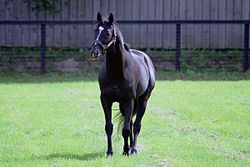
[edit]Sunday Silence was foaled on March 25, 1986, at Stone Farm in Paris, Kentucky.[5] He was sired by Halo out of Wishing Well by Understanding. Though he was registered as a dark bay/brown, he was in fact a true black.
He was bred by Oak Cliff Thoroughbreds, Ltd. and escaped death twice: first as a weanling when he nearly died from a freak virus;[6] and later at age two, traveling in a van when the driver experienced a heart attack and the van flipped over.[7] He was passed over twice at the sales ring as a yearling before he was sold in California for $50,000 as a two-year-old in training. Arthur B. Hancock III bought him as a "buy-back" (he had bred him), hoping to ship him to Kentucky. However, the van accident kept Sunday Silence in California. Hall of Fame trainer Charlie Whittingham bought a half share of the colt and then sold half of that to Ernest Gaillard. (Ownership designate: H-G-W Partners.)[8]
Ownership
[edit]H-G-W Partners (Hancock-Gaillard-Whittingham) represents the names of the three partners who owned the horse.The three partners were:
- Arthur B. Hancock III (b. 1943) - 50% partner, who is a horse breeder and the owner of Stone Farm near Paris, Kentucky.
- Charlie Whittingham (1913–1999) - 25% partner, who was the horse's Hall of Fame trainer;
- Ernest Gaillard (1913–2004) - 25% partner, who was a 1938 graduate of the University of Louisville and active in the organizing of the Kentucky Derby, and a medical doctor with the Eighth Army Air Force during World War II.
Racing record
[edit]1988: two-year-old season
[edit]Although Sunday Silence showed ability, he didn't make it to the races until late in his two-year-old season, finishing second in a maiden race, then winning a maiden special weight race and finishing second in an allowance race from three starts.
1989: three-year-old season
[edit]Sunday Silence began his three-year-old year by winning an allowance race at Santa Anita by four lengths which opened the door of Kentucky Derby potential. His next race was a victory in the Grade 2 San Felipe Stakes, and then he won the G1 Santa Anita Derby by eleven lengths to qualify for a start in the Kentucky Derby.
Kentucky Derby
[edit]In what became an iconic rivalry, Sunday Silence and Easy Goer would only meet four times, the first of which was the 1989 Kentucky Derby on May 6. In the buildup to the 1989 Triple Crown, the rivalry developed between the West Coast-based Sunday Silence and the East Coast-based Easy Goer, winner of the 1988 Eclipse Award for Champion Two Year Old Colt. Easy Goer was coming in off of a victory in the Wood Memorial and a record breaking performance in the Gotham Stakes. Unknown to the public however, Easy Goer had a small crack in his left front.[9] The favorite was Easy Goer, with Sunday Silence as the 3:1 second choice.
Kentucky Derby day was a cold one at 44°, the coldest in 72 years, with rain creating a slow muddy track.[10] After stalking the pace and making his move around the turn, Sunday Silence and jockey Pat Valenzuela defeated Easy Goer by 2+1⁄2 lengths, in the slowest time (2:05) for a Kentucky Derby since 1958.[11] Sunday Silence ducked in and out sharply throughout the stretch run, with his jockey switching from left and right handed urging trying to keep him running straight. Even with ducking in and out, the champion Easy Goer was unable to make up ground. Daily Racing Form writer Dan Illman stated after Sunday Silence's victory that "the best horse won that afternoon."[12] Daily Racing Form chairman Steve Crist stated his opinion that "Easy Goer had a legitimate explanation for his defeat, as he didn't handle the muddy Churchill track."[13]
Preakness Stakes
[edit]While both horses were preparing for the 1+3⁄16-mile Preakness two weeks after the Derby, each had minor ailments. Sunday Silence came up lame after a gallop seven days before the race. Trainer Whittingham contacted well-known Kentucky veterinarian Alex Harthill, who diagnosed a bruise under the sole, a common injury that "wasn't a serious problem but it had happened at a serious time." Harthill had Sunday Silence step on a clean sheet of white paper which was subsequently faxed to Ric Redden of Lexington, Kentucky, and from which Redden prepared a set of aluminum bar shoes. Redden and his assistant then flew via rented jet to Baltimore with the bar shoes and X-ray machine to confirm that no fracture was involved. After the shoes were fitted, Sunday Silence resumed training four days before the race. After his connections saw the colt's "remarkably" rapid recovery from the injury, the bar shoes were removed the day before the race.[12][14] With all the uncertainty over Sunday Silence's soundness, he would go on to be second choice once again to Easy Goer at 2:1.
Meanwhile, unknown to the public at his rival's stable, throughout Preakness week (as late as Friday, the day before the race), Easy Goer's front feet were being soaked in tubs of Epsom salts due to small scratches or cracks on both heels. An ultrasound was also performed on his ankles and knees. Some wondered if these ailments could compromise the chances of both horses.[15] Easy Goer had "problematic, puffy" ankles that he dealt with throughout his career.
The 1989 Preakness Stakes on May 20 is one that continues to live in racing lore as one of the best races ever run, and one of the most iconic stretch duels. It was added into Horse Racing's Top 100 Moments, placing at #70. Easy Goer broke slow, and Sunday Silence was bumped at the start, then the pair settled into their sports. After three-quarters of a mile, Day guided Easy Goer to the front where Sunday Silence dug in and went with him. The legendary stretch duel was fought the entire length of the stretch, with neither Sunday Silence or Easy Goer giving an inch. Sunday Silence prevailed in the photo finish, with a finishing time of 1:53 4/5, the third fastest Preakness at the time.[16][17]
Some Easy Goer loyalists in the media maintained their horse's superiority, attributing the loss to the fact that Easy Goer had leapt in the air at the start and his jockey, Pat Day, reined Easy Goer's head to the right when he had a short lead in the home stretch. Day, who lodged a failed objection against Valenzuela, has called his ride "a mistake."[18]
Belmont Stakes
[edit]In 1989, New York was the only state in America that banned all race-day drugs and medications, including the now-commonly used medication Lasix.[19][20][21] In the three weeks between the Preakness and Belmont, Whittingham was angered that the controversial veterinarian Alex Harthill, who treated Sunday Silence earlier for the Kentucky Derby and Preakness, was not licensed in New York and prohibited from practicing.[22][23] The day before the 1+1⁄2-mile Belmont Stakes, Sunday Silence, with exercise rider Pam Mabes up, was spooked and kicked trainer Whittingham in the temple, a glancing blow that came close to killing the trainer.[24]
Belmont Park received several inches of rain in the days leading up to the race,[25] but by race day on June 10 the track was rated fast with Sunday Silence this time the 4:5 post time favorite, and the entry of Easy Goer and Awe Inspiring at 8:5.[26] While initially planning on going to the lead, Sunday Silence settled into second behind the longshot French colt Le Voyageur. Easy Goer was never too far behind either. When Sunday Silence made his move on the turn, Easy Goer made a faster one and swept to the front. Easy Goer defeated Sunday Silence by eight lengths in the time of 2:26, producing the second-fastest Belmont Stakes in history, behind only Secretariat, and denied Sunday Silence the Triple Crown, and thus a $5M bonus.[27][28][29] However, by virtue of his two Classic wins and his runner-up performance, Sunday Silence was awarded the third $1,000,000 Visa Triple Crown Bonus for best three-year-old in the series.
Breeders' Cup Classic
[edit]After the Belmont Stakes, the pair went their separate ways with Sunday Silence returning to California where he finished second to eventual Breeders' Cup Turf winner Prized in the Grade II 1+1⁄4-mile Swaps Stakes at Hollywood Park on July 23.[30] From there he went to Louisiana Downs where he won the Grade I Super Derby on September 24, giving him six weeks' rest going into the Breeder's Cup Classic. Over in New York, Easy Goer won 4 successive Grade I stakes after the Belmont... the Whitney Handicap, Travers Stakes, Woodward Stakes, and the Jockey Club Gold Cup, giving him 27 days' rest going into the Classic.
This set up one final face-off between the rivals at the season-ending $3 million 1+1⁄4-mile Breeders' Cup Classic at Gulfstream Park, on November 4. The contest was expected to decide the winner of the Eclipse Award for Horse of the Year.[31] Sunday Silence's jockey Pat Valenzuela had earlier been suspended for cocaine use and was replaced by Hall of Fame rider Chris McCarron. Sunday Silence was the post time 2:1 second choice behind Easy Goer at 1:2.
The race started as usual for Sunday Silence who settled five lengths behind the leader, but Easy Goer broke slow and was 11 lengths from the front for much of the race. On the backstretch, Sunday Silence inched closer to the lead with Easy Goer noticeably and suddenly getting into stride with three quarters of a mile to go, with track announcer Tom Durkin commenting during the race "he is five lengths behind Sunday Silence and now he's beginning to roll!" and near the half mile pole he continued, "Sunday Silence bracing for the oncoming power of Easy Goer, who's right at his neck!" On the turn however, Sunday Silence continued to gain on the leader, leaving Easy Goer behind. Sunday Silence took control with about an eighth of a mile to go, with Easy Goer three lengths behind. Jockey Chris McCarron continued with a hand ride, and was able to withstand a strong late charge by Easy Goer to win the Classic by a neck. The victory solidified a 3:1 advantage in Sunday Silence's favor.[32]
At this point, Sunday Silence had earned what was then a single-season record $4.59 million[33][34][35][36][37] and won seven times in nine starts for the 1989 campaign, earning him Eclipse Award for Outstanding 3-Year-Old Male Horse and Horse of the Year honors. For the latter award, Sunday Silence received 223 of 242 votes, making him the most decisive winner since John Henry eight years earlier.[38] Even with the championship honors, debate continues decades after their careers on who was the better horse.
1990: four-year-old season
[edit]At the age of four, Sunday Silence won the Californian and placed second in the Hollywood Gold Cup behind Criminal Type by a head, while giving away 5 pounds.[39] He suffered an injured ligament that eventually led to his retirement.[40] Out of 14 career races, he had 9 wins (including 6 Grade 1’s) and 5 runner-up finishes.
Accomplishments
[edit]In 1996, Sunday Silence was inducted into the National Museum of Racing and Hall of Fame.[41] He was ranked #31 in the Bloodhorse Top 100 Horses of the 20th Century, while Easy Goer ranked #34. Blood-Horse stated that its rankings "will generate debate for years to come."[42] The electoral friction was ultimately reflected in the introduction to the Blood-Horse's "Top 100 Racehorses" book, which said, "For all the work and dreaming that went into it... one approaches the list... with a nagging sense of its folly as a rational exercise and of the maddening arbitrariness of its outcome. However, one views this list of horses, whether in peace and contentment—or shock and dismay—all such judgments, of course, are entirely subjective, a mixture of whim, wisdom, and whatever prejudices howl through the back of the mind."[43]
Since the Breeders’ Cup Classic was instituted in 1984, Alysheba and Sunday Silence were the only two horses to win three legs of a four-race sequence that was defined in 2015 as the Grand Slam of Thoroughbred racing: The Triple Crown races, plus the Breeders' Cup Classic, and Sunday Silence was the first horse to win three legs of the modern Grand Slam in the same year. As the Breeders' Cup began after the 1978 Triple Crown win of Affirmed, the potential for a sweep of all four races only became possible in 1984, and did not occur until 2015 when American Pharoah won the Triple Crown and eventually the Grand Slam.[44]
Stud record
[edit]
Sunday Silence was sold to Japanese breeder Zenya Yoshida,[45] to stand at his Shadai Stallion Station in Shiraoi, Hokkaido. Yoshida had acquired a 25% interest in Sunday Silence early in his 4-year-old season and bought out the other partners for $7.5 million in 1991.[46]
Sunday Silence flourished in Japan and became their leading sire from 1995 through 2007,[45] taking over from Northern Taste (ten-time leading sire in Japan). He was particularly successful with daughters from the Northern Dancer sire line.[46] However, breeders were generally not successful expanding his influence outside of Japan.[45] His progeny have won many races in Japan, including 20 out of 22 JRA Grade 1 flat races (the only exceptions are the NHK Mile Cup and the Japan Cup Dirt). His progeny also have won International Grade 1 race including the Hong Kong Vase, Hong Kong Mile and Dubai Sheema Classic.
Descendants of Sunday Silence have broken many earnings records, in part because he was active at the start of the "big crop" era (siring about 2000 foals) and also because the average purses in Japan are significantly higher than the rest of the world. Conservative estimates on the earnings of Sunday Silence descendants place the total near JPY 80 billion (approximately $730 million according to Equibase).[47]
He was also the leading broodmare sire in North America in 2016 with Japanese racehorse Lani's entry in the Kentucky Derby that year with a Grade II win in Dubai, followed by off the board finishes in the Derby and Preakness, and a third-place finish in the Belmont.[48] Once qualified to appear on the broodmare sire list, Sunday Silence then got enhancements from his Japanese runners, where there is a substantial disproportion between North American purses and the significantly higher purses in Japan.
Major winners
[edit]| Foaled | Name | Sex | Major Wins |
|---|---|---|---|
| 1992 | Dance Partner | f | Yūshun Himba, Queen Elizabeth II Cup |
| 1992 | Fuji Kiseki | c | Asahi Hai Sansai Stakes |
| 1992 | Genuine | c | Satsuki Shō, Mile Championship |
| 1992 | Marvelous Sunday | c | Takarazuka Kinen |
| 1992 | Tayasu Tsuyoshi | c | Tokyo Yūshun |
| 1993 | Bubble Gum Fellow | c | Asahi Hai Sansai Stakes, Tennō Shō (Autumn) |
| 1993 | Dance in the Dark | c | Kikuka Shō |
| 1993 | Ishino Sunday | c | Satsuki Shō |
| 1994 | Silence Suzuka | c | Takarazuka Kinen |
| 1994 | Stay Gold | c | Hong Kong Vase, Dubai Sheema Classic |
| 1995 | Special Week | c | Tokyo Yūshun, Japan Cup, Tennō Shō (Spring and Autumn) |
| 1996 | Admire Vega | c | Tokyo Yūshun |
| 1996 | Stinger | f | Hanshin Sansai Himba Stakes |
| 1996 | To the Victory | f | Queen Elizabeth II Cup |
| 1997 | Agnes Flight | c | Tokyo Yūshun |
| 1997 | Air Shakur | c | Satsuki Shō, Kikuka Shō |
| 1997 | Cheers Grace | f | Oka Shō |
| 1998 | Agnes Tachyon | c | Satsuki Shō |
| 1998 | Believe | f | Sprinters Stakes, Takamatsunomiya Kinen |
| 1998 | Manhattan Cafe | c | Kikuka Shō, Arima Kinen, Tennō Shō (Spring) |
| 1998 | Mejiro Bailey | c | Asahi Hai Sansai Stakes |
| 1999 | Admire Max | c | Takamatsunomiya Kinen |
| 1999 | Durandal | c | Mile Championship, Sprinters Stakes |
| 1999 | Gold Allure | c | February Stakes |
| 1999 | Sunday Joy | f | Australian Oaks |
| 2000 | Admire Groove | f | Queen Elizabeth II Cup (twice) |
| 2000 | Heavenly Romance | f | Tennō Shō (Autumn) |
| 2000 | Neo Universe | c | Satsuki Shō, Tokyo Yūshun |
| 2000 | Orewa Matteruze | c | Takamatsunomiya Kinen |
| 2000 | Peace of World | f | Hanshin Juvenile Fillies |
| 2000 | Still in Love | f | Japanese Triple Tiara (Oka Shō, Yūshun Himba, Shūka Shō) |
| 2000 | Zenno Rob Roy | c | Japan Cup, Arima Kinen, Tennō Shō (Autumn) |
| 2001 | Daiwa el Cielo | f | Yūshun Himba |
| 2001 | Daiwa Major | c | Mile Championship, Yasuda Kinen, Satsuki Shō, Tennō Shō |
| 2001 | Dance in the Mood | f | Oka Shō |
| 2001 | Hat Trick | c | Mile Championship, Hong Kong Mile |
| 2001 | Heart's Cry | c | Dubai Sheema Classic, Arima Kinen |
| 2001 | Suzuka Mambo | c | Tennō Shō (Spring) |
| 2002 | Air Messiah | f | Shūka Shō |
| 2002 | Deep Impact | c | Japanese Triple Crown (Satsuki Shō, Tokyo Yūshun, Kikuka Shō), Japan Cup, Arima Kinen, Takarazuka Kinen, Tennō Shō (Spring) |
| 2002 | Shonan Peintre | f | Hanshin Juvenile Fillies |
| 2002 | Suzuka Phoenix | c | Takamatsunomiya Kinen |
| 2003 | Fusaichi Pandora | f | Queen Elizabeth II Cup |
| 2003 | Matsurida Gogh | c | Arima Kinen |
| Foaled | Name | Sex | Major Wins |
|---|---|---|---|
| 1992 | Bright Sunday | m | 1995 Sapphire Stakes |
| 1992 | Prime Stage | m | 1994 Sapporo Sansai Stakes |
| 1992 | Magic Kiss | m | 1996 Kitakyushu Kinen |
| 1992 | Daitaku Surgeon | c | 1996 Osaka Jo Stakes |
| 1992 | Silent Happiness | m | 1995 Sankei Sports Sho Yonsai Himba Tokubetsu |
| 1992 | Sunday Well | c | 1995 St Lite Kinen |
| 1992 | Summer Suspicion | c | 1995 Aoba Sho |
| 1992 | Silent Happiness | m | 1995 Sankei Sports Sho Yonsai Himba Tokubetsu |
| 1992 | King of Daiya | c | 1997 Nakayama Kinen |
| 1993 | Rosen Kavalier | c | 1997 American Jockey Club Cup |
| 1993 | Royal Touch | c | 1996 Kisaragi Sho |
| 1993 | Silent Hunter | c | 1999 Sankei Osaka Hai |
| 1993 | Sakura Keizan O | c | '96 Choshi Tokubetsu |
| 1993 | She's Grace | m | 1995 Fuyo Stakes |
| 1993 | Sericite Dandy | c | 1997 TUF Hai |
| 1993 | Hornet Pierce | m | 1998 Sumidagawa Tokubetsu |
| 1994 | Big Sunday | c | 1998 Yomiuri Milers Cup |
| 1994 | Waltz Dancer | m | 1999 Ichikawa Stakes |
| 1994 | Air Wings | m | 1997 Hanshin Himba Tokubetsu |
| 1994 | Orange Peel | m | 1997 Sankei Sports Sho Yonsai Himba Tokubetsu |
| 1995 | Meisho Odo | c | 2000 Sankei Osaka Hai |
| 1995 | Divine Light | c | 2000 TV Yamanashi Hai |
| 1995 | Jo Big Bang | c | 1999 Hakodate Kinen |
| 1995 | Tayasu Again | c | 1998 Aoba Sho |
| 1995 | Egao o Misete | m | 1998 Hanshin Himba Tokubetsu |
| 1996 | Chokai Ryoga | c | 2003 May Stakes |
| 1996 | T.M.Sunday | c | 2003 Silk Road Stakes |
| 1996 | Rosado | c | 2002 Sankei Sho All Comers |
| 1996 | Maruka Candy | m | 2001 Fuchu Himba Stakes |
| 1996 | Fusaichi Airedale | m | 1999 Hochi Hai Yonsai Himba Tokubetsu |
| 1996 | Black Tuxedo | c | 1999 St Lite Kinen |
| 1996 | Painted Black | c | 1999 Stayers Stakes |
| 1996 | Thrilling Sunday | c | 2001 Narutaki Tokubetsu |
| 1996 | Eishin Rudens | m | 2001 Nakayama Himba Stakes |
| 1996 | Kiss Me Tender | c | 2003 Dotombori Stakes |
| 1996 | Saikyo Sunday | c | 1999 Chunichi Sports Sho Yonsai Stakes |
| 1996 | Silent Cruise | c | 2002 AM Kobe Sho Chushun Tokubetsu |
| 1996 | Silent Honor | f | 2001 Cherry Hinton Stakes |
| 1996 | Sunday Picnic | f | 1999 Prix Cléopâtre |
| 1997 | Yamanin Respect | c | 2002 Hakodate Kinen |
| 1997 | Yukino Sun Royal | c | 2005 Nikkei Sho |
| 1997 | Future Sunday | m | 2000 Queen Cup |
| 1997 | Meisho Dominica | g | 2003 Fukushima Kinen |
| 1997 | Nihon Pillow Neil | c | 2002 Murasaki Sho |
| 1997 | New England | c | 2001 STV Hai |
| 1997 | Bailarina | m | 2000 Sweetpea Stakes |
| 1997 | Fusaichi Zenon | c | 2000 Yayoi Sho |
| 1997 | Tokai Oza | c | 2001 Copa Republica Argentina |
| 1997 | Admire Boss | c | 2000 St Lite Kinen |
| 1997 | Apatheia | c | 2003 Hayama Tokubetsu |
| 1997 | Win Marvelous | c | 2003 Kyoto High Jump |
| 1997 | Ammirare | c | 2001 Keyaki Stakes |
| 1998 | Royal Cancer | c | 2003 NST Open |
| 1998 | Millennium Bio | c | 2002 Yomiuri Milers Cup |
| 1998 | Miscast | c | 2001 Principal Stakes |
| 1998 | Trust Fire | c | 2001 Radio Tampa Sho |
| 1998 | Noblesse Oblige | m | 2003 Emerald Stakes |
| 1998 | Happy Path | m | 2003 Kyoto Himba Stakes |
| 1998 | Hallelujah Sunday | c | Fukushima TV Open |
| 1998 | Dark Wizard | g | 2002 Inari Tokubetsu |
| 1998 | Diamond Biko | m | 2002 Sankei Sports Hai Hanshin Himba Stakes |
| 1998 | Daiwa Rogue | m | 2000 Niigata Sansai Stakes |
| 1998 | Cheers Brightly | c | 2003 Keihan Hai |
| 1998 | Sunrise Pegasus | c | 2005 Mainichi Okan |
| 1998 | Seiko Sunday | c | 2002 Spica Stakes |
| 1998 | Coin Toss | c | 2002 Shirafuji Stakes |
| 1998 | Admire Rich | m | 2005 Miyabi Stakes |
| 1998 | Isao Heat | c | 2004 Kanetsu Stakes |
| 1998 | Win Radius | c | 2004 Keio Hai Spring Cup |
| 1998 | Agnes Gold | c | 2001 Spring Stakes |
| 1999 | Monopole | c | 2006 Tomoe Sho |
| 1999 | Monopolizer | c | 2002 Port Island Stakes |
| 1999 | Yamanin Seraphim | c | 2002 Keisei Hai |
| 1999 | Pop Jewel | m | 2004 TUF Hai |
| 1999 | Tosen Humming | c | 2004 Abukuma Tokubetsu |
| 1999 | Hustler | c | 2004 Banshun Stakes |
| 1999 | Bash Earth | g | 2004 Hakuryo Memorial |
| 1999 | Tiger Cafe | c | 2007 April Stakes |
| 1999 | Daiwa Raiders | c | 2005 Tanabata Sho |
| 1999 | Cheers Stark | c | 2002 Kyodo Tsushin Hai |
| 1999 | Chapel Concert | m | 2004 Yonago Stakes |
| 1999 | Chokai Flight | c | 2006 Oguninuma Tokubetsu |
| 1999 | Shinin' Ruby | m | 2002 Queen Cup |
| 1999 | Win Duel | c | 2004 Onuma Styakes |
| 1999 | Emerald Isle | m | 2004 Shiranui Tokubetsu |
| 1999 | Er Nova | m | 2004 HTB Hai |
| 2000 | Vita Rosa | m | 2003 St Lite Kinen |
| 2000 | Reminiscence | m | 2005 Tsukioka Tokubetsu |
| 2000 | Black Cafe | c | 2006 Uzuki Stakes |
| 2000 | Tokai Elite | c | 2006 Orion Stakes |
| 2000 | Dancing On | c | 2004 Mr. C.B. Memorial |
| 2000 | Danuta | f | 2003 UAE Oaks |
| 2000 | Cheers Message | m | 2005 Kyoto Himba Stakes |
| 2000 | Cheerful Smile | m | 2006 Keeneland Cup |
| 2000 | Chunyi | m | 2003 Queen Cup |
| 2000 | T M Tanrai | c | 2007 Tajima Stakes |
| 2000 | Super Chance | c | 2006 Umeda Stakes |
| 2000 | Starry Heaven | m | 2004 Utopia Stakes |
| 2000 | Spicule | c | 2004 Betelguise Stakes |
| 2000 | Silent Deal | c | 2003 Musashino Stakes |
| 2000 | Sakura President | c | 2003 Sapporo Kinen |
| 2000 | Superieure | m | 2005 Takaragaike Tokubetsu |
| 2000 | Catch the Gold | m | 2005 Awaji Tokubetsu |
| 2000 | Quiet Day | c | 2007 March Stakes |
| 2000 | Alfajores | c | 2006 Kintei Stakes |
| 2000 | Albireo | c | 2005 Okabe Yukio Kishu Intai Kinen |
| 2001 | Vril | c | 2004 Ireland Trophy |
| 2001 | Valparaiso | m | 2004 Mimosa Sho |
| 2001 | Wadi Rum | m | 2006 Yonago Stakes |
| 2001 | Lord Marshal | c | 2004 Fukujuso Tokubetsu |
| 2001 | Lady in Black | m | 2004 Anemone Stakes |
| 2001 | Legolas | c | 2008 Ryogoku Tokubetsu |
| 2001 | Les Clefs d'Or | m | 2004 Rose Stakes |
| 2001 | Ribbon Art | m | 2006 Suzaku Stakes |
| 2001 | Rikiai Silence | c | 2007 October Stakes |
| 2001 | Meteor Burst | c | 2003 Icho Stakes |
| 2001 | Mejiro Nicolas | g | 2005 Shikotsuko Tokubetsu |
| 2001 | Meisho Ho O | c | 2007 Naigai Times Hai |
| 2001 | Mystic Age | c | 2004 Komakusa Sho |
| 2001 | Mile de Paris | m | 2007 Asuka Stakes |
| 2001 | Maino Chikara | m | 2006 Chushu Tokubetsu |
| 2001 | Beluga | c | 2008 Shumbo Stakes |
| 2001 | Pretty Princess | m | 2006 Kuta Tokubetsu |
| 2001 | Plasma | c | 2005 Oguninuma Tokubetsu |
| 2001 | Black Tide | c | 2004 Spring Stakes |
| 2001 | French Idea | m | 2005 Hita Tokubetsu |
| 2001 | Firenze | c | 2006 Suma Tokubetsu |
| 2001 | Fine Cela | m | 2006 Moiwayaka Tokubetsu |
| 2001 | Pisa no Kukai | c | 2004 Principal Stakes |
| 2001 | Hikaru Dokisei | m | 2004 Tokai Teio Memorial |
| 2001 | Higher Game | c | 2004 TV Aoba Sho |
| 2001 | Sundrop | f | 2005 Cardinal Handicap, 2005 Princess Elizabeth Stakes |
| 2001 | Dolce Limone | m | 2004 Wasurenagusa Sho |
| 2001 | Stratagem | c | 2004 Sakaiminato Tokubetsu |
| 2001 | Swift Current | c | 2006 Kokura Kinen |
| 2001 | Sunday Stream | g | 2005 Shin Hakodate Shi Tanjo Kinen |
| 2001 | Silence Gold | g | 2005 Aoshima Tokubetsu |
| 2001 | Gorgeous Dinner | c | 2006 Dannoura Tokubetsu |
| 2001 | Great Journey | c | 2006 Lord Derby Challenge Trophy |
| 2001 | Kyowa Roaring | c | 2007 Kitakyushu Kinen |
| 2001 | Kyowa Splendor | c | 2003 Clover Sho |
| 2001 | Capital Flight | c | 2006 Yokote Tokubetsu |
| 2001 | Air Shady | c | 2008 American Jockey Club Cup |
| 2001 | Admire Big | c | 2003 Tokyo Sports Hai Nisai Stakes |
| 2001 | Azuma Sanders | m | 2005 Kyoto Himba Stakes |
| 2002 | Layman | c | 2005 Sovereign Stakes |
| 2002 | Lofty Aim | m | 2006 Fukushima Himba Stakes |
| 2002 | Lord Anthem | c | 2006 Senriyama Tokubetsu |
| 2002 | Rosenkreuz | c | 2007 Kinko Sho |
| 2002 | Rhett Butler | c | 2008 TV U Fukushima Sho |
| 2002 | Raise Your Dream | c | 2006 Enoshima Tokubetsu |
| 2002 | Race Pilot | m | 2005 Mimoza Sho |
| 2002 | Yamanin Ariel | m | 2007 Okazaki Tokubetsu |
| 2002 | Megaton Cafe | c | 2005 Oriental Sho |
| 2002 | Meisho Ote | c | 2006 Kotobuki stakes |
| 2002 | Maruka Sieg | c | 2006 Ogori Tokubetsu |
| 2002 | Machikane Kirara | c | 2006 April Stakes |
| 2002 | Machikane Aura | c | 2006 Chukyo Kinen |
| 2002 | Bonaparte | g | 2005 Soma Tokubetsu |
| 2002 | Daring Heart | f | 2005 Queen Stakes |
| 2002 | Penny Whistle | m | 2005 Sapporo Nikkan Sports Hai |
| 2002 | Peer Gynt | c | 2004 Daily Hai Nisai Stakes |
| 2002 | Princess Lucita | m | 2007 Nayabashi Stakes |
| 2002 | Princess Grace | m | 2005 Kitano Tokubetsu |
| 2002 | Principe del Sol | c | 2008 Nishigo Tokubetsu |
| 2002 | Silent Name | c | 2006 Arcadia Handicap, 2007 Commonwealth Breeders' Cup Stakes |
| 2002 | Brave Heart | c | 2008 Abukuma Stakes |
| 2002 | Pisa no Patek | c | 2009 UHB Hai |
| 2002 | Pixie Dust | m | 2008 Uzushio Stakes |
| 2002 | Passional Dance | m | 2006 Yamakunigawa Tokubetsu |
| 2002 | Perfect Match | m | 2005 Haramachi Tokubetsu |
| 2002 | Hulk Banyan | c | 2007 Isezaki Tokubetsu |
| 2002 | New York Cafe | c | 2006 Yunokawa Tokubetsu |
| 2002 | Tokai Wild | c | 2007 Nikkei Shinshun Hai |
| 2002 | Dia de la Novia | m | 2005 Flora Stakes |
| 2002 | Dantsu Kitcho | c | 2005 Aoba Sho |
| 2002 | Double Timpani | c | 2007 Orion Stakes |
| 2002 | Soldier's Song | c | 2008 Okutama Stakes |
| 2002 | Jadeite | m | 2005 Wasurenagusa Sho |
| 2002 | Six Sense | c | 2006 Kyoto Kinen |
| 2002 | Thanks a Lot | m | 2007 Seibunikkan Sports Hai |
| 2002 | Samurai Heart | c | 2005 Doncaster Cup |
| 2002 | King's Trail | c | 2005 St Lite Kinen |
| 2002 | Eishin Lighten | c | 2006 Boso Tokubetsu |
| 2002 | Air Sabbath | c | 2006 Kiyotaki Tokubetsu |
| 2002 | Ibuki Revolution | c | 2005 Yukiyanagi Sho |
| 2002 | African Beat | c | 2007 Rokusha Tokubetsu |
| 2002 | Admire Japan | c | 2005 Keisei Hai |
| 2002 | Agnes Treasure | c | 2008 Murasaki Sho |
| 2003 | Russell Barows | c | 2006 Higashiyama Tokubetsu |
| 2003 | Maruka Shenck | c | 2005 Daily Hai Nisai Stakes |
| 2003 | Magic Hour | g | 2006 Atago Tokubetsu |
| 2003 | Fusaichi Junk | c | 2006 Wakagoma Stakes |
| 2003 | Hagino Princess | m | 2008 Akanko Tokubetsu |
| 2003 | Nirvana | c | 2008 Kokura Nikkei Open |
| 2003 | Trophy Deal | c | 2008 Biwako Tokubetsu |
| 2003 | Tosen Shana O | c | 2006 St Lite Kinen |
| 2003 | Tudor Rose | c | 2007 Sakurayama Tokubetsu |
| 2003 | Chokai Sunday | c | 2006 Zao Tokubetsu |
| 2003 | Tagano Eiger | c | 2007 Mino Tokubetsu |
| 2003 | Saint Victoire | m | 2006 Elfin Stakes |
| 2003 | King Arthur | c | 2008 Koto Stakes |
| 2003 | Captain Vega | c | 2008 Sekigahara Stakes |
| 2003 | F Seiko | c | 2006 Wakatake Sho |
| 2003 | Eterno | g | 2009 Sakaiminato Tokubetsu |
| 2003 | Air Magdalene | m | 2007 Kamomejima Tokubetsu |
| 2003 | Win Legend | c | 2006 Aoi Stakes |
| 2003 | Admire Main | c | 2006 Aoba Sho |
| 2003 | Admire Kiss | m | 2006 Rose Stakes |
| 2003 | Axion | c | 2010 Nakayama Kimpai |
Sire of sires and broodmares
[edit]_20051023_3.jpg)
Many of Sunday Silence's sons have gone on to become successful breeding stallions, with at least seventeen of them siring Group or Grade I winners. These include:
- Fuji Kiseki sired Kane Hekili, Straight Girl, Sun Classique (Dubai Sheema Classic) and Isla Bonita.
- Dance in the Dark sired Delta Blues, the winner of Australia's Melbourne Cup.
- Stay Gold sired Orfevre, Gold Ship, Dream Journey, Nakayama Festa, Fenomeno, Oju Chosan, Red Reveur (Hanshin Juvenile Fillies), Admire Lead (Victoria Mile), Rainbow Line, Win Bright and Indy Champ. Orfevre in turn sired Marche Lorraine and Ushba Tesoro, while Gold Ship sired Uberleben, Meiner Grand (Nakayama Daishogai), and Meisho Tabaru.
- Agnes Gold sired Silence Is Gold, Abu Dhabi, Mais Que Bonita, Abidjan, Antonella Baby, Ivar, Energia Fribby, Hevea, Honra Real, Nathan, Olympic Kremlin, Culo e Camicia, Olympic Jhonsnow, Orfeu Negro, Olympic Las Palmas, Janelle Monae, In Love, Online, Look Of Love, No Fear, Doutor Sureño and Neverwalkalone.
- Divine Light sired Natagora.
- Special Week sired Toho Jackal (Kikuka Sho), Buena Vista and Cesario; who in turn foaled Epiphaneia, Leontes, and Saturnalia.
- Manhattan Cafe sired Grape Brandy (February Stakes), Hiruno d'Amour (Tenno Sho), Jo Cappuccino (NHK Mile Cup), Red Desire and Queens Ring (Queen Elizabeth II Commemorative Cup).
- Agnes Tachyon sired Logic (NHK Mile Cup), Daiwa Scarlet, Deep Sky, Captain Thule (Satsuki Sho), Little Amapola (Queen Elizabeth II Cup) and Reve d'Essor (Hanshin Juvenile Fillies).
- Neo Universe sired Unrivaled (Satsuki Shō), Logi Universe, Victoire Pisa, and Neorealism. Victoire Pisa in turn sired the Oka Sho winner Jeweler.
- Zenno Rob Roy sired Saint Emilion (Yūshun Himba)
- Daiwa Major sired Curren Black Hill (NHK Mile Cup), Major Emblem, Admire Mars, Resistencia, Serifos, Double Major, and Ascoli Piceno.
- Hat Trick sired Dabirsim and King David (Jamaica Handicap).
- Deep Impact sired Gentildonna, Deep Brillante, Kizuna, Harp Star, A Shin Hikari, Makahiki, Shonan Pandora, Beauty Parlour (Poule d'Essai des Pouliches), Ayusan, Verxina, Tosen Ra, Mikki Isle, Dee Majesty, Spielberg (Tennō Shō), Lachesis (Queen Elizabeth II Commemorative Cup), Danon Shark (Mile Championship), Shonan Adela, Danon Platina, Real Impact, Mikki Queen, Marialite, Real Steel, Sinhalite, Danon Premium, Vivlos, Satono Diamond, Al Ain, Saxon Warrior, Study of Man, Fierement, Fierce Impact, Wagnerian, Gran Alegria, Roger Barows, Loves Only You, Contrail, Fancy Blue, Ask Victor More, and Auguste Rodin. Real Steel in turn sired Saudi Cup and Breeders' Cup Classic winner Forever Young.
- Suzuka Phoenix sired Meiner Ho O (NHK Mile Cup)
- Gold Allure sired Espoir City, Smart Falcon, Copano Rickey, Gold Dream (February Stakes), Chrysoberyl (Japan Cup Dirt, Champions Cup), and Naran Huleg.
- Heart's Cry sired Just A Way, Admire Rakti, Cheval Grand, Nuovo Record (Yūshun Himba), One And Only, Lys Gracieux, Suave Richard, Yoshida, Time Flyer, Salios, Do Deuce, and Continuous.
- Black Tide sired Kitasan Black and Kamunyak. Kitasan Black in turn sired Equinox, Sol Oriens, and Croix du Nord.
- Suzuka Mambo sired Meisho Mambo and Sambista (Champions Cup)
In addition to his sons, his daughter Sun is Up was the dam of 2014 Breeders' Cup Mile winner Karakontie.[49] Sunday Silence is also the damsire of Screen Hero (foaled by Running Heroine), Duramente (foaled by Admire Groove), and Almond Eye (foaled by Fusaichi Pandora), among others.[50][51][52]
When Blood-Horse magazine started to include Japanese earnings in their stallion rankings in 2016, Sunday Silence was the leading broodmare sire of the year.[53] In 2022, Gendarme (a grandson of Sunday Silence through his daughter Believe) won the G1 Sprinters Stakes, the same race his dam won in 2002.[54] In 2025, Forever Young (a great grandson of Sunday Silence through his son Deep Impact) won the 2025 Breeders' Cup Classic, the first win in the Classic for Japan.[55]
Death
[edit]Sunday Silence died on August 19, 2002. He had been treated for laminitis for the previous 14 weeks and had developed an infection in one leg as well. He had been given a stronger dose of a different painkilling medication the previous day to provide him relief, and apparently as a result, he had become comfortable enough to lie down for the first time in a week. The following morning, he appeared unable to rise, and while veterinarians were discussing what to do, he died, apparently of heart failure.[56]
Pedigree
[edit]| Sire Halo black 1969 |
Hail To Reason brown 1958 |
Turn-To (IRE) bay 1951 |
Royal Charger (GB) |
|---|---|---|---|
| Source Sucree (FR) | |||
| Nothirdchance bay 1948 |
Blue Swords | ||
| Galla Colors | |||
| Cosmah brown 1953 |
Cosmic Bomb dark brown 1944 |
Pharamond (GB) | |
| Banish Fear | |||
| Almahmoud chestnut 1947 |
Mahmoud (FR) | ||
| Arbitrator | |||
| Dam Wishing Well brown 1975 |
Understanding chestnut 1963 |
Promised Land gray 1954 |
Palestinian |
| Mahmoudess | |||
| Pretty Ways brown 1953 |
Stymie | ||
| Pretty Jo | |||
| Mountain Flower bay 1964 |
Montparnasse (ARG) brown 1956 |
Gulf Stream (GB) | |
| Mignon (ARG) | |||
| Edelweiss bay 1959 |
Hillary | ||
| Dowager (Family: 3-e) |
In popular culture
[edit]In the horse racing game Derby Owners Club, Sunday Silence is one of the sires available to breed in the game. He is also pictured on one of the official game cards.[citation needed]
See also
[edit]References
[edit]- ^ "National Museum of Racing, Hall of Fame, Thoroughbred Horses". Racingmuseum.org. Retrieved 2011-12-29.
- ^ Richard Sowers (2014-02-07). The Kentucky Derby, Preakness and Belmont Stakes: A Comprehensive History. MacFarland & Company, Inc. ISBN 9780786476985. Retrieved June 6, 2015.
- ^ "Leading Sires of Japan". Tbheritage.com. Retrieved 2012-12-28.
- ^ Peters, Anne (May 29, 2013). "Pedigree: Kentucky Derby Winners as Sires". The Blood-Horse.
- ^ "Sunday Silence: A Fighter 'Til The End". Horse Network. March 25, 2016. Retrieved August 23, 2020.
- ^ "History/Tributes". Stone Farm. Archived from the original on 2015-04-25. Retrieved 2013-04-20.
- ^ "Sunday Silence roars in '89 Derby". ESPN. 2011-05-03. Retrieved 2013-04-20.
- ^ "From unwanted colt to racing immortality". Thoroughbred Times. 2002-08-31. Archived from the original on 2012-05-12. Retrieved 2011-12-29.
- ^ Christine, Bill (May 18, 1989). "McGaughey decides not to run Easy Goer on bute in Preakness". Schenectady Gazette.
- ^ Nack, William (15 May 1989). "A Sunday Stroll". Sports Illustrated.
- ^ "The Kentucky Derby – Sunday Silence Is Golden Despite the Mud – California Colt Defeats Easy Goer". Retrieved 2013-04-21.
- ^ a b "Sunday Silence, Derby talk". Daily Racing Form. 2008-04-09. Retrieved 2013-04-20.
- ^ Crist, Steven (24 July 1990). "Closing the Chapter on Easy Goer". The New York Times. Retrieved 2013-04-21.
- ^ "Sunday Silence Iffy for Preakness". The Philadelphia Inquirer. 1989-05-15. Archived from the original on June 10, 2015. Retrieved 2013-04-20.
- ^ "Looking For Word To Whys Will Easy Goer Have Answers?". Archived from the original on July 14, 2014. Retrieved 2013-04-21.
- ^ Demmie, Stathoplos (29 May 1989). "Nose to Nose". Sports Illustrated.
- ^ "Sunday Silence Wins Preakness by Nose". The New York Times. 1989-05-21. Retrieved 2011-12-29.
- ^ "Day finally steers Easy Goer right". Retrieved 2013-04-21.
- ^ Christine, Bill (August 3, 1989). "Horse Racing : King Glorious to Skip Travers, and Easy Goer". Los Angeles Times. Retrieved July 6, 2016.
- ^ Christine, Bill (June 15, 1989). "Horse Racing / Bill Christine : Hawkster Wins the Triple Crown of Mediocrity". Los Angeles Times. Retrieved July 6, 2016.
- ^ Christine, Bill (June 6, 1990). "Lasix Debate Steals Belmont Spotlight : Horse racing: New York prohibits use of the diuretic to treat horses, in effect keeping bleeders such as Summer Squall away". Los Angeles Times. Retrieved July 6, 2016.
- ^ Perrone, Vinnie (June 11, 1989). "New York Still Bars Harthill". The Washington Post. Retrieved July 6, 2016.
- ^ Crist, Steven (June 9, 1989). "Belmont Stakes – The Big Two Will Go Head to Head at the Start". The New York Times. Retrieved July 6, 2016.
- ^ "Sunday Silence makes kick early". Associated Press. 1989-06-10. Retrieved 2013-04-20.
- ^ "Belmont Stakes – A Wet Track Could Dampen Bid for Crown". The New York Times. 1989-06-10. Retrieved 2013-04-20.
- ^ "The Belmont Stakes (G1)". belmontstakes.com. 2012-06-09. Archived from the original on 2011-07-07. Retrieved 2013-04-20.
- ^ "Belmont Stakes – An Appropriate Reaction From Whittingham: Silence". The New York Times. 1989-06-11. Retrieved 2011-12-29.
- ^ "Easy Goer Finally Beats Sunday Silence". The New York Times. 1989-06-11. Retrieved 2011-12-29.
- ^ Beyer, Andrew (11 June 1989). "Easy Goer Makes Hay With 8-Length Belmont Win". The Washington Post.
- ^ "Sunday Silence Surprised By Prized In Swaps Stakes - Philly.com". Articles.philly.com. 1989-07-24. Archived from the original on September 14, 2015. Retrieved 2011-12-29.
- ^ "Best vs. Best, Not East vs. West". The New York Times. 1989-10-29. Retrieved 2011-12-29.
- ^ "Daily Racing Form Chart of 1989 Breeder's Cup Classic". Daily Racing Form. 1989-11-04. Retrieved 2013-04-20.
{{cite news}}: CS1 maint: deprecated archival service (link) - ^ "Sunday Silence does the expected". The New York Times. 1990-01-30. Retrieved 2013-04-17.
- ^ "His big heart stops". Daily Racing Form. 2011-09-16. Retrieved 2013-04-17.
- ^ "National Museum of Racing, Hall of Fame, Thoroughbred Horses". Racingmuseum.org. Archived from the original on 2013-10-16. Retrieved 2013-05-03.
- ^ "National Museum of Racing, Hall of Fame, Thoroughbred Horses". Racingmuseum.org. Retrieved 2013-05-03.
- ^ "Horse Racing Statistics | Race Stats | Thoroughbred Racing Statistics". Equibase.com. Retrieved 2013-05-03.
- ^ "Sunday Silence Horse of Year". The New York Times. 1990-01-28. Retrieved 2011-12-29.
- ^ "Criminal Type Beats Sunday Silence". The New York Times. 1990-06-25. Retrieved 2011-12-29.
- ^ "Sunday Silence Joins Easy Goer In Retirement After Leg Injury". The New York Times. 1990-08-03. Retrieved 2011-12-29.
- ^ "National Museum of Racing, Hall of Fame, Thoroughbred Horses". Racingmuseum.org. Archived from the original on 2010-11-23. Retrieved 2011-12-29.
- ^ Horse Racing's Top 100 Moments. Blood-Horse Publications. 12 April 2006. ISBN 978-1-58150-139-1. Retrieved 2013-04-21.
- ^ Thoroughbred Champions: Top 100 Racehorse of the 20th Century. Blood-Horse Publications. 1999. ISBN 9781581500240. Retrieved 2013-04-21.
- ^ "Odds open for Pharoah's 'Grand Slam' attempt". The Courier-Journal.
- ^ a b c Hickman, Janet (December 7, 2015). "Eleven stallions who made it big after getting a second chance". Thoroughbred Racing Commentary. Retrieved October 24, 2016.
- ^ a b "Sunday Silence". American Classic Pedigrees. Retrieved 1 December 2019.
- ^ "JBIS-Search Result (in Japanese)". Jbis.or.jp. Retrieved 2011-12-29.
- ^ Sunday Silence Dominates Broodmare Sires
- ^ "Japan-Bred Karakontie Scores Mile Win". The Blood-Horse.
- ^ "Screen Hero(JPN)". JBIS-Search. Retrieved 2024-05-01.
- ^ "Duramente(JPN)". JBIS-Search. Retrieved 2024-03-18.
- ^ "Almond Eye(JPN)". JBIS-Search. Retrieved 2024-03-18.
- ^ "Sunday Silence Dominates Broodmare Sires". BloodHorse.com. Retrieved 1 December 2019.
- ^ Kieckhefer, Bob (2022-10-02). "Gendarme Scores the Upset in Japan's Sprinters Stakes". www.bloodhorse.com. Retrieved 2023-07-16.
- ^ "Forever Young wins the Breeders' Cup Classic over 2024 winner Sierra Leone". Los Angeles Times. 2025-11-01. Retrieved 2025-11-02.
- ^ "Derby Winner, Top Japanese Sire Sunday Silence Dies". The Blood-Horse.
- ^ "Classic Winner: Sunday Silence". Chef-de-race.com. Archived from the original on 2012-01-12. Retrieved 2011-12-29.
Breeders' Cup Classic winners | |
|---|---|
| 1980s |
|
| 1990s |
|
| 2000s |
|
| 2010s |
|
| 2020s |
|
Note: All horses were bred in the United States unless noted Legend – ₩ = Triple Crown winner; ♥ = Filly or mare | |


Sunday Silence
View on GrokipediaBackground
Early Years
Sunday Silence was foaled on March 25, 1986, at Stone Farm in Paris, Kentucky, a facility owned by breeder Arthur B. Hancock III.[3] Bred by Oak Cliff Thoroughbreds Ltd. through a lease arrangement for his dam, Wishing Well (by Understanding), to be covered by the stallion Halo at Stone Farm, the colt emerged as a leggy, dark bay individual who appeared unpromising from the outset.[7][8] As a weanling, Sunday Silence nearly succumbed to a severe viral infection that threatened his life, requiring intensive care before he recovered.[9] His awkward conformation—marked by a slender build, crooked hocks, and a tendency to bite handlers—further diminished his appeal during early handling at Stone Farm.[3] By the time he reached the Keeneland July yearling sale in 1987, consigned on behalf of Oak Cliff Thoroughbreds, the colt's unathletic appearance led to subdued bidding; Hancock bought him back for $17,000 when offers failed to meet the reserve.[7][10] Undeterred, Hancock entered the colt in the Barretts select two-year-old in training sale at Fairplex Park (near Hollywood) in March 1988, setting a $50,000 reserve.[11] Bidding stalled at $32,000, prompting another buyback, after which Hancock formed the H-G-W partnership with trainer Charlie Whittingham and Ernest A. Gaillard, a La Jolla surgeon, to retain ownership.[12] En route to Kentucky following the sale, the transport van suffered a catastrophic accident in Texas when the driver experienced a fatal heart attack, causing the vehicle to overturn; miraculously, Sunday Silence emerged with only minor injuries, including a temporary wobble attributed to possible spinal strain.[13][11] The incident kept the colt in California, where Whittingham, a Hall of Fame trainer known for developing patient, late-maturing horses, took charge of his education at his Hollywood Park base.[14] Initially described as "weedy" and green, Sunday Silence showed promise in early workouts despite his immaturity, prompting Whittingham to forecast potential improvement as a three-year-old.[15] This unassuming start belied the resilience that would define his career, as the partnership invested in his development without high expectations.[2]Ownership
Sunday Silence was bred by Arthur B. Hancock III at Stone Farm in Paris, Kentucky, through his Oak Cliff Thoroughbreds Ltd. operation.[16] As a yearling, the colt was consigned to the 1987 Keeneland July sale but failed to attract bids meeting the reserve price, prompting Hancock to buy him back for $17,000.[8] Seeking to recover his investment, Hancock partnered with friend Paul Sullivan and consigned the horse to the Barretts March 1988 two-year-old in training sale in California under agent Albert Yank, but the effort again resulted in a buyback, this time for $32,000, after which Sullivan exited the arrangement.[17] With the colt remaining unsold, Hancock entered into a new partnership with longtime friend and trainer Charles E. "Charlie" Whittingham, selling him a 25% interest for $50,000, with the understanding that Whittingham's investment would be recouped from future earnings.[18] Whittingham, who had trained previous Hancock horses, took charge of Sunday Silence's training at his Hollywood Park base, where the colt's potential began to emerge. Later, La Jolla surgeon Ernest A. Gaillard, a Whittingham client and racing enthusiast, joined as the third partner, acquiring another 25% share after expressing interest following the colt's early workouts, leaving Hancock with majority ownership at 50%.[19] This H-G-W Partners syndicate—named for Hancock, Gaillard, and Whittingham—owned Sunday Silence throughout his racing career from 1988 to 1990.[1] In early 1990, during his four-year-old season, Japanese breeder Zenya Yoshida purchased a 25% interest in the horse from the American partners, becoming a co-owner while Sunday Silence continued racing under the H-G-W banner.[20] Following his retirement later that year, Yoshida acquired the remaining shares, buying out the U.S. owners for $10 million to relocate the stallion to his Shadai Stallion Station in Hokkaido, Japan.[5]Pedigree
Sunday Silence was a dark bay Thoroughbred stallion foaled on March 25, 1986, at Stone Farm in Kentucky, USA.[16] He was bred from the mating of sire Halo and dam Wishing Well, a cross that combined speed and stamina influences from both sides of his pedigree.[21][22] Halo, Sunday Silence's sire, was a black stallion born on February 7, 1969, in Kentucky, sired by the prominent Hail to Reason out of the broodmare Cosmah.[23] Halo enjoyed a consistent racing career, securing 9 wins, 8 seconds, and 5 thirds from 31 starts, with earnings of $259,553, including victories in the Grade 1 Lawrence Realization Stakes and the Marlboro Cup Invitational Handicap.[24] At stud, Halo proved exceptionally influential, topping the North American general sire list in 1988 and 1997, and siring 62 stakes winners (8.3% from 749 named foals), among them two Kentucky Derby victors: Sunny's Halo (1983) and Sunday Silence himself.[25] His progeny earned over $44 million in races, establishing Halo as a "sire of sires" whose line, particularly through Sunday Silence, extended global impact in Thoroughbred breeding.[26] Hail to Reason, Halo's sire and Sunday Silence's paternal grandsire, was a bay stallion foaled in 1958 who raced successfully with 9 wins from 18 starts before retiring early due to temperament issues.[27] As a stallion, he became one of the most influential in modern Thoroughbred history, leading the North American sire list in 1970 and 1973, and producing champions such as Roberto (1972 Epsom Derby winner), Hail the Pirates, and Personality.[28] The Hail to Reason line, descending from Turn-To and ultimately Nearco, contributed speed and precocity, with his branch through Halo gaining renewed prominence in the U.S. by the late 20th century.[28] On the bottom side of Halo's pedigree, Cosmah (1953, by Cosmic Bomb out of Almahmoud) was a stakes-placed mare whose female line traced to influential sources like Mahmoud, enhancing Halo's broodmare sire potential.[23] Sunday Silence's dam, Wishing Well, was a bay mare foaled on April 12, 1975, in California, by Understanding out of Mountain Flower.[29] She was a versatile racemare, winning 12 races from 38 starts with earnings of $381,625, including multiple graded stakes triumphs such as the Grade 1 Santa Margarita Invitational Handicap and the Hawthorne Handicap.[30] As a broodmare, Wishing Well's value lay in her production of elite offspring, with Sunday Silence as her most celebrated foal; she also produced other stakes winners, underscoring her genetic contributions to distance aptitude and toughness.[31] Understanding, Wishing Well's sire and Sunday Silence's damsire, was a chestnut stallion foaled on February 17, 1963, in Kentucky, by Promised Land out of Pretty Ways (by Stymie).[32] He had a lengthy career with 7 wins, 16 seconds, and 12 thirds from 87 starts, earning $202,655, highlighted by a victory in the Stuyvesant Handicap at Aqueduct in 1966.[33] Though not a leading sire, Understanding's influence persisted as a broodmare sire, notably through Wishing Well to Sunday Silence, and his line added stamina from Promised Land, a 1950s champion who won the Jockey Club Gold Cup and Belmont Stakes.[34] Mountain Flower, Wishing Well's dam (1964, by Montparnasse II out of Edelweiss, by Hillary), brought South American bloodlines that bolstered the pedigree's diversity and endurance traits.[31] The following table outlines Sunday Silence's immediate four-generation pedigree:| Generation | Sire Line | Dam Line |
|---|---|---|
| Subject | Sunday Silence (1986, by Halo) | (out of Wishing Well, 1975) |
| 2nd | Halo (1969, by Hail to Reason) | Wishing Well (1975, by Understanding) |
| 3rd | Hail to Reason (1958, by Turn-To) Cosmah (1953, by Cosmic Bomb) | Understanding (1963, by Promised Land) Mountain Flower (1964, by Montparnasse II) |
| 4th | Turn-To (1951, by Royal Charger) Nothirdchance (1948, by Blue Larkspur) Cosmic Bomb (1944, by Pharamond II) Almahmoud (1947, by Mahmoud) | Promised Land (1954, by Nasrullah) Pretty Ways (1956, by Stymie) Edelweiss (1959, by Hillary) |
Racing Career
1988: Two-Year-Old Season
Sunday Silence began his racing career as a two-year-old under the training of Charles Whittingham and with jockey Patrick Valenzuela aboard for all three of his starts that year.[16][35] In his debut on October 30, 1988, at Santa Anita Park, the colt finished second in a 6½-furlong maiden special weight race, beaten by Caro Lover after a promising effort that hinted at his potential.[35] He secured his first victory just two weeks later on November 13, 1988, at Hollywood Park, rallying to win a 6-furlong maiden special weight by a head over Moment of Time, demonstrating his closing speed on a fast track.[35] Sunday Silence concluded his juvenile campaign on December 3, 1988, at Hollywood Park, where he again ran second, this time in a 6½-furlong allowance race behind Houston, after pressing the pace early.[35] Over three starts that season, he recorded one win and two seconds with no stakes competition, earning $21,700 while showing steady improvement in his late-running style.[1][17]1989: Three-Year-Old Season
Sunday Silence opened his three-year-old season with a dominant performance in an allowance race at Santa Anita Park on March 2, 1989, rallying from off the pace to win by 4½ lengths over 6½ furlongs in the slop.[19] Two weeks later, on March 19, he captured the San Felipe Stakes (G2) at the same track, edging stablemate Nines Wild by a head at 8½ furlongs to earn his first graded stakes victory.[19] Building momentum, Sunday Silence demolished the field in the Santa Anita Derby (G1) on April 9, surging clear to a track-record 11-length triumph under Patrick Valenzuela, positioning him as a leading contender for the classics. Entering the Triple Crown series, Sunday Silence faced his fiercest rival, Easy Goer, the undefeated East Coast star trained by Shug McGaughey. In the Kentucky Derby on May 6 at Churchill Downs, the 3-2 favorite Easy Goer set the pace on a sloppy track, but Sunday Silence closed relentlessly under Pat Valenzuela to win by 2½ lengths in 2:05.00, the slowest Derby time since 1958 but a decisive upset.[36][37] The rematch came in the Preakness Stakes (G1) on May 20 at Pimlico Race Course, where the two colts dueled head-and-head through the stretch before Sunday Silence prevailed by a nose in a photo finish before a record crowd of 90,145, marking one of the tightest decisions in the race's history.[38] Seeking the Triple Crown, Sunday Silence met Easy Goer once more in the Belmont Stakes (G1) on June 10 at Belmont Park, but Easy Goer unleashed a powerful stretch run to win by eight lengths in 2:26, leaving Sunday Silence a well-beaten second and denying him immortality.[39] Following a brief layoff, Sunday Silence returned in the Swaps Stakes (G1) on July 23 at Hollywood Park, where he faltered in the stretch and finished second by three-quarters of a length to the unheralded Prized, ending a four-race win streak amid concerns over his form.[40] Rebounding strongly, he dominated the Super Derby (G1) on September 24 at Louisiana Downs, taking command on the backstretch and drawing off to a six-length victory over 10 furlongs, reaffirming his status as the division's leader.[41] The season culminated in a fourth and final showdown with Easy Goer in the Breeders' Cup Classic (G1) on November 4 at Gulfstream Park, where Sunday Silence rated just off the pace before edging his rival by a neck in 2:00 1/5 with Chris McCarron substituting for the suspended Pat Valenzuela, securing a 3-1 series edge and clinching divisional supremacy before a crowd of over 50,000.[42][43][44] In nine starts during 1989, Sunday Silence amassed six victories, including five Grade 1 wins, and earned a then-record $4.59 million for the year, surpassing his rivals in the voting for Eclipse Awards as champion three-year-old male and Horse of the Year.[45] His campaign, defined by the epic rivalry with Easy Goer, captivated fans and elevated the sport's profile, with the pair's clashes often compared to historic matchups like Affirmed versus Alydar.[38]1990: Four-Year-Old Season
In 1990, Sunday Silence entered his four-year-old campaign as the reigning Horse of the Year, aiming to build on his dominant 1989 season under trainer Charlie Whittingham. However, the year proved brief, consisting of just two starts before a career-ending injury sidelined him. He competed exclusively at Hollywood Park, showcasing his enduring class but ultimately falling short in his final outing.[1][35] Sunday Silence's seasonal debut came on June 3 in the Grade 1 Californian Stakes, a 1 1/8-mile test on dirt that served as a key prep for the upcoming Hollywood Gold Cup. Ridden by jockey Pat Valenzuela, he faced a small but competitive field of three rivals and rallied from off the pace to secure a narrow victory by a half-length over Master Allectus, with Skywalker third. The win, worth $210,000, marked his ninth career victory and reaffirmed his stamina at the distance, completing the race in 1:49.40 despite a moderate early pace. This performance earned him a 126-pound impost for his next target and boosted his career earnings past $5 million. Three weeks later, on June 24, Sunday Silence tackled the $1 million Hollywood Gold Cup Handicap over 1 1/4 miles, carrying top weight of 128 pounds against a deep field including the improving Criminal Type. Valenzuela again aboard, the colt stalked the leaders through fractions of :24.40, :48.80, and 1:13.20 before launching a bid on the far turn. In a dramatic stretch duel, Criminal Type, ridden by Jose Santos, edged him by a head at the wire in 1:59 4/5, while Sunday Silence finished 3 1/2 lengths clear of third-place Opening Verse. The runner-up effort, which netted $300,000, highlighted his competitiveness but exposed vulnerabilities at Hollywood Park, where he had now lost three of five starts.[46][47][48][49] Following the Gold Cup, a ligament injury in Sunday Silence's right front leg was discovered, prompting his immediate retirement from racing at age four. The setback ended a season in which he recorded one win, one second, and $368,400 in earnings, bringing his overall record to 9 wins, 5 seconds, and $4,968,554 earned. Despite the abbreviated campaign, his performances solidified his status as one of the era's elite older males, though plans for further races like the Breeders' Cup were abandoned. He was subsequently syndicated and exported to Japan for stud duty.[1][35][8]Accomplishments and Honors
Sunday Silence concluded his racing career with an undefeated record in terms of finishes outside the top two, recording 9 wins and 5 second-place finishes in 14 starts, amassing career earnings of $4,968,554, which ranked him as the third-highest earner among Thoroughbreds at the time of his retirement.[1][16] His victories included seven graded stakes races, with six at the Grade I level, highlighting his dominance in American Thoroughbred racing during the late 1980s.[1] Among his most notable achievements were wins in two legs of the Triple Crown: the 1989 Kentucky Derby by 2½ lengths over Easy Goer and the 1989 Preakness Stakes by a nose over the same rival, establishing him as a leading contender for divisional honors despite a controversial second-place finish in the Belmont Stakes.[1] He capped his three-year-old campaign with a dramatic neck victory over Easy Goer in the 1989 Breeders' Cup Classic at Gulfstream Park, earning $1,350,000 and securing a single-season earnings record of $4,578,454.[42] Other key triumphs included the 1989 Santa Anita Derby, San Felipe Stakes, and Super Derby, as well as the 1990 Californian Stakes in his lone start as a four-year-old before injury sidelined him.[1] For his 1989 performances, Sunday Silence was honored with the Eclipse Award for Horse of the Year, receiving 223 of 242 votes from a panel comprising members of the National Turf Writers and Broadcasters Association, Daily Racing Form staff, and Thoroughbred Racing Association officials, far outpacing runner-up Bayakoa's 14 votes.[50][51] He also unanimously captured the Eclipse Award for Champion Three-Year-Old Male Horse that year, recognizing his seven wins from nine starts, including three victories over his arch-rival Easy Goer.[50][42] In 1996, Sunday Silence was inducted into the National Museum of Racing and Hall of Fame, acknowledging his exceptional career and impact on the sport.[1] He was retrospectively rated at 137 pounds by Timeform for his 1989 season, tying him with Easy Goer as one of the top-rated Thoroughbreds of that era.[8] Additionally, he was ranked No. 31 on Blood-Horse magazine's list of the top 100 U.S. Thoroughbred champions of the 20th century, cementing his legacy as a resilient and influential racehorse.[1]Breeding Career
Progeny and Major Winners
Sunday Silence proved exceptionally successful at stud, particularly in Japan after his export to Shadai Stallion Station in 1990. From 1,558 named foals, he sired 1,089 winners (69.9% of foals), including 171 stakes winners (11.0%), according to Jockey Club statistics compiled through 2002.[8] His progeny amassed over $500 million in earnings by 2004, with 2004 alone contributing $86.15 million and 37 stakes winners, securing his position as Japan's leading sire for the 10th consecutive year.[52] Japanese Racing Association data from his 12 crops indicate 1,514 foals, of which 1,386 raced (91.5%), 1,067 won (70.5%), and overall earnings of approximately $713 million, underscoring his influence on modern Japanese breeding.[53] Many of Sunday Silence's standout progeny achieved Grade 1 success and later excelled as sires or broodmare sires, perpetuating his line globally. Deep Impact (1999, by Wind in Her Hair), one of his most prominent sons, captured Japan's Triple Crown (Satsuki Sho, Tokyo Yushun, and Kikuka Sho) in 2005 and won six other Grade 1 races, including the Japan Cup. He became Japan's leading sire multiple times, siring over 2,500 winners before his death in 2019.[54] Heart's Cry (2002, by Irish Valentine) triumphed in the 2005 Arima Kinen (Grade 1) and the 2006 Dubai Sheema Classic (Grade 1); as a sire, he produced the 2018 American Triple Crown winner Justify.[54] [55] Zenno Rob Roy (2000, by Roamin' Rachel) secured the 2004 Japan Cup and Arima Kinen (both Grade 1), earning Japanese Horse of the Year honors that year.[52][54] Stay Gold (1994, by Golden Sash) developed into a top older horse, winning the 2001 Dubai Sheema Classic (Grade 1) and 2001 Hong Kong Vase (Grade 1), and later sired champions like Orfevre (triple Japanese Horse of the Year) and Gold Ship.[54] [56] Daiwa Major (2001, by Scarlet Bouquet) dominated Japanese racing with victories in the 2006 Tenno Sho (Autumn, Grade 1) and the 2006 Yasuda Kinen (Grade 1), retiring as a four-time Japanese champion.[54][57] [58] Other notable offspring include Fuji Kiseki (1992, by Dyna Carotene), winner of the 1995 Satsuki Sho (Japanese 2000 Guineas, Grade 1) and a leading sire in Japan, and Still in Love (2001, by Specular), the 2003 Japanese Oaks (Yushun Himba, Grade 1) winner and first Japanese filly to defeat colts in the Yasuda Kinen (2005, Grade 1).[59]| Progeny | Year Foaled | Dam | Major Wins | Notable Impact |
|---|---|---|---|---|
| Deep Impact | 1999 | Wind in Her Hair | Satsuki Sho (G1), Tokyo Yushun (G1), Kikuka Sho (G1), Japan Cup (G1) | Leading Japanese sire; over 2,500 winners |
| Heart's Cry | 2002 | Irish Valentine | Arima Kinen (G1), Dubai Sheema Classic (G1) | Sire of Justify (U.S. Triple Crown winner, 2018) |
| Zenno Rob Roy | 2000 | Roamin' Rachel | Japan Cup (G1), Arima Kinen (G1) | Japanese Horse of the Year, 2004 |
| Stay Gold | 1994 | Golden Sash | Dubai Sheema Classic (G1), Hong Kong Vase (G1) | Sire of Orfevre (3x Japanese Horse of the Year) |
| Daiwa Major | 2001 | Scarlet Bouquet | Tenno Sho (Autumn, G1), Yasuda Kinen (G1) | 4x Japanese champion; successful sire |
| Fuji Kiseki | 1992 | Dyna Carotene | Satsuki Sho (G1) | Leading sire in Japan; 30 stakes winners from first crop |
| Still in Love | 2001 | Specular | Yushun Himba (G1), Yasuda Kinen (G1) | First filly to win Yasuda Kinen against colts |