Hubbry Logo
SuperoperatorSuperoperatorMain
Open search
Superoperator
Community hub
Superoperator
logo
7 pages, 0 posts
0 subscribers
Be the first to start a discussion here.
Superoperator
Superoperator
from Wikipedia

In physics, a superoperator is a linear operator acting on a vector space of linear operators.[1]

Sometimes the term refers more specially to a completely positive map which also preserves or does not increase the trace of its argument. This specialized meaning is used extensively in the field of quantum computing, especially quantum programming, as they characterise mappings between density matrices.

The use of the super- prefix here is in no way related to its other use in mathematical physics. That is to say superoperators have no connection to supersymmetry and superalgebra which are extensions of the usual mathematical concepts defined by extending the ring of numbers to include Grassmann numbers. Since superoperators are themselves operators the use of the super- prefix is used to distinguish them from the operators upon which they act.

Left/right multiplication

[edit]

Fix a choice of basis for the underlying Hilbert space .

Defining the left and right multiplication superoperators by and respectively one can express the commutator as

Next we vectorize the matrix which is the mapping

where denotes a vector in the Fock-Liouville space. The matrix representation of is then calculated by using the same mapping

indicating that . Similarly one can show that . These representations allows us to calculate things like eigenvalues associated to superoperators. These eigenvalues are particularly useful in the field of open quantum systems, where the real parts of the Lindblad superoperator's eigenvalues will indicate whether a quantum system will relax or not.

Examples

[edit]

Von Neumann's equation

[edit]

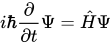
In quantum mechanics the Schrödinger equation,

,

expresses the time evolution of the state vector by the action of the Hamiltonian which is an operator mapping state vectors to state vectors.

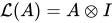
In the more general formulation of John von Neumann, statistical states and ensembles are expressed by density operators rather than state vectors. In this context the time evolution of the density operator is expressed via the von Neumann equation in which density operator is acted upon by a superoperator mapping operators to operators. It is defined by taking the commutator with respect to the Hamiltonian operator:

where

As commutator brackets are used extensively in quantum mechanics this explicit superoperator presentation of the Hamiltonian's action is typically omitted.

Derivatives of functions on the space of operators

[edit]

When considering an operator valued function of operators as for example when we define the quantum mechanical Hamiltonian of a particle as a function of the position and momentum operators, we may (for whatever reason) define an “Operator Derivative” as a superoperator mapping an operator to an operator.

For example, if then its operator derivative is the superoperator defined by:

This “operator derivative” is simply the Jacobian matrix of the function (of operators) where one simply treats the operator input and output as vectors and expands the space of operators in some basis. The Jacobian matrix is then an operator (at one higher level of abstraction) acting on that vector space (of operators).

References

[edit]
Revisions and contributorsEdit on WikipediaRead on Wikipedia
from Grokipedia
In , a superoperator, also known as a linear superoperator or quantum map, is a linear transformation that acts on the space of linear operators, such as matrices or observables, to describe the dynamics of . These maps are essential for modeling open quantum systems where interactions with an environment lead to non-unitary evolution, contrasting with the unitary transformations of closed systems. Superoperators can be mathematically represented in various equivalent forms, including the Kraus operator decomposition, where a quantum channel Φ\Phi applied to a density operator ρ\rho is given by Φ(ρ)=kKkρKk\Phi(\rho) = \sum_k K_k \rho K_k^\dagger, with the Kraus operators {Kk}\{K_k\} satisfying the completeness relation kKkKk=I\sum_k K_k^\dagger K_k = I to ensure trace preservation. This form highlights their action as higher-dimensional objects, often conceptualized in Liouville space, where the operator space is vectorized into a larger . The Liouvillian L\mathcal{L}, a specific type of superoperator, generates the time evolution of the density operator via the ρt=Lρ=i[H,ρ]+D[ρ]\frac{\partial \rho}{\partial t} = \mathcal{L} \rho = -\frac{i}{\hbar} [H, \rho] + \mathcal{D}[\rho], incorporating both Hamiltonian dynamics and dissipative terms. Key properties of superoperators include linearity, which preserves statistical mixtures of states; trace preservation, ensuring the total probability remains unity; Hermiticity preservation, ensuring that Hermitian input operators map to Hermitian outputs; and complete positivity, which preserves the positivity of density operators and guarantees physical validity even when tensoring with ancillary systems. Complete positivity is verified through the Choi-Jamiłkowski isomorphism, mapping the superoperator to a positive semidefinite operator in an enlarged space. These attributes make superoperators foundational in quantum information theory for analyzing processes like decoherence, quantum error correction, and noisy quantum channels. Examples include the amplitude damping channel, which models energy relaxation, and the depolarizing channel, which uniformly mixes states toward the maximally mixed state.

Definition and Formalism

General Definition

A superoperator, also referred to as a superoperator map, is a linear transformation that acts on the of linear operators defined on a H\mathcal{H}. Formally, it belongs to the space of bounded linear maps L(B(H))\mathcal{L}(\mathcal{B}(\mathcal{H})), where B(H)\mathcal{B}(\mathcal{H}) denotes the of bounded linear operators on H\mathcal{H}. This framework provides a higher-level for operations within quantum theory, where the domain and codomain are themselves operator spaces. Unlike conventional linear operators, which act directly on vectors in the to transform states, superoperators apply to operators—such as density matrices or observables—thereby facilitating the description of composite transformations in . This distinction enables superoperators to model processes like quantum evolutions and information transfers without explicitly resolving underlying state representations, which is essential for analyzing open quantum systems and effects. The concept of superoperators traces its origins to foundational developments in during the mid-20th century, building on John von Neumann's pioneering work in operator algebras from . Von Neumann's formulation of in terms of laid the groundwork for treating transformations on operator spaces, particularly through equations like the Liouville-von Neumann equation, which implicitly employs superoperator-like structures. The explicit terminology and broader application in gained prominence in subsequent decades, particularly in and open systems theory.

Mathematical Formulation

A superoperator Φ\Phi is mathematically formulated as a linear transformation that maps linear operators on a to other linear operators on the same or a different . In standard notation, for a H\mathcal{H}, the superoperator acts as Φ:B(H)B(H)\Phi: \mathcal{B}(\mathcal{H}) \to \mathcal{B}(\mathcal{H}), where B(H)\mathcal{B}(\mathcal{H}) is the of bounded linear operators on H\mathcal{H}, and Φ(A)B(H)\Phi(A) \in \mathcal{B}(\mathcal{H}) for any AB(H)A \in \mathcal{B}(\mathcal{H}). The defining property of ensures that Φ(αA+βB)=αΦ(A)+βΦ(B)\Phi(\alpha A + \beta B) = \alpha \Phi(A) + \beta \Phi(B) for all A,BB(H)A, B \in \mathcal{B}(\mathcal{H}) and complex scalars α,βC\alpha, \beta \in \mathbb{C}. More generally, superoperators can map between operators on distinct Hilbert spaces, formulated as Φ:B(H1)B(H2)\Phi: \mathcal{B}(\mathcal{H}_1) \to \mathcal{B}(\mathcal{H}_2) for Hilbert spaces H1\mathcal{H}_1 and H2\mathcal{H}_2. In applications involving quantum states, such as density operators—which are trace-class operators that are positive semidefinite with unit trace—the domain is often restricted to ensure the superoperator preserves relevant physical properties like positivity and normalization. Abstractly, this is expressed as Φ:L(H)L(H)\Phi: \mathcal{L}(\mathcal{H}) \to \mathcal{L}(\mathcal{H}), where L(H)\mathcal{L}(\mathcal{H}) denotes the of all linear operators on H\mathcal{H}, equipped with the Hilbert-Schmidt inner product for a structure. Since the space B(H)\mathcal{B}(\mathcal{H}) (or L(H)\mathcal{L}(\mathcal{H})) is finite-dimensional with dimension d2d^2 when dimH=d\dim \mathcal{H} = d, any superoperator Φ\Phi is uniquely determined by its action on a complete basis {Ei}i=1d2\{E_i\}_{i=1}^{d^2} of operators, where specifying Φ(Ei)\Phi(E_i) for each basis element fully defines Φ\Phi via linearity. This basis-dependent characterization facilitates computational representations and analysis without loss of generality.

Properties and Structure

Linearity and Composition

Superoperators, as linear transformations acting on the space of bounded linear operators B(H)\mathcal{B}(\mathcal{H}) on a Hilbert space H\mathcal{H}, inherit their linearity from the vector space structure of B(H)\mathcal{B}(\mathcal{H}) over the complex numbers C\mathbb{C}. Specifically, for any superoperator Φ:B(H)B(H)\Phi: \mathcal{B}(\mathcal{H}) \to \mathcal{B}(\mathcal{H}), scalars c,dCc, d \in \mathbb{C}, and operators A,BB(H)A, B \in \mathcal{B}(\mathcal{H}), the linearity condition holds as Φ(cA+dB)=cΦ(A)+dΦ(B).\Phi(cA + dB) = c\Phi(A) + d\Phi(B). This follows directly from the definition of a linear map between vector spaces, where addition and scalar multiplication in B(H)\mathcal{B}(\mathcal{H}) are defined pointwise: (cA+dB)ψ=cAψ+dBψ(cA + dB) \psi = c A \psi + d B \psi for all ψH\psi \in \mathcal{H}, and Φ\Phi preserves these operations by construction. The composition of superoperators provides a fundamental , endowing the set of all superoperators with the properties of a . For two superoperators Φ,Ψ:B(H)B(H)\Phi, \Psi: \mathcal{B}(\mathcal{H}) \to \mathcal{B}(\mathcal{H}), the composition is defined by (ΦΨ)(A)=Φ(Ψ(A))(\Phi \circ \Psi)(A) = \Phi(\Psi(A)) for all AB(H)A \in \mathcal{B}(\mathcal{H}). This operation is associative, as (Φ(ΨΞ))(A)=Φ(Ψ(Ξ(A)))=((ΦΨ)Ξ)(A)(\Phi \circ (\Psi \circ \Xi))(A) = \Phi(\Psi(\Xi(A))) = ((\Phi \circ \Psi) \circ \Xi)(A) for any third superoperator Ξ\Xi, mirroring the associativity of on the space of operators. The identity superoperator I:B(H)B(H)\mathcal{I}: \mathcal{B}(\mathcal{H}) \to \mathcal{B}(\mathcal{H}), given by I(A)=A\mathcal{I}(A) = A, acts as the neutral element, satisfying ΦI=IΦ=Φ\Phi \circ \mathcal{I} = \mathcal{I} \circ \Phi = \Phi. Since the composition of linear maps is itself linear, the semigroup consists entirely of linear transformations. For composite with H=H1H2\mathcal{H} = \mathcal{H}_1 \otimes \mathcal{H}_2, the structure allows superoperators on subsystems to combine naturally. Given Φ1:B(H1)B(H1)\Phi_1: \mathcal{B}(\mathcal{H}_1) \to \mathcal{B}(\mathcal{H}_1) and Φ2:B(H2)B(H2)\Phi_2: \mathcal{B}(\mathcal{H}_2) \to \mathcal{B}(\mathcal{H}_2), their Φ1Φ2:B(H)B(H)\Phi_1 \otimes \Phi_2: \mathcal{B}(\mathcal{H}) \to \mathcal{B}(\mathcal{H}) acts on product operators as (Φ1Φ2)(A1A2)=Φ1(A1)Φ2(A2)(\Phi_1 \otimes \Phi_2)(A_1 \otimes A_2) = \Phi_1(A_1) \otimes \Phi_2(A_2) and extends by linearity to the full space B(H1H2)\mathcal{B}(\mathcal{H}_1 \otimes \mathcal{H}_2), which is spanned by such products. This construction preserves linearity and enables the description of independent operations on multipartite systems. Invertibility of a superoperator Φ:B(H)B(H)\Phi: \mathcal{B}(\mathcal{H}) \to \mathcal{B}(\mathcal{H}) requires it to be a bijective , meaning Φ\Phi is both injective and surjective onto B(H)\mathcal{B}(\mathcal{H}), with an inverse superoperator Ψ\Psi satisfying ΨΦ=ΦΨ=I\Psi \circ \Phi = \Phi \circ \Psi = \mathcal{I}. In finite-dimensional cases, where dimH=n<\dim \mathcal{H} = n < \infty and dimB(H)=n2\dim \mathcal{B}(\mathcal{H}) = n^2, this is equivalent to Φ\Phi having full rank when vectorized into an n2×n2n^2 \times n^2 matrix. For superoperators representing physical quantum channels—those that are completely positive and trace-preserving—additional conditions apply: the inverse must also be completely positive and trace-preserving, often restricting invertible channels to unitary embeddings with an ancilla, such as E(ρ)=U(ρω)U\mathcal{E}(\rho) = U (\rho \otimes \omega) U^\dagger where UU is unitary and ω\omega is a fixed operator. In general, many superoperators, particularly those modeling dissipative dynamics, are not invertible due to information loss.

Adjoint and Trace Preservation

The adjoint superoperator Φ\Phi^\dagger of a linear superoperator Φ:L(H)L(H)\Phi: \mathcal{L}(\mathcal{H}) \to \mathcal{L}(\mathcal{H}), where L(H)\mathcal{L}(\mathcal{H}) denotes the space of linear operators on a H\mathcal{H}, is defined such that it preserves the Hilbert-Schmidt inner product: B,Φ(A)=[Φ](/page/Adjoint)(B),A\langle B, \Phi(A) \rangle = \langle [\Phi^\dagger](/page/Adjoint)(B), A \rangle for all operators A,BL(H)A, B \in \mathcal{L}(\mathcal{H}), with the inner product given by X,Y=Tr(XY)\langle X, Y \rangle = \operatorname{Tr}(X^\dagger Y). This leads to the explicit relation Tr(BΦ(A))=Tr(([Φ](/page/Adjoint)(B))A)\operatorname{Tr}(B^\dagger \Phi(A)) = \operatorname{Tr} \bigl( ([\Phi^\dagger](/page/Adjoint)(B))^\dagger A \bigr) for all A,BA, B. In common cases, such as when Φ\Phi arises from a unitary evolution Φ(A)=UAU\Phi(A) = U A U^\dagger for a unitary UU, the adjoint takes the form Φ(B)=UBU\Phi^\dagger(B) = U^\dagger B U, preserving the structure of conjugation. For more general quantum operations represented in the Heisenberg picture, the adjoint maps observables in a dual manner, ensuring consistency with expectation values. Trace-preserving superoperators are those that maintain the trace of input operators, satisfying Tr(Φ(ρ))=Tr(ρ)\operatorname{Tr}(\Phi(\rho)) = \operatorname{Tr}(\rho) for all density operators ρ\rho. This property is fundamental in quantum information theory, as it guarantees that Φ\Phi conserves the total probability when acting on normalized states, making it indispensable for modeling physical processes like quantum channels. For instance, in the context of noisy quantum evolutions, trace preservation ensures that the output remains a valid probability distribution, distinguishing legitimate maps from those that would violate normalization. A prominent class of such maps is the completely positive trace-preserving (CPTP) maps, which combine trace preservation with complete positivity. Complete positivity requires that the extended map idkΦ\mathrm{id}_k \otimes \Phi, where idk\mathrm{id}_k is the identity on an arbitrary kk-dimensional ancillary space, maps positive semidefinite operators to positive semidefinite ones for all k1k \geq 1. This stronger condition ensures that Φ\Phi preserves positivity even for entangled inputs, preventing unphysical negativity in the output density operators and thus capturing all valid quantum dynamical maps. CPTP maps are the standard framework for quantum channels, underpinning error correction and information transmission protocols. Self-adjoint superoperators exhibit symmetry under the operation, satisfying Φ=Φ\Phi^\dagger = \Phi. This Hermitian property implies that B,Φ(A)=Φ(B),A\langle B, \Phi(A) \rangle = \langle \Phi(B), A \rangle for all A,BA, B, reflecting a balanced action in the operator space akin to matrices in standard . Such superoperators often arise in equilibrium descriptions or symmetric dynamics, where the map treats bras and kets equivalently in the superoperator formalism.

Representations

Matrix and Vectorized Forms

In , superoperators acting on linear operators can be represented in matrix form through vectorization, which maps an operator to a vector in a higher-dimensional space. The vectorization operator, denoted vec\operatorname{vec}, takes a d×dd \times d matrix AA and stacks its columns into a d2×1d^2 \times 1 column vector; for example, if A=klAklklA = \sum_{kl} A_{kl} |k\rangle\langle l|, then vec(A)=klAklkl\operatorname{vec}(A) = \sum_{kl} A_{kl} |k\rangle \otimes |l\rangle. This process linearizes the action of a superoperator Φ\Phi such that vec(Φ(A))=MΦvec(A)\operatorname{vec}(\Phi(A)) = \mathbf{M}_\Phi \operatorname{vec}(A), where MΦ\mathbf{M}_\Phi is the d2×d2d^2 \times d^2 matrix representation of Φ\Phi. The dimension of MΦ\mathbf{M}_\Phi follows directly from the vectorization: for a Hilbert space of dimension dd, the space of operators is d2d^2-dimensional, so MΦ\mathbf{M}_\Phi operates on Cd2\mathbb{C}^{d^2}. This matrix form facilitates numerical computations, such as solving master equations or performing , by reducing superoperator actions to standard matrix-vector multiplications. To illustrate, consider a simple unitary channel on a qubit (d=2d=2) defined by the Pauli XX operator, X=(0110)X = \begin{pmatrix} 0 & 1 \\ 1 & 0 \end{pmatrix}, where Φ(ρ)=XρX\Phi(\rho) = X \rho X^\dagger. The vectorized form is vec(Φ(ρ))=(XXˉ)vec(ρ)\operatorname{vec}(\Phi(\rho)) = (X \otimes \bar{X}) \operatorname{vec}(\rho), where Xˉ\bar{X} denotes the complex conjugate of XX (and Xˉ=X\bar{X} = X since XX is real); since X=XX^\dagger = X, this yields the tensor product structure. Explicitly, XX=(0001001001001000)X \otimes X = \begin{pmatrix} 0 & 0 & 0 & 1 \\ 0 & 0 & 1 & 0 \\ 0 & 1 & 0 & 0 \\ 1 & 0 & 0 & 0 \end{pmatrix}
Add your contribution
Related Hubs
User Avatar
No comments yet.