Hubbry Logo
SwatheSwatheMain
Open search
Swathe
Community hub
Swathe
logo
8 pages, 0 posts
0 subscribers
Be the first to start a discussion here.
Swathe
Swathe
from Wikipedia
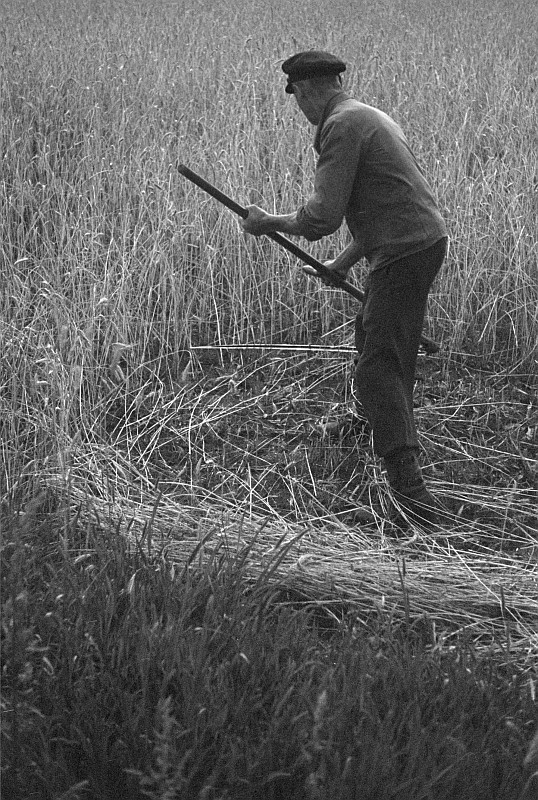
A mower with a scythe cuts a swathe through the crop.
A mechanical swather.

A swathe (/swð/ British English, rhymes with "bathe"; or swath /swɒθ/ American English, rhymes with "cloth") is the strip of cut crop made by a scythe or a mowing-machine. A mower with a scythe cuts a swathe along the mowing-edge leaving the uncut grass to the right and the cut grass laid in a windrow to the left on the previously mown land. The swathe width depends on the blade length, the nature of the crop, and the mower, but for grass is usually about 1.5 metres (4.9 ft) wide. When mowing in a team the mowers start at the edge of a meadow in a staggered line, then proceed clockwise, leaving a series of swathes with windrows and finishing in the middle.[1][2]

The scythe has generally been replaced by machinery, such as a mechanical swather or a combine harvester, which cut much wider swathes while forming windrows. Early in the introduction of machinery, when horses or tractors had to precede a towed cutter, it was still necessary for mowers with scythes to open up a swathe wide enough to take the machine before it could start.[2][1]

Swathe width of a satellite.

Swathe width may also refer to the width of any repetitively cut, scanned or sampled strip such as in aerial mapping, lidar, radar or sonar scans or multibeam echosounder bathymetric surveys collected by a moving satellite, aircraft or ship.[3][4]

See also

[edit]

References

[edit]
Revisions and contributorsEdit on WikipediaRead on Wikipedia
from Grokipedia
Swathe is an English verb meaning to wrap, bind, or envelop something closely, often with or fabric, and as a , it refers to a , wrapping band, or an enveloping layer. The term originates from swathian (verb) and swæthu (noun), denoting a track or band, with roots in Proto-Germanic languages related to binding or covering. In agricultural contexts, a related form "swath" (often interchangeable with "swathe" in ) describes a row of cut grass, grain, or crop left by a or , forming a continuous strip for drying or collection. Historically, swathing has been associated with practices like infants or binding wounds, symbolizing protection and care, as seen in ancient Near Eastern customs where newborns were wrapped in bands of cloth to secure their limbs. In modern usage, the verb commonly appears in descriptions of enveloping natural phenomena, such as "mountains swathed in ," or applications like bandaging injuries. The noun extends metaphorically to denote a broad area or expanse, as in "vast swathes of land," particularly in discussions of environmental impact, like rainforest clearance for . Distinctions in spelling and pronunciation persist regionally: favors "swath" (pronounced /swɒθ/ or /swɔːθ/) for the form, while "swathe" (pronounced /sweɪð/) is retained for the verb in both British and American varieties, reflecting evolving linguistic preferences since the period. This duality highlights swathe's versatility across literal, figurative, and technical domains, from everyday wrapping to specialized farming techniques.

Noun Usage

Agricultural Definition

In agriculture, a swathe refers to a row or strip of cut grain, grass, or other crop as it falls or lies when mown or reaped, often collectively denoting the mown crop lying on the ground in such a form. This term specifically describes the path or band of severed vegetation left behind during harvesting operations. Mowers using scythes begin at the meadow's edge and proceed around the field, depositing the cut material on previously mown ground to form windrows that could dry evenly before further processing. This method prevents trampling of standing crops and facilitates efficient coverage of the area. Traditional tools like the scythe—a handheld implement with a long, curved blade mounted on a snath—were used to create these initial narrow swathes, which served as paths for subsequent passes or larger equipment. In modern farming, swathers or windrowers have adapted this by cutting wider swathes—often several meters across—and arranging the into neat, centralized windrows for accelerated drying, baling, or direct combining. These machines, typically self-propelled, can achieve working widths of up to 5.5 meters or more, enhancing efficiency in large-scale operations for hay, small grains, or crops.

Broader Applications

Beyond its agricultural origins, the noun "swathe" denotes a long, narrow strip or an extensive area, often applied to landscapes or territories. For example, vast swathes of land may be cleared for urban development projects, while swathes of can be devastated by wildfires, leaving broad tracts scorched and barren. Metaphorically, "swathe" extends to describe large segments of or demographics influenced by broader events or trends. Phrases like "swathes of the " commonly refer to substantial portions affected by social, economic, or crises, such as reforms or pandemics that impact wide demographics. In technical contexts, particularly and mapping, "swathe" refers to the width of a scanned or imaged strip captured by technologies, including , , , , and systems. For instance, surveys in the , such as those by the , achieve a swathe width of approximately 600 meters when conducted from an altitude of 800 meters above ground level. Similarly, systems like the StarFish 452F Pro operate at 450 kHz to produce high-resolution images over swathes up to several hundred meters wide, depending on water depth. Although "swath" is often used interchangeably, especially in , "swathe" is the preferred variant in for denoting such strips or areas.

Verb Usage

Primary Meaning

The verb swathe primarily means to wrap, bind, or swaddle something tightly with bandages, cloth, or similar material, often for the purposes of , immobilization, or support. This action emphasizes a secure and comprehensive enclosure, typically involving multiple layers or bands to ensure the item or body part is fully covered. Common applications include bandaging wounds, as in "swathe a limb in " to secure dressings and prevent movement during healing. It also encompasses infants by wrapping them in cloth to promote calm, historically involving tight binding for straight limb positioning but now following safety guidelines to allow hip movement and prevent risks like . Contemporary guidelines from the emphasize safe practices: only while , stopping once the infant shows signs of rolling (typically 2-4 months), and ensuring loose lower wrapping for hip health to mitigate risks of and developmental issues. Additionally, the term applies to enveloping objects, such as "swathe a in ," where the focus is on complete bundling for preservation or presentation. In historical medical contexts, swathing was employed in ancient Egyptian practices to wrap completely in strips after , aiding preservation for the over a 70-day process. Similarly, injured individuals, including soldiers, were swathed in bandages made from or cloth in ancient civilizations like and to immobilize wounds and staunch bleeding. Compared to the wrap, swathe conveys a greater degree of tightness and totality, implying not just but often layered binding for restraint or , whereas wrap can denote looser or simpler coverings. The form, denoting or wrapping itself, directly relates to this sense as the material used in the binding process.

Extended Contexts

In figurative usage, "swathe" denotes the act of enveloping or surrounding something completely, often in a non-physical or atmospheric sense, extending beyond the literal binding of objects. This metaphorical application evokes a of immersion or obscuration, as seen in descriptions of natural landscapes where mountains are swathed in , creating an of ethereal concealment. Similarly, urban scenes may be portrayed as a swathed in , emphasizing visual and sensory that alters . Specialized employs of the verb appear in literature and rhetoric, where "swathe" conveys the wrapping of abstract concepts or emotions in layers of ambiguity or intensity. For instance, ideas may be swathed in mystery, suggesting a deliberate shrouding to heighten intrigue or depth. In 19th-century prose, frequently utilized this to depict environments enveloped in atmospheric or emotional veils, enhancing thematic immersion. This persists in modern , where emotions are swathed in to explore psychological states. In , "swathe" describes the elegant draping of fabric to envelop the body, implying a fluid, artistic covering rather than rigid constriction. Designers might swathe a in to create sweeping, body-conforming layers that evoke movement and grace, a technique rooted in historical couture practices. This usage highlights aesthetic envelopment, distinct from utilitarian wrapping. Contemporary examples illustrate "swathe" in environmental and decorative contexts, underscoring its adaptability to describe pervasive coverings. smoke can swathe entire regions in a hazardous , obscuring visibility and prompting evacuations, as reported in coverage of major blazes like those in . Decoratively, holiday lights swathe buildings in festive illumination, transforming architecture into glowing spectacles during winter celebrations. These applications reinforce the verb's role in capturing transformative, all-encompassing overlays in everyday and crisis scenarios.

Etymology and History

Origins

The word "swathe" originates from Old English swaþian, a meaning "to swaddle" or "to wrap up," and swæþ, a denoting "a track," "trace," or "band." These forms trace back further to Proto-Germanic swaþō or *swath-, which carried connotations of a "trace," "path," or "wind-swept place," evoking the idea of a linear mark or binding strip left behind. The earliest recorded uses of "swathe" appear in the period, prior to 1150, with the form swathian attested in texts describing acts of wrapping or binding. By the era, around the , it had evolved into more frequent usage in , initially as a applied to binding infants in clothes or securing wounds with bandages, reflecting its core sense of enveloping or restraining. "Swathe" shares cognates across , indicating a shared Proto-Germanic heritage; for instance, Old Norse svaða meant "to swathe" or "to bind," while swad or modern Dutch zwadel referred to clothes or binding bands. These parallels underscore the word's ancient roots in concepts of confinement and linear extension, common to early Germanic-speaking communities. In its formative stages, the and forms of "swathe" were closely intertwined, with the denoting the act of wrapping evolving from the 's imagery of a band-like strip or path, such that early applications linked the process of binding () directly to the resulting enveloped or traced form (). This connection highlights how the term's dual usage emerged from practical, everyday actions involving cloth and movement in society.

Evolution of Meanings

During the medieval period, the verb form of "swathe" primarily denoted the act of wrapping or binding, originating from Old English swaþian, which referred to swaddling infants or enclosing with bands; by the early 14th century, this meaning had expanded to include general bandaging, reflecting broader applications in medical and daily practices. Concurrently, the noun "swathe" evolved from Old English swæþ or swaðu, initially signifying a track or trace, to describe a line or ridge of mown grass or grain by the late 15th century, as documented in early farming contexts where it denoted the strip left by a scythe's cut. This shift marked a transition from personal binding to agricultural utility during the Renaissance, with 16th-century texts on husbandry implicitly referencing such crop strips in discussions of harvesting techniques. In the 18th and 19th centuries, amid the Agricultural Revolution and movements, the noun "swathe" extended beyond immediate crop rows to signify broader strips of land, aligning with systematic field divisions and improved mowing practices that emphasized efficient land use. The verb, influenced by Romantic literature, broadened to metaphorical enveloping, evoking atmospheric immersion in ; for instance, William Wordsworth's 1807 poem "I Wandered Lonely as a Cloud" was inspired by a "long belt" of daffodils observed by William and Dorothy in 1802, as recorded in Dorothy's journal, which later contributed to metaphorical uses of the term for expansive natural features. This literary usage infused the term with sensory and emotional depth, paralleling the era's emphasis on sublime environments. The saw further diversification in the post-industrial era. Metaphorically, the noun appeared in to denote large expanses, as in reports of "vast swathes of territory" lost or gained in WWII campaigns, extending its agricultural origins to geopolitical scales. Regional variations emerged distinctly: consistently favored "swathe" for both wrapping and strip senses across literal and figurative uses, while predominantly adopted "swath" for the noun denoting strips or areas, preserving "swathe" mainly for the verb of binding.

References

Add your contribution
Related Hubs
User Avatar
No comments yet.