Hubbry Logo
Swati MohanSwati MohanMain
Open search
Swati Mohan
Community hub
Swati Mohan
logo
8 pages, 0 posts
0 subscribers
Be the first to start a discussion here.
Swati Mohan
Swati Mohan
from Wikipedia

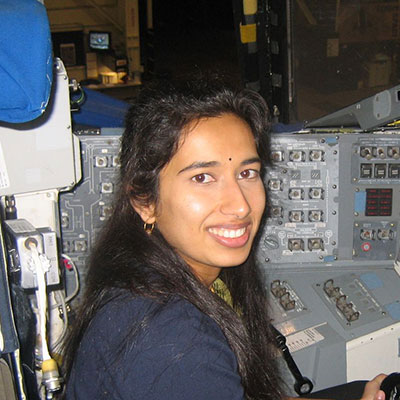
Swati Mohan is an Indian-American aerospace engineer and was the Guidance and Controls Operations Lead on the NASA Mars 2020 mission.[1][2][3]

Early life and education

[edit]

Mohan was born in Bengaluru, Karnataka, India, and emigrated to the United States when she was one year old.[4][5][6][7] She became interested in space upon seeing Star Trek at age 9.[8] She had originally planned to be a pediatrician but at the age of 16 took a physics class and decided to study engineering as a way to pursue a career in space exploration.[9][8] She studied Mechanical and Aerospace Engineering at Cornell University, before completing her master's degree and Ph.D. in Aeronautics and Astronautics at Massachusetts Institute of Technology.[4][10][11]

She researched on-orbit operations in the Space Systems Laboratory (MIT) with Professor Dave Miller. She worked with the Synchronized Position Hold Engage and Reorient Experimental Satellite (SPHERES),[12] SWARM, and ALMOST testbeds. With SPHERES, she had multiple tests performed on the International Space Station (ISS), including some by fellow MIT alumni astronauts Dan Tani[13] and Greg Chamitoff.[14] She also worked on the SPHERES Zero Robotics competition for middle and high school students.

At MIT, she was involved in the Graduate Student Council, Sidney-Pacific Residence Hall (including Sidney-Pacific Intercultural Exchange (SPICE)),[15] and Graduate Association of Aeronautics and Astronautics (GA^3) student organizations.[16]

Work at NASA

[edit]
Mohan studies monitors in mission control on 18 February 2021, at NASA's Jet Propulsion Laboratory in Pasadena, California[17]

Mohan works at NASA's Jet Propulsion Laboratory in Pasadena, California, and is the Guidance & Controls Operations Lead for the Mars 2020 mission.[1] Mohan joined the Mars 2020 team in 2013, shortly after the team was assembled.[18][19] In her role, she was responsible for ensuring the spacecraft that carries the rover was properly oriented during its travel to Mars and when landing on the planet's surface.[18][11][20] She narrated the landing events from inside mission control as the Perseverance rover landed on Mars on 18 February 2021.[1] She announced "Touchdown is confirmed," after which the JPL Mission Control Center erupted in celebration, clapping and fist bumping (socially distant due to COVID-19).[21]

Mohan explained the navigation system during the landing: "Perseverance will be the first mission to use Terrain-Relative Navigation. While it’s descending on the parachute, it will actually be taking images of the surface of Mars and determining where to go based on what it sees. This is finally like landing with your eyes open — having this new technology really allows Perseverance to land in much more challenging terrain than Curiosity, or any previous Mars mission, could."[22]

Previously, she had worked on the Cassini mission to Saturn,[9][18] and GRAIL, a pair of small spacecraft which mapped the gravitational field of the Moon.[9]

Selected publications

[edit]
  • Babuscia, Alessandra; Van de Loo, Mark; Wei, Quantum J.; Pan, Serena; Mohan, Swati; Seager, Sara (2014). "Inflatable antenna for cubesat: fabrication, deployment and results of experimental tests". 2014 IEEE Aerospace Conference. Big Sky, MT: IEEE: 1–12.[23]
  • Mohan, Swati; Miller, David (18 August 2008). "SPHERES Reconfigurable Control Allocation for Autonomous Assembly". AIAA Guidance, Navigation and Control Conference and Exhibit. Honolulu, Hawaii: American Institute of Aeronautics and Astronautics.[24]
  • Scharf, Daniel P.; Regehr, Martin W.; Vaughan, Geoffery M.; Benito, Joel; Ansari, Homayoon; Aung, MiMi; Johnson, Andrew; Casoliva, Jordi; Mohan, Swati; Dueri, Daniel; Acikmese, Behcet (2014-03). "ADAPT demonstrations of onboard large-divert Guidance with a VTVL rocket". 2014 IEEE Aerospace Conference. Big Sky, MT, USA: IEEE: 1–18.[25]
  • Mohan, Swati; Miller, David (10 August 2009). "SPHERES Reconfigurable Framework and Control System Design for Autonomous Assembly". AIAA Guidance, Navigation, and Control Conference. Chicago, Illinois: American Institute of Aeronautics and Astronautics.[26]
  • Mohan, Swati; Miller, David W. (2014-09). "Dynamic Control Model Calculation: A Model Generation Architecture for Autonomous On-Orbit Assembly". Journal of Spacecraft and Rockets. 51 (5): 1430–1453.[27]

Family

[edit]

Mohan is married to Santhosh Nadipuram, a pediatric infectious disease physician and research scientist at Cedars-Sinai in Los Angeles and clinical instructor in pediatric infectious disease at David Geffen School of Medicine at UCLA. Mohan and Nadipuram have two daughters, one of whom was born after Mohan began working on the Mars 2020 project in 2013.[28][8]

References

[edit]
[edit]
Revisions and contributorsEdit on WikipediaRead on Wikipedia
from Grokipedia
Swati Mohan is an Indian-American aerospace engineer best known for her pivotal role as the Guidance, Navigation, and Control (GNC) Operations Lead for NASA's Mars 2020 Perseverance rover mission, during which she narrated the historic landing on the Martian surface on February 18, 2021, announcing "Touchdown confirmed!" after a seven-month journey covering 293 million miles. Born in and immigrating to the at the age of one, Mohan developed a passion for in childhood, inspired by watching with her family, which fueled her pursuit of a career in . She earned a in Mechanical and from in 2004, where she conducted undergraduate research on attitude control systems under Professor Mark Campbell, graduating a semester early to advance her studies. Mohan then pursued graduate work at the (MIT), obtaining both a and a Ph.D. in Aeronautics and Astronautics, with her doctoral thesis focusing on the SPHERES experiment involving autonomous satellite formations tested on the . Following her education, Mohan joined NASA's Jet Propulsion Laboratory (JPL) in Pasadena, California, where she contributed to several high-profile missions, including the Cassini spacecraft's exploration of Saturn and its moons, as well as the GRAIL mission to map the Moon's gravity field. In 2013, she joined the Mars 2020 team as the GNC subsystem architect, overseeing the design, testing, and operations of the systems that enabled the Perseverance rover to land within approximately five meters of its target aim point, achieving the most precise landing in Mars mission history—while collecting rock samples for potential future return to Earth and deploying the Ingenuity helicopter for the first powered flight on another planet. As of 2025, Mohan serves as the Technical Group Supervisor for JPL's Guidance, Navigation, and Control Systems engineering group, a position she assumed in March 2021, and as the Mars Launch System Chief Engineer for the Mars Sample Return mission, continuing to advance NASA's deep space exploration efforts.

Early life and education

Early life

Swati Mohan was born in Bengaluru, , , and emigrated to the with her family at the age of one, settling in the Northern Virginia-Washington, D.C., metropolitan area. As an Indian immigrant family, they navigated cultural adjustments while prioritizing educational opportunities in their new environment. Her early fascination with began at age nine, sparked by watching Star Trek: The Next Generation as a family activity, which introduced her to visions of and scientific discovery. Throughout much of her childhood, Mohan aspired to become a pediatrician, drawn to the idea of helping children through . This path shifted at age sixteen during her first high school physics class at , where an inspiring teacher connected abstract concepts to real-world applications, igniting her interest in . Her growing passion for STEM was reinforced through early involvement in science-related pursuits, including a internship at after her junior year.

Education

Swati Mohan earned a Bachelor of Science degree in Mechanical and Aerospace Engineering from Cornell University in 2004, graduating a semester early from the Sibley School of Mechanical and Aerospace Engineering. During her undergraduate studies, Mohan completed internships at NASA's Goddard Space Flight Center, Kennedy Space Center, and Jet Propulsion Laboratory, where she gained practical exposure to aerospace engineering projects, including work on the Cassini mission at JPL. During her time at Cornell, she also conducted research on CubeSat attitude control systems under Professor Mark Campbell. Following her bachelor's degree, Mohan enrolled in the Massachusetts Institute of Technology in 2005, where she obtained both a and a in Aeronautics and Astronautics from the Space Systems Laboratory. Her PhD, completed in 2010, centered on the SPHERES (Synchronized Position Hold Engage Reorient Experimental Satellites) experiment aboard the , with her titled Quantitative Selection and Design of Model Generation Architectures for On-Orbit Autonomous Assembly, which explored algorithms and frameworks for enabling autonomous reconfiguration and assembly of satellite systems in space.

Professional career

Internships and early roles

Swati Mohan's professional journey began with internships at during her high school and undergraduate years, providing foundational exposure to and operations. Her first internship occurred after her junior year of high school at NASA's , lasting three weeks and introducing her to the agency's work environment and research initiatives. During her undergraduate studies at Cornell University, Mohan pursued additional internships at several NASA centers to explore various aspects of space systems. These included further work at Goddard Space Flight Center, where she engaged in systems engineering tasks; at Kennedy Space Center, focusing on launch operations; and at the Jet Propulsion Laboratory (JPL), involving robotic missions. Each internship lasted several months, allowing her to build practical skills and strengthen her resume for future roles in aerospace. Following her PhD from MIT in 2010, Mohan transitioned to full-time employment at JPL, marking the start of her early professional roles in the agency's (GNC) section. In these initial positions, she contributed to preliminary mission planning and testing phases, applying her academic expertise in control systems to support ongoing space projects. This period bridged her academic background to more established engineering responsibilities at JPL.

Roles at NASA's Jet Propulsion Laboratory

Following the completion of her PhD in and from the Massachusetts Institute of Technology in 2010, Swati Mohan returned to NASA's (JPL) as a full-time (GNC) engineer. In this capacity, she contributed to the design and implementation of GNC subsystems for various , focusing on maintaining orientation, controlling trajectories, and enabling autonomous operations to ensure mission reliability across deep projects. In 2013, Mohan was promoted to the role of Guidance and Controls Operations Lead for the mission, where she oversaw team coordination for GNC activities, including subsystem integration and operational planning. This leadership position involved directing a multidisciplinary team to align technical efforts with mission objectives, drawing on her expertise in real-time control systems. In March 2021, Mohan transitioned to Technical Group Supervisor for JPL's group, a senior role that expanded her responsibilities to include mentoring junior engineers, managing staffing for multiple flight projects, and contributing to strategic planning for GNC technologies. Under her supervision, the group advanced methodologies for autonomy and precision navigation, supporting broader JPL initiatives in solar system exploration. As of 2024, Mohan serves as for the Mars Launch System at JPL, overseeing the development and integration of GNC frameworks for advanced launch and ascent vehicle technologies while continuing to guide organizational priorities in . Her current duties emphasize fostering innovation in autonomous control and trajectory management, ensuring alignment with JPL's long-term goals for interplanetary missions without direct ties to specific operational phases.

Key contributions and missions

Mars 2020 Perseverance mission

Swati Mohan served as the Guidance, Navigation, and Controls (GNC) Operations Lead for NASA's Perseverance mission starting in 2013, where she managed a team responsible for developing, testing, and operating the rover's GNC systems, with a primary focus on the entry, descent, and landing (EDL) phase. Under her leadership, the team oversaw the integration of critical technologies to ensure precise navigation during the high-risk descent to Mars' surface. A key innovation under Mohan's oversight was the Terrain Relative Navigation (TRN) system, which enabled the rover to autonomously detect and avoid surface hazards during landing by comparing real-time images to onboard maps of Jezero Crater, the mission's target site. Her team conducted extensive testing, including hardware-in-the-loop simulations, software modeling, and field trials in Earth's deserts to validate TRN's performance, boosting the landing success probability to 99% in the challenging 7.7 km by 6.6 km ellipse filled with craters and boulders. On February 18, 2021, Mohan narrated the live broadcast from NASA's Jet Propulsion Laboratory, calmly calling out key milestones during the infamous "seven minutes of terror"—the autonomous EDL sequence where the spacecraft entered the Martian atmosphere at over 19,000 km/h and decelerated using a heat shield, supersonic parachute, retro-rockets, and sky crane maneuver, with no real-time control possible from Earth due to communication delays. Her team's pre-mission simulations and rigorous rehearsals enabled flawless real-time monitoring and decision-making, culminating in her announcement: "Touchdown confirmed! Perseverance is safely on the surface of Mars, ready to begin seeking the signs of past life." The rover landed approximately 5 meters from its targeted aim point within Jezero Crater, validating the TRN system's efficacy. Following the landing, Mohan's GNC team supported surface operations, including rover mobility across Jezero Crater's terrain, precise for collecting and caching rock and soil samples intended for the future , and integration of the Ingenuity helicopter's autonomous flight systems, which relied on GNC algorithms for safe takeoffs, , and landings from the rover's perch. Ingenuity completed 72 flights over nearly three years before its mission ended on January 25, 2024, following damage to its rotor blades during its final flight. These efforts overcame ongoing challenges like dust storms and uneven through systems and continuous performance monitoring, ensuring the mission's scientific objectives advanced without interruption.

Other NASA missions

Swati Mohan's early career at (JPL) involved contributions to the Cassini mission to Saturn, where she joined as a full-time employee approximately six months prior to the spacecraft's arrival at the planet in 2004. In this role, she supported general and operations, including the processing and analysis of incoming images from Saturn's rings and moons during the initial orbital phase. She later contributed to the Gravity Recovery and Interior Laboratory () mission, launched in 2011, focusing on the orbit termination phase for the dual spacecraft in 2012. This work ensured the safe deorbiting of the satellites to prevent contamination of the lunar surface, adhering to protocols while concluding the mission's gravity mapping objectives. Mohan also participated in the Orbiting Carbon Observatory-3 (OCO-3) mission, installed on the in 2019, where she applied her (GNC) expertise to develop and validate systems for precise Earth-pointing observations of atmospheric . Her involvement helped optimize the instrument's pointing accuracy for global monitoring. In more recent efforts, Mohan served as a key member of the GNC team for the Psyche mission, launched in 2023 to study the metal-rich asteroid . She contributed to pre-launch assessments and readiness evaluations, ensuring robust and control systems for the spacecraft's deep-space trajectory and eventual rendezvous maneuvers. As of 2025, the mission remains active in its cruise phase toward arrival in 2029. Beyond these flagship missions, Mohan engaged in other JPL projects leveraging her GNC skills, such as the and Integration on the eXperiment (OpTIIX), a proposed demonstration for autonomous assembly of space telescopes that was ultimately canceled. This work built on her doctoral research in satellite formation flying, highlighting her versatility in applying autonomous control techniques to emerging exploration concepts.

Research and publications

PhD research on SPHERES

During her doctoral studies at the Massachusetts Institute of Technology from 2005 to 2010, Swati Mohan focused her research on developing algorithms for autonomous satellite using the SPHERES (Synchronized Position Hold Engage Reorient Experimental Satellites) aboard the (ISS). The SPHERES facility consists of small, free-floating satellites that simulate microgravity conditions, allowing for the testing of control systems without external inputs such as ground commands. Mohan's work built on initial pre-PhD tests starting in 2005, evolving into comprehensive experiments that matured distributed satellite technologies. Central to her were key concepts in relative navigation, collision avoidance, and cooperative control for multi- operations. Relative navigation algorithms enabled precise positioning and tracking among satellites using and ultrasonic sensors, achieving sub-centimeter accuracy in position estimates and improved measurements through dual-satellite modeling. Collision avoidance was integrated via path planning and reconfiguration methods that adapted to dynamic environments, preventing impacts during close-proximity maneuvers. Cooperative control facilitated synchronized actions among up to three SPHERES units, allowing them to operate autonomously as a team without reliance on external positioning aids. These elements were implemented in a reconfigurable framework that updated plant, actuator, and measurement models in real-time to handle changes in satellite configuration, such as during docking. Mohan conducted several thesis experiments in the ISS microgravity environment, demonstrating practical applications of her algorithms. Notable tests included formation flying sessions in 2006 and 2007, where SPHERES units executed fuel-efficient maneuvers, such as optimized position-holding and reorientation with minimal propellant use, reducing delta-V requirements by adapting control allocations dynamically. Additionally, experiments showcased the assembly of structures, including tug-based docking for modular reconfiguration, as prototyped for applications like the OpTIIX formation. These microgravity validations confirmed the algorithms' robustness, with estimators converging within seconds to support safe, efficient operations. The research laid foundational groundwork for applications in future missions involving distributed for deep , such as autonomous swarms for inspection, servicing, and large-scale structure formation in environments beyond . By maturing these technologies on the ISS, Mohan's PhD contributions advanced the feasibility of fuel-efficient, self-organizing satellite networks for missions requiring long-duration autonomy.

Selected publications

Swati Mohan's peer-reviewed publications center on guidance, navigation, and control (GNC) architectures for autonomous space operations, spanning on-orbit assembly during her doctoral research and precision landing systems in her JPL tenure. Her work emphasizes robust algorithms for cooperative spacecraft and hazard avoidance, with representative examples highlighting innovations in reconfigurable control and relative localization. A foundational contribution from her PhD era is the 2008 conference paper "SPHERES Reconfigurable Control Allocation for Autonomous Assembly," co-authored with David W. Miller and presented at the AIAA Guidance, Navigation, and Control Conference. This study introduced control allocation methods for the SPHERES free-flying satellites aboard the International Space Station, enabling autonomous assembly by dynamically adjusting for evolving system dynamics like mass redistribution during docking. The algorithms improved fault tolerance and stability in distributed formations, laying groundwork for scalable on-orbit construction. Building on this, Mohan's 2009 paper "SPHERES Reconfigurable Framework and Control System Design for Autonomous Assembly," also co-authored with and published in the AIAA Conference proceedings, advanced relative navigation strategies for cooperative satellites. It proposed a modular framework integrating and control layers to handle uncertainties in proximity operations, such as and relative motion, facilitating synchronized maneuvers in multi-agent systems. These techniques enhanced the SPHERES testbed's utility for validating protocols. In her JPL career, Mohan contributed to planetary GNC with the 2023 journal article "Implementation of a Map Relative Localization for Planetary Landing," co-authored with Andrew E. Johnson, Yang Cheng, Nikolas Trawny, and others, appearing in the Journal of Guidance, Control, and Dynamics. The paper outlined the terrain-relative navigation subsystem for the Perseverance rover's entry, descent, and landing, using onboard imaging to match real-time terrain against pre-mapped hazards for autonomous divert maneuvers. This achieved sub-kilometer accuracy, reducing landing ellipse size by orders of magnitude compared to prior missions. Mohan has approximately 10 peer-reviewed outputs, accumulating over 130 citations as of 2024, with her SPHERES-related works cited in more than 50 subsequent studies on autonomous reconfiguration. These publications have influenced standards for GNC in autonomous systems, including integration into ISS experiments and planetary probe designs for enhanced reliability in unstructured environments.

Awards, recognition, and advocacy

Professional awards

In recognition of her sustained outstanding technical leadership in advancing engineering knowledge, Swati Mohan received the JPL Principal Designation in 2023 for her work in the Guidance & Control group (3430). This prestigious internal honor at NASA's acknowledges individuals who have demonstrated exceptional contributions over an extended period, particularly in critical areas like systems that support major space missions. Mohan earned this designation following her pivotal role as the Guidance and Controls Operations Lead for the Mars 2020 Perseverance mission, where she oversaw the systems ensuring the rover's precise navigation and landing on Mars in 2021. The award underscores her post-mission leadership as supervisor of the Systems Engineering Group at JPL, building on career milestones that include contributions to multiple deep-space projects since her early work at the laboratory in 2004-2005 and re-joining full-time in 2010.

Public speaking and diversity advocacy

Swati Mohan has been an active public speaker, sharing her experiences in aerospace engineering and space exploration to inspire audiences, particularly students and young professionals. In March 2024, she delivered a keynote address at Pondicherry University in India, where she discussed Mars exploration, career paths in STEM, and the importance of international collaboration in unlocking space mysteries. In July 2024, she spoke at the European Rover Challenge in Poland, engaging with students and space enthusiasts. Earlier, in February 2021, following the successful landing of NASA's Perseverance rover, Mohan featured prominently in media interviews, including a CNN profile highlighting her role as the mission's guidance lead and her journey as an Indian-American engineer. In 2024, she engaged with Cornell University alumni and students through talks and visits, reflecting on her undergraduate path from the Sibley School of Mechanical and Aerospace Engineering to NASA leadership. Mohan advocates for greater representation of women and South Asians in , emphasizing the need for diverse teams to drive . She has highlighted how diversity at NASA's (JPL) contributed to the Perseverance mission's success, noting the presence of multiple women of color and Indian professionals in key roles. In public forums, she encourages underrepresented groups to build robust support networks, drawing from her own advice in talks: know yourself, create a support system, and actively perform at your best. As a technical group supervisor at JPL, Mohan mentors engineers across missions, fostering inclusive environments that support career growth for diverse talent. In recent engagements through 2025, Mohan has addressed work-life balance in STEM, particularly for women balancing demanding careers and family. She describes it as an ongoing challenge, especially during high-stakes projects and the pandemic with young children, prioritizing it as a key lesson for aspiring professionals. Her efforts underscore the societal impact of space exploration, promoting equity and inspiration for future generations in underrepresented communities.

Personal life

Family

Swati Mohan is married to Santhosh Nadipuram, a pediatric infectious physician and research scientist at in . The couple, who reside in , share a professional alignment in science and engineering fields, with Nadipuram contributing to pediatric health research. Mohan and Nadipuram have two daughters; the second was born while Mohan was working on NASA's Perseverance mission, which began preparations in 2013. This timing added to the challenges of her high-stakes role, as she balanced demanding mission timelines with newborn care amid the . Her husband, parents, and in-laws provided crucial support in managing family responsibilities, allowing her to maintain focus on critical operations like the rover's 2021 landing. The family actively preserves their Indian cultural heritage, with Mohan speaking at home and practicing while raising their children in the United States. This blend of traditions fosters a strong sense of identity for their daughters, integrating South Indian roots into their American upbringing.

Interests and influences

Swati Mohan maintains a deep passion for and , which continues to motivate her professional endeavors in space exploration long after her childhood exposure to the series. She has described the show as a source of inspiration that shaped her vision of humanity's potential in the cosmos, influencing her approach to missions like by emphasizing exploration and discovery. Outside of her demanding career at , Mohan pursues hobbies that provide balance and creativity, including baking and decorating elaborate cakes—such as one she crafted with fondant for the Mars landing-minus-one-year party—and exploring diverse cultures through travel to destinations like Italy, Greece, Switzerland, , and . She also enjoys immersing herself in , having completed a formal tea program in to deepen her appreciation for the beverage. These activities reflect her commitment to personal fulfillment alongside her scientific pursuits. Mohan often shares advice for aspiring engineers, emphasizing as the foundation for success: individuals should honestly assess their passions, skills, and what brings them joy to align their careers accordingly. She urges proactive pursuit of opportunities by giving one's full effort in every role and actively seeking challenges, while stressing the importance of building robust support systems to navigate professional hurdles. This guidance stems from her own experiences navigating competitive fields. Drawing from her involvement in missions like Perseverance and ongoing Mars Sample Return efforts through 2025, Mohan holds philosophical views that plays a pivotal role in humanity's future by fostering international cooperation to tackle and providing a humbling cosmic perspective on Earth's place in the . She sees these endeavors as driven by endless mysteries that expand human understanding, such as probing Mars for signs of past to prepare for eventual , ultimately uniting diverse teams in the pursuit of shared and .

References

Add your contribution
Related Hubs
User Avatar
No comments yet.