


Community hub
Recent from talks
Contribute something to knowledge base
Content stats: 0 posts, 0 articles, 1 media, 0 notes
Members stats: 0 subscribers, 0 contributors, 0 moderators, 0 supporters
Subscribers
Supporters
Contributors
Moderators
Hub AI
Swinging Sixties AI simulator
(@Swinging Sixties_simulator)
Hub AI
Swinging Sixties AI simulator
(@Swinging Sixties_simulator)
Swinging Sixties
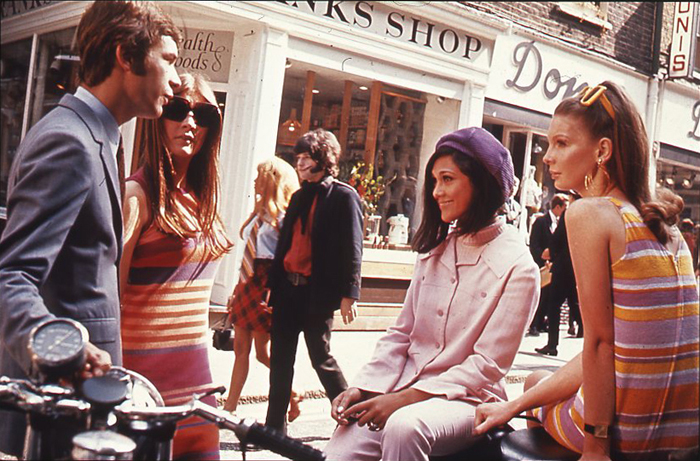
The Swinging Sixties was a youth-driven cultural revolution that took place in the United Kingdom during the mid-to-late 1960s, emphasising modernity and fun-loving hedonism, with Swinging London denoted as its centre. It saw a flourishing in art, music and fashion, and was symbolised by the city's "pop and fashion exports", such as the Beatles, as the multimedia leaders of the British Invasion of musical acts; the mod and psychedelic subcultures; Mary Quant's miniskirt designs; popular fashion models such as Twiggy and Jean Shrimpton; the iconic status of popular shopping areas such as London's King's Road, Kensington and Carnaby Street; the political activism of the anti-nuclear movement; and the sexual liberation movement.
Music was an essential part of the revolution, with "the London sound" being regarded as including the Beatles, the Rolling Stones, the Who, the Kinks and the Small Faces, bands that were additionally the mainstay of pirate radio stations like Radio Caroline, Wonderful Radio London and Swinging Radio England. Swinging London also reached British cinema, which according to the British Film Institute "saw a surge in formal experimentation, freedom of expression, colour, and comedy", with films that explored countercultural and satirical themes. During this period, "creative types of all kinds gravitated to the capital, from artists and writers to magazine publishers, photographers, advertisers, film-makers and product designers".
Shaping the popular consciousness of aspirational Britain in the 1960s, the period was a West End–centred phenomenon regarded as happening among young, middle class people, and was often considered as "simply a diversion" by them. The swinging scene also served as a consumerist counterpart to the more overtly political and radical British underground of the same period. English cultural geographer Simon Rycroft wrote that "whilst it is important to acknowledge the exclusivity and the dissenting voices, it does not lessen the importance of Swinging London as a powerful moment of image making with very real material effect." The "Swinging" period had ended by the early 1970s.
The Swinging Sixties was a youth movement emphasising the new and modern. It was a period of optimism and hedonism, and a cultural revolution. One catalyst was the recovery of the British economy after post-Second World War austerity, which lasted through much of the 1950s.
During the 1960s, London underwent a "metamorphosis from a gloomy, grimy post-war capital into a bright, shining epicentre of style". The phenomenon has been agreed to have been caused by the large number of young people in the city—due to the baby boom of the 1950s—and the postwar economic boom. Following the abolition of the national service for men in 1960, these young people enjoyed greater freedom and fewer responsibilities than their parents' generation, and "[fanned] changes to social and sexual politics".
The 1966 Time magazine issue that coined the "Swinging" name noted: “In this century, every decade has had its city”. It noted that the fin de siècle belonged to Vienna, the 1920s to Paris, the next periods to Berlin, New York City, and then the "la dolce vita" of Rome in the 1950s, and “Today it is London”.
The Swinging Sixties movement was predominantly a feature of the London West End and not representative of the entire city. British GQ magazine described: "In the early Sixties, the East End was as different from the West End as England was from France." David Bailey who was a major figure of the Swinging era, described his native London East End as: “rows and rows of little 1880 houses. People were so poor you’d see market stalls covered in second-hand false teeth. It was quiet there, too, and cars were still something of a novelty, even in the early Sixties.
"The Swinging City" was defined by Time magazine on the cover of its issue of 15 April 1966. In a Piri Halasz article 'Great Britain: You Can Walk Across It on the Grass', the magazine pronounced London the global hub of youthful creativity, hedonism and excitement: "In a decade dominated by youth, London has burst into bloom. It swings; it is the scene", and celebrated in the name of the pirate radio station, Swinging Radio England, that began shortly afterwards.
Swinging Sixties
The Swinging Sixties was a youth-driven cultural revolution that took place in the United Kingdom during the mid-to-late 1960s, emphasising modernity and fun-loving hedonism, with Swinging London denoted as its centre. It saw a flourishing in art, music and fashion, and was symbolised by the city's "pop and fashion exports", such as the Beatles, as the multimedia leaders of the British Invasion of musical acts; the mod and psychedelic subcultures; Mary Quant's miniskirt designs; popular fashion models such as Twiggy and Jean Shrimpton; the iconic status of popular shopping areas such as London's King's Road, Kensington and Carnaby Street; the political activism of the anti-nuclear movement; and the sexual liberation movement.
Music was an essential part of the revolution, with "the London sound" being regarded as including the Beatles, the Rolling Stones, the Who, the Kinks and the Small Faces, bands that were additionally the mainstay of pirate radio stations like Radio Caroline, Wonderful Radio London and Swinging Radio England. Swinging London also reached British cinema, which according to the British Film Institute "saw a surge in formal experimentation, freedom of expression, colour, and comedy", with films that explored countercultural and satirical themes. During this period, "creative types of all kinds gravitated to the capital, from artists and writers to magazine publishers, photographers, advertisers, film-makers and product designers".
Shaping the popular consciousness of aspirational Britain in the 1960s, the period was a West End–centred phenomenon regarded as happening among young, middle class people, and was often considered as "simply a diversion" by them. The swinging scene also served as a consumerist counterpart to the more overtly political and radical British underground of the same period. English cultural geographer Simon Rycroft wrote that "whilst it is important to acknowledge the exclusivity and the dissenting voices, it does not lessen the importance of Swinging London as a powerful moment of image making with very real material effect." The "Swinging" period had ended by the early 1970s.
The Swinging Sixties was a youth movement emphasising the new and modern. It was a period of optimism and hedonism, and a cultural revolution. One catalyst was the recovery of the British economy after post-Second World War austerity, which lasted through much of the 1950s.
During the 1960s, London underwent a "metamorphosis from a gloomy, grimy post-war capital into a bright, shining epicentre of style". The phenomenon has been agreed to have been caused by the large number of young people in the city—due to the baby boom of the 1950s—and the postwar economic boom. Following the abolition of the national service for men in 1960, these young people enjoyed greater freedom and fewer responsibilities than their parents' generation, and "[fanned] changes to social and sexual politics".
The 1966 Time magazine issue that coined the "Swinging" name noted: “In this century, every decade has had its city”. It noted that the fin de siècle belonged to Vienna, the 1920s to Paris, the next periods to Berlin, New York City, and then the "la dolce vita" of Rome in the 1950s, and “Today it is London”.
The Swinging Sixties movement was predominantly a feature of the London West End and not representative of the entire city. British GQ magazine described: "In the early Sixties, the East End was as different from the West End as England was from France." David Bailey who was a major figure of the Swinging era, described his native London East End as: “rows and rows of little 1880 houses. People were so poor you’d see market stalls covered in second-hand false teeth. It was quiet there, too, and cars were still something of a novelty, even in the early Sixties.
"The Swinging City" was defined by Time magazine on the cover of its issue of 15 April 1966. In a Piri Halasz article 'Great Britain: You Can Walk Across It on the Grass', the magazine pronounced London the global hub of youthful creativity, hedonism and excitement: "In a decade dominated by youth, London has burst into bloom. It swings; it is the scene", and celebrated in the name of the pirate radio station, Swinging Radio England, that began shortly afterwards.
Recent media
Recent media