Hubbry Logo
Swinging SixtiesSwinging SixtiesMain
Open search
Swinging Sixties
Community hub
Swinging Sixties
logo
8 pages, 0 posts
0 subscribers
Be the first to start a discussion here.
Swinging Sixties
Swinging Sixties
from Wikipedia

Swinging Sixties
Part of the counterculture of the 1960s
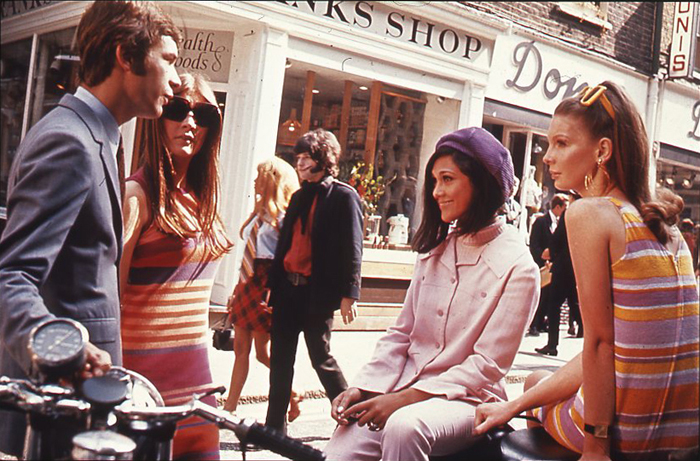
A scene in Carnaby Street, in London's West End, c. 1966
Date1960s
LocationUnited Kingdom
Also known asSwinging London
OutcomeChanging social, political and cultural values

The Swinging Sixties was a youth-driven cultural revolution that took place in the United Kingdom during the mid-to-late 1960s, emphasising modernity and fun-loving hedonism, with Swinging London denoted as its centre.[1] It saw a flourishing in art, music and fashion, and was symbolised by the city's "pop and fashion exports", such as the Beatles, as the multimedia leaders of the British Invasion of musical acts; the mod and psychedelic subcultures; Mary Quant's miniskirt designs; popular fashion models such as Twiggy and Jean Shrimpton; the iconic status of popular shopping areas such as London's King's Road, Kensington and Carnaby Street; the political activism of the anti-nuclear movement; and the sexual liberation movement.[1]

Music was an essential part of the revolution, with "the London sound" being regarded as including the Beatles, the Rolling Stones, the Who, the Kinks and the Small Faces, bands that were additionally the mainstay of pirate radio stations like Radio Caroline, Wonderful Radio London and Swinging Radio England.[2] Swinging London also reached British cinema, which according to the British Film Institute "saw a surge in formal experimentation, freedom of expression, colour, and comedy", with films that explored countercultural and satirical themes.[1] During this period, "creative types of all kinds gravitated to the capital, from artists and writers to magazine publishers, photographers, advertisers, film-makers and product designers".[2]

Shaping the popular consciousness of aspirational Britain in the 1960s, the period was a West End–centred phenomenon regarded as happening among young, middle class people, and was often considered as "simply a diversion" by them. The swinging scene also served as a consumerist counterpart to the more overtly political and radical British underground of the same period. English cultural geographer Simon Rycroft wrote that "whilst it is important to acknowledge the exclusivity and the dissenting voices, it does not lessen the importance of Swinging London as a powerful moment of image making with very real material effect."[3] The "Swinging" period had ended by the early 1970s.[4]

Background

[edit]

The Swinging Sixties was a youth movement emphasising the new and modern. It was a period of optimism and hedonism, and a cultural revolution. One catalyst was the recovery of the British economy after post-Second World War austerity, which lasted through much of the 1950s.[5]

During the 1960s, London underwent a "metamorphosis from a gloomy, grimy post-war capital into a bright, shining epicentre of style".[2] The phenomenon has been agreed to have been caused by the large number of young people in the city—due to the baby boom of the 1950s—and the postwar economic boom.[2] Following the abolition of the national service for men in 1960, these young people enjoyed greater freedom and fewer responsibilities than their parents' generation,[2] and "[fanned] changes to social and sexual politics".[1]

The 1966 Time magazine issue that coined the "Swinging" name noted: “In this century, every decade has had its city”. It noted that the fin de siècle belonged to Vienna, the 1920s to Paris, the next periods to Berlin, New York City, and then the "la dolce vita" of Rome in the 1950s, and “Today it is London”.[6]

Prominence

[edit]

The Swinging Sixties movement was predominantly a feature of the London West End and not representative of the entire city.[3][7] British GQ magazine described: "In the early Sixties, the East End was as different from the West End as England was from France."[7] David Bailey who was a major figure of the Swinging era, described his native London East End as: “rows and rows of little 1880 houses. People were so poor you’d see market stalls covered in second-hand false teeth. It was quiet there, too, and cars were still something of a novelty, even in the early Sixties.[7]

Name

[edit]

"The Swinging City" was defined by Time magazine on the cover of its issue of 15 April 1966.[6] In a Piri Halasz article 'Great Britain: You Can Walk Across It on the Grass',[8] the magazine pronounced London the global hub of youthful creativity, hedonism and excitement: "In a decade dominated by youth, London has burst into bloom. It swings; it is the scene",[9][10] and celebrated in the name of the pirate radio station, Swinging Radio England, that began shortly afterwards.

The term "swinging" in the sense of hip or fashionable had been used since the early 1960s, including by Norman Vaughan in his "swinging/dodgy" patter on Sunday Night at the London Palladium. In 1965, Diana Vreeland, editor of Vogue magazine, said that "London is the most swinging city in the world at the moment."[11] Later that year, the American singer Roger Miller had a hit record with "England Swings", although the lyrics mostly relate to traditional notions of Britain.

Music

[edit]
The Kinks in 1967

Already heralded by Colin MacInnes' 1959 novel Absolute Beginners which captured London's emerging youth culture,[12] Swinging London was underway by the mid-1960s and included music by the Beatles, the Rolling Stones, the Kinks, the Who, Small Faces, the Animals, Dusty Springfield, Lulu, Cilla Black, Sandie Shaw and other artists from what was known in the US as the "British Invasion".[13] Psychedelic rock from artists such as Pink Floyd, Cream, Procol Harum, the Jimi Hendrix Experience and Traffic grew significantly in popularity.

Large venues, besides former music halls, included Hyde, Alexandra and Finsbury Parks, Clapham Common and the Empire Pool (which became Wembley Arena). This sort of music was heard in the United Kingdom on TV shows such as the BBC's Top of the Pops (where the Rolling Stones were the first band to perform with "I Wanna Be Your Man"), and ITV's Ready Steady Go! (which would feature Manfred Mann's "5-4-3-2-1" as its theme tune), on commercial radio stations such as Radio Luxembourg, Radio Caroline and Radio London, and from 1967 on BBC Radio One.[14][15]

The Rolling Stones' 1966 album Aftermath has been cited by music scholars as a reflection of Swinging London. Ian MacDonald said, with the album the Stones were chronicling the phenomenon, while Philippe Margotin and Jean-Michel Guesdon called it "the soundtrack of Swinging London, a gift to hip young people".[16]

Fashion and symbols

[edit]

During the Swinging Sixties, fashion and photography were featured in Queen magazine, which drew attention to fashion designer Mary Quant.[17][18] Mod-related fashions such as the miniskirt stimulated fashionable London shopping areas such as Carnaby Street and King's Road, Chelsea.[19][20] Vidal Sassoon created the bob cut hairstyle.[21]

Carnaby Street, c. 1968, which was the center of the Swinging fashion scene[22]

The model Jean Shrimpton was another icon and one of the world's first supermodels.[23] She was the world's highest paid[24] and most photographed model[25] during this time. Shrimpton was called "The Face of the '60s",[26] in which she has been considered by many as "the symbol of Swinging London"[24] and the "embodiment of the 1960s".[27]

Like Pattie Boyd, the wife of Beatles guitarist George Harrison, Shrimpton gained international fame for her embodiment of the "British female 'look' – mini-skirt, long, straight hair and wide-eyed loveliness", characteristics that defined Western fashion following the arrival of the Beatles and other British Invasion acts in 1964.[28] Other popular models of the era included Veruschka, Peggy Moffitt and Penelope Tree. The model Twiggy has been called "the face of 1966" and "the Queen of Mod", a label she shared with, among others, Cathy McGowan, the host of the television rock show Ready Steady Go! from 1964 to 1966.[29]

The British flag, the Union Jack, became a symbol, assisted by events such as England's home victory in the 1966 World Cup. The Jaguar E-Type sports car was a British icon of the 1960s.[30]

In late 1965, photographer David Bailey sought to define Swinging London in a series of large photographic prints.[31] Compiled into a set titled Box of Pin-Ups, they were published on 21 November that year.[32] His subjects included actors Michael Caine and Terence Stamp; musicians John Lennon, Paul McCartney, Mick Jagger and five other pop stars; Brian Epstein, as one of four individuals representing music management; hairdresser Vidal Sassoon, ballet dancer Rudolf Nureyev, Ad Lib club manager Brian Morris, and the Kray twins; as well as leading figures in interior decoration, pop art, photography, fashion modelling, photographic design and creative advertising.[31]

Bailey's photographs reflected the rise of working-class artists, entertainers and entrepreneurs that characterised London during this period. Writing in his 1967 book The Young Meteors, journalist Jonathan Aitken described Box of Pin-Ups as "a Debrett of the new aristocracy".[33]

Film

[edit]
The Mini became an icon of 1960s popular culture, and featured in the 1969 British caper film The Italian Job.

The phenomenon was featured in many films of the time, including Darling (1965) starring Julie Christie, The Pleasure Girls (1965),[34] The Knack ...and How to Get It (1965), Michelangelo Antonioni's Blowup (1966), Alfie (1966), Morgan: A Suitable Case for Treatment (1966), Georgy Girl (1966), Kaleidoscope (1966), The Sandwich Man (1966), The Jokers (1967), Casino Royale (1967) starring Peter Sellers, Smashing Time (1967), To Sir, with Love (1967), Bedazzled (1967) starring Dudley Moore and Peter Cook, Poor Cow (1967), I'll Never Forget What's'isname (1967), Tonite Let's All Make Love in London (1967), Up the Junction (1968), Joanna (1968), Otley (1968), Interlude (1968), The Strange Affair (1968), Baby Love (1968), The Touchables (1968), Wonderwall (1968), Les Bicyclettes de Belsize (1968), All Neat in Black Stockings (1969), The Italian Job (1969), Two Gentlemen Sharing (1969), The Magic Christian (1969), Performance (1970), and Deep End (1970).[35]

The comedy films Austin Powers: International Man of Mystery (1997) and Austin Powers: The Spy Who Shagged Me (1999), written by and starring Mike Myers, resurrected the imagery of the Swinging London scene (but were filmed in Hollywood), as did the 2009 film The Boat That Rocked.[30] Another film about the era, Hippie Hippie Shake, was shelved.[36]

Television

[edit]

Books

[edit]

See also

[edit]

References

[edit]

Bibliography

[edit]
[edit]
Revisions and contributorsEdit on WikipediaRead on Wikipedia
from Grokipedia
The Swinging Sixties refers to a youth-dominated cultural phenomenon in Britain, primarily , spanning the mid-1950s to late 1960s, marked by rapid shifts in fashion, , and social behaviors that challenged and traditional values. This era gained international prominence through Time magazine's April 1966 feature dubbing "the Swinging City," portraying it as a hub of youthful energy, creativity, and hedonism driven by economic prosperity and a burgeoning generation. Central to the movement were innovations in fashion and music that originated in working-class and middle-class subcultures, evolving from mod styles with tailored suits and scooters to psychedelic influences by the decade's end. Boutiques on and popularized short hemlines, bold patterns, and androgynous looks pioneered by designers like , reflecting a rejection of conservative attire in favor of expressive . Concurrently, bands such as and exported globally, blending with innovative songwriting and studio techniques, which fueled concerts, fan hysteria, and a commodified market. Socially, the period witnessed a liberalization of attitudes toward premarital sex and contraception, facilitated by the 1961 liberalization of abortion laws and widespread adoption of the birth control pill, though these changes were uneven and often exaggerated in retrospective accounts. Recreational drug use, including marijuana and LSD, became associated with countercultural experimentation, contributing to both creative outputs and public health concerns like addiction and overdoses. While celebrated for fostering optimism and modernity, the Swinging Sixties masked persistent class divisions, economic strikes, and racial tensions, with the phenomenon largely confined to urban elites rather than the broader population. Its legacy endures in perceptions of the 1960s as a pivotal decade of permissiveness, though empirical analyses highlight media amplification over uniform societal transformation.

Origins and Historical Context

Post-War Prosperity and Demographic Shifts

Following the end of in 1945, the experienced a sustained characterized by rapid GDP growth, near-full , and rising , which laid the groundwork for increased affluence. Annual averaged around 3% from 1950 to 1973, with periods exceeding 4% in the mid-, driven by reconstruction efforts, export-led recovery, and government policies promoting industrial modernization. remained exceptionally low, averaging 2% throughout the and , reflecting labor shortages and high demand for workers in and services. rose significantly, increasing by 130% between 1955 and 1969, enabling broader access to goods such as televisions, washing machines, and automobiles after rationing ended in 1954. This prosperity extended to household disposable income, which grew 25% per capita from the late to the late , fostering a shift from to . Demographically, the period saw a pronounced , with total fertility rates rising from 2.0 children per woman in 1946 to 2.6 by 1948, sustaining elevated birth rates into the early . Live births peaked at 875,972 in 1964, contributing to a youth bulge where individuals born between 1946 and 1964—often termed —comprised a growing proportion of the entering adolescence and young adulthood during the decade. By the mid-1960s, this cohort represented a significant demographic shift, with younger age groups dominating urban centers like , where migration from rural areas and countries further amplified the proportion of under-25s. Improved rates, with survival to age 70 rising from 58% for the 1920 birth cohort to 78% for the cohort, ensured that more of these young people reached working age amid economic expansion. These economic and demographic trends converged to empower youth autonomy, as low unemployment and wage gains provided teenagers and young adults with unprecedented disposable income—often from part-time jobs or family support—fueling spending on leisure, fashion, and entertainment rather than necessities. Real household disposable income per head increased steadily, enabling this cohort to prioritize personal consumption over traditional savings or familial obligations, a pattern evident in the expansion of youth-oriented markets by the early 1960s. This combination of prosperity and a youthful population demographic reduced economic pressures on early marriage and homemaking, creating fertile conditions for cultural experimentation and the rejection of pre-war social norms.

Rise of Youth Autonomy and Consumerism

The post-war baby boom in the United Kingdom, spanning 1946 to 1965, produced approximately 8.3 million births during the 1960s alone, creating a substantial youth demographic that reached adolescence in the mid-to-late decade. This cohort, numbering around 800,000 to one million births annually, coincided with sustained economic expansion, including full employment and a 25% increase in real disposable household income per head from the late 1950s to the end of the 1960s. These conditions enabled young people, particularly teenagers and those in their early twenties, to access unprecedented levels of disposable income relative to prior generations, fueling a distinct youth market oriented toward leisure and personal expression. The abolition of compulsory in 1960 marked a pivotal shift toward , as the final intake of conscripts ended that year, freeing an entire of young men from mandatory two-year military obligations that had previously structured early adulthood. This change, combined with low and rising wages in expanding sectors like and services, allowed working-class and middle-class alike to prioritize individual lifestyles over traditional familial or institutional constraints. , including television and imported American , further amplified this independence by promoting subcultural identities and peer-driven norms over parental authority. Consumerism flourished as this affluent demographic directed spending toward targeted goods, with channeling earnings into , , and , evidenced by the rapid growth of specialized retail districts like London's . Magazines and campaigns capitalized on this trend, portraying consumption as a marker of and , which in turn consolidated as a viable economic segment distinct from adult markets. By the mid-1960s, this dynamic had transformed everyday experiences, embedding market-driven choices in , , and social venues as core elements of personal .

Cultural Manifestations

Music and Subcultural Movements

The Swinging Sixties music scene in London was dominated by the emergence of beat groups and rhythm-and-blues bands that captured the energy of youth culture, with key acts like The Beatles, The Rolling Stones, The Kinks, The Who, and The Animals gaining prominence from the early 1960s. The Beatles' arrival in the United States on February 7, 1964, sparked the British Invasion, a wave of British rock and pop that topped American charts and reshaped global music trends, displacing much of the prior American pop dominance. Television programs such as Ready Steady Go!, airing from 1963 to 1966, broadcast live performances of these mod-associated acts, amplifying their reach across Britain every Friday evening. Subcultural movements like the embodied rival expressions of working-class youth identity, with mods favoring tailored suits, scooters, and music blending , and —often linked to bands such as The Who—while embraced leather jackets, motorcycles, and harder rock 'n' roll reminiscent of influences. Tensions erupted in clashes during weekends, most notably on May 18, 1964, in , where thousands of youths fought, leading to arrests, , and a media-fueled that exaggerated the violence as a sign of societal decay. By the mid-1960s, the scene evolved toward , influenced by drug experimentation and Eastern philosophies, with underground clubs like the (operating 1966–1967) and hosting experimental acts such as in immersive, light-show environments that fostered a countercultural "happening" atmosphere. These venues in London's West End and became hubs for the subculture, shifting from mod precision to freer, improvisational sounds that reflected broader sentiments.

Fashion, Symbols, and Lifestyle Aesthetics

The Swinging Sixties marked a pivotal shift in British fashion, centered in London's , which emerged as a hub for youth-oriented boutiques starting with John Stephen's 'His Clothes' shop in 1957 and expanding rapidly in the early 1960s. By the mid-1960s, independent designers including had established presence there, promoting clothing that emphasized affordability and novelty for young consumers. This mod aesthetic drew from Italian tailoring and French influences, featuring slim-fit suits for men, paired with Chelsea boots and short haircuts, while women adopted geometric patterns, bold colors, and space-age elements like vinyl and PVC materials. Mary Quant played a central role in popularizing the , with designs reaching 6 to 7 inches above the knee by 1966, though she had worn knee-skimming versions as early as 1960. The garment symbolized youthful rebellion and mobility, often accessorized with opaque or go-go boots, reflecting a broader trend toward casual, ladylike yet provocative womenswear. Men's fashion similarly rejected post-war austerity, incorporating peacock elements like velvet collars and patterned shirts, fostering a culture of constant stylistic innovation driven by weekly style changes among mods. Symbols integral to the era's aesthetics included the flag and , incorporated into clothing and accessories to evoke British identity and modernism. patterns and motifs, such as targets and bold graphics, further defined the visual language, appearing in dresses and album covers that blurred with visual media. The car, launched in , embodied compact efficiency and fun, becoming an of urban mobility for the young professional class. Lifestyle aesthetics emphasized hedonism, self-expression, and consumerism, with youth frequenting coffee bars, nightclubs, and boutiques in and Chelsea to curate personal styles. This mod ethos prioritized sharp dressing, scooters for transport, and all-night dancing to and , representing a break from parental norms through disposable income from post-war prosperity. By the late , aesthetics evolved toward psychedelic influences, but the core remained a celebration of novelty and individualism, uniting , , and urban exploration.

Film, Television, and Visual Media

British cinema during the Swinging Sixties transitioned from the of the early decade's New Wave films to more stylized portrayals of urban youth culture, affluence, and sexual mores, often set against the backdrop of . Alfie (1966), directed by and starring as a philandering , exemplified this shift by examining casual relationships and personal consequences in a modernizing , grossing over $10 million at the box office and earning five Academy Award nominations. Similarly, Michelangelo Antonioni's Blow-Up (1966), filmed on location in , depicted a uncovering ambiguity in his work amid the era's hedonistic scene, influencing perceptions of Swinging through its portrayal of celebrity, drugs, and perceptual uncertainty; the film won the at and drew international attention to British cultural exports. Other notable entries included The Knack ...and How to Get It (1965), a comedic exploration of sexual pursuit, and Darling (1965), which satirized social climbing in media circles. Television in the period featured innovative satire that eroded traditional deference to authority, aligning with youth-led challenges to establishment norms. That Was the Week That Was (TW3), broadcast on BBC from November 1962 to 1963, combined sketches, interviews, and songs to mock politicians, royalty, and social conventions, attracting audiences of up to 12 million viewers per episode despite its late-night slot. Hosted initially by David Frost and featuring contributors like Millicent Martin and Roy Kinnear, the program prompted backlash from conservatives, including claims by Tory minister Ted Heath that it contributed to declining respect for institutions, leading to its cancellation ahead of the 1964 general election to avoid perceived bias. Successors such as BBC-3 (1965–1966) extended this experimental format with edgier content, while The Frost Report (1966–1967), starring John Cleese and Ronnie Barker, refined sketch-based political humor for broader appeal. Visual media, particularly fashion and documentary photography, documented and amplified the era's aesthetic innovations, with practitioners elevating street and studio work to cultural artifacts. David Bailey, alongside Terence Donovan and Brian Duffy—collectively dubbed the "Black Trinity"—produced stark, high-contrast images of models, musicians, and celebrities that defined Swinging London's chic, youthful vibe, appearing in Vogue and Queen magazines. Bailey's collaborations, such as those with Jean Shrimpton, captured raw energy and informality, shifting from posed formality to candid dynamism and influencing global perceptions of British style. Donovan's work, including portraits of figures like Julie Christie, emphasized speed and modernity, redefining commercial photography's role in promoting the mod subculture and Carnaby Street trends. These images not only chronicled but arguably propelled the export of London's visual identity, with exhibitions and publications reinforcing the decade's narrative of liberation and innovation.

Literature, Arts, and Intellectual Currents

The obscenity trial of D.H. Lawrence's Lady Chatterley's Lover in 1960, culminating in Penguin Books' acquittal on November 2, represented a watershed for British literature, as the court's ruling under the Obscene Publications Act 1959 affirmed a "public good" defense for works of literary merit despite explicit sexual content. This decision eroded prior censorship barriers, facilitating narratives that confronted class divides, adultery, and bodily realism previously deemed unfit for print. Subsequent novels captured the era's youth-driven disruptions and moral flux. ' The L-Shaped Room (1960) depicted an unmarried woman's navigation of pregnancy, backstreet abortion risks, and interracial tensions in a boarding house, highlighting pre-permissive stigmas amid rising affluence. ' A Clockwork Orange (1962) portrayed ultraviolent teenage gangs in a dystopian near-future Britain, using invented to evoke fears of unchecked tied to post-war generational rifts. Margaret Drabble's The Millstone (1965) examined single motherhood without marriage, underscoring evolving attitudes toward female autonomy and welfare-state dependencies. These works, often rooted in social realism extensions from the 1950s "Angry Young Men," shifted focus to permissive experimentation while exposing its undercurrents of isolation and ethical ambiguity. In the visual arts, British Pop Art dominated, fusing fine art with commercial ephemera to mirror the consumerist boom fueling youth autonomy. Emerging from the Independent Group's experiments, Richard Hamilton's collage Just what is it that makes today's homes so different, so appealing? (1956), displayed at the "This Is Tomorrow" exhibition, crystallized Pop's ironic embrace of advertising, domestic gadgets, and mass media—hallmarks of 1960s prosperity. Peter Blake's On the Balcony (1955–1957) collaged celebrities and comic-strip icons, blurring elite and popular realms, while his 1967 design for The Beatles' Sgt. Pepper's Lonely Hearts Club Band album integrated art into rock merchandising. David Hockney's A Bigger Splash (1967) infused California pool scenes with youthful glamour, reflecting expatriate artists' absorption of American influences amid London's scene. Eduardo Paolozzi and Allen Jones extended this into provocative sculptures, with Jones' 1969 fiberglass figures evoking fetishistic furniture, aligning with fashion's erotic turn yet critiquing commodified femininity. By democratizing aesthetics through screenprints and billboards, Pop Art validated disposable culture but often subordinated depth to gimmickry. Intellectual currents emphasized irreverence and anti-deference, manifesting in a satire surge that targeted institutional pieties. , premiering August 22, 1960, at the Festival with sketches by , , , and , lampooned monarchy, church, and empire, eroding post-war deference and inspiring transatlantic transfers to Broadway by 1962. magazine's launch in 1961 amplified this through pseudonymous exposés on scandals and hypocrisy, achieving circulation peaks by mid-decade. Underpinning these was the "permissive society" paradigm, where psychological and sociological arguments—drawing on Freudian influences and welfare expansions—advocated dismantling taboos on sexuality and authority, as seen in legislative relaxations like the 1964 Murder (Abolition of Death Penalty) Act and decriminalization pushes. Yet this ethos, while fostering expressive freedoms, frequently conflated liberation with , prioritizing experiential immediacy over structured moral inquiry.

Social and Behavioral Changes

Sexual Liberation and Family Structure Erosion

The introduction of the contraceptive pill in the in 1961, initially available on the only to married women and expanded to unmarried women in 1967, facilitated a decoupling of sexual activity from reproduction, enabling greater premarital and non-marital sexual experimentation. This technological shift, combined with cultural endorsements of "" in media and youth subcultures, reduced stigmas around and contributed to the sexual revolution's ethos during the Swinging Sixties. By the late , surveys indicated a marked increase in reported premarital sexual experience among young adults, with attitudes toward extramarital affairs also liberalizing, as evidenced by polling data showing approval rising from under 10% in the early to over 20% by decade's end. These changes correlated with early signs of family structure destabilization, particularly a sharp rise in births outside marriage. Illegitimacy rates in increased by nearly 60% between 1960 and 1968, from approximately 5% to 8% of total live births, reflecting heightened sexual activity without corresponding commitments to . The pill's efficacy in preventing unintended pregnancies encouraged over formal unions, undermining traditional marriage as the normative gateway to formation; by the mid-1960s, preliminary data showed cohabiting couples comprising a growing share of childbearing partnerships, foreshadowing later expansions. Divorce rates, while still low in absolute terms during the 1960s—averaging around 24,000 to 28,000 annually in from to 1962—began accelerating mid-decade amid shifting norms that prioritized individual fulfillment over marital permanence. The cultural de-emphasis on lifelong , amplified by the , laid groundwork for the Divorce Reform Act of 1969, which introduced no-fault grounds and doubled divorce petitions within a year of enactment. Empirical analyses link this permissive ethos to elevated family instability, with post-1960s cohorts experiencing higher rates of single-parent households and , as sexual liberation reduced incentives for paternal investment in non-marital contexts. rates, peaking at over 340,000 ceremonies in , masked incipient declines in marital stability, as younger generations increasingly viewed unions as optional rather than obligatory for child-rearing. Longitudinally, these trends contributed to the erosion of norms, with data indicating that the proportion of children born to unmarried mothers—stabilized below 7% pre-1960s—surged thereafter, correlating with socioeconomic vulnerabilities such as and reduced paternal involvement. Critics, drawing on demographic records, argue that the revolution's causal chain—from reliable contraception to normalized serial monogamy—prioritized adult at the expense of familial cohesion, yielding intergenerational effects like diminished prevalence among offspring of disrupted homes. While proponents hailed liberation as empowering, aggregate evidence underscores its role in fragmenting stable two-parent structures that had predominated in prior decades.

Drug Experimentation and Psychedelic Influences

In the mid-1960s, drug experimentation among British expanded beyond amphetamines favored by mod subcultures to include hallucinogens like and , reflecting a shift toward mind-altering substances perceived as tools for expanded consciousness. This trend was influenced by American figures such as , whose 1966 mantra "turn on, tune in, drop out" resonated in London's underground scenes, though UK adoption was shaped by local and traditions where use predated the decade. LSD, synthesized in 1938 but popularized recreationally in the , saw widespread experimentation in creative circles; for instance, and of inadvertently consumed it in spring 1965 via spiked coffee, an experience that influenced their subsequent music, including the psychedelic elements of the album Revolver. Such incidents among high-profile figures amplified cultural fascination, with LSD often distributed freely at events, contributing to its role in fostering improvisational art and music. However, reports of adverse psychological effects, including toxic reactions in sensitive users, began accumulating by the late , prompting scrutiny beyond celebratory narratives. The psychedelic underground coalesced around venues like the , operational from December 1966 to August 1967 in , , where bands such as performed amid light shows and free distribution, embodying the era's fusion of drugs, music, and visual experimentation. This scene drew from Eastern musical influences and hallucinogenic experiences, birthing characterized by distorted guitars, extended improvisations, and thematic exploration of . Government response intensified with LSD's prohibition under the Drug Dependence Act amendment effective September 1966, amid rising concerns over unregulated use in youth networks, which epidemiological tracking later linked to broader illicit drug trends from the decade onward. While proponents credited psychedelics with inspiring innovation in music and art, the era's experimentation foreshadowed shifts, culminating in the 1971 Misuse of Drugs Act, as authorities addressed not just but emerging risks in a increasingly detached from prior social norms. The (CND), founded in 1958, organized annual marches to the Atomic Weapons Research Establishment at , drawing tens of thousands of participants by the early as a focal point for anti-nuclear sentiment amid tensions. These demonstrations, peaking with estimates of 150,000 attendees in 1961 and 1962, symbolized broader youth disillusionment with government policies on unilateral disarmament and reflected influences from pacifist and left-wing ideologies, including some Marxist groups advocating non-violent through the Committee of 100 formed in 1961. While CND emphasized moral opposition to nuclear weapons, its events often intersected with anti-establishment rhetoric critiquing Britain's alignment with and U.S. , fostering a culture of public confrontation with authority. Anti-Vietnam War protests escalated mid-decade, culminating in large-scale clashes that highlighted anti-authority impulses. On March 17, , approximately 10,000 demonstrators marched to the U.S. Embassy in , where confrontations with police resulted in injuries to over 100 officers and dozens of protesters, marking a shift toward more aggressive tactics among radicals influenced by international currents. A larger rally on October 27, , drew 25,000 to 30,000 participants, with violence erupting as subsets broke police lines, leading to 117 police injuries and 45 treated among demonstrators; these events underscored protesters' rejection of perceived imperial complicity in U.S. actions, often framed by Trotskyist and anarchist factions as part of a global struggle against capitalist authority. Such incidents eroded traditional deference to , with media reports noting the use of smoke bombs and attempts to storm official sites, amplifying narratives of systemic oppression despite official inquiries attributing escalation to militant fringes within the crowds. Student activism at institutions like the London School of Economics exemplified institutional anti-authority trends, triggered by disputes over administrative decisions and free speech. In March 1967, hundreds occupied LSE buildings in protest against the suspension of student union officials David Adelstein and Henry Collins for challenging the non-renewal of lecturer Sean Gervasi's contract, amid broader grievances against Director Walter Adams' alleged ties to colonial regimes; the eight-day sit-in involved over 800 participants and hunger strikes, paralyzing campus operations. This unrest, part of a 1966-1969 wave influenced by global student revolts, incorporated demands for democratic governance and opposition to perceived authoritarianism, with radicals drawing on Marxist critiques of university hierarchies as extensions of state power. Outcomes included arrests, facility closures, and a porter's death in 1969 clashes, revealing fault lines between youthful idealism and institutional resistance, though participant accounts later emphasized ideological motivations over mere disruption. These movements collectively challenged the post-war political consensus, prioritizing direct action and ideological purity over incremental reform, with empirical records showing participation skewed toward urban youth radicalized by perceived failures of establishment liberalism.

Contemporary Criticisms and Backlash

Traditionalist and Moral Objections

Traditionalists and moral conservatives criticized the Swinging Sixties for fostering a culture of unrestrained that directly contravened established ethical norms centered on self-discipline, marital exclusivity, and communal . They contended that the era's celebration of casual sexual encounters, use, and anti-authoritarian attitudes in London's youth scene eroded the foundational structures of , replacing objective moral absolutes—often derived from teachings—with relativistic . This shift, they argued, prioritized ephemeral pleasures over enduring responsibilities, setting the stage for broader ethical decline. A leading voice in these objections was , a Christian educator who launched the Clean Up TV campaign on May 5, 1964, at , rallying women against the BBC's increasing portrayal of sex, violence, and irreverence in programming. Whitehouse asserted that such content desensitized viewers, particularly children, to vice and undermined family-oriented values, citing specific broadcasts as exemplars of moral corruption. In 1965, she founded the , which amassed thousands of complaints to broadcasters and policymakers, framing the permissive media landscape as a causal driver of societal permissiveness. Religious authorities reinforced these moral critiques, with Pope Paul VI's encyclical Humanae Vitae, issued on July 25, 1968, condemning artificial contraception—the technological enabler of widespread premarital and non-procreative sex—as a violation of natural law that would predictably result in marital infidelity, diminished respect for women, and overall ethical degradation. Conservative Protestant groups in Britain echoed this by opposing reforms like the Sexual Offences Act 1967, which partially decriminalized homosexuality, viewing it as an abandonment of biblical prohibitions against sodomy and a further liberalization of sexual conduct. These objections highlighted a perceived causal chain from cultural experimentation to the weakening of institutional restraints on human impulses.

Empirical Evidence of Social Costs

The liberalization of divorce laws in the , culminating in the Divorce Reform Act of , coincided with a sharp escalation in marital dissolution rates, doubling from the 1960-1969 period and doubling again by 1972, contributing to widespread family instability. This trend accelerated the erosion of traditional structures, with births outside marriage rising from approximately 5-6% in the to over 47% by 2012, positioning the as having among the highest rates of family breakdown in . Children from such disrupted households face empirically documented disadvantages, including elevated risks of poverty, lower , and involvement in criminal activity, as longitudinal data from cohorts born around the millennium cohort show four in ten experiencing parental separation by age 11—four times the rate of the 1960s generation. Drug experimentation, normalized through countercultural influences of the era, precipitated a rapid increase in prevalence; notified addicts grew from 47 in 1959 to 328 by 1964, with subsequent epidemics in opioids and other substances linked to long-term burdens including thousands of annual overdose deaths. Historical analyses attribute this surge to the mainstreaming of via psychedelic and youth movements, fostering dependency cycles that strained and correlated with rises in associated criminality. By the late , hard drug users numbered in the hundreds of thousands, a stark departure from pre-1960s lows, with enduring costs in healthcare and lost productivity. Youth crime trends mirrored these shifts, with sentences climbing steadily through the late amid weakening familial and authoritative norms, exacerbating intergenerational cycles of delinquency tied to absent parental oversight and normalized attitudes. Overall, these metrics indicate causal pathways from behavioral liberations to heightened societal vulnerabilities, including diminished child welfare outcomes and elevated public expenditures on remedial interventions, as evidenced by persistent correlations in post-era data despite economic factors.

Long-Term Impacts and Modern Reevaluations

Enduring Cultural Influences

The Swinging Sixties established as a global epicenter of youth-driven fashion innovation, with Mary Quant's introduction of the around 1965 challenging traditional hemlines and embodying female autonomy through simplified, leg-baring designs that rejected constrictions like girdles and petticoats. This garment, rising to 4 inches above the knee by 1966, symbolized the era's emphasis on modernity and mobility, influencing subsequent waves of short skirts in high fashion revivals, such as those seen in 1990s and 2010s collections by designers like and . Quant's boutique on popularized accessible, styles drawing from street subcultures like mods, fostering a "bubble-up" dynamic where trends originated from young consumers rather than elite designers, a model that persists in contemporary and industries. Carnaby Street emerged as the vivid hub of mod fashion by 1966, featuring bold patterns, slim suits, and colorful prints that prioritized sharp tailoring and affordability for working-class youth, exporting British style via media coverage to influence global menswear toward casual, expressive aesthetics. This shift democratized fashion, with sales of mod-inspired clothing reaching millions annually by the late 1960s, and its legacy endures in periodic revivals of slim-fit silhouettes and geometric motifs in brands like and . The era's fusion of fashion with elements, including dresses by designers like , integrated visual experimentation into everyday wear, paving the way for interdisciplinary influences in modern apparel. In music, The Beatles' evolution from 1963 Beatlemania to experimental albums like Sgt. Pepper's Lonely Hearts Club Band in 1967 introduced , orchestral arrangements, and concept albums, techniques that redefined rock production and inspired genres from to indie. Selling over 600 million records worldwide by the , their output during the Swinging Sixties—peaking with hits like "" in —normalized youth rebellion in lyrics and visuals, embedding countercultural motifs into mainstream pop that echo in artists like Oasis and . The , amplified by bands such as and , disseminated London's mod and psychedelic sounds globally, with enduring impacts on festival culture and originating from promotional films like "" in 1966. These elements collectively perpetuated a legacy of cultural export, where Sixties innovations in sound and style continue to inform multimedia entertainment formats. The liberalization of sexual norms and family laws during and following the Swinging Sixties contributed to a marked of traditional structures in the . The Divorce Reform Act of , enacted amid shifting attitudes toward marriage and personal autonomy promoted in the counterculture, introduced based on irretrievable breakdown, leading to a sharp rise in rates from approximately 50,000 annually in the late to over 150,000 by the mid-1980s. Similarly, the illegitimacy ratio—births outside marriage—increased by nearly 60% between and , rising from about 5% of total live births in the early to over 30% by the 1990s, reflecting diminished stigma around non-marital childbearing and as normalized by the era's emphasis on individual fulfillment over marital obligation. These shifts fostered a proliferation of single-parent households, which empirical data link to adverse child outcomes that compound into broader societal costs. Children from such families exhibit higher risks of educational underachievement, poverty, and criminal involvement; for instance, longitudinal studies indicate that father absence correlates with delinquency rates up to twice as high as in intact families, a pattern intensified post-1960s as family instability rose in tandem with youth crime spikes in the 1970s and 1980s. Sociologist Charles Murray attributes this to the 1960s sexual revolution and welfare expansions forming a "perfect storm" that undermined marriage incentives, creating intergenerational cycles of dependency and behavioral dysfunction observable in white working-class communities, where marriage rates plummeted from over 90% in 1960 to below 50% by 2010. Physician and commentator Theodore Dalrymple similarly critiques the era's counterculture for devastating lower-class family cohesion in Britain, arguing that its promotion of hedonism and anti-authoritarianism eroded self-control and responsibility, exacerbating social pathologies like welfare reliance and urban decay. Critics contend that while correlations between 1960s cultural changes and these declines are evident, causation stems from the deliberate dismantling of restraining norms—such as premarital and lifelong commitment—that historically buffered against , with peer-reviewed analyses showing the sexual revolution's technological enablers (e.g., contraception) accelerating norm collapse without commensurate social safeguards. This perspective, echoed in conservative reports, highlights how the era's legacy persists in elevated burdens and economic burdens from family fragmentation, though mainstream academic sources often downplay causal intent due to ideological commitments to progressive narratives.

References

Add your contribution
Related Hubs
User Avatar
No comments yet.