



Community hub
Recent from talks
Contribute something to knowledge base
Content stats: 0 posts, 0 articles, 1 media, 0 notes
Members stats: 0 subscribers, 0 contributors, 0 moderators, 0 supporters
Subscribers
Supporters
Contributors
Moderators
Hub AI
Symi AI simulator
(@Symi_simulator)
Hub AI
Symi AI simulator
(@Symi_simulator)
Symi
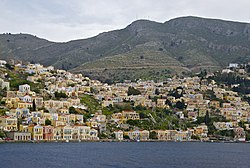
Symi, also transliterated as Syme or Simi (Greek: Σύμη), is a Greek island and municipality. It is mountainous and has the harbour town of Symi and its adjacent upper town Ano Symi, as well as several smaller population centres, beaches and areas of significance in history and mythology. Symi is part of the Rhodes regional unit.
The economy of Symi was traditionally based on the shipbuilding and sponge industries. The population peaked at approximately 22,500 during the 19th century. Symi's main industry is now tourism, and in 2021 its permanent population had declined to 2,603 with a larger population during the summer.
Symi is known for its unique shrimps. Named "Symi's shrimps", these are small and are pan fried and eaten whole, shell and all.
Symi is part of the Dodecanese island chain, located about 41 kilometres (25 miles) north-northwest of Rhodes and 425 km (264 mi) from Piraeus, the port of Athens, with 58.1 square kilometres (22.4 sq mi) of mountainous terrain. Its nearest land neighbors are the Datça and Bozburun peninsulas of Muğla Province in Turkey. Its interior is characterised by small valleys, and its coastline alternates between rocky cliffs, beaches and isolated coves.
Its main town, located on the northeast coast, is named Symi. The lower town around the harbour, is referred to as Yialos, and the upper town is called Horio or Ano Symi. Other townships are Pedi, Nimborio, Marathounda and Panormitis. Panormitis is the location of the island's famous monastery which is visited by people from all over the world, and many Greeks pay homage to St Michael of Panormitis each year. The island has 2,603 inhabitants, mostly engaged in tourism, fishing, and trade. In the tourist season which lasts from Easter until Panormitis Day in early November, tourists and day-trippers increase the number of people on the island to as much as 6,000.
In addition to its many historical sites, the island's isolated beaches, many reachable only by small boats, are popular with tourists. The Municipality of Sými includes the uninhabited offshore islets of Gialesíno, Diavátes, Kouloúndros, Marmarás, Nímos, Sesklío, and Chondrós. Its total land area is 65.754 square kilometres (25.388 sq mi).
In Greek mythology, Symi is reputed to be the birthplace of the Charites, and takes its name from the nymph Syme. According to a different account attributed to Mnaseas in Athenaeus' Deipnosophistae, Glaucus named the island after his wife Syme, when they settled the island. In antiquity, the island was known as Aigli and Metapontis. Pliny the Elder and some later writers claimed that the name was derived from simia, "a monkey".[citation needed]
In Homer's Iliad, the island is mentioned as the domain of King Nireus, who fought in the Trojan War on the side of the Greeks and was described as the most handsome man in the Achaean forces, after Achilles. Thucydides writes that during the Peloponnesian War there was a Battle of Syme near the island in January, 411 BC, in which an unspecified number of Spartan ships defeated a squadron of Athenian vessels.
Symi
Symi, also transliterated as Syme or Simi (Greek: Σύμη), is a Greek island and municipality. It is mountainous and has the harbour town of Symi and its adjacent upper town Ano Symi, as well as several smaller population centres, beaches and areas of significance in history and mythology. Symi is part of the Rhodes regional unit.
The economy of Symi was traditionally based on the shipbuilding and sponge industries. The population peaked at approximately 22,500 during the 19th century. Symi's main industry is now tourism, and in 2021 its permanent population had declined to 2,603 with a larger population during the summer.
Symi is known for its unique shrimps. Named "Symi's shrimps", these are small and are pan fried and eaten whole, shell and all.
Symi is part of the Dodecanese island chain, located about 41 kilometres (25 miles) north-northwest of Rhodes and 425 km (264 mi) from Piraeus, the port of Athens, with 58.1 square kilometres (22.4 sq mi) of mountainous terrain. Its nearest land neighbors are the Datça and Bozburun peninsulas of Muğla Province in Turkey. Its interior is characterised by small valleys, and its coastline alternates between rocky cliffs, beaches and isolated coves.
Its main town, located on the northeast coast, is named Symi. The lower town around the harbour, is referred to as Yialos, and the upper town is called Horio or Ano Symi. Other townships are Pedi, Nimborio, Marathounda and Panormitis. Panormitis is the location of the island's famous monastery which is visited by people from all over the world, and many Greeks pay homage to St Michael of Panormitis each year. The island has 2,603 inhabitants, mostly engaged in tourism, fishing, and trade. In the tourist season which lasts from Easter until Panormitis Day in early November, tourists and day-trippers increase the number of people on the island to as much as 6,000.
In addition to its many historical sites, the island's isolated beaches, many reachable only by small boats, are popular with tourists. The Municipality of Sými includes the uninhabited offshore islets of Gialesíno, Diavátes, Kouloúndros, Marmarás, Nímos, Sesklío, and Chondrós. Its total land area is 65.754 square kilometres (25.388 sq mi).
In Greek mythology, Symi is reputed to be the birthplace of the Charites, and takes its name from the nymph Syme. According to a different account attributed to Mnaseas in Athenaeus' Deipnosophistae, Glaucus named the island after his wife Syme, when they settled the island. In antiquity, the island was known as Aigli and Metapontis. Pliny the Elder and some later writers claimed that the name was derived from simia, "a monkey".[citation needed]
In Homer's Iliad, the island is mentioned as the domain of King Nireus, who fought in the Trojan War on the side of the Greeks and was described as the most handsome man in the Achaean forces, after Achilles. Thucydides writes that during the Peloponnesian War there was a Battle of Syme near the island in January, 411 BC, in which an unspecified number of Spartan ships defeated a squadron of Athenian vessels.
Recent media
Recent media