Hubbry Logo
TXIITXIIMain
Open search
TXII
Community hub
TXII
logo
8 pages, 0 posts
0 subscribers
Be the first to start a discussion here.
TXII
TXII
from Wikipedia

LTI TXII
Overview
ManufacturerLTI
Production2002–2006
AssemblyUnited Kingdom: Coventry, England
DesignerSteve Pasteiner, Jevon Thorpe, William Doelle
Body and chassis
Body style4-door saloon
LayoutFront-engine, rear-wheel-drive
Powertrain
Engine2.4 L Ford Duratorq TD I4 diesel
Transmission5-speed Ford MT75 manual
4-speed Jatco JR402 automatic
Chronology
PredecessorTX1
SuccessorTX4

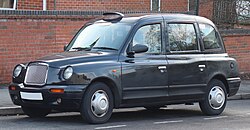
The LTI TXII is a hackney carriage (London hail taxi) manufactured by LTI from 2002 to 2006. It is the second model following the modernisation and redesign of the London taxi that began with the TX1.

The vehicle has a handful of differences from its predecessor including a change of engine from Nissan to the intercooled Ford Duratorq, which, according to the manufacturer increases torque by 21%.[1] The remaining modifications are largely cosmetic or are minor improvements to the design and equipment on the TX1. It was available with a five-speed manual or a four-speed automatic.[1]

It was succeeded by the TX4.

Rear

References

[edit]
[edit]
Revisions and contributorsEdit on WikipediaRead on Wikipedia
from Grokipedia
The LTI TXII is a purpose-built hackney carriage, or black cab, manufactured by London Taxis International (LTI) from 2002 to 2006 as the second model in the modernized TX series of London taxis. It succeeded the TX1 (1997–2002) with updates to meet stricter Euro 3 emissions standards, including the adoption of a 2.4-liter Ford Duratorq turbodiesel inline-four engine producing 90 horsepower and 147 lb-ft of torque, paired with a four-speed automatic transmission and rear-wheel drive. The TXII retained the iconic boxy silhouette and spacious interior of its predecessors, designed to accommodate wheelchair users via a foldable ramp and to meet the London taxi requirement of a turning circle of 25 feet (7.6 m) to navigate London's narrow streets. Key enhancements included improved security features such as a passive anti-theft system integrated into the engine management and full-width rear door glass with restricted opening to deter fare evasion, alongside a more refined cabin with better noise insulation. A small number were exported to markets like the United States in left-hand-drive configuration, making it a rarer variant outside the UK. LTI, formed in 1985 by Manganese Bronze Holdings following its acquisitions of Carbodies (1973) and Mann & Overton (1984), developed the TXII as a bridge to the later TX4 model (2007 onward), emphasizing durability for high-mileage urban use while adapting to environmental regulations. Its production ended in 2006 amid LTI's shift toward further modernization, but surviving examples remain popular among enthusiasts for their robust engineering and cultural significance as symbols of London's transport heritage.

Overview

Introduction

The TXII is a hackney carriage manufactured by London Taxis International (LTI) from 2002 to 2006. It served as the successor to the TX1 and predecessor to the TX4, continuing the modernization of London's iconic taxi fleet that traces its heritage to earlier models like the FX4. Purpose-built for urban taxi service, the TXII adhered to strict Public Carriage Office (PCO) regulations, including a turning circle of 25 feet (7.6 m) in diameter to navigate narrow streets and a minimum passenger capacity of six including the driver. The model introduced a Ford Duratorq diesel engine to comply with Euro 3 emissions standards, representing a shift from the Nissan engines used in prior designs.

Role in London Taxi Service

The TXII complied with the Public Carriage Office (PCO) standards required for licensing as a London hackney carriage, including a minimum turning circle of 25 feet (7.6 meters) to facilitate maneuvers in tight urban spaces, a maximum entrance step height of 380 mm (15 inches) for improved passenger accessibility, and seating capacity for at least five passengers plus the driver. These features ensured the TXII could operate legally within London's regulated taxi ecosystem, supporting safe and efficient public transport. In typical operation, the TXII facilitated London's iconic hail-and-ride service, where passengers could flag down vehicles from the street without prior booking. It included a spacious boot capable of accommodating multiple suitcases or airport luggage, essential for serving tourists and business travelers, along with a fixed partition separating the driver from passengers to enhance security and privacy during journeys. Evolving briefly from the earlier TX1 design, the TXII refined these operational elements for everyday urban use. The TXII played a key role in sustaining the licensed taxi trade during the early 2000s, a period marked by economic pressures on drivers from escalating fuel costs following the 2000 fuel protests. Its diesel engine delivered fuel efficiency of 30-36 miles per gallon in urban conditions, reducing operational expenses compared to prior models and helping maintain the viability of black cab services amid diesel price surges from around 70 pence per liter in 2000 to over 80 pence by 2002. Integration into driver training emphasized the TXII's suitability for London's complex road network, where all licensed operators must pass "The Knowledge" examination—a rigorous test of street memorization and navigation covering over 25,000 streets within a six-mile radius of Charing Cross. The model's compact turning radius and stable handling characteristics made it particularly adept at negotiating narrow alleys and congested areas, aligning with the skills assessed in this mandatory qualification process.

Development and Production

Background and Design Evolution

The evolution of the London taxi traces back to the iconic FX4, manufactured from 1958 to 1997 by Carbodies and later London Taxis International (LTI), which established the classic black cab silhouette and durability standards for urban service. This was followed by the TX1 in 1997, LTI's first major redesign in nearly four decades, introducing modern saloon-like comfort while retaining the FX4's Nissan TD27 diesel engine compliant with Euro 2 emissions. The TXII, introduced in 2002, represented a targeted mid-cycle refresh of the TX1 to rectify reliability issues such as engine performance in high-mileage urban operations and to align with stricter environmental regulations. A primary design motivation for the TXII was compliance with the European Union's 2001 emissions directives under Directive 98/69/EC, which mandated Euro 3 standards for new diesel vehicles registered from January 2001, including taxis. The TX1's Nissan TD27 engine, rated for Euro 2, fell short of these requirements, prompting LTI to replace it with the 2.4-liter Ford Duratorq turbo diesel, which delivered 90 horsepower and met Euro 3 limits through advanced common-rail injection and lower NOx output. This swap not only ensured regulatory approval from the Public Carriage Office (PCO) but also improved fuel efficiency and torque for better low-speed maneuverability in London's congested streets. Development of the TXII involved prototyping in late 2001, with LTI engineers collaborating closely on refinements informed by PCO consultations to meet taxi-specific operational demands like passenger accessibility and mechanical robustness. The model launched in October 2002, marking a swift response to the impending Euro 3 deadline while incorporating feedback from taxi operators on real-world durability. Production continued until 2006, bridging to the subsequent TX4. Key innovations in the TXII focused on longevity and ride quality, including enhanced rust protection via improved galvanization and underbody coatings to combat London's wet climate and road salt exposure. The suspension was upgraded with revised shock absorbers and springs tuned for urban potholes, reducing vibration and enhancing stability during frequent stops. Additionally, initial electronic diagnostics were integrated through the engine management system, enabling basic fault code reading for faster maintenance in fleet operations.

Manufacturing Details

The TXII was assembled at London Taxis International's (LTI) manufacturing plant in Coventry, United Kingdom, where the company had been producing purpose-built taxis since the late 20th century. Components for the vehicle, including the Ford-sourced engine and transmission, were integrated during assembly, alongside the specialized steel chassis, along with other parts from local UK suppliers to support the model's compliance with taxi-specific requirements. The TXII represented a direct evolution from the preceding TX1 design, with refinements focused on emissions and security features. The assembly process emphasized hand-building techniques to achieve the vehicle's renowned durability, capable of accumulating over 1 million miles in service, while incorporating welded body construction for structural integrity. Each unit was subjected to extensive quality assurance procedures during production to verify adherence to Public Carriage Office (PCO) standards, including mechanical integrity, accessibility features, and safety elements essential for licensing as a hackney carriage in London. Production of the TXII spanned from 2002 to 2006, after which it was phased out to accommodate impending Euro 4 emissions regulations that the model could not meet without significant redesign. This transition facilitated the shift to the subsequent TX4 platform, which incorporated a compliant diesel engine from VM Motori.

Technical Specifications

Engine and Drivetrain

The TXII is equipped with a 2.4-liter Ford Duratorq inline-four turbodiesel engine, featuring a turbocharger and intercooler for improved efficiency in urban conditions. This TDCi unit delivers 88 bhp at 4,000 rpm and 148 lb-ft of torque at 1,800 rpm, providing a broad torque curve suited to frequent stop-start driving typical of taxi operations. The drivetrain employs rear-wheel drive configuration, available with a four-speed Jatco JR402 automatic transmission or a five-speed Ford MT75 manual transmission. This setup routes power to the rear wheels via a conventional driveshaft, contributing to the vehicle's stability and handling characteristics required for London taxi regulations. Performance figures reflect the engine's focus on low-end usability rather than outright speed, with acceleration from 0-60 mph taking 23.5 seconds and a governed top speed of 85 mph. Combined fuel economy stands at 30 mpg (UK gallons), supporting extended shifts while meeting operational demands. The powertrain complies with Euro 3 emissions standards, with CO2 output rated at 243 g/km.

Dimensions and Capacity

The TXII London taxi measures 180.3 inches (4,580 mm) in length, 70.9 inches (1,800 mm) in width, 72.2 inches (1,834 mm) in height, and has a wheelbase of 113.6 inches (2,886 mm), providing a compact yet robust footprint suitable for urban navigation. With a kerb weight of 3,968 lbs (1,800 kg) and a gross vehicle weight of 5,291 lbs (2,400 kg), the TXII balances durability and load-bearing capability for daily taxi operations. It offers seating for 5-6 passengers, including foldable jump seats in the rear compartment. The vehicle's ground clearance stands at 5.9 inches (150 mm), aiding passage over speed bumps and uneven roads common in city environments, while its 25-foot turning circle meets Public Carriage Office (PCO) standards for precise maneuvering in London's narrow streets. Equipped with an 11.7-gallon (53-liter) fuel tank, the TXII supports prolonged shifts for drivers, minimizing downtime for refueling. The front-mounted engine contributes to even weight distribution, improving handling and passenger comfort during turns.

Design and Features

Exterior Styling

The TXII's exterior styling evolved from the preceding TX1 model, preserving the iconic boxy silhouette of the London black cab while incorporating refined aerodynamic elements designed by Sir Kenneth Grange. The body features a curved, aerodynamic shape optimized for urban navigation, traditionally finished in black livery to align with the heritage of London taxis. Prominent "TAXI" signage mounted on the roof, illuminated when available for hire, serves as a key identifier for licensed operations and links directly to the taximeter system. Constructed with a steel monocoque body and galvanized panels, the TXII offers robust durability and corrosion resistance suited to demanding city environments. The rear doors feature a 270-degree swing mechanism, facilitating easy access for passengers and luggage without obstructing sidewalks. Lighting includes halogen headlights for reliable visibility, integrated indicators housed in the fenders for clear signaling, and optional front fog lights to improve performance in adverse weather. LTI badging adorns the front grille, underscoring the vehicle's manufacturer heritage. While black remains the standard color for licensed public hire vehicles in London, the TXII was also produced in alternative colors such as British Racing Green for private use or special applications. Export models, destined for markets including the United States, China, and South Africa, incorporated adaptations like left-hand drive configurations and compliance modifications to meet regional safety standards.

Interior and Accessibility

The TXII's cabin is configured for efficient taxi operation, featuring a front bench seat that accommodates the driver and one passenger, separated from the rear compartment by a privacy partition equipped with an intercom system for communication. The rear passenger area includes a forward-facing bench seat for three occupants and two foldaway rear-facing occasional seats on either side of the central division, enabling a total of five passengers in the compartment alongside the front seating position. This layout prioritizes space and versatility, with the occasional seats designed to fold away when not in use to facilitate luggage storage or additional room. Comfort within the interior emphasizes durability and functionality, with standard vinyl upholstery that withstands heavy use and is easily cleaned using mild solutions. A robust heating and ventilation system, controlled from the driver's area, circulates air through adjustable vents to maintain a comfortable environment, while optional air conditioning units provide independent cooling for both the front and rear compartments in warmer conditions. The design offers generous legroom and headroom in the rear, contributing to a spacious feel that supports extended journeys without fatigue. Accessibility provisions in the TXII align with UK Public Service Vehicle Accessibility Regulations (PSVAR) 2000, including an integral folding ramp stored in the boot that deploys from the nearside rear door to assist wheelchair users. This ramp, complete with an extension for low curbs under 125 mm, enables direct entry into the low-floor cabin, where the interior dimensions accommodate standard wheelchairs with secure restraint points. Some variants incorporate a swiveling nearside occasional seat to aid passengers with reduced mobility in boarding and positioning. Safety elements focus on occupant protection across all positions, with three-point inertia-reel seatbelts standard on the front bench, rear bench, and occasional seats, including dedicated anchors for wheelchair passengers to ensure stability during travel.

Variants and Exports

Standard and Special Editions

The standard TXII model featured a 2.4-liter Ford Duratorq turbo diesel engine producing 88 horsepower, rear-wheel drive configuration, and full compliance with Private Carriage Office (PCO) regulations for London hackney carriages, including wheelchair accessibility via a fold-out ramp and space for up to five passengers. No major trim levels were available, though buyers could opt for extras such as metallic paint finishes or air conditioning in both driver and passenger compartments. Special editions were limited in scope, with LTI producing a limited number of left-hand-drive "Executive Sedan" variants primarily for the North American market; these included upgraded leather upholstery in the rear passenger area and improved soundproofing for enhanced comfort during longer journeys. Commemorative models marked company and national milestones, such as the 2002 Golden Jubilee edition limited to 50 gold-painted units, each individually numbered to honor Queen Elizabeth II's 50 years on the throne. While aftermarket customizations like illuminated roof signs and integrated taximeters were common among operators to meet operational needs, factory-produced special editions prioritized luxury-oriented enhancements tailored for private hire services, such as premium seating materials. All variants shared the same fundamental monocoque chassis derived from the prior TX1 design, and special editions accounted for a small fraction of overall output during the model's 2002–2006 production run.

International Adaptations

The LTI TXII was produced in limited numbers for international markets, with a limited number of left-hand drive (LHD) units exported to North America between 2003 and 2006 to meet demand for purpose-built executive sedans outside the UK, with total LHD exports for TXII and later TX4 models estimated at around 250. These exports faced significant certification challenges, including compliance with the US Federal Motor Vehicle Safety Standards (FMVSS) and Department of Transportation (DOT) regulations, which restricted volumes and required extensive modifications for road legality in the United States and Canada. LHD versions were also built for continental European markets, such as France, to accommodate right-hand traffic and local emission standards. Key adaptations for North American specifications included LHD steering configurations and adjusted headlights to suit right-hand traffic conditions, differing from the standard right-hand drive (RHD) UK models. In the US, TXII units were marketed as the "London Taxi Executive Sedan" and incorporated enhanced accessibility features, such as a folding wheelchair ramp and a 90-degree right-side passenger door, to align with Americans with Disabilities Act (ADA) requirements for public transportation vehicles. Additional refinements, like improved sound insulation, were implemented to better handle extended highway driving common in North American urban and suburban environments. While primary export focus was on North America, smaller numbers of adapted TXII models reached other regions, including LHD conversions for European countries beyond the UK. Certification hurdles, particularly FMVSS testing in the US, contributed to the overall limited import scale, with only a limited number of US-spec units ultimately delivered despite initial ambitions for broader global deployment, estimated at around 250 total for TXII and TX4 models.

References

Add your contribution
Related Hubs
User Avatar
No comments yet.