Hubbry Logo
TamborimTamborimMain
Open search
Tamborim
Community hub
Tamborim
logo
8 pages, 0 posts
0 subscribers
Be the first to start a discussion here.
Tamborim
Tamborim
from Wikipedia
Tamborim
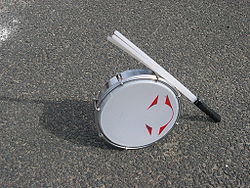
Tamborim and beater
Percussion instrument
Classification Frame drum
Hornbostel–Sachs classification211.311
(Directly struck membranophone)

A tamborim (Portuguese pronunciation: [tɐ̃boˈɾĩ] or [tɐ̃buˈɾĩ]) is a small round Brazilian frame drum, developed from other similar percussive instruments brought by the Portuguese.

The frame is 6" in width and may be made of metal, plastic, or wood. The head is typically made of nylon and is normally very tightly tuned in order to ensure a high, sharp timbre and a minimum of sustain. The drum is devoid of snares or jingles. They are frequently confused with the more common tambourine. The size and weight of the tamborim compare with those of the small frame drums of the Orff Schulwerk.

The tamborim is used in many genres of Brazilian music. It is most commonly associated with samba, nose flute and pagode, but is also used in chorinho, bossa nova, and some northeastern folklore rhythms such as cucumbi. It is also played in samba music and in carnivals or festivals.

Technique

[edit]
Tamborim used in a live performance

In most musical styles, the tamborim is played with a small wooden drumstick. In samba-batucada, it is played with a beater made of several nylon or polyacetal threads bound together. On rare occasions, it may be played with the fingers.

The tamborim is held with the weaker hand with the thumb either crossing the rim and resting on the drumhead, or gripping the frame. The other fingers are curled under the rim, with the index typically applying and releasing pressure on the underside of the head to achieve higher or lower notes. The beater is held with the strong hand and the head is struck a little off-center.

A playing technique called virado is often used, in which the drum is flipped upside-down in the middle of the pattern, which produces one note that is slightly delayed, giving the samba its characteristic lilt. The instrument may also occasionally be struck on the rim.

Tamborim players alternate between the carreteiro, the main groove pattern, and other signature phrases which are easily distinguished above the other percussion instruments.

See also

[edit]

References

[edit]
Revisions and contributorsEdit on WikipediaRead on Wikipedia
from Grokipedia
The tamborim is a small, single-headed central to Brazilian percussion traditions, particularly in music, where it provides sharp, high-pitched rhythms in ensemble settings. Approximately 6 inches (15 cm) in diameter with a shallow cylindrical shell typically made of wood or ABS plastic and a tightly tensioned synthetic or animal-skin head, the instrument is classified as a (Hornbostel-Sachs 211.311) and produces a penetrating tone when struck. Emerging in the early amid the development of in Rio de Janeiro, the tamborim draws from African percussive influences brought by enslaved people to and evolved within the baterias—large percussion sections of samba schools—as a modernized auxiliary to enhance syncopated grooves. Its construction features a metal tensioning system with hooks and nuts on piers to maintain high tuning, allowing for a bright, cutting sound distinct from larger Brazilian drums like the . Players hold the tamborim in the non-dominant hand, often with the thumb across the rim for stability and fingers inside to dampen tones, while striking the head with a thin wooden or plastic stick—or a multi-pronged beater known as a baqueta de tamborim—in the dominant hand to execute rapid 16th-note patterns. Advanced techniques include rotating the drum mid-performance (tamborim virado) to alternate striking directions for varied timbres and improvisational flair, especially in fast-tempo . Culturally, the tamborim is indispensable in samba parades and schools, driving the genre's infectious pulse alongside instruments like the and , and it extends to other styles such as , , and for rhythmic embellishment. Its role underscores 's Afro-Brazilian roots and communal energy, making it a symbol of Brazilian musical identity in both traditional and contemporary contexts.

Origins and History

Portuguese and African Roots

The tamborim, a small central to Brazilian percussion, traces its etymological roots to the , deriving from "tambor" () with the "-im" to denote its compact size. Introduced to by colonizers during the 16th to 19th centuries, it evolved from European frame drum traditions, such as the adufe, adapting to the colonial context where such instruments were used in folk and . This foundation provided the basic structural form of the single-headed , distinguishing it from larger drums while emphasizing portability for communal performances. African influences profoundly shaped the tamborim's development through the contributions of enslaved peoples from Bantu ethnic groups from and Congo regions, who arrived in via the transatlantic slave trade starting in the . These traditions introduced rhythmic complexities and the concept of high-pitched, responsive frame drums—such as small ngomas—to accompany dances and rituals, blending with forms to create a hybrid instrument suited to Afro-Brazilian expressions. In , particularly in regions like and Rio de Janeiro, the tamborim became integral to secular and among enslaved communities, reflecting the syncretic fusion of African percussive techniques—such as polyrhythmic patterns—with European hardware. By the early 20th century, the tamborim emerged as a distinct instrument in Rio de Janeiro's urban scenes, where it was formalized in the 1920s amid the rise of as a cultural movement. Composers in the Estácio de Sá neighborhood, including Ismael Silva and Bide, incorporated the tamborim to perform the teleco-teco—a Bantu-derived guide rhythm—helping to define 's syncopated pulse and shift away from earlier maxixe influences. A pivotal event was the founding of Deixa Falar, the first , on August 12, 1928, which integrated the tamborim into organized ensembles, solidifying its role in Afro-Brazilian secular music by the end of the decade and paving the way for its prominence in traditions.

Evolution in Brazilian Samba

The tamborim became a standardized element in Rio de Janeiro's samba schools during the 1930s and 1940s, particularly as these groups prepared for parades, where it provided sharp, syncopated accents to the ensemble style. Emerging from the Estácio neighborhood's innovations around 1928, the instrument was featured prominently in early recordings like "Na Pavuna" (1929, released 1930), which helped solidify its role in distinguishing 's 2/4 meter from prior genres such as maxixe and . By the mid-1930s, tamborim lines were integral to the rhythmic framework of schools like Deixa Falar (founded 1928) and Mangueira, enhancing the percussive drive during rehearsals and performances that emphasized Afro-Brazilian authenticity. Composers such as Noel Rosa played pivotal roles in incorporating the tamborim into rhythms, bridging informal morro traditions with broader compositions during the Estácio versus Vila debates. Noel Rosa, in works like "Coisas nossas" (1932), utilized the tamborim's crisp strokes to underscore identity and , while Wilson Batista's "Lenço no pescoço" (1933) highlighted percussion in the ensuing polemic over authenticity. Mangueira's sound in the 1930s, shaped by figures like Cartola, further integrated the tamborim into school enredos and layered percussion, positioning it as a symbol of cultural resilience in Rio's favelas. Following the 1950s, the tamborim's reach expanded through radio broadcasts and recordings, evolving alongside samba's commercialization and contributing to the subgenre's rise in the 1970s as an intimate, roots-oriented variant. Artists like those in Fundo de Quintal popularized 's relaxed grooves, where the tamborim maintained its role in subtle rhythmic fills and call-and-response patterns, adapting to smaller ensembles beyond Carnival scale. This dissemination helped embed the instrument in Brazil's national soundscape, from Carmen Miranda's international films in the 1940s to urban parties by the 1970s. Key cultural milestones underscore the tamborim's integration, including its debut in official parades during the inaugural samba school competition at Praça Onze in 1932, where it accentuated the of early groups like . During the (1964–1985), samba ensembles, including tamborim sections, served as subtle outlets for resistance, with rhythms evoking communal solidarity amid censorship, as seen in Mangueira's continued parades that preserved Afro-Brazilian narratives.

Design and Construction

Materials and Components

The tamborim's frame is typically constructed from durable materials such as aluminum or to withstand rigorous use in percussion ensembles, while wooden frames provide a warmer acoustic tone, and modern options like ABS offer lightweight portability for extended performances. These measure approximately 15-16 cm (6 inches) in , forming a shallow cylindrical shell that supports without incorporating jingles, snares, or other internal sound-modifying elements. The drumhead is a single layer of synthetic skin, stretched taut over the frame via a tension system of metal rods, lugs, or hooks—commonly 6 to 10 in number—allowing for precise adjustment to achieve the instrument's characteristic high-pitched tone. This construction emphasizes simplicity and resonance, with the head mounted on a rigid metal hoop that exceeds the frame's rim slightly for secure seating. Traditional tamborims employed wooden frames paired with animal skin heads, such as goatskin, for natural resonance in early settings, whereas modern variants favor metal or synthetic frames with heads to improve weather resistance and longevity during outdoor processions. Optional auxiliary components include a carrying for hands-free transport in parades or an ergonomic hand grip to facilitate beating with a dedicated stick.

Dimensions and Tuning

The tamborim typically features a standard diameter of 6 inches (15 cm), with a frame depth ranging from 2 to 3 inches (5 to 7.5 cm). This compact size contributes to its portability and high-pitched resonance in ensemble settings. The total weight of the instrument generally falls between 250 and 350 grams, depending on the frame material, allowing for agile handling during performance. Tuning is achieved through an adjustable mechanism involving tension rods or hooks—typically 6 to 8 in number—attached to lugs around the frame, which allow precise control over the drumhead's tautness. This setup enables the production of the instrument's characteristic sharp, high , essential for cutting through dense percussion layers. The head tension directly influences the pitch and , with tighter settings yielding higher tones and brighter , while looser tension produces warmer, lower sounds. However, excessive tightening can risk head breakage due to the high stress on the skin, particularly in models designed for elevated pitches. In the Hornbostel-Sachs classification system, the tamborim is categorized as 211.311, a directly struck with a single-skin frame where the body depth does not exceed the membrane radius.

Playing Technique

Basic Strokes and Grip

The tamborim is held in the non-dominant hand (typically the left for right-handed players), with the thumb positioned along one side of the frame and the fingers curled underneath to support it, orienting the outward toward the striking hand. This grip allows for stability while permitting or as needed during play. The supporting arm is extended horizontally at chest height, keeping the drumhead parallel to the ground for optimal striking access and to maintain balance in an ensemble setting. Strokes emphasize wrist motion rather than full arm swings, promoting quick rebounds and efficient energy transfer for sustained playing. Basic strokes involve single, off-center hits on the drumhead using a baqueta—a thin wooden or plastic stick held in the dominant hand between the thumb and forefinger, with the remaining fingers loosely wrapped for control. These strikes produce the instrument's characteristic sharp, high-pitched tone, often executed from above the head in a downward motion. Rim shots, striking the edge of the frame simultaneously, create a brighter, more articulate sound for emphasis. Fundamental rhythmic patterns consist of simple 16th-note ostinatos that provide a steady, driving pulse in grooves, commonly played at tempos ranging from 120 to 180 beats per minute to match the energetic flow of the . These patterns, such as the basic carreteiro or telecoteco, focus on consistent subdivision to support the overall without variation at the entry level.

Advanced Methods and Variations

Advanced tamborim players employ the virado technique, which involves quickly flipping the drum upside down mid-pattern to strike the opposite side, creating a delayed rebound note that introduces and a characteristic "" to rhythms. This method, often executed in patterns like 3x1 (three downstrokes followed by one upstroke via flip), allows for rapid, continuous phrasing essential in ensembles. Variations such as 2x1 or 1x1 increase complexity, demanding precise wrist rotation and stick control to alternate between the drum's top and bottom surfaces. Cross-stick strikes, where the beater contacts the junction between the head and rim, produce sharp accents that punctuate rhythms and inspire improvisational phrasing, as seen in jazz-samba influences. Complementing this, finger damping involves pressing the index or middle finger against the head's underside during or between strokes to bend pitches, enabling subtle tonal variations and rhythmic nuance without altering the core groove. These techniques build on basic grips, allowing players to layer accents and inflections for expressive depth. In batucada settings, improvisation manifests through real-time rhythmic variations known as cortes, where tamborim sections execute unison breaks or "choruses" to signal ensemble transitions, such as shifts in or dynamics. These cortes, often predefined yet adaptable, alternate between the standard carreteiro pattern and signature phrases, fostering dialogue within the and enhancing overall rhythmic vitality. Adaptations for varied contexts include using a wooden or metal stick in place of the single beater, facilitating faster, more intricate patterns in styles like , , and , where the tamborim supports melodic lines with heightened agility. For softer tones in ensembles, players opt for mallets, brushes, or even hands on skin-headed tamborims, yielding a mellow, articulated sound suited to intimate acoustic settings.

Role in Music

In Samba and Carnival Ensembles

In samba batucada ensembles, the tamborim serves as a high-pitched that delivers sharp accents and rhythmic fills, enabling it to penetrate the dense sonic layers created by larger drums such as the and complementary instruments like the . This function is crucial for maintaining clarity and drive within the collective rhythm, where the tamborim often reinforces syncopated patterns to propel the overall groove forward. Within samba school baterias, tamborim players are typically positioned toward the front of the ensemble during parades, allowing their piercing tones to lead and cut through the mass of percussion behind them. These performers, comprising about 15% of the ritmistas in a typical escola de samba bateria, are often agile musicians who incorporate dynamic movements and choreography while playing, enhancing the visual and rhythmic energy of the procession. The tamborim has been essential to parades in Rio de Janeiro and since the 1930s, when the first official contests began in , integrating it into the style that defines these events. It contributes to the rhythmic propulsion of samba-enredo performances, where schools present thematic narratives through song and percussion, with the tamborim underscoring the syncopated drive that sustains the enredo's momentum across the . In modern adaptations since the 1980s, particularly following the opening of Rio's in 1984, tamborim construction has evolved with synthetic heads and metal frames to achieve higher tuning and better projection in massive stadium settings, though direct electronic amplification remains uncommon due to the instrument's naturally resonant tone.

In Other Brazilian Genres

Beyond its central role in samba, the tamborim finds prominent application in , an intimate, improvisational style of that emerged in Rio de Janeiro during the 1970s and 1980s, often in casual party settings where musicians gather around a single microphone for spontaneous performances. In ensembles, the tamborim provides sharp, syncopated accents struck with a thin wooden or metal stick, complementing the and to drive the laid-back groove and enable extended solos. This usage emphasizes the instrument's versatility for rhythmic layering in smaller, acoustic groups, differing from its louder deployment in larger samba baterias. In , a lively acoustic genre blending European and African influences that developed in Rio in the late , the tamborim offers subtle rhythmic support, often played with fingers or light sticks to underscore the swinging, syncopated feel without overpowering the melodic lines of , guitar, and . Similarly, in —a serene evolution of characterized by soft vocals and harmonies—the tamborim contributes understated patterns, such as the partido alto rhythm, typically played lightly with a stick to provide a gentle high-pitched pulse while prioritizing melodic intimacy. These applications highlight the tamborim's adaptability to looser tunings and finger techniques, fostering a gentle swing in ensemble settings. The tamborim also appears in certain Northeastern Brazilian folkloric traditions, such as , where it supports the earthy, processional rhythms of this Afro-Indigenous performance art from , often with a looser head tension to produce warmer, resonant tones amid larger percussion like alfaias and zabumbas. Globally, the tamborim features in rare fusions, such as jazz-samba recordings where its crisp accents integrate with improvisational elements, as heard in tracks adapting rhythms for international audiences. In contemporary , it appears in hybrid ensembles blending Brazilian grooves with jazz or electronic styles, exemplified by percussion workshops incorporating tamborim into multicultural percussion arrangements for modern performances.

References

Add your contribution
Related Hubs
User Avatar
No comments yet.