Hubbry Logo
AdequalityAdequalityMain
Open search
Adequality
Community hub
Adequality
logo
7 pages, 0 posts
0 subscribers
Be the first to start a discussion here.
Adequality
Adequality
from Wikipedia

Adequality is a technique developed by Pierre de Fermat in his treatise Methodus ad disquirendam maximam et minimam[1] (a Latin treatise circulated in France c. 1636 ) to calculate maxima and minima of functions, tangents to curves, area, center of mass, least action, and other problems in calculus. According to André Weil, Fermat "introduces the technical term adaequalitas, adaequare, etc., which he says he has borrowed from Diophantus. As Diophantus V.11 shows, it means an approximate equality, and this is indeed how Fermat explains the word in one of his later writings." (Weil 1973).[2] Diophantus coined the word παρισότης (parisotēs) to refer to an approximate equality.[3] Claude Gaspard Bachet de Méziriac translated Diophantus's Greek word into Latin as adaequalitas.[citation needed] Paul Tannery's French translation of Fermat's Latin treatises on maxima and minima used the words adéquation and adégaler.[citation needed]

Fermat's method

[edit]

Fermat used adequality first to find maxima of functions, and then adapted it to find tangent lines to curves.

To find the maximum of a term , Fermat equated (or more precisely adequated) and and after doing algebra he could cancel out a factor of and then discard any remaining terms involving To illustrate the method by Fermat's own example, consider the problem of finding the maximum of (in Fermat's words, it is to divide a line of length at a point , such that the product of the two resulting parts be a maximum[1]). Fermat adequated with . That is (using the notation to denote adequality, introduced by Paul Tannery):

Canceling terms and dividing by Fermat arrived at

Removing the terms that contained Fermat arrived at the desired result that the maximum occurred when .

Fermat also used his principle to give a mathematical derivation of Snell's laws of refraction directly from the principle that light takes the quickest path.[4]

Descartes' criticism

[edit]

Fermat's method was highly criticized by his contemporaries, particularly Descartes. Victor Katz suggests this is because Descartes had independently discovered the same new mathematics, known as his method of normals, and Descartes was quite proud of his discovery. Katz also notes that while Fermat's methods were closer to the future developments in calculus, Descartes' methods had a more immediate impact on the development.[5]

Scholarly controversy

[edit]

Both Newton and Leibniz referred to Fermat's work as an antecedent of infinitesimal calculus. Nevertheless, there is disagreement amongst modern scholars about the exact meaning of Fermat's adequality. Fermat's adequality was analyzed in a number of scholarly studies. In 1896, Paul Tannery published a French translation of Fermat's Latin treatises on maxima and minima (Fermat, Œuvres, Vol. III, pp. 121–156). Tannery translated Fermat's term as “adégaler” and adopted Fermat's “adéquation”. Tannery also introduced the symbol for adequality in mathematical formulas.

Heinrich Wieleitner (1929)[6] wrote:

Fermat replaces A with A+E. Then he sets the new expression roughly equal (angenähert gleich) to the old one, cancels equal terms on both sides, and divides by the highest possible power of E. He then cancels all terms which contain E and sets those that remain equal to each other. From that [the required] A results. That E should be as small as possible is nowhere said and is at best expressed by the word "adaequalitas".

(Wieleitner uses the symbol .)


Max Miller (1934)[7] wrote:

Thereupon one should put the both terms, which express the maximum and the minimum, approximately equal (näherungsweise gleich), as Diophantus says.

(Miller uses the symbol .)


Jean Itard (1948)[8] wrote:

One knows that the expression "adégaler" is adopted by Fermat from Diophantus, translated by Xylander and by Bachet. It is about an approximate equality (égalité approximative) ".

(Itard uses the symbol .)


Joseph Ehrenfried Hofmann (1963)[9] wrote:

Fermat chooses a quantity h, thought as sufficiently small, and puts f(x + h) roughly equal (ungefähr gleich) to f(x). His technical term is adaequare.

(Hofmann uses the symbol .)


Peer Strømholm (1968)[10] wrote:

The basis of Fermat's approach was the comparition of two expressions which, though they had the same form, were not exactly equal. This part of the process he called "comparare par adaequalitatem" or "comparer per adaequalitatem", and it implied that the otherwise strict identity between the two sides of the "equation" was destroyed by the modification of the variable by a small amount:

.

This, I believe, was the real significance of his use of Diophantos' πἀρισον, stressing the smallness of the variation. The ordinary translation of 'adaequalitas' seems to be "approximate equality", but I much prefer "pseudo-equality" to present Fermat's thought at this point.

He further notes that "there was never in M1 (Method 1) any question of the variation E being put equal to zero. The words Fermat used to express the process of suppressing terms containing E was 'elido', 'deleo', and 'expungo', and in French 'i'efface' and 'i'ôte'. We can hardly believe that a sane man wishing to express his meaning and searching for words, would constantly hit upon such tortuous ways of imparting the simple fact that the terms vanished because E was zero.(p. 51) Claus Jensen (1969)[11] wrote:

Moreover, in applying the notion of adégalité – which constitutes the basis of Fermat's general method of constructing tangents, and by which is meant a comparition of two magnitudes as if they were equal, although they are in fact not ("tamquam essent aequalia, licet revera aequalia non sint") – I will employ the nowadays more usual symbol .

The Latin quotation comes from Tannery's 1891 edition of Fermat, volume 1, page 140. Michael Sean Mahoney (1971)[12] wrote:

Fermat's Method of maxima and minima, which is clearly applicable to any polynomial P(x), originally rested on purely finitistic algebraic foundations. It assumed, counterfactually, the inequality of two equal roots in order to determine, by Viete's theory of equations, a relation between those roots and one of the coefficients of the polynomial, a relation that was fully general. This relation then led to an extreme-value solution when Fermat removed his counterfactual assumption and set the roots equal. Borrowing a term from Diophantus, Fermat called this counterfactual equality 'adequality'.

(Mahoney uses the symbol .) On p. 164, end of footnote 46, Mahoney notes that one of the meanings of adequality is approximate equality or equality in the limiting case. Charles Henry Edwards, Jr. (1979)[13] wrote:

For example, in order to determine how to subdivide a segment of length into two segments and whose product is maximal, that is to find the rectangle with perimeter that has the maximal area, he [Fermat] proceeds as follows. First he substituted

(he used A, E instead of x, e) for the unknown x, and then wrote down the following "pseudo-equality" to compare the resulting expression with the original one:

After canceling terms, he divided through by e to obtain Finally he discarded the remaining term containing e, transforming the pseudo-equality into the true equality that gives the value of x which makes maximal. Unfortunately, Fermat never explained the logical basis for this method with sufficient clarity or completeness to prevent disagreements between historical scholars as to precisely what he meant or intended."

Kirsti Andersen (1980)[14] wrote:

The two expressions of the maximum or minimum are made "adequal", which means something like as nearly equal as possible.

(Andersen uses the symbol .) Herbert Breger (1994)[15] wrote:

I want to put forward my hypothesis: Fermat used the word "adaequare" in the sense of "to put equal" ... In a mathematical context, the only difference between "aequare" and "adaequare" seems to be that the latter gives more stress on the fact that the equality is achieved.

(Page 197f.) John Stillwell (Stillwell 2006 p. 91) wrote:

Fermat introduced the idea of adequality in 1630s but he was ahead of his time. His successors were unwilling to give up the convenience of ordinary equations, preferring to use equality loosely rather than to use adequality accurately. The idea of adequality was revived only in the twentieth century, in the so-called non-standard analysis.

Enrico Giusti (2009)[16] cites Fermat's letter to Marin Mersenne where Fermat wrote:

Cette comparaison par adégalité produit deux termes inégaux qui enfin produisent l'égalité (selon ma méthode) qui nous donne la solution de la question" ("This comparison by adequality produces two unequal terms which finally produce the equality (following my method) which gives us the solution of the problem")..

Giusti notes in a footnote that this letter seems to have escaped Breger's notice.

Klaus Barner (2011)[17] asserts that Fermat uses two different Latin words (aequabitur and adaequabitur) to replace the nowadays usual equals sign, aequabitur when the equation concerns a valid identity between two constants, a universally valid (proved) formula, or a conditional equation, adaequabitur, however, when the equation describes a relation between two variables, which are not independent (and the equation is no valid formula). On page 36, Barner writes: "Why did Fermat continually repeat his inconsistent procedure for all his examples for the method of tangents? Why did he never mention the secant, with which he in fact operated? I do not know."

Katz, Schaps, Shnider (2013)[18] argue that Fermat's application of the technique to transcendental curves such as the cycloid shows that Fermat's technique of adequality goes beyond a purely algebraic algorithm, and that, contrary to Breger's interpretation, the technical terms parisotes as used by Diophantus and adaequalitas as used by Fermat both mean "approximate equality". They develop a formalisation of Fermat's technique of adequality in modern mathematics as the standard part function which rounds off a finite hyperreal number to its nearest real number.

See also

[edit]

References

[edit]

Bibliography

[edit]
Revisions and contributorsEdit on WikipediaRead on Wikipedia
from Grokipedia
Adequality is a mathematical technique developed by the French mathematician in the mid-17th century for finding the maxima and minima of functions, determining tangents to curves, and addressing other optimization problems that anticipate modern infinitesimal calculus. Originating from the Greek term parisotēs (παρισότης), coined by in the 3rd century CE to denote approximate equality—such as in the relation 1321/711 ≈ 11/6—the concept was adapted by Fermat through Jacques de Bachet's Latin translation as adaequo, meaning "to make equal." Fermat's method of adequality involves introducing an infinitesimal increment e to a variable x (replacing it with x + e), substituting into an equation f(x) = 0 to form f(x + e) = 0, and then equating the two expressions while canceling common terms, dividing by e, and suppressing higher-order terms in e to achieve an approximate equality that yields the desired result, such as a tangent slope or extremum condition. This procedure effectively computes the constant term in the expansion of the [f(x](/page/F/X)+e)f(x)e\frac{[f(x](/page/F/X) + e) - f(x)}{e}, mirroring the definition of the in limit form. The technique's significance lies in its role as a bridge between ancient algebraic methods—drawing from , Pappus of , and —and the development of , influencing later figures like , whose Transcendental Law of Homogeneity parallels adequality in handling infinitesimals. Fermat applied it to diverse problems, including geometric constructions like the and physical principles such as of , demonstrating its versatility in both pure and before the formalization of by and Leibniz.

Historical Development

Origins in Ancient Mathematics

The concept of adequality traces its roots to the ancient Greek mathematician Diophantus of Alexandria (c. 200–284 AD), who introduced the term parisotēs (παρισότης) in his seminal work Arithmetica. This Greek term, meaning "near equality" or "approximate equality," referred to the technique of setting two rational expressions equal while acknowledging their approximate nature to resolve indeterminate equations, particularly those involving rational solutions. Diophantus employed parisotēs to navigate the constraints of working exclusively with positive rational numbers, allowing him to approximate solutions in problems where exact equalities were elusive. In Arithmetica, applied this method extensively in problems requiring the equality of rational expressions, such as those in Book III, which focus on finding squares equal to sums of other terms or numbers. For instance, these problems often involved constructing rational numbers whose squares summed to a given square or related form, using parisotēs to balance expressions that were notionally equal but adjusted for precision in rational terms. This approach underscored 's emphasis on parametric solutions and clever substitutions to generate infinite families of rationals satisfying the conditions, prioritizing conceptual ingenuity over numerical enumeration. The transmission of Diophantus's ideas to later scholars occurred through Arabic intermediaries, including the mathematician al-Karaji (c. 953–1029), who drew inspiration from Arithmetica in developing algebraic techniques for powers and equations, thereby preserving and extending Greek mathematical traditions during the . The work reached Renaissance Europe via the Latin translation by Claude-Gaspar Bachet de Méziriac in 1621, which rendered parisotēs as adaequalitas (approximate equality) and made the text accessible to Western readers; this edition was studied intensively by , who adapted the concept in his 17th-century mathematical explorations. A representative example of Diophantus's use of parisotēs appears in solving equations like x2+a=y2x^2 + a = y^2, where aa is a given . He assumed x2y2x^2 \backsim y^2 (treating the squares as approximately equal) and introduced a small adjustment to account for the difference aa, enabling the derivation of rational solutions through or substitution, such as expressing the difference as (yx)(y+x)=a(y - x)(y + x) = a and selecting parameters to maintain rationality. This method highlighted the approximate equality's role in bridging exact algebraic manipulation with the pursuit of rational outcomes.

Fermat's Contribution

(1607–1665) was a French lawyer and mathematician whose work laid foundational contributions to early and . Born in Beaumont-de-Lomagne to a family of leather merchants, Fermat's father was a wealthy merchant and second consul of the town, which may have exposed him to administrative duties that shaped his precision in analytical work. He pursued self-study of classical mathematical texts, particularly the works of on algebraic analysis and Diophantus' Arithmetica, the latter translated by Claude-Gaspar Bachet, which sparked his interest in Diophantine equations. In 1636, Fermat circulated an unpublished Latin treatise titled Methodus ad disquirendam maximam et minimam among French mathematicians, including , introducing adequality as a systematic method for addressing continuous geometric problems. Motivated by the desire to extend ' discrete techniques of adaequalitas—briefly referenced as roots in problem-solving—to broader applications in the continuum, Fermat developed this approach to determine maxima and minima without relying on infinitesimals, instead using finite approximations that could be refined. Fermat's initial applications of adequality focused on solving geometric problems, notably finding tangents to algebraic curves, which he communicated in letters to Mersenne in 1638. These efforts demonstrated the method's utility in constructing tangents by equating expressions at points of interest, bridging algebraic manipulation with geometric intuition. To denote the concept of approximate equality central to his technique, Fermat introduced the symbol \backsim for "adequality," distinguishing it from strict equality while emphasizing its role in limiting processes.

Mathematical Principles

Core Method of Adequality

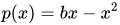
Fermat's method of adequality provides a technique for finding maxima and minima of algebraic functions by comparing a function value at a point with its value at a nearby point, treating the difference as negligible under certain conditions. The core procedure involves selecting a function p(x)p(x), where xx is the variable to be determined, and introducing a small positive increment ee, assumed to be infinitesimally small but non-zero. The method sets p(x)p(x+e)p(x) \backsim p(x + e), where \backsim denotes "adequality," meaning the two expressions are considered equal after neglecting terms that vanish with ee. This approach requires the function to be algebraic, implicitly assuming differentiability through polynomial expansion. The algorithmic steps proceed as follows: first, expand p(x+e)p(x + e) using algebraic substitution, typically via binomial expansion for polynomials. Common terms independent of ee are then canceled from both sides of the adequality , leaving an expression involving powers of ee. Higher-order terms, such as those with e2e^2 or greater, are neglected because ee is treated as a vanishing , allowing the remaining linear term in ee to be set to zero. This yields the value of xx that extremizes the function, without invoking formal limits or infinite series. Fermat justified neglecting these higher-order terms by their inherent smallness, describing ee as a quantity that "vanishes" in the comparison, thereby approximating equality for practical computation. A representative example illustrates the method for the p(x)=bxx2p(x) = bx - x^2, which might model the area of a with fixed perimeter bb. Set p(x)p(x+e)p(x) \backsim p(x + e), so: bxx2b(x+e)(x+e)2.bx - x^2 \backsim b(x + e) - (x + e)^2. Expanding the right side gives: b(x+e)(x2+2ex+e2)=bx+bex22exe2.b(x + e) - (x^2 + 2ex + e^2) = bx + be - x^2 - 2ex - e^2. Canceling the common terms bxx2bx - x^2 from both sides results in: 0be2exe2,0 \backsim be - 2ex - e^2, or equivalently, 0e(b2x)e2.0 \backsim e(b - 2x) - e^2. Neglecting the higher-order e2e^2 term as vanishing yields e(b2x)0e(b - 2x) \backsim 0, implying b2x=0b - 2x = 0, so x=b2x = \frac{b}{2}. This identifies the maximum at half the parameter bb. Fermat described this process in his 1636 Ad Locos Planos et Solidos Isagoge, where adequality served as a foundational tool for such optimizations.

Examples and Applications

One prominent application of Fermat's method of adequality was in determining maxima and minima of algebraic expressions, such as optimizing the area of a inscribed in a of fixed length bb. Consider the y=x(bx)y = x(b - x), where yy represents the area and xx is one side. To find the maximum, Fermat set the value at x=a+ex = a + e adequal to the value at x=ax = a: (a+e)(bae)a(ba)(a + e)(b - a - e) \approx a(b - a). Expanding and subtracting common terms yields e(b2ae)0e(b - 2a - e) \approx 0. Dividing by ee (nonzero) gives b2ae0b - 2a - e \approx 0, and suppressing the ee term results in b2a=0b - 2a = 0, so a=b/2a = b/2. Thus, the maximum area occurs at x=b/2x = b/2, yielding y=b2/4y = b^2/4. Fermat also employed adequality to construct tangents to curves, particularly algebraic ones like the parabola y2=axy^2 = ax. At a point (x0,y0)(x_0, y_0) on the curve where y02=ax0y_0^2 = a x_0, he assumed a tangent line intersecting the x-axis at (v,0)(v, 0) and used similar triangles to relate intercepts. Setting a nearby point (x0+e,y1)(x_0 + e, y_1) where y12=a(x0+e)y_1^2 = a(x_0 + e), he adequalated the proportions: y0x0vy1x0+ev\frac{y_0}{x_0 - v} \approx \frac{y_1}{x_0 + e - v}. Substituting and simplifying, the equation becomes approximately linear in ee, and suppressing ee terms solves for v=x02y02av = x_0 - \frac{2 y_0^2}{a} (or equivalently v=x0v = -x_0), and the m=a2y0m = \frac{a}{2 y_0}. This yields the tangent yy0=m(xx0)y - y_0 = m (x - x_0). In , Fermat applied adequality to minimize the time for light propagation, deriving of in his 1657 letter to Marin Cureau de La Chambre. Considering a ray from point A in medium 1 (speed v1v_1) to point B in medium 2 (speed v2v_2) via interface point P, he parameterized the path lengths L1L_1 and L2L_2 with a small deviation ee along the interface and adequalated the total time t=L1v1+L2v2t = \frac{L_1}{v_1} + \frac{L_2}{v_2} at the extremum. Expanding the expressions, canceling common terms, dividing by ee, and suppressing higher-order terms yields siniv1=sinrv2\frac{\sin i}{v_1} = \frac{\sin r}{v_2}, where ii and rr are the angles of incidence and , equivalent to n1sini=n2sinrn_1 \sin i = n_2 \sin r with refractive indices n=c/vn = c/v. Fermat noted that his method of adequality functioned most effectively for polynomial expressions, where algebraic expansions readily revealed the necessary equalities after introducing the infinitesimal ee. For implicit curves, such as conics not explicitly solved for one variable, the approach required additional algebraic manipulation to express the relation in a form amenable to adequation, often involving substitutions or geometric interpretations to handle radicals or higher degrees.

Criticisms and Responses

Descartes' Objections

(1596–1650), a French philosopher and mathematician best known for introducing in his 1637 treatise as part of Discours de la méthode, engaged in a heated exchange with over methods for determining tangents to curves. Descartes' critiques of Fermat's adequality method emerged amid a broader rivalry concerning priority in mathematical innovations, particularly in the application of algebra to geometry during the late 1630s. The core of Descartes' objection appeared in his correspondence with the Minim friar , who served as an intermediary between the two mathematicians. In a letter dated 27 May 1638 (AT II, 140–141), Descartes dismissed Fermat's technique for finding tangents as fundamentally flawed due to : Fermat set the small increment ee equal in his equations but then treated it as zero to derive the result, effectively assuming what he sought to prove while denying the assumption's implications. He labeled this approach "sophistical," arguing that it failed to provide a rigorous geometric foundation and could not reliably yield exact tangents without hidden inconsistencies. This criticism extended to Fermat's related methods for maxima and minima, which Descartes viewed as equally imprecise and unworthy of serious consideration in . Philosophically, Descartes championed an algebraic framework that eliminated variables systematically to solve for s, emphasizing the construction of normals—perpendicular lines to the at of contact—as a more exact alternative to Fermat's approximate equalities. He contended that adequality introduced unnecessary ambiguity, contrasting sharply with his commitment to clear and distinct ideas in , where problems should be resolved through finite, algebraic manipulations rather than approximations. The personal and competitive dimension of the dispute was highlighted when Descartes, in early 1638 letters to Mersenne, challenged Fermat to apply his method to the of the , given by x3+y3=3axyx^3 + y^3 = 3axy. This cubic , which Descartes had devised, posed a deliberate test of Fermat's capabilities, underscoring Descartes' belief that his rival's approach would falter on higher-degree equations requiring robust algebraic handling. These objections, voiced through Mersenne's network between 1637 and 1638, reflected deeper methodological divides in the emerging field of coordinate geometry.

Fermat's Defense

In his June 1638 letter to , mounted a defense of his method of adequality against ' criticisms, portraying it as a reliable for determining maxima, minima, and tangents rather than a circular procedure. Fermat emphasized that the technique involves setting two expressions as equal—though they differ by a small, non-zero ee—and then dividing by ee while neglecting higher-order terms containing ee, thereby yielding precise geometric insights without assuming e=0e = 0. This approach, he argued, aligns with rigorous synthetic methods akin to those in Euclid's Elements, ensuring certainty in solutions. To counter Descartes' doubts about its generality, Fermat demonstrated adequality's efficacy by correctly computing the to the , a cubic defined by x3+y3=3axyx^3 + y^3 = 3axy that Descartes had introduced as a challenge; notably, Descartes' own initial attempt at this contained an error. Fermat's calculation proceeded by introducing a small variation ee along the , equating ordinates, and eliminating higher terms to isolate the , showcasing the method's algebraic precision in handling complex loci. This example underscored adequality's practical superiority over geometric constructions. Fermat refined his presentation in subsequent clarifications within , stressing that adequality circumvents infinitesimals altogether by finite algebraic steps—discarding superfluous terms post-division—thus avoiding the "imaginary" or fictitious quantities Descartes dismissed as ungrounded. In contrast to Descartes' reliance on normals and proportionalities, Fermat's treated ee as a positive increment whose effects vanish in the limit without invoking non-standard entities. The rivalry's outcome highlighted Fermat's edge in targeted problems, as Descartes conceded the validity of adequality's results upon reviewing Fermat's folium solution and refinements in July 1638, though philosophical differences persisted. These exchanges spurred both to sharpen their techniques—Fermat toward broader applications in loci and quadratures—yet Fermat withheld formal publication of adequality, disseminating it solely via private letters to figures like Mersenne.

Scholarly Interpretations

Early Translations and Analyses

The rediscovery of Pierre de Fermat's method of adequality in the was largely driven by the efforts of French mathematician and historian Paul Tannery (1843–1904), who collaborated with Charles Henry to publish the first modern edition of Fermat's collected works, Œuvres de Fermat, initiated in 1891 and completed in five volumes between 1891 and 1922, with the first three volumes edited by Tannery and Henry between 1891 and 1896 under the auspices of the French Ministry of Public Instruction. This comprehensive edition included the Latin texts of Fermat's lesser-known treatises, such as the Methodus ad disquirendam maximorum et minimorum (Method for Finding Maxima and Minima), along with Tannery's French translations and scholarly annotations. Tannery's rendered Fermat's key term "adaequalitas" as "adégaler," facilitating broader accessibility and analysis of the method's role in early optimization problems. Tannery's annotations, particularly in the 1896 volume, emphasized the algebraic underpinnings of adequality, portraying it as a rigorous manipulation of equations rather than a vague , while interpreting the procedure as an embryonic limit process akin to foundational steps in the emerging . This perspective positioned Fermat's approach as a bridge between ancient algebraic traditions and modern , influencing subsequent 19th-century historians who sought to contextualize it within the evolution of mathematical techniques for extrema. Tannery's work thus revitalized interest in Fermat's contributions, correcting earlier oversights and providing a critical framework for understanding adequality's deductive structure. A key aspect of these early analyses traced adequality's roots to Claude-Gaspard Bachet de Méziriac's 1621 Latin translation of Diophantus's Arithmetica, which Fermat consulted extensively and annotated in his personal copy. Bachet's edition introduced the term "adaequo" as a rendering of Diophantus's Greek "parisotēs" (approximate equality), a Fermat adapted for his optimization methods; 19th-century commentaries, building on Tannery's edition, explicitly linked this terminological inheritance to Fermat's innovations, highlighting how Bachet's scholarly apparatus inspired Fermat's algebraic equalizations. This connection underscored adequality's continuity with Hellenistic problem-solving, as explored in Tannery's notes linking Diophantine techniques to Fermat's 17th-century applications.

Modern Perspectives

In the late 19th century, Paul Tannery interpreted Fermat's concept of adaequalitas as denoting an approximate equality, a view reflected in his French translation of Fermat's works where he rendered the term as adégaler. This perspective framed adequality as a involving small but non-zero increments, aligning with early efforts to understand Fermat's technique through the lens of emerging . However, 20th- and 21st-century scholarship has intensified debates over its precise meaning, with key figures challenging whether it implies approximation, exact equality, or a provisional construct. A prominent interpretive controversy centers on whether adequality represents approximate equality, as Tannery suggested, or a form of pseudo-equality where expressions are temporarily treated as equal before selectively discarding higher-order terms. Katz, Schaps, and Shnider (2013) advocate the latter, describing pseudo-equality as a Fermat employed to simplify algebraic manipulations without committing to quantities or limits, emphasizing its roots in Diophantine parisotēs (near-equality) rather than proto-. In contrast, Herbert Breger (1994) argues for a non- reading, positing that adaequare simply means "to make equal" or "to put on the same level," functioning as a straightforward algebraic equivalence without any notion of approximation or vanishing quantities. Mikhail Katz (2020) further critiques adequality as an algebraic procedure highlighting discontinuities with later infinitesimal calculus developments. Attempts to formalize adequality within modern frameworks have included links to non-standard analysis, where the procedure of discarding higher-order resembles applying the standard part function to hyperreal numbers. Robinson (1966) introduced this function as a way to map finite hyperreals to their closest real approximations, providing a rigorous basis for infinitesimal methods that some scholars retroactively apply to Fermat's steps. However, such connections are widely debated as anachronistic, imposing 20th-century logical tools on 17th-century algebraic practices without historical warrant. Recent scholarship continues to probe the validity of adequality, particularly Fermat's inconsistent handling of discarded terms across examples. Katz, Błaszczyk, and Sherry (2013) highlight potential inconsistencies, noting that Fermat's selective elimination of higher-order terms sometimes yields correct results through ad hoc adjustments but lacks a uniform justification, raising questions about the method's logical coherence. More recent analyses as of 2025 continue to emphasize adequality's algebraic nature over proto-calculus interpretations. These analyses prioritize textual fidelity over anachronistic glorification, reinforcing adequality's status as a clever but bounded algebraic innovation rather than a direct harbinger of modern analysis.

Legacy and Influence

Precursor to Calculus

Fermat's method of adequality, developed in the late 1630s, represents a significant precursor to the later formalized by and in the 1660s and 1670s. By introducing a small auxiliary ee and setting the function value at x+ex + e "adequally" equal to that at xx, Fermat effectively computed expressions resembling the p(x+e)p(x)e\frac{p(x+e) - p(x)}{e}, then suppressed higher-order terms in ee to identify points of maxima, minima, or tangency. This process anticipates the modern as lime0p(x+e)p(x)e\lim_{e \to 0} \frac{p(x+e) - p(x)}{e}, though Fermat did not employ explicit limits or a general theory of infinitesimals. The method shared conceptual ground with contemporary approaches to infinitesimal reasoning, such as Bonaventura Cavalieri's method of indivisibles introduced in 1635, which decomposed curves into infinite assemblages of lines, and John Wallis's 1656 arithmetic of , which interpolated areas under curves using infinite series. These techniques, like adequality, bridged earlier geometric methods toward the dynamic fluxions of Newton, who built on similar ideas of ultimate ratios in his 1671 manuscript. Fermat's algebraic manipulations for specific problems—such as finding tangents to curves like y=x3y = x^3 or optimizing geometric figures—preceded formal by 25 to 30 years, providing practical solutions without a unified framework. A key distinction lies in adequality's primarily algebraic orientation, focused on manipulating equations for targeted results, in contrast to Newton's geometric fluxions, which emphasized rates of change over time, and Leibniz's symbolic differentials. Despite its ingenuity, Fermat's approach exerted limited direct influence due to its obscurity; disseminated mainly through private letters and unpublished treatises, it remained largely unknown until Paul Tannery's critical edition of Fermat's works in 1891–1896 brought the full scope of his methods to scholarly attention.

Connections to Optimization

Fermat applied his method of adequality to in , deriving the law of () by seeking the path of minimum time for rays crossing media boundaries, establishing the principle of least time as a foundational optimization concept. This approach treated the time as a function to extremize using algebraic approximations akin to adequality, where small variations in path are set equal to identify stationary points. The principle of least time influenced subsequent developments in , notably Euler's 1744 formulation of variational principles, which extended extremal paths to general dynamical systems and laid groundwork for . Euler's work generalized Fermat's optimization by deriving equations for functions that minimize action integrals, bridging and through shared extremal conditions. Adequality's focus on extremal values resonated in broader optimization problems, such as Johann Bernoulli's 1696 brachistochrone challenge, which sought the curve of fastest descent between points under gravity—a minimum-time path solved via early variational techniques resembling Fermat's algebraic balancing of terms. This problem spurred the , formalized by Lagrange in 1788, where necessary conditions for minima involve setting variations to zero, echoing adequality's step of equating expressions after introducing a small increment and eliminating higher-order terms. The method's discrete, algebraic roots—tracing to via Fermat's manipulations—contrast with the continuous limits of later , where extremal conditions are sought over smooth continua.

References

Add your contribution
Related Hubs
User Avatar
No comments yet.