Hubbry Logo
Tangent coneTangent coneMain
Open search
Tangent cone
Community hub
Tangent cone
logo
7 pages, 0 posts
0 subscribers
Be the first to start a discussion here.
Tangent cone
Tangent cone
from Wikipedia

In geometry, the tangent cone is a generalization of the notion of the tangent space to a manifold to the case of certain spaces with singularities.

Definitions in nonlinear analysis

[edit]

In nonlinear analysis, there are many definitions for a tangent cone, including the adjacent cone, Bouligand's contingent cone, and the Clarke tangent cone. These three cones coincide for a convex set, but they can differ on more general sets.

Clarke tangent cone

[edit]

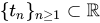
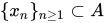
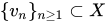
Let be a nonempty closed subset of the Banach space . The Clarke's tangent cone to at , denoted by consists of all vectors , such that for any sequence tending to zero, and any sequence tending to , there exists a sequence tending to , such that for all holds

Clarke's tangent cone is always subset of the corresponding contingent cone (and coincides with it, when the set in question is convex). It has the important property of being a closed convex cone.

Definition in convex geometry

[edit]

Let be a closed convex subset of a real vector space and be the boundary of . The solid tangent cone to at a point is the closure of the cone formed by all half-lines (or rays) emanating from and intersecting in at least one point distinct from . It is a convex cone in and can also be defined as the intersection of the closed half-spaces of containing and bounded by the supporting hyperplanes of at . The boundary of the solid tangent cone is the tangent cone to and at . If this is an affine subspace of then the point is called a smooth point of and is said to be differentiable at and is the ordinary tangent space to at .

Definition in algebraic geometry

[edit]
y2 = x3 + x2 (red) with tangent cone (blue)

Let X be an affine algebraic variety embedded into the affine space , with defining ideal . For any polynomial f, let be the homogeneous component of f of the lowest degree, the initial term of f, and let

be the homogeneous ideal which is formed by the initial terms for all , the initial ideal of I. The tangent cone to X at the origin is the Zariski closed subset of defined by the ideal . By shifting the coordinate system, this definition extends to an arbitrary point of in place of the origin. The tangent cone serves as the extension of the notion of the tangent space to X at a regular point, where X most closely resembles a differentiable manifold, to all of X. (The tangent cone at a point of that is not contained in X is empty.)

For example, the nodal curve

is singular at the origin, because both partial derivatives of f(x, y) = y2x3x2 vanish at (0, 0). Thus the Zariski tangent space to C at the origin is the whole plane, and has higher dimension than the curve itself (two versus one). On the other hand, the tangent cone is the union of the tangent lines to the two branches of C at the origin,

Its defining ideal is the principal ideal of k[x] generated by the initial term of f, namely y2x2 = 0.

The definition of the tangent cone can be extended to abstract algebraic varieties, and even to general Noetherian schemes. Let X be an algebraic variety, x a point of X, and (OX,x, m) be the local ring of X at x. Then the tangent cone to X at x is the spectrum of the associated graded ring of OX,x with respect to the m-adic filtration:

If we look at our previous example, then we can see that graded pieces contain the same information. So let

then if we expand out the associated graded ring

we can see that the polynomial defining our variety

in

See also

[edit]

References

[edit]
Revisions and contributorsEdit on WikipediaRead on Wikipedia
from Grokipedia
In , the tangent cone to a set or variety at a point is a conical of the ambient that captures the first-order local near that point, generalizing the classical to accommodate singularities or non-smooth structures. It consists of all limiting directions of secant rays approaching the point while staying within or to the object, and serves as a key tool for analyzing approximations, optimality conditions, and singularity resolution across , , and algebra. In the context of Euclidean spaces and convex analysis, the tangent cone TS(xˉ)T_S(\bar{x}) to a set SRnS \subset \mathbb{R}^n at a point xˉS\bar{x} \in S is defined as the set of all vectors vRnv \in \mathbb{R}^n such that distS(xˉ+tv)=o(t)\mathrm{dist}_S(\bar{x} + t v) = o(t) as t0+t \to 0^+, meaning sequences of points in SS can approach xˉ\bar{x} along directions asymptotically parallel to vv. Equivalently, it is the closure of the set of limits v=limktk1(xkxˉ)v = \lim_{k \to \infty} t_k^{-1} (x_k - \bar{x}), where xkSx_k \in S and tk0t_k \downarrow 0. This cone is always closed and conic (closed under positive scalar multiplication), and for convex sets CC, it simplifies to TC(xˉ)=cl{t(yxˉ)yC,t0}T_C(\bar{x}) = \mathrm{cl} \{ t (y - \bar{x}) \mid y \in C, \, t \geq 0 \}, providing a linear approximation useful in optimization for constraint qualifications and directional derivatives. For smooth manifolds or graphs of C1C^1 functions, the tangent cone reduces to the tangent subspace. In , the tangent cone to an VAnV \subset \mathbb{A}^n at a point (often taken as the origin after translation) is the zero locus of the initial forms—the lowest-degree homogeneous components—of the polynomials defining VV. For a defined by a F(X,Y)=Fd+Fd+1+F(X,Y) = F_d + F_{d+1} + \cdots where FdF_d is the lowest-degree homogeneous part, the tangent cone is the curve V(Fd)A2V(F_d) \subset \mathbb{A}^2, which may consist of multiple lines indicating branches of a singularity. More abstractly, for a variety with OV,p\mathcal{O}_{V,p} at point pp and m\mathfrak{m}, the tangent cone is Specgr(OV,p)\mathrm{Spec} \, \mathrm{gr}(\mathcal{O}_{V,p}), the of the associated i0mi/mi+1\bigoplus_{i \geq 0} \mathfrak{m}^i / \mathfrak{m}^{i+1}, which encodes the multiplicity and type of the singularity (e.g., a node has two transverse lines, while a cusp has a double line). This structure facilitates blow-up resolutions and of singular points, such as ordinary multiple points where lines are distinct. Beyond these settings, tangent cones appear in differential and metric geometry, where for a metric space they are defined as Gromov-Hausdorff limits of rescaled balls around the point, yielding conical tangent structures that bound curvature and regularity (e.g., in spaces with Alexandrov curvature bounded below). Overall, the tangent cone's properties—such as convexity in analytic cases or multiplicity in algebraic ones—underpin theorems on uniqueness, stability, and approximation in diverse applications from variational inequalities to singularity theory.

In Convex Analysis

Definition

In convex analysis, for a set SRnS \subset \mathbb{R}^n and a point xˉS\bar{x} \in S, the tangent cone TS(xˉ)T_S(\bar{x}) is the set of all vectors vRnv \in \mathbb{R}^n such that \distS(xˉ+tv)=o(t)\dist_S(\bar{x} + t v) = o(t) as t0+t \to 0^+. Equivalently, it is the closure of the set of limits v=limktk1(xkxˉ)v = \lim_{k \to \infty} t_k^{-1} (x_k - \bar{x}), where xkSx_k \in S and tk0t_k \downarrow 0. For convex sets CC, the tangent cone simplifies to TC(xˉ)=\cl{t(yxˉ)yC,t0}T_C(\bar{x}) = \cl \{ t (y - \bar{x}) \mid y \in C, \, t \geq 0 \}, providing a closed that linearizes the feasible directions from xˉ\bar{x}.

Properties and Characterizations

The tangent cone TK(x)T_K(x) to a KK at a point xKx \in K is always a closed . This property arises because KK is convex, so the directions KxK - x form a convex cone, and taking the closure preserves convexity and ensures closedness. The boundary of the solid tangent cone—which is the closure of the cone generated by rays from xx through points in KK—coincides with the tangent cone proper. A boundary point xx of KK is smooth if TK(x)T_K(x) is an affine subspace. A key duality relation holds: the polar cone of TK(x)T_K(x), defined as TK(x)={yy,d0 dTK(x)}T_K(x)^\circ = \{ y \mid \langle y, d \rangle \leq 0 \ \forall d \in T_K(x) \}, equals the normal cone NK(x)={yy,zx0 zK}N_K(x) = \{ y \mid \langle y, z - x \rangle \leq 0 \ \forall z \in K \}. In , the tangent cone to the epigraph of a ff at (x,f(x))(x, f(x)) is the epigraph of the f(x;)f'(x; \cdot), while the subdifferential f(x)\partial f(x) is the normal cone to the epigraph at that point. This connection underpins optimality conditions and proximal methods. For example, consider the half-space K={za,zb}K = \{ z \mid \langle a, z \rangle \leq b \} with a=1\|a\| = 1. If xx lies on the boundary, so a,x=b\langle a, x \rangle = b, then TK(x)={da,d0}T_K(x) = \{ d \mid \langle a, d \rangle \leq 0 \}, the supporting half-space at xx. For convex sets, the tangent cone coincides with the contingent cone.

In Nonsmooth Analysis

Contingent Cone

In nonsmooth analysis, the contingent cone provides a approximation to a ARnA \subseteq \mathbb{R}^n at a point xAx \in A, capturing directions in which the set can be approached via sequences of points within AA. Formally, it is defined as T(A;x)={vRn  |  tk0+,vkv with x+tkvkA k}.T(A; x) = \left\{ v \in \mathbb{R}^n \;\middle|\; \exists\, t_k \to 0^+, \, v_k \to v \ \text{with} \ x + t_k v_k \in A \ \forall k \right\}.
Add your contribution
Related Hubs
User Avatar
No comments yet.